
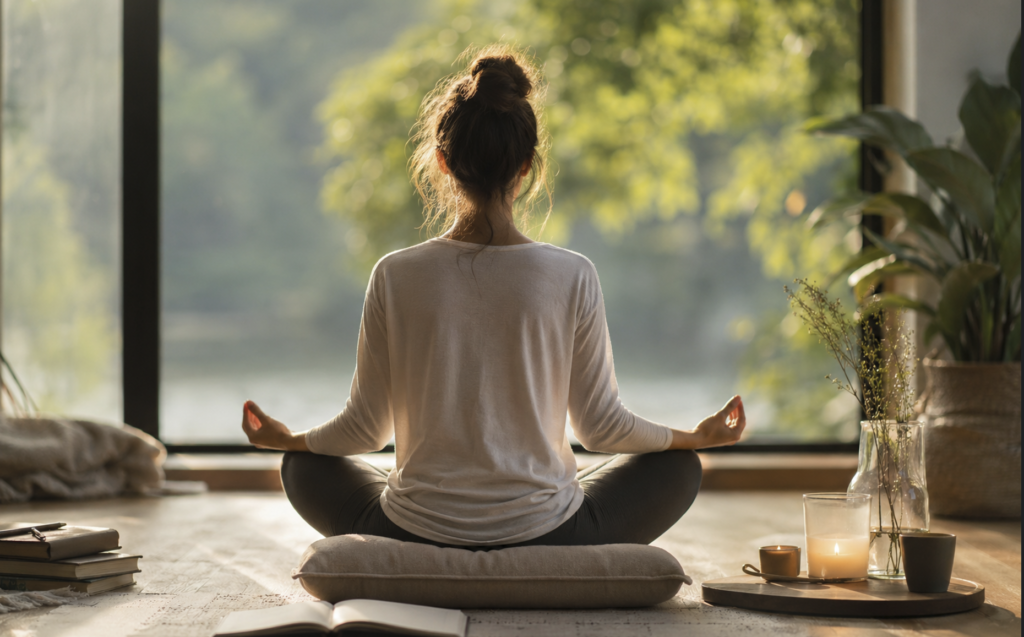
There was a time in my life when the idea of meditation felt distant, almost intimidating, like something reserved for people who had their lives perfectly balanced, their emotions completely regulated, and their mornings filled with peaceful silence. I imagined sitting cross-legged in a quiet room, mind completely empty, floating somewhere between calm and enlightenment. And because my reality looked nothing like that — busy days, racing thoughts, endless responsibilities, and a mind that never seemed to stop talking — I convinced myself meditation simply wasn’t for me.
Like many women juggling work, health goals, relationships, and the constant pressure to be everything for everyone, my mind rarely rested. Even when my body was still, my thoughts were loud. I replayed conversations, worried about the future, questioned my decisions, and carried stress in ways I didn’t fully understand. I didn’t realize how disconnected I had become from myself until I experienced what it felt like to pause.
My introduction to meditation was not graceful or peaceful. It was uncomfortable, frustrating, and at times deeply confronting. But it also became one of the most transformative practices in my life — not because it removed my stress, but because it changed how I related to it.
What surprised me most was discovering that meditation is not about escaping your thoughts or forcing your mind into silence. It’s about learning how to be present with what is already happening inside you.
For years I believed meditation meant clearing the mind completely. I would sit down, close my eyes, and immediately feel like I was failing because my thoughts kept coming. My grocery list appeared. Work deadlines surfaced. Old memories resurfaced. The more I tried to push these thoughts away, the louder they seemed to become. I assumed this meant I simply wasn’t good at meditation.
It took time to understand that meditation is not about stopping thoughts — it’s about noticing them without immediately reacting. That subtle shift changed everything. Instead of fighting my mind, I began observing it. Instead of judging my thoughts, I became curious about them.
This practice of awareness revealed something profound: my thoughts were not problems to solve, but patterns to understand.
Meditation slowly became less about achieving calm and more about building awareness — awareness of my emotions, my reactions, my habits, and even the tension I carried in my body without realizing it. It showed me how often I lived on autopilot, reacting rather than responding, rushing rather than experiencing.
The science behind meditation explains why these changes happen. Research shows that consistent meditation strengthens areas of the brain involved in attention, emotional regulation, and self-awareness. It supports the nervous system, helping the body shift out of chronic stress responses into a state of balance. But what fascinated me most was not just the science — it was how deeply personal the experience felt.
I began noticing small changes first. I reacted less impulsively during stressful moments. I listened more carefully in conversations. I became more aware of how my body felt throughout the day. There was a growing sense of space between my thoughts and my actions, and in that space I found a sense of choice.
As a woman, this awareness felt especially powerful. So much of our daily experience involves caring for others, meeting expectations, and managing emotional labor. We often become experts at reading everyone else’s needs while ignoring our own internal signals. Meditation gently brought my attention back inward.
It allowed me to hear myself again.
One of the most surprising discoveries in my meditation journey was how journaling deepened the experience. After sitting in silence, I began writing about what I noticed — my emotions, recurring thoughts, physical sensations, and moments of clarity. Writing created a bridge between experience and understanding. Patterns emerged that I had never seen before. I recognized how certain situations triggered anxiety, how certain beliefs shaped my reactions, and how often I spoke to myself with harshness rather than compassion.
Journaling transformed meditation from something abstract into something tangible. It made growth visible.
Over time, meditation stopped feeling like a separate activity and became part of how I moved through life. It influenced how I exercised, how I ate, how I communicated, and how I cared for myself. I became more aware of my body during movement, noticing tension and release, breath and rhythm. Exercise shifted from punishment to presence. Health became less about control and more about connection.
This mind-body awareness is something health and fitness professionals are increasingly recognizing as essential. Physical health cannot be separated from emotional and mental well-being. When we understand how stress affects behavior, motivation, and consistency, we begin to approach health more holistically.
I saw this clearly when I started sharing meditation practices with others. Many women I spoke with believed they were “too busy” to meditate. They imagined it required long sessions, perfect environments, or complete silence. But what I learned — and what I now share — is that meditation does not need to be complicated to be powerful.
Sometimes it begins with a single breath.
I started practicing mindfulness in ordinary moments — while walking, while drinking tea, while preparing meals. I noticed sensations, sounds, and emotions without rushing past them. These small pauses created space in my day, moments of stillness within movement.
Consistency mattered far more than duration.
Even one or two minutes of intentional awareness shifted how I experienced stress. Instead of feeling overwhelmed by responsibilities, I felt grounded within them. Meditation became something that supported my life rather than competing with it.
Another misconception I once held was that meditation is passive. I believed it was about relaxing or doing nothing. In reality, meditation is an active mental practice. It trains attention, strengthens emotional resilience, and develops the ability to respond thoughtfully rather than react automatically.
It requires patience and practice, just like physical training.
The benefits, however, extend far beyond stress reduction. Meditation improves focus, enhances listening skills, and strengthens emotional boundaries. It helps you remain present with discomfort rather than avoiding it. It builds clarity in decision-making and fosters a deeper understanding of your internal world.
Perhaps the most meaningful change I experienced was learning to sit with my emotions without trying to fix or suppress them. Instead of resisting difficult feelings, I began allowing them to exist. This created a sense of emotional stability I had never known before.
I also noticed how meditation improved my relationships. When you learn to observe your own thoughts and reactions, you naturally become more patient with others. You listen more deeply. You respond more thoughtfully. Communication becomes clearer and more compassionate.
This shift toward presence is something many health and wellness professionals seek, especially those working with clients. Supporting others requires emotional energy, empathy, and attention. Without self-awareness, burnout becomes almost inevitable. Meditation offers a way to sustain that energy by cultivating inner stability.
Yet meditation does not require perfection. This is something I wish I had understood earlier. There is no “perfect” meditation session. Some days the mind feels calm, other days it feels restless. Some sessions bring insight, others feel ordinary. The practice is simply returning, again and again, to awareness.
That gentle return builds resilience.
For many women, the idea of stillness can feel uncomfortable because we are so accustomed to constant productivity. Sitting quietly may even trigger feelings of guilt, as though we should be doing something more useful. Meditation challenges this mindset by reminding us that being present is not wasted time — it is essential care.
Learning to pause became an act of self-respect.
Over time, meditation changed my understanding of well-being. It was no longer about achieving constant happiness or eliminating stress. Instead, it became about developing the capacity to meet life with clarity, steadiness, and awareness.
Life still brings challenges. Stress still arises. Emotions still fluctuate. But meditation provides tools to navigate these experiences with greater balance.
It teaches you to respond rather than react, to observe rather than judge, to experience rather than avoid.
What makes meditation especially relevant today is the pace of modern life. We live in a world of constant stimulation, endless information, and persistent demands on our attention. Our minds rarely rest. Our nervous systems rarely reset. In such an environment, practices that cultivate presence and awareness are not luxuries — they are necessities.
Meditation offers a way to reconnect with ourselves in the midst of noise.
It reminds us that beneath the constant activity of the mind, there is a quiet space of awareness always available. A place where we can observe our thoughts without being controlled by them. A place where clarity and calm can emerge naturally.
Looking back, I realize meditation did not change my life by transforming my external circumstances. It changed my life by transforming my relationship with my inner world. It taught me to listen to myself, trust my awareness, and respond to life with greater intention.
It is not about becoming a different person. It is about becoming more present as the person you already are.
And that, perhaps, is the most powerful transformation of all.
If you are curious about meditation but feel uncertain, overwhelmed, or skeptical, know that you do not need to begin with perfection. You do not need to silence your mind. You do not need to change who you are. You simply need to start noticing — your breath, your thoughts, your feelings, your experience.
From that simple act of awareness, everything else unfolds.
Meditation is not an escape from life. It is a deeper way of living it.