
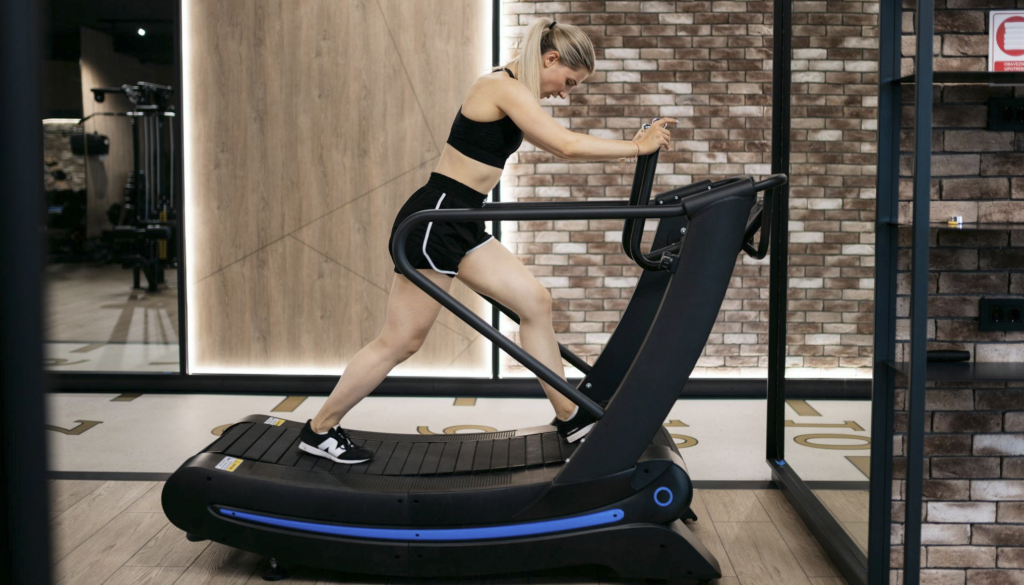
I didn’t switch to a manual treadmill because it was trendy. I switched because I was tired of feeling disconnected from my own workouts.
For years, like most people, I used motorized treadmills. You step on, press a button, choose a speed, maybe an incline, and then you just… keep up. It works, sure. You sweat, your heart rate goes up, and technically you’re doing cardio. But at some point, I started noticing something I couldn’t ignore anymore—I wasn’t really running. I was reacting.
The machine decided the pace. I adjusted.
And as a personal trainer, that started to bother me.
Because real movement—the kind that builds strength, endurance, and confidence—should come from you, not from a motor underneath your feet.
That’s what led me to try a curved manual treadmill for the first time. I still remember that moment clearly, because it was humbling in the best possible way.
I stepped on, expecting it to feel similar. It didn’t.
There was no button to press. No “start.” No safety net. The belt didn’t move until I moved. And the second I took my first step, I felt the difference immediately. The treadmill responded to me, not the other way around.
At first, it felt unfamiliar. Even slightly uncomfortable. My body had to relearn something it should have known all along—how to create momentum naturally. But within a few minutes, something clicked. My stride became more fluid, my posture adjusted automatically, and instead of forcing movement, I was generating it.
That’s the moment I understood why this type of training is different.
And honestly, why it’s better—especially if you care about long-term results.
When I started using the Strive™ Curved Treadmill more consistently, I began to appreciate the details that don’t show up in flashy marketing. The curved deck, for example, isn’t just a design choice—it changes how your body moves. You naturally land more midfoot, your stride shortens slightly, and your cadence becomes more efficient without you having to think about it.
As a trainer, I see people struggle with running mechanics all the time. Overstriding, heel striking too hard, inefficient movement patterns that lead to fatigue or even injury. And here’s the thing—you can coach those things, yes, but when the environment itself encourages better movement, progress becomes faster and more natural.
That’s exactly what happens here.
The curve guides you without forcing you.
And because there’s no motor pulling the belt, every step requires engagement. Your glutes, hamstrings, calves—everything works a little harder. Not in a dramatic, overwhelming way, but in a consistent, honest way.
You don’t get to “zone out” completely.
You stay present.
And that presence changes the quality of your workout.
One thing I always tell my clients—especially women who are balancing a lot mentally—is that your workout should not feel like another obligation. It should feel like something that brings you back into your body. Something that clears your head instead of adding more noise.
This type of treadmill does exactly that.
Because you can’t just press a button and disconnect, you become more aware of your breathing, your rhythm, your effort. It becomes almost meditative in a strange way, even when it’s challenging.
And yes, it is more challenging.
I’m not going to pretend otherwise.
A manual treadmill demands effort. If you stop pushing, it slows down. If you want to speed up, you have to earn it. There’s no artificial assistance. But that’s also where the magic happens.
Because suddenly, your workouts become honest.
When I program sessions for clients on this type of treadmill, I don’t rely on arbitrary speeds like “run at 10 km/h.” Instead, I focus on effort. Output. How it feels. And that’s a much more accurate way to train.
For example, if we’re doing intervals, I might say: “Give me 20 seconds of strong, controlled effort, then recover.” On a motorized treadmill, that often turns into awkward button pressing, waiting for speed changes, and losing rhythm. Here, it’s instant.
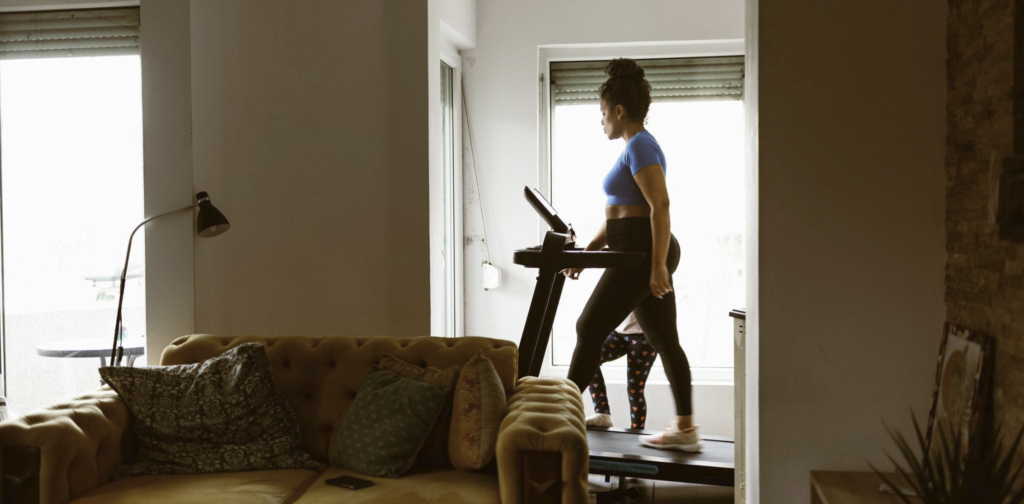
You push—you go faster.
You ease off—you recover.
It’s seamless.
That makes interval training not only more effective, but also more enjoyable. There’s no interruption, no frustration. Just movement.
And then there’s resistance.
This is something that completely changes how you can use the treadmill. By adding resistance, you’re not just running anymore—you’re working against load. It starts to feel more like pushing a sled than traditional cardio, and from a training perspective, that’s incredibly valuable.
For clients who want fat loss, this is gold.
Because you’re combining cardiovascular demand with muscular effort. Your heart rate climbs quickly, your legs work harder, and you get more done in less time. It’s efficient without feeling rushed.
For athletes, it becomes even more interesting.
We can work on acceleration, power, and repeatability. Short bursts, high effort, controlled recovery. It’s specific, it’s measurable, and it translates well to real-world performance.
But what I personally love most is how adaptable it is.
Not every day is a high-energy day. And I think this is especially important for women to understand and respect. Your energy fluctuates. Your recovery matters. Your body isn’t meant to perform at maximum intensity every single day.
Some days, I step on the treadmill and keep it simple. A steady walk, light pace, just moving. And because there’s no motor noise, no aggressive hum in the background, it feels calm. Quiet. Almost grounding.
Other days, I push.
And the treadmill meets me there too.
That’s what makes it sustainable.
It doesn’t force you into one style of training. It adapts to you, while still requiring you to take responsibility for the effort.
From a practical standpoint, it also fits beautifully into a home gym environment. No electricity needed, no complicated setup, no constant maintenance. You can move it, reposition it, even take it outside if you want a different atmosphere.
For someone building a home setup, that simplicity is a huge advantage.
Because let’s be honest—if something is complicated, loud, or inconvenient, you’re less likely to use it consistently.
And consistency is everything.
I’ve had clients invest in expensive equipment that ends up collecting dust, not because it’s bad, but because it doesn’t fit into their daily life. This is different. It’s accessible. It’s ready when you are.
And over time, that matters more than any feature list.
There’s also something empowering about using equipment that requires your input. It doesn’t carry you—it responds to you. That subtle shift builds confidence. You start to trust your body more. You understand your limits, but also your potential.
And that’s something I care deeply about as a trainer.
Because physical strength is only part of the picture.
When a woman starts to feel capable—when she realizes she can push harder, last longer, recover faster—that changes how she shows up in other areas of life too.
Training becomes more than just exercise.
It becomes proof.
Proof that you can handle discomfort. That you can adapt. That you can improve.
And tools like this support that process without getting in the way.
If you’re expecting something easy, something passive, something that does the work for you—this isn’t it.
But if you’re ready for something that meets you at your level, challenges you appropriately, and grows with you over time, then this kind of treadmill makes a lot of sense.
Not because it’s fancy.
But because it’s honest.
And in a world full of shortcuts, quick fixes, and overcomplicated solutions, that honesty is refreshing.
For me, it brought me back to what training is supposed to feel like.
Simple. Demanding. Real.
And once you experience that, it’s very hard to go back.