
There are moments when something you’ve heard a hundred times suddenly lands differently. Not louder, not clearer even—just deeper. Like it has finally found the part of you that was ready to understand it.
That’s how this story came back to me.
I didn’t plan for it. It wasn’t during some profound retreat or perfectly quiet morning meditation. It came in the middle of an ordinary day, somewhere between work, responsibilities, and that low hum of background stress that so many of us have learned to live with. The kind you don’t even question anymore—you just carry it.
And maybe that’s why it hit the way it did.
Because this past year, if I’m honest, hasn’t been about big, dramatic struggles. It’s been about something quieter. A kind of subtle tension. A feeling that life is happening, but I’m not always fully in it. Like I’m slightly braced against something I can’t quite name.
That’s when the story of the Trickster came back.
I first heard it years ago through Tai Chi. Not as a philosophical lecture, but as one of those strange, poetic teachings that don’t explain themselves—they just sit with you. At the time, I appreciated it in an abstract way. It sounded wise. Interesting. But distant.
Now it feels uncomfortably relevant.
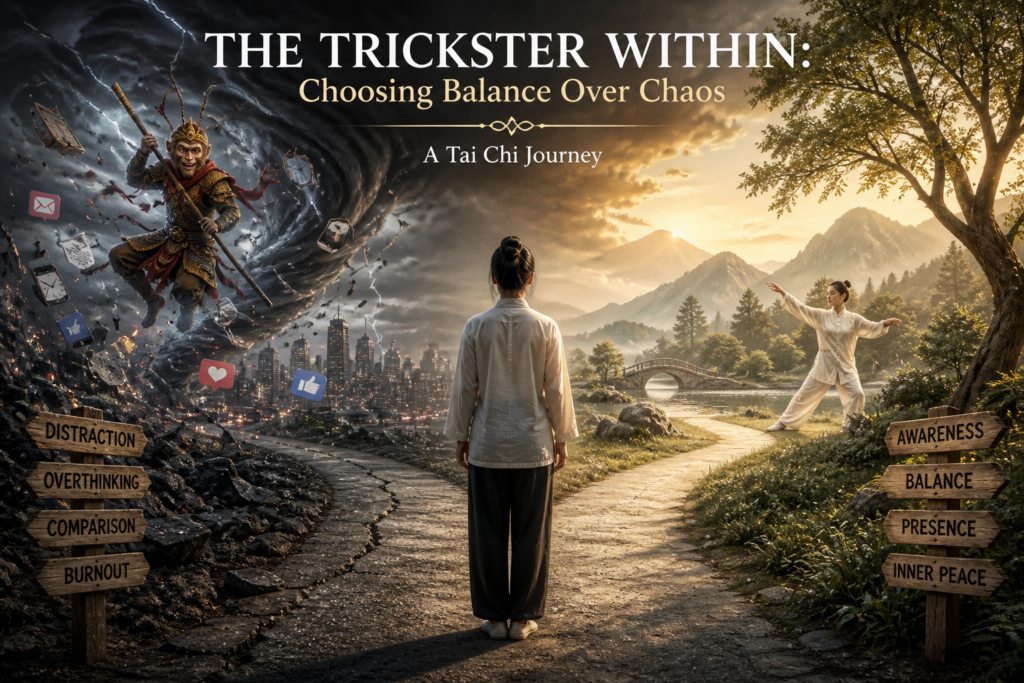
The story goes something like this: in traditional martial wisdom, you are meant to keep a place in your home for the Monkey God—the Trickster. But the placement matters. You shouldn’t hide him away completely, because he will feel ignored and cause chaos to get your attention. But you also shouldn’t place him at the center, on your main altar, because then chaos becomes the organizing force of your life.
You have to give him a place—but not the throne.
That balance felt like a metaphor at the time. Now it feels like a diagnosis.
Because somewhere along the way, it seems like we stopped negotiating with chaos… and started celebrating it.
I’ve noticed it slowly, almost imperceptibly, in the stories we consume, the voices that rise to the surface, even in the way we talk about ourselves. There’s a certain admiration for disruption now. For rebellion. For tearing things down. And don’t get me wrong—there are times when that energy is necessary. When something rigid needs to be shaken, when old structures need to be questioned.
But what happens when that energy becomes the default?
What happens when the Trickster is no longer the teacher at the edge of the story—but the one sitting at the center of it?
I started seeing it everywhere once I noticed it.
Not just in media, though that’s the easiest place to spot it. You can trace it in character arcs—the shift from clear, grounded heroes to fractured, ambiguous figures, and then further into stories where chaos itself becomes the main attraction. Where the most unpredictable, unstable presence is also the most compelling.
But it’s not just fiction.
It’s in the way we relate to stability. To responsibility. To consistency.
Somewhere along the line, being steady became… less interesting. Almost suspicious. And being disruptive—being the one who breaks patterns, challenges norms, resists structure—that became something to aspire to.
And I get it. I really do.
Structure can feel suffocating. Expectations can feel limiting. Especially as women, I think many of us have had to push against roles, definitions, and boxes that never quite fit. There’s power in reclaiming space. In saying no. In refusing to play by rules that don’t serve you.
But there’s a difference between reclaiming your autonomy… and living in constant opposition.
And I think that’s where something has quietly shifted.
Because living in opposition is still a kind of dependence. You’re still defined by what you’re resisting.
That realization didn’t come to me all at once. It came through my body first, the way these things often do.
Through tension.
Through that subtle, ongoing feeling of being slightly “on edge,” even when nothing is technically wrong.
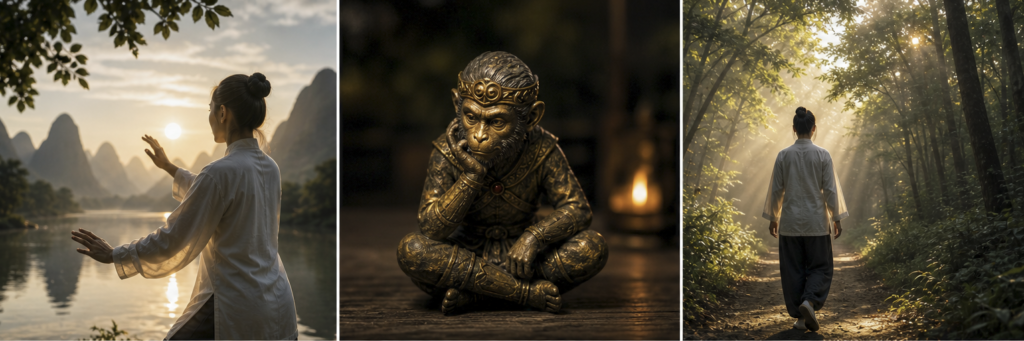
Tai Chi has a way of revealing that. It’s not a loud practice. It doesn’t demand intensity or force. If anything, it does the opposite. It asks you to slow down enough to notice what’s already there.
And when you do, you start to see how much unnecessary effort you’ve been carrying.
The shoulders that never fully drop.
The breath that never quite reaches your belly.
The way your mind anticipates the next thing before you’ve even finished the current one.
It’s humbling, in a quiet way.
Because you realize that the chaos isn’t just “out there.” It’s in you too. Not as something dramatic, but as a constant micro-pattern of tension, reaction, resistance.
And this is where the Trickster story shifted for me—from cultural observation to something much more personal.
Where have I placed chaos in my own life?
Not in an obvious way. I’m not someone who thrives on drama or seeks out instability. If anything, I’ve always thought of myself as someone who values calm, balance, and control.
But control, I’ve learned, can be its own kind of chaos.
Because underneath it is often fear.
Fear of things going wrong. Fear of losing direction. Fear of not being enough if you’re not constantly managing everything.
And when you live from that place—even subtly—you’re still orienting your life around instability. You’re just trying to contain it instead of dancing with it.
That’s still giving the Trickster too much power.
Tai Chi offers a different approach.
It doesn’t try to eliminate chaos. That would be impossible. Instead, it teaches you how to meet it without becoming it.
When someone pushes you, you don’t resist directly. You don’t collapse either. You listen. You yield just enough to stay connected, and then you redirect. It’s not passive. It’s incredibly precise. It requires sensitivity, awareness, and a kind of grounded presence that isn’t easily shaken.
And that, I think, is the missing piece in so many areas of life right now.
We’re very good at reacting.
We’re getting better at resisting.
But we’re not always great at responding with awareness.
There’s a difference.
Reaction is fast, emotional, often necessary in the moment—but it doesn’t create long-term stability.
Resistance can be empowering, but if it becomes your default, it keeps you locked in a constant push against something.
Response, though—that requires space. It requires you to not immediately jump into the pattern. To pause, even briefly, and choose how you engage.
That’s where the balance lives.
That’s where the Trickster gets gently guided back to his place—not exiled, not worshipped, but integrated.
I’ve been thinking a lot about what that looks like in everyday life. Not in some abstract philosophical sense, but in the small, almost invisible moments.
Like when something goes wrong and my first instinct is frustration—can I notice that without letting it take over?
When I feel the urge to prove something, to push harder, to control the outcome—can I soften just enough to see if there’s another way?
When I’m tired but still trying to keep everything together—can I step back instead of pushing through?
These aren’t big, dramatic shifts. No one would look at them from the outside and think anything remarkable is happening.
But internally, they change everything.
Because each of those moments is a choice about where I place my attention. What I center my life around.
And slowly, I’m realizing that peace isn’t something you find once and keep forever. It’s something you choose, over and over again, in small ways.
The same is true for chaos.
If you feed it constantly—through stress, through overthinking, through the need to react to everything—it grows. Not explosively, but steadily. Until it becomes the background of your life.
But if you acknowledge it, give it space without letting it take over, it settles.
Not completely. It’s still there. It always will be.
But it’s no longer in charge.
I think that’s what the old stories were trying to teach us all along.
Not to eliminate parts of ourselves. Not to chase some ideal version of calm or control. But to understand the different forces within us—and to place them wisely.
The Trickster isn’t the enemy.
But he’s also not the leader.
And maybe that’s the quiet work so many of us are being invited into right now.
Not fixing the world all at once.
Not finding perfect answers.
But noticing, gently and honestly, where we’ve let chaos take up too much space—in our thoughts, our habits, our expectations—and beginning, slowly, to shift that balance.
Not through force.
But through awareness.
Through softness.
Through choosing, again and again, to come back to ourselves.
And if there’s one thing I’ve learned from both Tai Chi and life, it’s this:
The most powerful changes rarely look dramatic from the outside.
But they feel like everything on the inside.
Aloha—for now.