
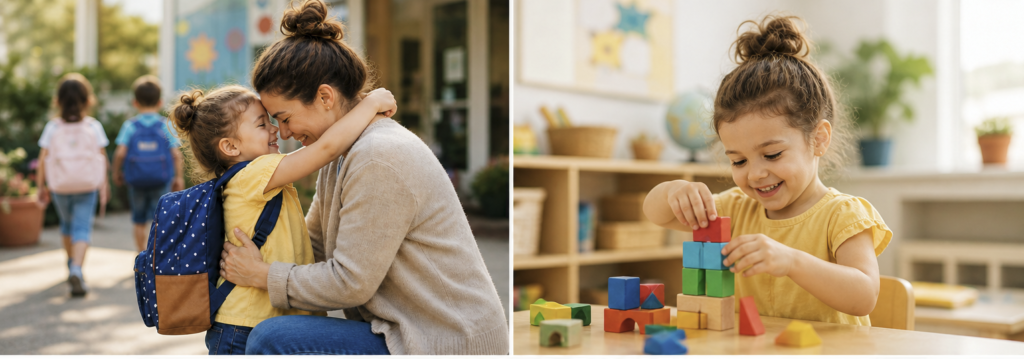
When my oldest daughter was getting close to three, I found myself standing in that quiet, emotional space that I don’t think anyone really prepares you for—the moment when your child is no longer just your baby at home, but a little person ready to step into the world.
I had imagined that moment so many times. In my head, it looked simple: she would turn three, I would enroll her in the local preschool, and just like that, we would step into this new chapter. But reality, as it tends to do, had other plans.
The only preschool program in our small town had one non-negotiable requirement: children had to be fully potty trained. And she… wasn’t. Not quite. We were close, but not there yet. And if you’ve ever been in that stage as a parent, you know how unpredictable it can be. Some days feel like a breakthrough, others like you’ve gone ten steps backward.
What made it harder was that, in every other way, she was ready. She was curious, social, eager to learn. She loved being around other kids. She asked questions constantly, observed everything, and had that spark I didn’t want to dim by keeping her home longer than necessary. I could feel that she needed more than what I alone could give her during the day.
So I made a decision that felt both right and slightly overwhelming at the same time—I enrolled her in a preschool about 30 minutes away. It wasn’t the most convenient option, but it was the one that met her where she was, not where a checklist said she should be.
I still remember that first morning so vividly. I packed her little bag with more care than I probably needed to—extra clothes, snacks, her favorite cup. I made her lunch, double-checking everything like I was sending her off on a week-long journey instead of a few hours.
As we stepped outside, she looked down the street and asked, “Where’s the school bus?”
It caught me off guard, but it also made me smile. For years, she had watched the big yellow buses pass our house, carrying older children to school. To her, that was what “going to school” meant. That was the image she had built in her mind.
And of course, she loved The Magic School Bus. In her world, school buses weren’t just buses—they were magical, adventurous, full of possibility.
So, without overthinking it, I told her, “Our van turns into a magic school bus when we go to your preschool.”
She looked at me for a second, processing it, and then her whole face lit up. That was all she needed. She climbed into her seat like she was about to go on the adventure of her life.
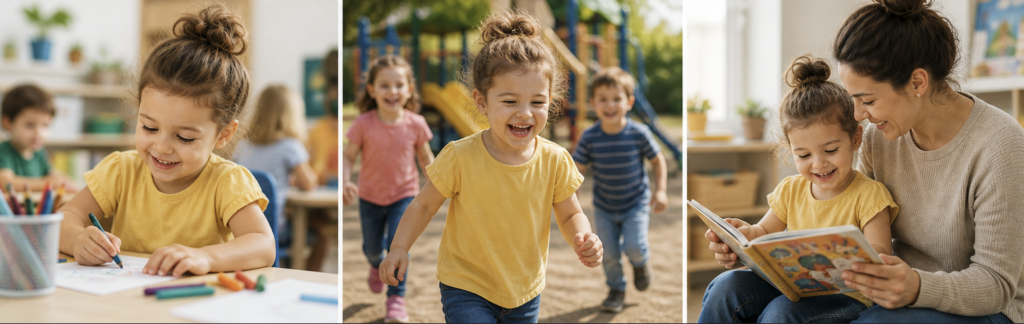
And in a way, she was.
What surprised me most that day wasn’t her excitement—it was her confidence. I had prepared myself for tears at drop-off. I had rehearsed comforting words in my head, braced myself for that tug at my heart when she might cling to me and not want to let go.
But when we arrived, she simply turned, waved, and said, “Bye, Mommy!”
Just like that.
I sat in the car afterward for a moment, not because I was upset, but because I needed to catch up emotionally with what had just happened. It felt like a quiet confirmation of something I had been slowly learning: children often show us they’re ready long before we feel ready to let them go.
That experience shaped how I approached preschool with my other children, too. Each of them was different. Each of them needed something slightly different from me, and from the world around them. And I realized there isn’t one perfect timeline—there’s only the one that fits your child, your family, and your reality.
When people ask, “When should a child start preschool?” they’re often hoping for a clear, definitive answer. But the truth is, it’s rarely just about age.
Yes, many children start around three. That’s the most common window, and for many families, it works beautifully. But readiness is so much more layered than a number.
It’s in the small things.
It’s in whether your child shows curiosity about the world beyond home. It’s in how they respond to other children—do they watch them, approach them, try to engage, even in simple ways? It’s in those moments when they try to do things independently, even if they don’t quite succeed yet.
It’s also in how they handle separation. Not perfectly, not without emotion—but whether they can move through that discomfort and find their footing in a new environment.
And then there are the practical considerations—the ones we don’t always talk about as openly, but that matter just as much. Work schedules. Financial realities. The needs of other children in the family. The availability of programs in your area.
Sometimes, the “ideal” choice on paper isn’t the one that works in real life. And that’s okay.
One of the biggest lessons I learned is that flexibility matters more than perfection. My daughter wasn’t fully potty trained when she started preschool, and for a while, I worried that it might be a problem. But instead of holding her back, the right environment helped her move forward. Within a few months, she caught up naturally, without pressure or stress.
That experience changed how I viewed readiness. It’s not about ticking every box before moving forward—it’s about finding an environment that supports your child where they are, while gently guiding them to where they’re going.
As children grow, the conversation shifts again—from preschool to pre-kindergarten, and eventually to kindergarten. And while these stages are often grouped together, they each carry a slightly different focus.
Preschool is softer, more exploratory. It’s about play, social interaction, discovering routines, and learning how to be part of a group.
Pre-K begins to introduce more structure. There’s still play, still creativity, but also a growing emphasis on early learning skills—letters, numbers, problem-solving, independence.
By the time kindergarten approaches, the expectations shift again. Children are stepping into a more structured environment, one that asks for longer attention spans, clearer communication, and a greater level of independence.
But even then, readiness isn’t just academic.
It’s emotional.
It’s social.
It’s practical.
Can they follow simple directions? Can they participate in group activities? Can they manage basic self-care tasks like using the bathroom, washing hands, opening their lunch?
These might seem like small things, but in a classroom setting, they make a big difference in how confident and comfortable a child feels.
Looking back, I realize that one of the most important parts of this entire journey wasn’t choosing the “perfect” program—it was staying connected to my child throughout the process.
Visiting schools, talking to teachers, observing how she responded to different environments—those moments mattered more than any brochure or checklist.
I learned to trust what I felt when I walked into a space. Did it feel warm? Did the children seem engaged? Did the teachers interact with them in a way that felt respectful and attentive?
Because at the end of the day, preschool isn’t just about learning shapes and colors. It’s about how a child feels when they walk into that room.
Do they feel safe?
Do they feel seen?
Do they feel like they belong?
Those are the things that stay with them.
If there’s one thing I would tell any parent standing at the edge of this decision, it’s this: you don’t have to get it perfect.
You just have to get it right enough for your child.
There will always be doubts. There will always be moments when you wonder if you chose too early, or too late, or the wrong place. That’s part of caring deeply—it comes with the territory.
But children are incredibly adaptable. When they are supported, loved, and given space to grow, they find their way.
Sometimes faster than we expect.
Sometimes in ways we didn’t plan.
And sometimes, like on that first morning, they surprise us completely—by stepping forward with a confidence we didn’t even know they had.
And we sit there, watching them go, realizing that this is what growth looks like.
Not just for them.
But for us, too.