
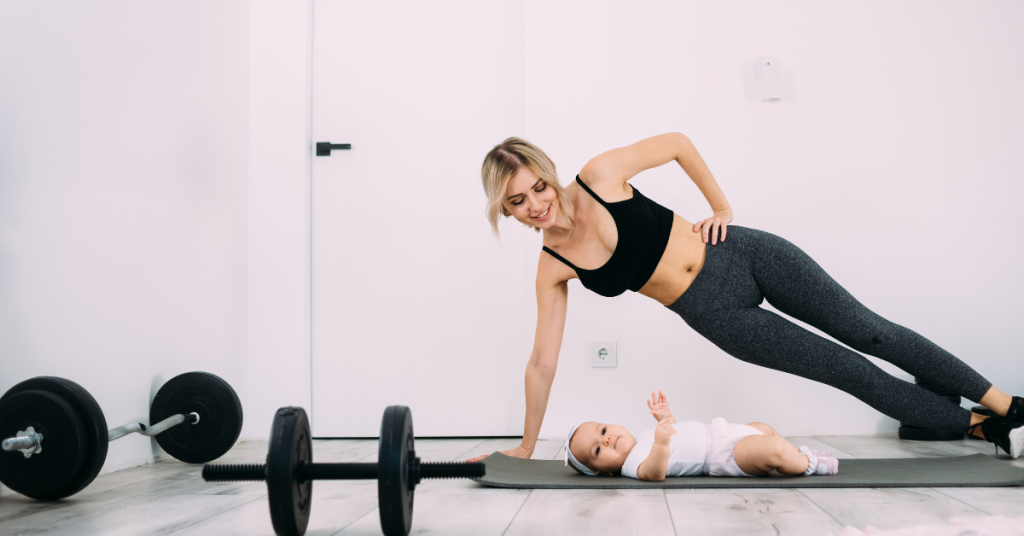
The science-backed truth about press-ups, squats, and why the most powerful gym you’ll ever need is probably already inside your home.
“The most transformative workout I ever did wasn’t in a gym. It was in my living room, in the ten minutes between the school run and my first meeting of the day, with the breakfast dishes still on the table and my trainers untied. And it changed everything.”
Let’s start with something honest: the idea that getting fit requires a gym membership, a childcare arrangement, a specific outfit, and a carefully blocked-out hour in your calendar is one of the most persistent — and frankly, most unhelpful — myths in women’s wellness. It keeps so many mothers on the outside of their own health, watching the gap between intention and action grow wider every week.
The truth is far more accessible, and honestly, far more exciting. Everything you need to meaningfully improve your cardiovascular health, your brain function, your mood, your sleep quality, and your daily energy is available to you right now, in the space you already occupy. No commute. No membership fee. No need to find a willing grandparent to watch the kids. Just you, a small patch of floor, and the knowledge that what you’re about to do is genuinely, scientifically, measurably good for you.
This is what I want to talk about today — not just the logistics of fitting movement into a busy motherhood schedule, but the deeper why behind it. Because once you understand what exercise is actually doing to your brain and your heart, it stops feeling like a chore you ought to be doing and starts feeling like a gift you get to give yourself. That shift in perspective? It’s everything.
◆
The Real Cost of Not Moving
I want to be gentle with this, because the last thing any busy mother needs is another source of guilt. You are already doing so much. The emotional labour alone — the scheduling, the remembering, the anticipating of everyone else’s needs before they even arise — is exhausting in ways that are difficult to articulate and nearly impossible to quantify. I know this firsthand.
But I also want to be honest, because I think you deserve honesty more than you deserve comfort. When we stop moving — really stop, for weeks and months at a time — the effects accumulate quietly. The brain fog that makes you feel like you’re thinking through cotton wool. The sleep that is never quite restful enough, no matter how many hours you manage. The low-level anxiety that sits in your chest on otherwise ordinary days. The fatigue that a cup of tea can’t touch. These aren’t just the inevitable side effects of being a mother. They are, in significant part, the side effects of a body that isn’t getting the movement it needs to function at its best.
The research on this is unambiguous: regular physical activity is one of the most effective interventions we have for cognitive function, mood regulation, sleep quality, and cardiovascular health. Not one of the most effective. One of the most. Full stop. And the beautiful thing — the thing that I genuinely want you to hold onto — is that it doesn’t take much to start experiencing these benefits. It takes consistency over intensity, every single time.
Why Home Is the Best Gym You’ll Ever Have
There is a version of fitness culture that is built on friction. The idea that the difficulty of getting to the gym — the planning, the packing, the driving, the finding of parking — is part of the commitment. That suffering inconvenience is somehow part of the process. I would like to respectfully, firmly, disagree.
Friction is the enemy of consistency. And consistency is the only thing that actually works. When your workout requires zero preparation, zero travel, and zero logistical coordination, the barrier to doing it is so low that even the most time-pressed, exhausted version of yourself can clear it. That is a feature, not a compromise.
A home workout in the twenty minutes while the baby naps is infinitely more valuable than a gym session you intend to do three times a week and manage once a fortnight. A few press-ups and squats between tasks — done consistently, done with intention — will do more for your health over the course of a year than any gym programme you struggle to maintain. This isn’t a consolation prize. This is a strategy.
Friction is the enemy of consistency. And consistency is the only thing that actually works. Remove the barriers, and you remove the excuses — including the ones you make to yourself.
— Michelle Baynham, Mother Fit
There is also something deeply underrated about exercising in your own space. No mirrors to make you self-conscious. No comparing yourself to the woman on the treadmill next to you. No performance anxiety, no waiting for equipment, no conversation you have to navigate when you really just want to move and think. At home, the workout is purely yours. That privacy, that freedom, can make a significant difference to how you feel about movement — and therefore how consistently you return to it.
◆
01
Press Your Way to a Healthy Heart
The Exercise That Predicts Your Cardiovascular Future
Heart HealthFull BodyZero EquipmentMetabolism Boost
Of all the exercises I could ask you to add to your day, this is the one I’d make non-negotiable. Not because press-ups are the most glamorous movement (they’re not), or because they’re the easiest to start (for many of us, they very much aren’t), but because the evidence behind what they do for your heart is so compelling that once you know it, you can’t unknow it.
A landmark study of over a thousand participants found that press-up capacity was a more accurate predictor of cardiovascular disease risk than almost any other bodyweight fitness test. Men and women who could perform more press-ups were significantly less likely to experience heart attacks or strokes over the following decade. Not marginally less likely. Significantly. This is an exercise that you can do on your kitchen floor while the kettle boils, and it is giving researchers insight into your future heart health. That is remarkable.
But beyond that headline finding, press-ups do something that I think is particularly relevant for mothers who spend a lot of time in a slightly hunched, forward-curved posture — feeding, picking up, carrying, and bending. They strengthen the chest, shoulders, triceps, and core simultaneously, pulling the body into better alignment and improving postural strength in a way that directly reduces the back and shoulder discomfort that so many mothers deal with daily. A press-up, done well, is essentially a moving plank. It requires the whole body to work together. That’s why it works so efficiently.
Start where you are. If full press-ups on your toes aren’t available to you right now, start with your knees down. There is no shame in this — it is a different variation, not a lesser one, and the cardiovascular and strength benefits are meaningful regardless. The goal is to build, gradually, over weeks and months, until the full version is yours. And when it is, you will feel the difference in your posture, your energy, and according to the research, your heart.
🔬 The SciencePress-up capacity has an inverse association with future cardiovascular disease. Put simply: the more press-ups you can perform over time, the lower your statistical risk of heart attack or stroke. They also stimulate metabolism, improve blood circulation, and give your entire cardiovascular system a meaningful workout — all with no equipment, anywhere, at any time.
02
Squat Your Way to a Stronger Brain
The Surprising Neuroscience of Getting Low
Brain HealthMemory BoostStrengthMulti-Muscle
I am going to tell you something about squats that I genuinely wish someone had told me earlier, because it completely changed how I think about this exercise. Yes, squats work your glutes, your quads, your hamstrings, your calves, your core, and your hip flexors. Yes, they are one of the most efficient lower body exercises in existence. But here is the part that the fitness industry doesn’t talk about nearly enough: squats may be better for your brain than running.
This is not a casual claim. Multiple studies have examined the effects of different types of exercise on cognitive function, and repeatedly, compound movements that involve the whole body — particularly those with a vertical component, like squats — produce measurable improvements in memory, executive function, and neuroplasticity that match or exceed the effects of steady-state cardiovascular exercise. The reason, researchers believe, lies in what happens to your brain during a squat.
As you lower and rise, your brain moves through gravity. This creates a unique pattern of blood flow changes — the kind that challenge and strengthen the brain’s vascular system in a way that horizontal movement simply doesn’t replicate. Those blood flow changes stimulate the production of brain-derived neurotrophic factor, often described as “fertiliser for the brain” — a protein that encourages the growth of new neural connections, supports memory formation, and plays a crucial role in protecting against cognitive decline.
For mothers who are experiencing the particular fog that comes with early parenthood, or the mental tiredness that accumulates over years of prioritising everyone else’s needs, this matters enormously. The exercise that also works your bum and your legs and your core is simultaneously doing something quite extraordinary in your head. That efficiency — that double-duty impact — is exactly why squats belong in every home workout, every time.
Three to four sets of bodyweight squats, three to four times a week. That is genuinely all the research asks of you. You don’t need a barbell. You don’t need a gym. You need your body weight, a safe patch of floor, and the knowledge that every single rep is making your brain work better.
🔬 The ScienceMultiple sets of bodyweight squats performed 3–4 times per week can produce greater brain benefits than 30 minutes of steady-state running. The vertical movement creates unique blood flow patterns in the brain that stimulate new tissue connections, increase oxygen supply, and encourage the production of BDNF — the protein responsible for memory formation and cognitive resilience.
◆
The Three Benefits Busy Mums Need Most
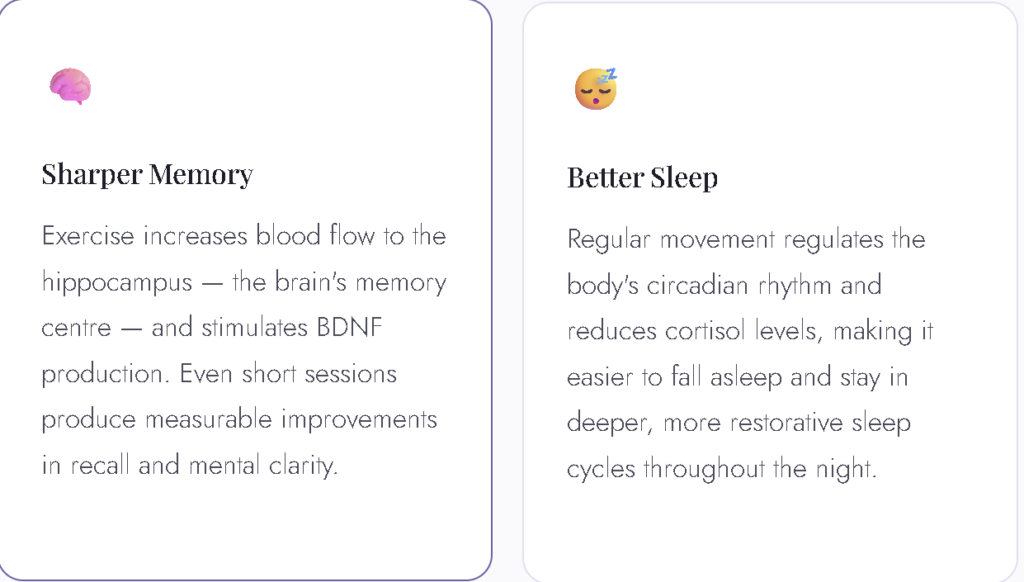
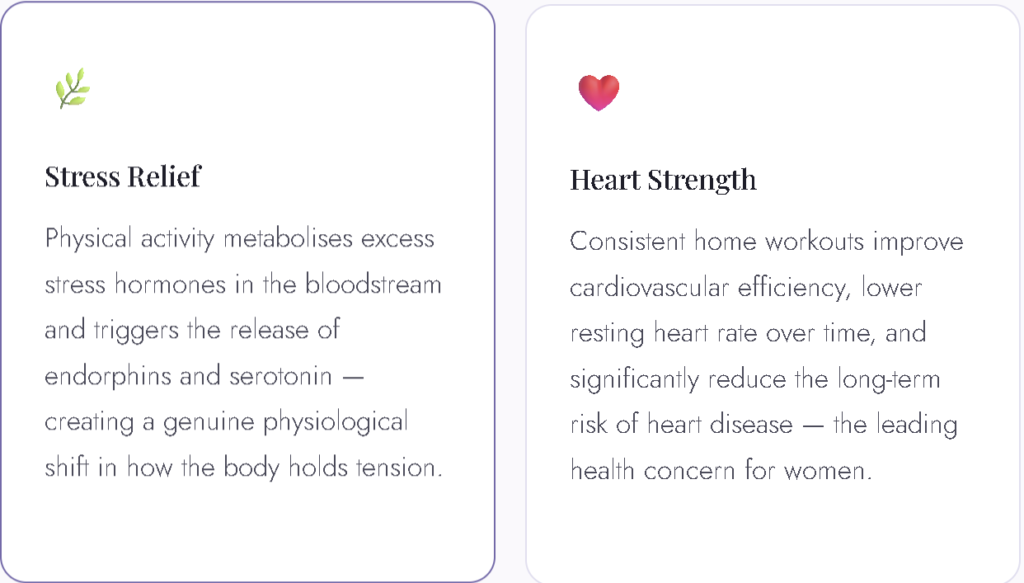
When I talk to mothers about what they most want from their health — really want, underneath the surface-level answers about weight or fitness — three themes come up again and again, in almost every conversation. Better sleep. A clearer head. Less of that low-level, ever-present stress. And these aren’t separate problems with separate solutions. They are deeply interconnected, and regular movement addresses all three simultaneously.
On sleep, specifically
I want to spend a moment on sleep because I think it is the most underrated aspect of maternal wellbeing, and the one most women have resigned themselves to simply not having. The broken nights of early parenthood become a habit of poor sleep that can persist long after children start sleeping through. And the exhaustion compounds everything — the brain fog, the emotional reactivity, the inability to find pleasure in ordinary things.
Exercise is one of the most reliably effective sleep interventions we have. Not in a sedative way — not because it tires you out, though it does — but because it genuinely regulates the biological systems that govern sleep quality. It lowers cortisol, the stress hormone that can keep you wired at 11pm even when you’re exhausted. It raises core body temperature during exercise and allows it to fall afterwards, which is a key signal to the body that it’s time to sleep. And over time, it deepens the slow-wave sleep phases where the brain consolidates memory and the body does its most important repair work.
Mothers who exercise consistently sleep better. That’s not inspirational rhetoric. That’s physiology.
On stress, and what it’s actually doing to you
Stress in small doses is useful. It sharpens focus, drives action, and keeps us responsive to the needs of our children and our households. But chronic, low-grade stress — the kind that is so normalised in motherhood that we often don’t even recognise it as stress — is genuinely harmful to the body over time. Elevated cortisol disrupts sleep, impairs memory, increases inflammation, and affects cardiovascular health. It is not nothing. It is something that deserves to be taken seriously.
Movement is one of the most direct ways to interrupt the stress cycle. When you exercise, your body uses up the cortisol and adrenaline that stress has deposited in your bloodstream. It gives those hormones somewhere to go. The result is a physiological downregulation of the stress response — a literal calming of the nervous system — that no amount of deep breathing or hot baths can fully replicate. This is why even a ten-minute walk, taken when things feel overwhelming, can shift your entire internal state. You are not imagining it. You are metabolising stress.
Starting Simply: A Home Workout Framework for Busy Mums
- ✓3–4 sets of press-ups (start on knees if needed) — three times per week minimum. This alone will begin to meaningfully impact your cardiovascular health over six to eight weeks.
- ✓3–4 sets of bodyweight squats, performed slowly and with intention — three to four times per week. For brain health benefits, consistency matters far more than intensity.
- ✓A short plank hold — 20 to 45 seconds — after your squats engages the core and ties everything together into a full-body session.
- ✓Do not wait for the “perfect” block of time. Ten minutes is enough to begin. Done consistently, ten minutes will compound into something extraordinary over months.
- ✓Keep your trainers somewhere visible. The physical cue matters more than you’d expect — it reduces the psychological friction of starting.
The Brain That Hasn’t Been Challenged in a While
Here is something that the research tells us and that I find genuinely moving: the brain that hasn’t had regular exercise in a long time benefits the most dramatically when it starts again. The neural pathways that govern responses to changes in blood flow — the vascular adaptations that make the brain more efficient, more resilient, and more capable — these pathways have been dormant. And when you start exercising, when blood flow begins to change in the ways that movement creates, the brain responds with what can only be described as enthusiasm.
If you have been largely sedentary for months or years — not because you are lazy or undisciplined, but because motherhood is consuming and time is genuinely short and your needs have consistently come last on the list — please hear this: you are not starting from behind. You are starting at a point where every workout will produce disproportionate benefit. The fog will clear faster than you expect. The sleep will improve sooner than seems reasonable. The energy will begin to return before you feel like you’ve done nearly enough to deserve it.
That is how the body works. It is not punitive. It is responsive. And it is waiting for you to begin.
A Note on Pre and Postnatal Exercise
For mothers who are pregnant or recently postpartum, the landscape of exercise shifts — as it should. The principles remain the same (consistency over intensity, movement as medicine, home as the most sustainable gym), but the specific exercises need to be chosen with care and with professional guidance. Some exercises are contraindicated in pregnancy. Others need modification postpartum while the core and pelvic floor are in recovery. These are not reasons to avoid movement — quite the opposite. They are reasons to seek out programmes designed specifically for your body at this stage.
My online pre and postnatal programmes are built around exactly this: the science of safe, effective movement during pregnancy and in the months after birth, delivered in a format that works for real motherhood — at home, without equipment, in whatever time you actually have. Because the idea that you should wait until things are “back to normal” before prioritising your health is one of the most counterproductive ideas in maternal wellness. Your health cannot wait. Your body needs support precisely now, at this stage, in this season of life.
Live workouts that you can do in the comfort of your own home. No commute, no childcare needed, no performance required. Just you, your body, and a programme that understands exactly what you’re going through — because it was built by someone who has been through it too.
Your health cannot wait for things to settle down. Movement is the thing that helps things settle. That is not a paradox — it is a prescription.
— Michelle Baynham, Mother Fit
To the Mum Reading This at 10pm
I know who you are. You’ve been going since before anyone else in the house was awake. You’ve made the lunches and resolved the arguments and sent the emails and handled the unexpected thing that arrived in the middle of the day and derailed the plan you’d actually had for once. You are tired in a way that is hard to describe to anyone who hasn’t experienced it. And somewhere in the back of your mind, there is a voice telling you that you should be doing more for yourself — exercising, eating better, sleeping properly — but the gap between knowing and doing has never felt wider.
I’m not here to make that gap feel more shaming. I’m here to tell you that it is smaller than it looks. That two sets of press-ups tomorrow morning, before anyone else is up, before the day has had a chance to claim your time, is a beginning. That those two sets, done three mornings a week for a month, will change something. You will feel it in your energy first. Then in your sleep. Then in the clarity of your thinking. Then in the quiet reduction of that background anxiety that you’ve come to think of as simply part of who you are now.
It is not who you are. It is what insufficient movement does to a body and brain that are capable of so much more. And the distance between here and there is shorter than a gym membership, cheaper than a new set of equipment, and closer than you think.
Start with the floor beneath your feet. Start tomorrow morning. Start now, if the spirit moves you.
You already have everything you need. 💜