
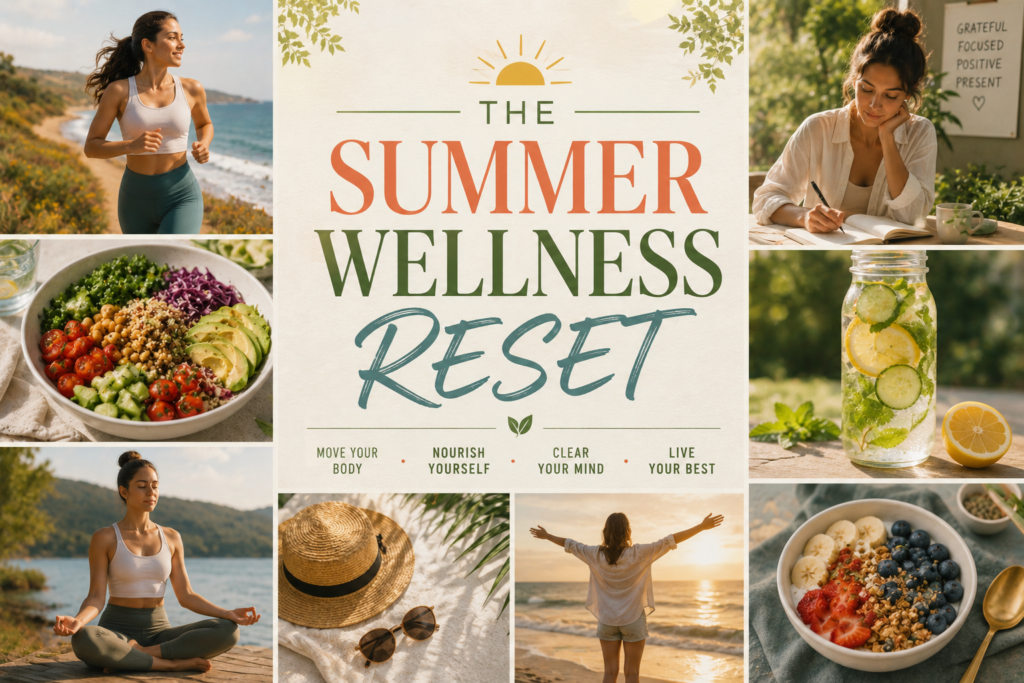
THE SUMMER WELLNESS RESET
Fresh Recipes, Daily Movement & the Kind of Lasting Results Nobody Talks About Honestly
By The Wellness Edit · June 2026 · Summer Living · Elegant Streetwear
Every summer I tell myself the same lie. I tell myself that this will be the season everything clicks — that I’ll wake up early and do the sunrise workout and drink the green juice and emerge from three months of heat and light a visibly different, visibly better version of myself. And every summer, somewhere around the second week of July, I’m standing in my kitchen at nine PM eating crackers directly from the box because I skipped lunch again, and the beautiful discipline I imagined has quietly dissolved in the heat.
I’m telling you this not because it’s funny — though it is, a little — but because I want this piece to be something different. Not a list of things you already know you should be doing. Not a collection of aspirational habits that fall apart the moment real summer life arrives with its late evenings and spontaneous plans and heat that makes everything feel like too much effort. I want to write about the summer wellness reset in the way I wish someone had written about it for me years ago: honestly, beautifully, and with enough warmth that it actually makes you want to try.
Because here’s what I’ve come to understand about this particular season and our relationship with food and movement and the way we present ourselves to the world: summer is not a testing ground. It’s not an exam you pass or fail based on your discipline or your body or your ability to choose a salad over something fried and golden and wonderful. Summer is, or should be, a season of genuine pleasure. And the most sustainable wellness reset I’ve ever managed was the one built entirely around that premise — around the idea that looking and feeling extraordinary doesn’t require suffering. It requires alignment. It requires choosing, over and over, things that genuinely feel good rather than things that merely look good in theory.
This is the piece about that reset. About fresh food that actually excites you. About movement that feels like summer rather than like a punishment scheduled for summer. About the style and the aesthetic and the way you carry yourself through this season — because yes, the elegant streetwear you put on your body every morning is part of your wellness practice, whether anyone tells you so or not. And about the kind of lasting results that have nothing to do with a number on a scale and everything to do with how deeply alive you feel when August rolls around.
Let’s begin.
— — —
Chapter One: What a Real Wellness Reset Actually Looks Like
The word “reset” has been overused to the point of meaninglessness. It has appeared in so many captions above green smoothie photographs and gym selfies and before-and-after comparisons that it has lost almost all of its original power. Which is unfortunate, because the actual concept — the genuine, intentional act of pressing pause and recalibrating the way you live — is one of the most powerful things a woman can do for herself.
A real wellness reset is not a detox. It is not five days of subsisting on lemon water and virtuous misery. It is not cutting out every food group that brings you joy and then wondering why you feel terrible. A real reset is subtler and more lasting than any of those things. It is the process of noticing, honestly, where you’ve drifted from the version of yourself that feels most like you — and then making small, deliberate, beautiful adjustments in the direction of that self.
For me, the drift usually happens gradually and without drama. A few weeks of eating late and eating whatever’s fastest. A stretch of poor sleep from overcommitted evenings. A period of movement that is either obsessive and compensatory or completely absent, nothing in between. And underneath all of it, a wardrobe that has become a source of low-level anxiety rather than pleasure — too many pieces that don’t quite fit, not enough things that make me feel like myself when I put them on.
The reset isn’t about fixing any one of these things in isolation. It’s about understanding that they are all connected. The food you eat affects how you move. The way you move affects how you sleep. The way you sleep affects the quality of your attention and your emotional resilience and, yes, your skin. And the way you dress yourself — the daily, seemingly small act of choosing what you put on your body — feeds back into all of it, influencing your posture, your confidence, your relationship with the body you’re living in.
This is the holistic truth about wellness that most programs miss because it can’t be easily packaged or sold. It’s all one thing. And the summer, with its particular abundance and its particular freedoms, is the best possible season to recalibrate all of it at once.
The Emotional Architecture of Starting Over
I want to spend a moment on the emotional side of this, because I think it’s consistently undervalued in wellness conversations. The decision to reset — to begin again, to pay more careful attention to yourself — is not a purely practical one. It carries a weight of hope that can be both motivating and destabilising.
There is a particular kind of vulnerability in deciding you want things to be different. It requires acknowledging that how things have been isn’t how you want them to be. It requires enough self-compassion to believe you deserve the effort. And it requires a certain resistance to perfectionism — the understanding that beginning imperfectly is infinitely better than waiting for perfect conditions that will never arrive.
The summer wellness reset I’m describing in this piece is built to accommodate all of that emotional complexity. It doesn’t require perfection. It doesn’t require that you throw out everything from your current life and start from scratch. It asks only that you begin to pay closer, kinder, more deliberate attention to the way you nourish yourself — in every sense of that word.
“Sustainable wellness isn’t built in a week of perfect habits. It’s built in a thousand tiny moments of choosing yourself.”
— — —
Chapter Two: Fresh Recipes for the Season That Actually Loves You Back
Food in summer is, without exaggeration, one of my greatest pleasures. There is no other time of year when eating well is this easy, this beautiful, or this genuinely delicious. The produce alone — the heirloom tomatoes in their improbable colours, the white peaches that smell like perfume, the corn that is so sweet you can eat it raw, the basil growing thick and fragrant in the sun — is enough to make even the most reluctant cook want to be in the kitchen.
What I’ve found, after years of approaching summer eating as either rigid discipline or complete abandon, is that there is a third way. A way of eating that is nourishing and intentional without being restrictive or joyless. A way that takes the extraordinary gifts of summer produce and turns them into meals that are beautiful to look at, deeply satisfying to eat, and genuinely good for the body that has to carry you through the season.
Everything I’m sharing here comes from my actual kitchen. These are not recipes I’ve read about and found inspiring in theory. These are the things I actually make, that my body actually craves in the heat, that have become as much a part of my summer ritual as the morning walk and the evening cool-down and the perfect linen outfit I put on when I want to feel most like myself.
The Morning: Rituals That Anchor the Day
I have become, in the past two years, a true believer in the morning anchor. Not in the productivity-guru, wake-up-at-four-and-meditate-before-your-workout sense, but in the simpler, more personal sense of having something in your morning that is entirely yours — that is predictable and pleasurable and that signals to your nervous system that the day has officially, intentionally begun.
My summer morning anchor is a long glass of cold water with a generous squeeze of lemon and a few bruised leaves of fresh mint from the pot on my kitchen windowsill. I drink it before anything else: before coffee, before my phone, before conversation. It is such a small thing. And it has changed the quality of my mornings more than any other single habit I’ve tried.
After that, breakfast. In summer my appetite shifts significantly from what it wants in colder months — the desire for warming, substantial things largely disappears, replaced by a preference for something bright and cool and full of contrasting textures. My current obsession is a yogurt bowl that I have been refining for three summers now and which I finally feel I’ve got exactly right. Full-fat Greek yogurt — the kind that is genuinely thick, that you have to spoon rather than pour, which makes a meaningful difference to the experience of eating it — with sliced ripe peaches or nectarines, a scatter of toasted pistachios, a drizzle of really good dark honey, and a few small fresh basil leaves that add this unexpected herbal note that makes the whole thing feel sophisticated rather than just sweet. It photographs beautifully, it keeps me full until lunchtime, and it tastes like something you’d order at a very good hotel breakfast.
On days when I want something more functional — when I have an early workout or a full morning of demands ahead — I make the smoothie I call my golden hour: frozen mango and frozen pineapple as the base, half a ripe avocado for that silky creaminess that no other ingredient replicates, a thumb-sized piece of fresh ginger, a generous pinch of turmeric, the juice of a whole lime, and enough coconut milk to blend it smooth. The colour is extraordinary — a deep amber gold that looks like summer in a glass. The taste is bright and tropical and slightly spicy from the ginger. And the way it makes me feel, within about twenty minutes of drinking it, is alert and energised in this sustained way that no coffee has ever quite managed.
Midday: The Composed Lunch
If there is a single meal category I feel most passionate about, it is the composed lunch. Not a sad desk salad. Not a hasty sandwich eaten without sitting down. Not an afterthought between the real moments of the day. The composed lunch is a deliberate, considered meal — one that you actually sit down for, that has been given enough thought and care to look beautiful on the plate, and that nourishes rather than merely fills.
I’ve spent years advocating for this meal to anyone who will listen, because I believe that what you eat at midday has an enormous effect on the quality of your afternoon — on your energy, your mental clarity, your mood, your capacity to move through the second half of the day with grace and intention rather than exhaustion and caffeine dependence.
My favourite summer composed lunch right now is built around the Niçoise principle — not a strict Niçoise salad, but the idea behind it: a beautiful arrangement of several complementary components that create a meal of genuine substance. Mine currently looks like this: a base of cold, just-cooked green beans and thinly sliced radishes, fanned across the plate in a way that is more about pleasure than precision. Alongside them: a soft boiled egg, its yolk still slightly golden and jammy at the centre, halved and seasoned with flaky salt and a crack of pepper. Some good canned tuna, flaked gently, or leftover seared salmon if I have it. A handful of cherry tomatoes, halved, slightly salted so their juices run into the dressing. And over everything: a vinaigrette I’ve been making for years that is so good I have given the recipe to at least seven people who have all reported that their lives improved as a result. Good Dijon mustard whisked with red wine vinegar, a small minced shallot, a little honey, and a generous pour of excellent olive oil. That’s it. Dress the whole plate liberally and eat it slowly, somewhere you can actually see the day.
Grain bowls have also become a fixture of my summer lunches, primarily because they are better the next day and therefore lend themselves perfectly to the kind of quiet Sunday afternoon meal prep that I have gradually, genuinely come to enjoy. There is something meditative about roasting a tray of vegetables while music plays and something cold is on the table beside you — something that belongs entirely to the pleasant unhurried quality of summer weekends. My current grain bowl combination: farro (which has a nutty chewiness that I find deeply satisfying and which absorbs dressings beautifully) with roasted zucchini and cherry tomatoes, torn fresh herbs — basil, mint, flat-leaf parsley — sliced cucumber for freshness, a generous spoonful of labneh or good hummus, and a drizzle of pomegranate molasses and olive oil that adds this sweet and complex depth to the whole thing. It is a meal I genuinely look forward to eating, which is, I think, the non-negotiable standard for anything you’re trying to build a sustainable habit around.
Dinner: Beauty, Ease, and the Art of Not Overthinking It
The summer dinner philosophy I have landed on after many years of trial and very delicious error can be expressed in six words: let the season do the work. This is not a philosophy of laziness. It is a philosophy of trust. Trust that a perfect tomato, sliced thick and seasoned with nothing but flaky salt, good oil, and a torn handful of basil, is a better dish than anything that requires hours of effort. Trust that fish grilled over high heat with lemon and herbs in eight minutes is a more honest dinner than a complicated preparation you’re too tired to enjoy making. Trust that simplicity, when it comes from genuinely excellent ingredients, is its own form of elegance.
The dish I have made more than anything else this summer is embarrassingly simple and I have no shame about how often it appears on my table. It is this: a large platter of ripe heirloom tomatoes in different colours, sliced into thick rounds and arranged overlapping. Torn fresh mozzarella or burrata, placed in generous pieces throughout. Fresh basil leaves, the good ones with the slightly purple edges. A very long pour of the best olive oil I have, which at this point in my cooking life is non-negotiable — I would rather eat less of something excellent than more of something mediocre. Flaky salt, black pepper, and if I want to make it feel special: a scatter of toasted pine nuts and a few torn anchovies, which add this profound savoury depth that transforms the whole thing.
The other dinner that appears constantly on my summer table is the sheet pan concept. I have written about this before and I will write about it again because it has genuinely simplified the weekday cooking problem in a way that feels almost too good to be true. Whatever vegetables look best at the market or in my refrigerator drawer — right now: bell peppers in different colours, small courgettes, red onion in wedges, whole cherry tomatoes still on their vine, a fennel bulb cut into eighths — tossed in olive oil with whole garlic cloves still in their skins, fresh thyme or rosemary from the garden, good salt, and whatever protein I’m in the mood for: bone-in chicken thighs, Italian sausages, slices of halloumi for a vegetarian version. High oven, 425 degrees, thirty-five to forty minutes. While it roasts I change into something comfortable, water anything that needs it, open something cold to drink. When it comes out, everything is caramelised and fragrant and the juices from the tomatoes and the garlic have created this extraordinary sauce at the bottom of the pan. I eat it straight from the tray with good bread. It is one of the most satisfying dinners I know.
The Beautiful Extras: Drinks, Snacks & Rituals
I want to mention the smaller food rituals because I think they matter more than most wellness content acknowledges. The glass of cold sparkling water with cucumber and a leaf of fresh lemon verbena that I drink on the terrace while the sun is still high. The handful of salted Marcona almonds and a few squares of dark chocolate that are my midafternoon invariable. The iced hibiscus tea, cold-brewed overnight and sweetened with a small amount of honey, that I pour over ice into a beautiful glass every afternoon around four o’clock because it is the exact colour of a sunset and it makes the act of hydrating feel like a luxury.
These are the things that make the reset sustainable. Not the grand gestures but the small, recurring pleasures. The food rituals that you actually look forward to, that become woven into the daily fabric of summer living, that make you feel — without any performance of it — like a woman who is taking excellent care of herself.
— — —
Chapter Three: Daily Movement That Feels Like Summer
The relationship between summer and exercise is, in my experience, deeply paradoxical. On paper, summer should be the easiest season to be active. Everything is outdoors and accessible. The days are long. The light and the warmth are inherently inviting. And yet — there is something about the heat, the disrupted routines, the social pull in every direction — that makes it surprisingly easy to spend an entire summer in beautiful clothes doing very little movement at all.
I have done this. I have also done the opposite — treated summer like a fitness sprint, forced myself through punishing workouts in thirty-degree heat, and arrived in September feeling exhausted and resentful. Neither extreme produced the kind of lasting results I was looking for. What did produce them — what continues to produce them, in the most sustainable and genuinely enjoyable way I’ve found — is a movement practice built specifically for the season, rather than imported from a different time of year and forced to work in the heat.
The Morning Walk: Non-Negotiable, Non-Complicated
If I had to choose a single summer fitness habit and give up everything else, I would choose the morning walk without a moment’s hesitation. I know this isn’t glamorous. I know it doesn’t come with a transformation story or a before-and-after photograph. But the morning walk has done more for my health, my mental clarity, my energy levels, my sleep quality, and my relationship with my own body than any other practice I’ve tried, and I’ve tried quite a lot.
The summer walk is different from walks at any other time of year. There is a quality to the early morning in June and July that is almost unrepeatable — the air is cool and soft before the day has heated up, the light is golden and low, the streets or paths or parks you move through have a particular morning quiet that is nothing like the quiet of evening. Moving your body slowly through that specific quality of light and air does something to your nervous system that I’ve never been able to fully explain but that I feel with complete certainty every single time.
My rule for the morning walk is beautifully simple: it happens before the heat, it lasts at least thirty minutes, and it is not a workout. I don’t track my heart rate. I don’t wear a sports watch that tells me my pace and my exertion and how many calories I’ve expended. I wear good shoes — currently a pair of clean white New Balance 327s that have become my summer footwear signature — and comfortable clothes, and I go. Sometimes I listen to something: a podcast that makes me think or laugh, an audiobook I’m absorbed in, a playlist I’ve made. Sometimes I go in complete silence, which is its own particular luxury. The walk is mine. The city or the landscape I move through is my morning backdrop. And the cumulative effect of this daily practice, done consistently over a summer, is profound.
Strength Training: The Minimalist Approach That Actually Works
I train with weights three days a week in summer, and I keep the sessions short, focused, and deliberately simple. Not because I don’t believe in more elaborate training programs — I have spent years in gyms that had me doing very complicated things with cables and machines — but because I’ve discovered, through extensive personal experimentation, that three well-chosen movements done consistently across a full season produce better results, both physically and psychologically, than six elaborate sessions that I resent and frequently skip.
My current split: two full-body sessions and one session focused on lower body and core. Each session is forty to forty-five minutes and built around compound movements — movements that work multiple muscle groups simultaneously and therefore give you the most benefit per minute of effort. Squats, deadlifts, pressing, pulling. I choose weights that are heavy enough to feel like genuine work but light enough that my form stays exactly where it needs to be, because a well-executed movement with a moderate weight will always serve you better than a sloppy movement with a heavy one.
What makes summer strength training particularly satisfying, I’ve found, is the visibility. Not in any vain sense, but in the practical, pleasurable sense that summer clothing — the fitted tanks, the sleeveless dresses, the short sets that I’ll talk about shortly — allows you to see and feel the physical changes that consistent training creates in a way that winter layers don’t. The straightness of posture, the ease of carrying yourself, the particular solidity that comes from a body that is regularly asked to be strong: these are summer’s rewards for the work you put in during the other seasons and the consistency you maintain through this one.
Water: The Summer Workout Nobody Rates Enough
Swimming is the most underrated summer fitness practice, full stop. I say this as someone who resisted it for years under the misguided impression that anything that didn’t make me sweat intensely couldn’t possibly be effective enough to count. I was, of course, completely wrong.
Swimming works the entire body simultaneously — cardiovascular system, muscles, breathing mechanics — with zero impact on joints, which makes it accessible to a far wider range of bodies and fitness levels than most land-based exercise. It keeps you cool while you work, which means you can sustain effort longer in the summer heat. And it has this profoundly restorative quality — the physical sensation of cool water moving over overheated skin, the enforced rhythmic breathing, the particular silence of being underwater — that functions almost like meditation for me and that I’ve come to think of as a non-negotiable part of my summer mental health maintenance.
I swim laps when I have access to a pool. I swim in open water when circumstances allow, which is one of the purest pleasures I know how to access. And on days when neither is possible, I do water-based movement of a different kind — some gentle aqua jogging, or simply floating and moving in ways that feel good, which sounds unserious but which produces a particular kind of physical pleasure and lightness that translates directly into how I feel and carry myself for the rest of the day.
Yoga, Stretching & the Evening Wind-Down
The final pillar of my summer movement practice is the evening flexibility session, and I want to make the case for it more strongly than I usually do because I think it’s the component most likely to be dismissed as optional or supplementary when it is, in fact, among the most transformative parts of the whole picture.
Twenty to thirty minutes of yoga or intentional stretching in the evening does several things simultaneously. It signals to the nervous system that the physical and mental demands of the day are completed, which accelerates the transition toward sleep — something particularly important in summer when heat and longer evenings and more active social lives conspire to disrupt rest. It works progressively on flexibility and posture in ways that have visible, feeling-level effects within a few weeks of consistent practice. And it creates a container of quiet at the end of the day that functions as a kind of daily review — a few minutes of being still in your own body, taking stock of how it feels, before the day is finished.
I do this practice without any particular formality. Sometimes I follow a YouTube session. Sometimes I put on something quiet and move through whatever my body is asking for — hip flexors that tightened on the walk, shoulders that held tension during a long afternoon of work, hamstrings that want attention after the morning’s training. I have a soft mat, a candle if it’s evening, whatever music matches my mood. It is one of the most personal parts of my day and one of the most restorative, and over the course of a summer it creates changes in posture and in ease of movement that genuinely affect how clothing sits on the body and how confidently and fluidly I move through the world.
— — —
Chapter Four: The Elegant Streetwear Edition — How You Dress Is Part of Your Wellness
I need to make a case for something that lifestyle and wellness content tends to treat as separate from the conversation about health and fitness: the way you dress yourself. I believe, with genuine conviction, that the daily act of choosing what you put on your body is as much a part of your wellness practice as what you eat for breakfast or how consistently you move. It affects your posture. It affects your mood. It affects how you walk into rooms and conversations and the ordinary moments of your day. It is not a superficial concern. It is a daily vote for how you want to feel about yourself.
And the aesthetic category I find most resonant in 2026 — for summer living specifically, and for the wellness-forward lifestyle I’ve been describing throughout this piece — is elegant streetwear. Women’s elegant streetwear has had a quiet revolution in the past two years, moving definitively away from the purely athletic or the purely casual and toward something far more interesting: clothing that is relaxed and practical and real-life-functional but also considered, quality-driven, and shot through with a feminine elegance that makes it feel like a genuine choice rather than an absence of one.
What Elegant Streetwear Means in 2026
The 2026 fashion landscape is, if you’re paying attention, in a genuinely exciting place. The conversation has matured significantly from the first wave of quiet luxury content — those somewhat stiff, deliberately beige, almost aggressively understated images that populated every platform around 2023 and 2024. What’s emerged in its place is something warmer and more personal: a dressing sensibility that retains the quality-over-quantity philosophy and the understated colour palette of quiet luxury but adds back in movement, playfulness, physical ease, and the particular kind of confidence that comes from a woman who knows exactly who she is.
Clean girl aesthetic has also evolved beautifully. The original version — which was wonderfully minimal and genuinely influential but could sometimes read as slightly prescriptive — has grown into something more capacious. The clean girl of 2026 is less a specific type and more a set of sensibilities: an appreciation for simplicity, a commitment to quality basics, a preference for natural textures and neutral palettes, a polish that comes from intentionality rather than effort. She has absorbed influences from multiple cultural directions and the result is something genuinely pluralistic and, I think, genuinely beautiful.
And then there is the influence I find most compelling: the increasingly seamless integration of activewear aesthetics and high fashion. What started as athleisure — which, let’s be honest, was not always elegant — has evolved into something far more sophisticated. The technical properties of performance fabric: the precision structure, the architectural details, the functional intelligence of clothing designed for a body in motion. These qualities, applied to elevated, feminine silhouettes in considered colours, produce something that feels both of-the-moment and genuinely timeless. This is the heart of what elegant streetwear means right now.
The Capsule for Summer Wellness Living
Let me walk you through the wardrobe I’ve built for summer wellness living — for days that move from morning walk to work to lunch to movement to evening, all in clothing that feels both beautiful and completely practical.
The first and most essential piece is what I call the elevated set. Not a matching lounge set in the sense of something you wear to look comfortable on a couch — though those have their place and their undeniable current-moment appeal — but a coordinated two-piece in quality, slightly technical fabric: wide-leg or straight-leg shorts with a perfectly fitted tank or a bralette-style top in a matching or deliberately complementary colour. The set that has been living in permanent rotation in my wardrobe since April is a soft sage green — a colour that is having a very long and very well-deserved moment in 2026 — in a matte stretch fabric that photographs beautifully and wears even better. I put it on and it communicates something that I can only describe as “effortlessly together,” which is exactly the impression I want every summer outfit to give.
Linen remains non-negotiable and I will not hear arguments against it. The wide-leg linen trouser in a warm neutral — sand, cream, ecru, soft terracotta, a beautiful warm grey — paired with a fine-gauge ribbed tank or a silk camisole tucked in: this is the summer formula that works for every occasion from the farmers market to a lunch meeting to a first date on a terrace. It is the outfit equivalent of a conversation that goes exactly the way you wanted it to.
The linen blazer — and I will continue to advocate for this garment until the end of time — is the single most versatile piece in my summer wardrobe. Oversized, in a warm neutral: ivory, soft camel, pale sand, an unexpected dusty rose. Worn over the athletic set, it elevates it into something that reads as intentional and polished. Thrown over a bikini on the way to a pool. Draped over a slip dress at an evening event. Paired with tailored shorts and a tank for the kind of casual-but-not-careless daytime look that I chase constantly and only occasionally fully achieve.
The slip skirt has permanently joined my summer rotation and I’m slightly embarrassed it took me this long. Bias-cut, mid-length, in something fluid — real silk if the budget allows, a very good silk-feel fabric if it doesn’t — in a warm neutral or a print that is subtle enough to feel sophisticated rather than busy. Worn with a simple tank and flat sandals for day. Worn with a bodysuit and a heel or a block-sole sandal for evening. The slip skirt is the piece that makes everything around it feel more considered.
The Shoes That Carry Everything
Shoes in 2026 are doing genuinely interesting things and I find myself paying more attention to them than I have in years. The sneaker conversation has refined itself considerably. The chunky maximalist trainer that dominated for a long stretch is still around but has lost some of its cultural grip, replaced by a return to clean, sleek silhouettes that bridge the gap between athletic and elegant with more ease.
My current summer shoe rotation: the clean white low-profile trainer — New Balance 327 in off-white or a simple white court shoe — worn with almost everything including the slip skirt, which feels slightly transgressive and therefore extremely satisfying. A minimal leather flat sandal in tan or cognac that works with linen trousers, dresses, jeans, everything. A woven flat mule in a warm natural tone that is the most summer-appropriate shoe I own and that requires absolutely nothing else from an outfit to make it feel right. And a single pair of block-heel sandals in off-white for evenings, which are comfortable enough for a long dinner and elegant enough for almost any setting.
Accessories, Beauty & the Details That Make It
The accessory philosophy of 2026 elegant streetwear is: fewer, better, and more intentional. We have moved away from the stacked maximalism of a few years ago toward a kind of considered curation — choosing one or two pieces that mean something, that add rather than simply accumulate.
For summer I rely on a small, rotating collection of gold jewellery. A delicate chain necklace that I barely take off. One or two fine stacking rings. Small gold hoop earrings in a size that is present without being dramatic. A bangle or cuff on days when I want something that moves. These are the pieces that create a visual language of understated wealth — the quiet luxury signature — without requiring any particular effort or thought.
The bag situation in 2026 is, as I’ve been watching it evolve, extremely satisfying. There are two directions happening simultaneously and both are worth noting. First: the structured tote that walks the line between luxury and functional — big enough to carry everything you actually need, made in quality leather or quality canvas with beautiful hardware, in the warm neutral palette that aligns with everything else. Second: the miniature sculptural bag as a deliberate stylistic statement — worn with athletic or casual pieces to create a tension that reads as very knowing and very current. I carry both depending on the day and what I’m trying to say.
Sunglasses remain one of summer’s great equalizers. A genuinely excellent pair — the kind that fit your face properly and have lenses that make the world look more beautiful — will do more for an outfit than almost any other single accessory. I’ve been wearing an oversized slightly-cat-eye frame in warm tortoise that flatters almost every face shape and goes with almost every colour combination I put together. They are, objectively, the best purchase I made this spring.
Summer makeup in 2026 is continuing to refine itself toward the beautiful paradox: looking like you’re wearing almost nothing while actually looking better than you normally do. Glass skin as a foundation approach — exceptional skincare first, a very light skin-tint or tinted SPF over it, nothing that sits on the skin in a way that heat and humidity will disagree with. Cream blush in a warm peachy-brown tone, tapped lightly onto the cheeks and blended into the temples. One coat of mascara, applied from root to tip without stacking. A lip product that is more conditioner than lipstick — right now I’m devoted to a glazed lip formula in a warm rosy nude that is simultaneously more beautiful and more comfortable than any traditional lipstick I’ve used. And that’s it. The rest is SPF, good sleep, enough water, and trusting that a well-rested, well-nourished, genuinely well-cared-for face is its own most beautiful state.
— — —
Chapter Five: The Inner Work — What Wellness Actually Asks of You
We need to talk about the part of the wellness reset that has nothing to do with recipes or workouts or wardrobe choices. The inner work. The slow, unglamorous, deeply personal process of becoming more honest with yourself about what you actually need and then — this is the harder part — deciding that those needs are worth meeting.
I’ve been in and out of various wellness practices for most of my adult life and the pattern I notice most consistently — in myself and in the women I talk to about this — is that the external changes only stick when there’s a corresponding internal shift. When the decision to eat better comes not from shame about your body but from genuine respect for it. When the decision to move more comes not from a desire to change how you look but from the knowledge of how good movement makes you feel. When the wardrobe choices come not from anxiety about how you’re perceived but from a positive, clear sense of who you are and how you want to show up.
That shift — from external to internal motivation, from self-criticism to self-respect — is the actual wellness reset. Everything else we’ve talked about in this piece is the beautiful, pleasurable expression of it. But this is the root.
Rest as a Radical Act
Summer, with its longer days and fuller social calendars and the general cultural permission it seems to grant for staying out later and doing more, is paradoxically one of the most exhausting seasons for many women I know. The FOMO is real. The social invitations multiply. The evenings stretch invitingly and you push your bedtime later, and later, and then suddenly you’re sleeping six hours a night and wondering why your skin looks tired and your motivation has evaporated and the beautiful routines you built in June have crumbled by August.
I want to make a deliberate case for rest as part of your summer wellness reset. Not passive rest, though that has its place. But active, intentional rest: the kind where you choose, consciously, to have a quiet evening. Where you go to bed when you’re tired rather than when the entertainment runs out. Where you say no to the thing that sounds fun but which your body is telling you it can’t absorb. This is one of the most elegant and least celebrated forms of self-care, and one of the most powerful.
Journaling, Reflection & the Quiet Luxury of Knowing Yourself
The practice I’ve found most transformative for the internal dimension of the wellness reset is the simplest imaginable: writing a few sentences each morning about how I feel and what I need. Not elaborate journaling in the therapeutic sense, though there is great value in that. Just three or four sentences, written while the coffee brews, that create a small, daily point of honest self-contact.
It sounds almost absurdly simple. But the cumulative effect of this practice over a summer is remarkable. You start to notice patterns in your energy and your mood. You start to see the connections between what you ate and how you slept and how you feel. You start to develop a kind of self-knowledge that is at once specific and holistic — an understanding of your own rhythms and needs that no wellness program or fitness app can give you, because it comes entirely from the only expert on your experience: you.
This is, I’ve come to believe, the deepest luxury available to us. Not the designer bag or the beautiful holiday or even the perfect linen outfit, though I love all of those things. The deepest luxury is the quiet, confident knowledge of who you are and what you need and how to take care of yourself. The rest is beautiful decoration.
“The woman who knows herself is the most elegantly dressed person in any room. The rest is just fabric.”
— — —
Chapter Six: Building Habits That Last Beyond August
Every wellness conversation eventually arrives at this point: the sustainability question. It’s easy enough to build a beautiful summer routine. It’s something else entirely to ensure that the good things you’ve started in June are still present, in some evolved form, in November. This is where most wellness resets fail — not in their early enthusiasm but in their inability to survive the transition back to ordinary time.
I want to leave you with what I’ve learned about making things last. Not through willpower or discipline or the kind of white-knuckled commitment that treats healthy living as a constant battle against your own nature. But through the kind of genuine integration that happens when good habits stop feeling like choices and become simply who you are.
The Identity Shift: From Doing to Being
There is a meaningful difference between a woman who is “trying to eat healthier” and a woman who is “someone who eats in a way that feels good.” The first is performing a behaviour. The second has made a quiet, internal claim about who she is. And this shift in framing — from doing to being — is, I think, the most powerful thing you can do for the long-term sustainability of anything you’re building this summer.
It sounds almost too simple, and yet: when I started thinking of myself as a woman who moves every morning rather than a woman who is trying to build a workout habit, everything changed. The walk stopped being something I had to remember and decided to do. It became part of the story I tell about myself. And in my experience, we are remarkably good at behaving in alignment with the stories we tell about ourselves.
This same principle applies to food, to rest, to the way we dress ourselves. When your wardrobe choices come from a clear identity — “I am someone who dresses with intention and quality” — rather than from trend-chasing or anxiety or whatever algorithm is currently selling you something, they become stable and self-reinforcing. The elegant streetwear aesthetic, with its emphasis on quality basics and intentional choices, is particularly well-suited to this kind of identity-grounded dressing. It rewards the woman who knows who she is.
Seasonal Transitions: How to Keep What You’ve Built
September arrives and the summer routines we’ve lovingly built begin to face real pressure. The mornings get darker. The wardrobe shifts. The social rhythms change. The produce that made eating beautifully so easy in August starts to thin out. How do you keep what you’ve built?
The answer, in my experience, is not to try to keep it exactly as it is. Summer’s wellness practices are of summer. They should be. What you’re trying to preserve isn’t the specific practices but the underlying intention that created them. The commitment to daily movement stays, even as its form shifts from outdoor walks and pool sessions to something more indoor and layered. The commitment to eating food that is genuinely good and genuinely beautiful stays, even as the seasonal produce changes and the warm plates of roasted vegetables replace the composed salads. The commitment to dressing intentionally stays, even as the linen makes way for cashmere and the flat sandals give way to beautiful boots.
The summer wellness reset, done right, doesn’t end in September. It evolves. It becomes the foundation of an autumn wellness practice, and then a winter one. And gradually, across seasons, it becomes something better than a practice: it becomes a way of living.
The Results Nobody Photographs
I want to end with something honest about the results you can expect from a summer spent living in the way I’ve been describing. Because the results I care most about — the ones that have proven most lasting and most meaningful in my own experience — are not the ones that photograph well.
They are things like: walking into a room and feeling genuinely comfortable in your own body, not because it looks any particular way but because you’ve been taking care of it and it knows that. Waking up at seven in the morning with actual energy, not because you’ve tricked your body into it with caffeine but because you’ve been sleeping well and eating well and moving in ways that honour what your body needs. Reaching into your wardrobe and feeling a quiet pleasure rather than a low hum of anxiety because the pieces there are considered and quality and actually yours rather than accumulated evidence of someone else’s vision of who you should be.
These results don’t show up in before-and-after photographs. They don’t register on scales or in measurements. They live in the texture of ordinary days — in the quality of your attention, the steadiness of your mood, the ease with which you move through the world, the depth of pleasure you’re able to experience in small things. A perfect tomato. A golden morning walk. A glass of cold hibiscus tea on a warm afternoon. Linen trousers that move with you as you walk somewhere you want to be.
These are the lasting results. These are worth building for. And summer — this particular summer, with its particular light and warmth and invitation to begin again beautifully — is the best possible place to start.
— — —
A Final Note: You Deserve the Beautiful Version
I’ve been thinking, as I finish writing this, about the women who will read it. Some of you are already deeply invested in your wellness practice and looking for fresh inspiration. Some of you are somewhere in the drift I described at the beginning — not quite living the version of summer you wanted, not quite taking the care of yourself that you know you deserve. And some of you are somewhere in between, curious and willing but not quite sure where to start.
To all of you: the beautiful version of this season is available. Not the curated, filtered, aspirational version that exists in social media content and that requires a specific body, budget, or lifestyle to approximate. The actual beautiful version — the one built from good food and honest movement and clothes you love and the particular satisfaction of knowing yourself and taking care of yourself with genuine consistency. That version is accessible from exactly where you are.
Start with the thing that feels most manageable. The morning walk, maybe. Or the yogurt bowl with the peaches. Or the linen piece you’ve been meaning to buy. Or just the journaling — three sentences about how you feel and what you need, written while the coffee brews, before the day has had a chance to tell you who to be.
Summer is long enough. There is time to build something beautiful. And you, whoever you are and wherever you’re starting from, are exactly worth the effort.
That’s the wellness reset I’m recommending. Not a program. A practice. A season-long act of choosing yourself, beautifully, every day.
— The Wellness Edit, Summer 2026
Summer Living · Wellness · Elegant Streetwear · Style