
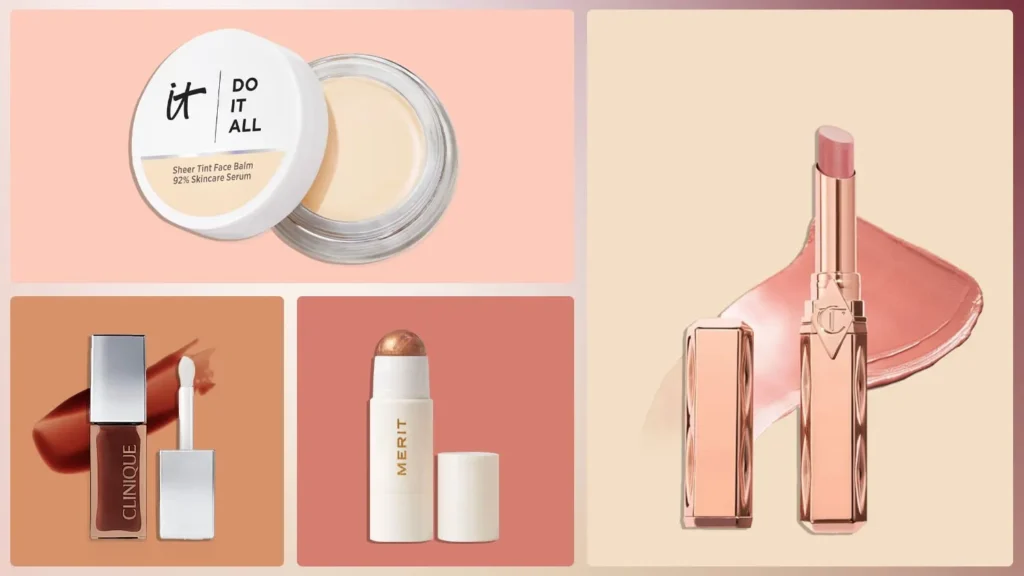
How to look like the most luminous version of yourself — without looking like you tried too hard.
I had a moment a couple of years ago that quietly changed everything about the way I approach beauty. I was standing in front of my mirror — the large, round one with the brass frame that I impulse-bought during a very Pinterest-heavy phase of my life — and I was applying what I would have then described as a ‘natural look.’ Foundation. Setting powder. Concealer under the eyes and around the nose. A neutral contour. A highlighter on the high planes of my face. Brow gel. A coat of mascara. Neutral lip liner and a tinted balm. I looked, by most standards, pretty good.
And then I saw a photograph of myself from a few weeks earlier — no makeup, damp hair, the kind of photograph you take on a phone when you’re not thinking about it, standing in the kitchen in good morning light. And I looked… better. Not polished. Not finished. But alive. There was something in my skin in that photo that all the products in front of me were somehow hiding rather than enhancing.
I don’t tell this story because I think makeup is bad or because I’ve become one of those people who delivers speeches about ‘being comfortable in your own skin’ while clearly still being very invested in their skincare routine. I tell it because it was the beginning of a question I’ve been exploring ever since: what would it look like to enhance the real texture of my face, instead of creating a different surface over the top of it?
That question led me to the philosophy I’d now call subtle beauty — and it is a philosophy, not a product category or a trend, though it has absolutely found its cultural moment. Subtle beauty is the art of looking like yourself, but more so. It’s the difference between wearing makeup and wearing skin. It lives in the space between a bare face and a full face, and it requires — perhaps counterintuitively — more knowledge, more intention, and more self-awareness than the full coverage approach ever did.
This is a guide to that art. It covers skincare as foundation (the literal kind), the products worth knowing about, the techniques that make the difference, the aesthetics that are shaping this conversation in 2026, and the mindset shift that, in my experience, makes all of it actually work. Welcome. Get comfortable. This might take a while, and I think you’ll be glad it did.
— ✦ —
Why Subtle Beauty Is the Most Sophisticated Choice You Can Make Right Now
Let me begin with some cultural context, because I think it illuminates why this conversation is happening so prominently in 2026 and why it feels different from previous iterations of the ‘no-makeup makeup look’ that beauty editors have been writing about since approximately forever.
The early 2020s were dominated by a particular kind of maximalism in beauty — heavy foundation, dramatic contouring, falsie-level lash extensions, overdrawn lips. Social media had created a visual culture where faces were not so much presented as constructed, filtered, and rendered. The tools of that construction were impressive and the results were often technically extraordinary. But something was being lost, and somewhere around 2023, a significant portion of women started quietly opting out.
What emerged from that opting-out was a cluster of aesthetics that now define the beauty conversation in 2026: the clean girl aesthetic, with its emphasis on glowing, fresh skin and effortless simplicity. Quiet luxury beauty, which favours quality over quantity and an understated elegance that reads as expensive precisely because it doesn’t try too hard. Soft glam, which keeps the enhancement but strips away the heaviness. And a broader cultural shift toward what I’d call authentic presentation — the idea that the goal of beauty is to look like a better version of yourself, not a different person entirely.
These aesthetics share a common thread: they privilege skin above everything else. Not skin as a blank canvas to be covered and corrected, but skin as the primary feature. Texture, luminosity, the natural variation of tone — these are not problems to be solved in the subtle beauty philosophy. They are characteristics to be enhanced, celebrated, worked with.
This is a more demanding brief than it might initially appear. When you’re working with your real skin rather than over it, every quality of that skin becomes relevant. Which means the most important investment you can make in a subtle beauty approach is not in makeup at all — it’s in skin health. And that is where this guide begins.
“The goal of beauty is to look like a better version of yourself — not a different person entirely.”
— ✦ —
The Skin-First Revolution: Why Your Canvas Changes Everything
I have spent more money on skincare in the past three years than I ever did during the decade when I was buying the most makeup. Not because I was told to, not because a beauty editor persuaded me, but because I discovered — firsthand and unmistakably — that genuinely healthy skin changes the entire equation of how you look with minimal product on your face.
This is not a revolutionary idea. Dermatologists and aestheticians have been saying it for years. But I think there’s a version of this message that gets lost in the translation from clinical advice to real life, and I want to try to say it in a way that actually lands: when your skin is hydrated, when the barrier is intact, when circulation is good and inflammation is low and your texture is smooth — you look phenomenally better with nothing on your face than you did at your most perfectly made-up six months ago. I am speaking from personal experience and from observing it in every woman I know who has made the shift to skin-first thinking.
Hydration: The Single Most Transformative Thing
We have been told about hydration so many times that most of us have tuned it out entirely. Water, eight glasses, yes yes. But the hydration conversation in skincare is more specific and more interesting than the generic advice suggests, and it’s worth engaging with properly.
Skin dehydration — as distinct from skin dryness (a skin type) — is a temporary condition in which the skin lacks water in the uppermost layers. Dehydrated skin looks dull, feels tight, shows fine lines more prominently, and photographs poorly in that specific, flat, lifeless way that no filter quite fixes. The cause is usually a compromised skin barrier — the thin, protective outer layer of the skin that regulates moisture loss — combined with inadequate topical hydration.
Rebuilding hydration, and protecting it once rebuilt, is the single most impactful thing most women can do for the quality of their skin’s appearance. The ingredients to look for are well-established by now: hyaluronic acid, which draws water into the skin from the environment; ceramides, which repair and strengthen the barrier; niacinamide, which regulates sebum and soothes inflammation while supporting barrier function; and glycerin, which is quietly one of the most effective humectants in skincare and appears in almost every good moisturiser for good reason.
In 2026, the hero formats for hydration are the barrier-repair cream and the hydrating serum layered underneath it. The approach is simple: a well-formulated hydrating serum applied to damp skin, sealed in with a nourishing moisturiser, morning and evening. That’s it. The complexity of ten-step routines has largely given way, among those paying attention, to a thoughtful edit of fewer products used consistently. Less really is more — in skincare as in everything else.
Glow From Within: Circulation, Sleep, and the Less Glamorous Foundations
There is a kind of luminosity that no highlighter can replicate, and it comes from within the skin rather than on top of it. You see it in people who sleep well and manage stress reasonably and move their bodies regularly and drink enough water. It shows up as a warmth in the skin, a kind of subtle aliveness in the undertones, a quality that photographers and makeup artists call ‘skin that catches the light.’
I raise this not to make anyone feel guilty about their sleep patterns or their stress levels — both of which are often very much outside our control — but to make a point about the hierarchy of priorities in the subtle beauty approach. The internal foundations of skin health are more powerful than any external product. Which means that sleep, when you can protect it, is genuinely a beauty treatment. That daily movement, which increases circulation and brings oxygen and nutrients to the skin cells, shows on your face in ways that are measurable. That chronic stress, which elevates cortisol and drives inflammation, will undermine even the best skincare routine.
None of this requires perfection. A regular gentle walk, a reasonably consistent bedtime, a daily large glass of water first thing in the morning — these are not dramatic lifestyle overhauls. They are small, sustainable habits that compound over weeks and months into genuinely visible improvements in skin quality. And when your skin quality improves, the need for coverage decreases, and the opportunity for subtle beauty expands.
SPF: The Anti-Aging Product That Also Gives You Glow
I know we have all been told about SPF and I know most of us are using it more consistently than we were five years ago. But I want to make a specific case for SPF as a subtle beauty essential, not just a health precaution. Because the skin that ages most beautifully — the skin that holds its luminosity and evenness over decades — is, more than anything else, the skin that has been consistently protected from UV exposure.
Hyperpigmentation, uneven tone, the texture changes of photodamage — these are the things that coverage makeup most often attempts to address. Consistent, daily SPF use is the most effective way to prevent them accumulating in the first place. The woman who has worn SPF every day for ten years looks, at forty, like she has a much simpler beauty routine than she might actually have, because her skin doesn’t need the level of correcting that unprotected skin typically requires.
The good news for those who struggled with the white-cast, heavy textures of earlier SPF formulations: the 2026 market is genuinely excellent. Lightweight, hydrating, glow-giving mineral and hybrid SPF formulas now exist that function simultaneously as the final step of skincare and the first step of a subtle makeup look. Some of them are so good they make a separate primer entirely redundant. Look for formulas with a finish that plays well with whatever you layer on top — and find one you actually love using, because the best SPF is the one you’ll wear every single day.
— ✦ —
The Edit: What Subtle Beauty Actually Looks Like in Product Terms
Now we’re getting into it. I want to talk about products — not in a listicle way, not in a ‘top ten products for a no-makeup makeup look’ way that feels like it was written by an algorithm in five minutes — but in a way that actually explains the philosophy behind each category and helps you make genuinely good choices for your face and your life.
The subtle beauty approach requires a very specific kind of restraint: not the restraint of using no products, but the restraint of using fewer products and using them better. Every product earns its place by doing something specific and real. There is no place in a subtle beauty edit for products that exist primarily to add more product, or products that solve a problem created by a different product, or products you use out of habit rather than purpose.
Skin Tint and Tinted Moisturiser: The Gateway Product
If you’re transitioning from a full-coverage foundation to a more skin-forward approach, the skin tint is your best first step. Not because it’s a compromise, but because it genuinely does something different from foundation — it evening without flattening, it adds a luminosity that foundation can sometimes remove, and it works with your skin’s texture rather than smoothing over it.
The skin tint category has exploded in 2026, driven partly by the clean girl aesthetic and partly by a genuine improvement in formulation. The best skin tints offer buildable, customisable coverage that can be sheered out with a damp beauty sponge for the faintest hint of evening, or layered slightly for more correction in specific areas, all while maintaining that ‘skin but better’ finish that is the hallmark of the subtle beauty look.
What to look for: a formula with skincare ingredients (hyaluronic acid, squalane, vitamin C are common and genuinely useful in this format), an SPF if you plan to use it as your sole sun protection, and a finish that reads as skin rather than makeup. Satin, natural, and ‘your skin’ finishes work best for this approach. Avoid anything described as ‘full coverage’ or ‘long-wearing’ if luminosity is your goal — these formulas tend to set in a way that reads as makeup from across the room.
Application technique matters as much as product choice here. A damp beautyblender, pressed — not dragged — across the skin, sheers out a skin tint in a way that your fingers or a brush simply don’t replicate. The pressing motion pushes the product into the skin rather than sitting it on top, and the damp sponge dilutes the coverage slightly while adding a surface freshness that is very difficult to achieve otherwise. This single technique change has transformed the finish of many women’s base makeup, and it costs nothing.
Concealer: Less Than You Think, More Precisely Than You’re Probably Using It
Concealer is the most common place where the subtle beauty approach breaks down, because it’s the product most of us reach for with the most anxiety behind it. Dark circles. Blemishes. The redness around the nose that persists regardless of what we eat or how we sleep. The instinct is to cover completely. The subtle beauty approach says: cover selectively, blend imperfectly, and leave more than you think you should.
The most illuminating advice I ever received about concealer came from a makeup artist who works almost exclusively on editorial and commercial shoots — the kind of work where skin needs to look remarkable from three feet away and in high-resolution photography. She told me that the best concealer application, for a natural result, involves using half the amount you instinctively reach for, placing it only at the darkest point of the under-eye (not in a full triangle or half-moon), and blending it not downward toward the cheek but upward into the skin, leaving a gradient rather than a line.
The product itself: for under-eyes, a slightly luminous formula in a colour that is half to one shade lighter than your skin tone (cooler tones to neutralise warmth; warmer tones to neutralise blueness — know your particular under-eye concern). For blemishes, a more full-coverage formula applied with a fine brush or fingertip only to the specific area, not blended into the surrounding skin. The goal is to reduce the visibility of the concern, not to erase it.
Setting powder on concealer is one of the most debated topics in beauty, and for good reason — it extends wear significantly but can also create a flat, powdery finish that is the opposite of what subtle beauty requires. The compromise: a very light dusting of finely milled translucent powder, applied with a fluffy brush in gentle pressing motions, only under the eye and only where the concealer is thickest. Everywhere else, let the skin breathe and move as it naturally does.
Blush: The Product That Does the Most Work for the Least Effort
If I had to nominate a single product as the secret weapon of subtle beauty, it would be blush. Not the dramatic, heavily pigmented blush that had its maximalist moment a few years ago, but a soft, wearable flush of colour applied with a light hand in a placement that mimics where the skin naturally reddens — the high apples of the cheeks, sometimes sweeping lightly toward the temples and the bridge of the nose.
The reason blush does so much is physiological: a flush of colour in the cheeks signals youth, health, and warmth to the human eye in a way that is deeply subconscious. It adds life to a face in the way that foundation and concealer, used alone, often remove. It’s the difference between a face that looks polished and a face that looks alive. And in the subtle beauty approach, ‘alive’ always wins.
Cream and liquid blush formats have been dominant for several years and continue to be the best choice for skin-forward makeup, because they melt into the skin rather than sitting on top of it. Applied with fingertips — pressed gently into the skin in the area just above the cheekbone — they create a flush that looks genuinely natural, as if it came from inside rather than from a product. The 2026 market is full of excellent options; look for formulas that blend easily and dry down to a natural, semi-sheer finish rather than a solid wash of colour.
Placement is everything with blush, and the most flattering placement for most women is higher than they think — genuinely on the cheekbone, sometimes even near the corner of the eye, rather than on the fleshy apple. This is the placement that lifts the face visually and avoids the slightly dated, rosy-cheeked look that lower blush placement can create. Blend upward and outward, feather the edges until they disappear, and step back. What’s left should be the suggestion of colour, not the statement of it.
Brows: Structure Without Architecture
Eyebrows have been through a remarkable journey in the past decade of beauty culture, from overplucked to dramatically drawn to now, in 2026, arriving at something that feels genuinely evolved: natural, textured, individual-shaped brows that look like they grew that way rather than like they were designed by someone with a ruler.
For a subtle beauty approach, the goal with brows is structure, not fullness. You want the brow to have shape and presence without looking drawn or constructed. The products that achieve this best: a brow serum, used daily over time to actually improve the health and density of the brow hairs themselves (the results are real and they are worth the patience). A clear or tinted brow gel that brushes hairs into place, adding the impression of neatness and definition without adding colour or filling. And, sparingly, a micro-brow pencil used only to fill true gaps — not to extend the tail, not to darken the whole brow, just to address the specific sparse spots that a groomed brow otherwise would show.
The laminated brow look that has been so predominant is softening in 2026 into something slightly more relaxed — still brushed up, still textured, but less rigidly upswept, more naturalistically full. The ideal reference is a brow that looks like it might belong to a woman in her mid-twenties who has simply been blessed with good brows. Artlessly perfect. Effortlessly shaped. The result of time and technique that should not, under any circumstances, be visible in the finished look.
Eyes: The Art of Enhancement Without Drama
Eye makeup is where the subtle beauty philosophy faces its most interesting challenge, because eyes are the feature most culturally associated with dramatic enhancement. The entire history of eye makeup is essentially a history of drama — kohl, smoky shadows, winged liner, false lashes. All of it designed to make eyes bigger, darker, more defined, more significant.
Subtle beauty asks a different question: what does this specific pair of eyes actually need to look most beautiful? And the answer is almost never drama. The answer is usually: definition that follows the natural shape, a touch of colour that brightens rather than intensifies, and lashes that are enhanced rather than transformed.
For definition: a brown or warm-toned eyeliner applied to the upper lash line only, using a fine brush or a soft kohl pencil smudged gently, gives definition without the sharpness of black liner that can look harsh on a natural face. Tightlining — applying a dark tone to the waterline between the upper lashes — adds the illusion of fuller lashes without any visible liner at all. This is the most subtle form of eye definition available and it is devastatingly effective.
For lashes: a good, separating mascara applied to the upper lashes only (lower lash mascara almost always reads as heavy in the context of subtle beauty) is all that most looks need. The technique matters: one coat applied from root to tip with a wiggling motion at the base, followed by a second coat at the outer corner to add a slight cat-eye effect to the natural lash line. Do not add a third coat. Set the wand down. Walk away.
And for those rare occasions when you want the eyes to carry slightly more presence: a wash of warm, tawny shadow on the lid — terracotta, soft bronze, warm taupe — pressed gently with a finger, blended at the edges, and left with that intentionally unblended quality that reads as artful rather than unfinished. This is the technique that appears throughout the soft glam aesthetic that is defining editorial beauty in 2026, and it works because it adds depth and dimension without the formality of a traditional eye look.
Lip Products: The Quietest Statement
The lips in subtle beauty exist on a spectrum from ‘enhanced natural’ to ‘soft bitten,’ and virtually nothing that lives outside that spectrum belongs in a truly skin-forward look. What we’re talking about is lip products that add colour, definition, and moisture without the precision or intensity of a full lip look.
The tinted lip balm has been the perennial hero of this category, and for good reason — it requires no application skill, adds warmth and moisture, and looks good on virtually everyone. In 2026, the category has been elevated considerably by formulas that offer genuine skincare benefits (hyaluronic acid, peptides, botanical oils) alongside tint, making them genuinely nourishing rather than merely decorative.
For slightly more definition: a lip liner in a colour that is one to two shades deeper than your natural lip tone, used to define only the outer edge of the lips (not filled in, not overdrawn) and then blended inward with a finger. This adds definition and longevity to whatever goes on top without creating the hard outline that reads as heavily made-up. Top with a tinted balm or a sheer gloss in a complementary shade, and the effect is a lip that looks naturally full, naturally coloured, and completely effortless.
The colour families that serve subtle beauty best at the lips in 2026: warm nudes that are pink-adjacent, mauve tones that read as ‘your lips but enhanced,’ soft terracottas and warm browns that play beautifully against the bronzed, warm-skinned aesthetic that has been dominant across multiple beauty aesthetics this year. The colours to be cautious with: anything very pale, which can look washed out without the contrast of heavy eye makeup, and anything very bold, which pulls the focus from the skin-forward approach that subtle beauty prioritises.
— ✦ —
Technique Is Everything: The Small Things That Make the Biggest Difference
I want to spend real time here, because I believe — wholeheartedly, from years of experimenting with my own face and observing the results — that technique accounts for at least fifty percent of the outcome in subtle beauty. The other fifty is product choice and skin preparation. What it is not, notably, is product quantity.
More is almost never more in this context. A beautiful, luminous, alive-looking face with subtle makeup is almost always the result of less product applied with more skill, not more product applied with less. And the skills involved are genuinely learnable — they just require patience, attention, and the willingness to practice in situations where the stakes are low enough that imperfect results don’t matter.
The Damp Sponge Method: Why It Changes Everything
I have mentioned the damp beautyblender already but I want to go deeper, because I think it’s one of those techniques that sounds simple — so simple that people assume they’re already doing it correctly — but which, when you really understand the mechanics, produces a result that is genuinely transformative.
The damp sponge method works for several reasons simultaneously. The dampness itself dilutes the product slightly, sheering out the coverage and creating a more transparent finish. The pressing motion, as opposed to swiping or dragging, pushes product into the skin rather than sitting it on the surface, which creates the ‘skin from within’ quality that is so hard to replicate with other application methods. And the rounded, irregular shape of a good beautyblender gets into the curves and contours of the face in a way that flat brushes and fingers simply don’t.
The correct dampness level is more than damp — the sponge should be wet enough that it feels heavy in your hand, and you should squeeze it firmly over a sink before use. A too-dry sponge absorbs product instead of depositing it. Once the sponge is at the right dampness, bounce it lightly across the skin with the product applied either directly to the sponge or dotted onto the face with fingertips. Work from the centre of the face outward, with lighter pressure at the edges so that the coverage naturally fades toward the hairline and jaw.
Finger Painting: The Oldest Trick and the Best One
There is something deeply satisfying about applying makeup with your fingers — it feels instinctive, human, and slightly rule-breaking in the context of a beauty world full of specialised tools. And for certain products, it produces results that are categorically superior to any brush or sponge.
Cream blush, as I’ve mentioned, is best applied with a finger — pressed firmly onto the cheekbone and then tapped outward in gentle, stippling motions that blur the edges. The warmth of the finger helps the product melt into the skin in a way that feels genuinely integrated. Cream eyeshadow, particularly the wash-of-colour application that defines the soft glam eye, is best pressed on with the ring finger (the weakest finger, which naturally provides the lightest pressure) and then barely blended with the same finger or a clean fluffy brush.
Concealer applied with a fingertip, in small patting motions, blends imperceptibly in a way that can be harder to achieve with tools. The heat of the skin helps the product integrate. And a tinted balm applied with the ring finger, pressed from the centre of the lip outward, creates the kind of naturally diffuse lip colour that is the ideal finish for a subtle beauty look.
What fingers cannot do: apply product in precise lines, or create even coverage over large areas of skin. For those tasks, tools are genuinely better. But for blending, for softening, for the kind of application that makes makeup disappear into skin — hands are often the most sophisticated tool available.
The One-Minute Rule: Less Time, Better Results
Here is a counterintuitive practice I have developed and tested extensively on my own face: if you’re trying to achieve a subtle, natural result, apply your makeup, step back from the mirror, and do not touch anything for one full minute. Then take a single look, decide whether one specific thing needs adjusting, adjust only that thing, and stop.
The reason this works is that the instinct to keep going — to add more blush because the first application looked light, to deepen the liner because the first swipe seemed subtle, to add another layer of concealer because the first didn’t fully cover — is the instinct that takes a natural, subtle look and turns it into something heavier and more constructed than intended. One minute of distance gives your eye time to adjust to the colour and take in the whole face, rather than fixating on individual areas that seem underdone in isolation but are correct in context.
It also helps to look at your face from a conversational distance — about three feet — rather than up close in a magnifying mirror. The close mirror is useful for precision application, but it is the enemy of a naturally finished result, because it shows you details that no one in normal social interaction will ever see, and it triggers the urge to ‘fix’ things that are not, from any real-world perspective, broken.
— ✦ —
The Aesthetic Context: Where Subtle Beauty Lives in 2026 Culture
Beauty does not exist in a vacuum — it exists within a broader cultural conversation about identity, femininity, aspiration, and what we want to signal to the world about who we are. The rise of subtle beauty as a dominant aesthetic in 2026 is inseparable from the wider cultural shifts that have shaped how women present themselves, dress, and curate their public-facing identities.
The quiet luxury aesthetic — that movement toward understated elegance, investment in quality over visibility of effort, the idea that the best version of something doesn’t announce itself — has fundamentally shaped the beauty conversation of this era. In quiet luxury fashion, the logo is hidden or absent, the fabric is exceptional, the cut is perfect, and the overall impression is of someone who simply has excellent taste rather than someone who is trying to demonstrate that they have excellent taste. Subtle beauty is the direct equivalent in makeup.
The clean girl aesthetic, which emerged on social media a few years ago and has since evolved into something richer and more nuanced, centres on a similar set of values: freshness over construction, skin over coverage, a groomed but effortless quality that suggests health and ease rather than effort. The clean girl of 2026 is not just someone who uses fewer products — she is someone who has made peace with her actual face and has the skill and the confidence to enhance it rather than transform it.
Soft glam, the more dressed-up sibling of clean beauty, takes these principles and applies them to slightly more intentional makeup — the kind of look that belongs at an evening event or a significant occasion but still reads as ‘you, beautifully dressed’ rather than ‘a made-up version of you.’ Soft glam still prioritises skin, still keeps coverage lighter than traditional glamour, but adds warmth and definition that makes the face shimmer in candlelight and photograph with genuine allure.
What unites all of these aesthetics — and what makes them distinctly of this moment — is a shift in what beauty is understood to be for. It’s less about transformation and more about revelation. Less about performing a femininity that conforms to external standards and more about expressing an individual femininity that is authentic and considered. The woman at the centre of this aesthetic knows herself. She has good skin because she takes care of it. She knows which two products make the most difference on her face and she uses those products well. She looks the way she does not because she spent an hour in front of a mirror but because she has spent years learning what her face actually needs.
Social Media and the Subtle Beauty Moment
It would be disingenuous to discuss subtle beauty in 2026 without acknowledging the significant role that social media — particularly TikTok, Instagram, and Pinterest — has played in both driving and documenting the shift.
Pinterest, in particular, has been a defining influence on the visual language of subtle beauty. The boards and collections that drive the most saves are full of images that feel aspirationally real: women in excellent light with glowing skin, minimal makeup, clothes that feel expensive without being recognisably branded, interiors that are beautiful and liveable simultaneously. The Pinterest aesthetic is increasingly a quiet luxury aesthetic, and the beauty that exists within it is soft, natural, and luminous.
On TikTok, the ‘your skin but better’ trend has spawned an enormous amount of content, some of it genuinely excellent, that documents the process of achieving a skin-forward look — the skincare routine, the skin prep, the light-handed product application, the final result. What’s interesting about this content is how it has shifted the beauty conversation away from ‘how to’ and toward ‘why’ — creators talking about the philosophy of their approach, the relationship with their skin, the mindset behind the minimalist edit. That depth of engagement is relatively new in mainstream beauty content, and it reflects a genuine shift in what women are looking for from the beauty conversation.
Instagram remains the platform where the aesthetic is most curated and most influential, with the feed aesthetics of the most followed beauty accounts reflecting back the same values: warm light, natural skin, effortful effortlessness, the suggestion of a life that is rich in texture and ease. The models and creators who resonate most powerfully in this ecosystem are the ones who look like real women with extraordinary skin and refined taste, rather than flawlessly constructed versions of a beauty ideal.
— ✦ —
Fragrance and the Invisible Layer of Subtle Beauty
I want to take a brief and genuine detour into fragrance, because I think it belongs in any full conversation about subtle beauty — and it’s rarely included, which I find puzzling, because fragrance is the most intimate layer of personal presentation and the one that lingers longest in memory.
The fragrance aesthetic of 2026 is deeply aligned with the quiet luxury philosophy: skin scents and soft musks that read as ‘expensive clean skin’ rather than perfume. The big, statement fragrances that announce an entrance are giving way to scents that reveal themselves slowly, that require proximity to be properly experienced, that feel like a natural extension of the wearer rather than an additional layer applied over them.
The quiet luxury fragrance canon of this moment includes: white musks that smell like warm skin. Soft woods — sandalwood, cashmere wood — that add depth without heaviness. Clean florals, particularly white flowers like jasmine and tuberose, that stop short of sweetness. And the ingredient that has become the olfactory signature of understated elegance in recent years: ambrette seed, which smells uncannily like the best version of your own skin.
For subtle beauty dressing, fragrance should be applied to pulse points — inner wrists, the hollow of the throat, behind the ears — but with a light hand that leaves the scent discovered rather than encountered. One or two sprays, not five. Close to the skin, not from a distance. The goal is that when someone is close to you, they notice something wonderful that they may not immediately be able to identify. That is the quiet luxury of fragrance: presence without proclamation.
— ✦ —
Hair: The Frame That Makes the Painting
No conversation about the complete subtle beauty aesthetic can stay only on the face, because hair is inextricably part of the overall impression. And the hair aesthetic of 2026 is beautifully consistent with everything else we’ve been discussing: effortful effortlessness, quality of texture over precision of style, the appearance of natural beauty that is in fact very carefully cultivated.
The dominant hair aesthetics right now — clean girl hair with its centre-parted, glassy sleekness; the ‘expensive undone’ of a textured blowout with the right amount of movement; the quietly romantic quality of a loose, low style that looks like it took ten minutes but actually required thirty — all of them share the same commitment to looking like your hair is simply doing something wonderful on its own.
Hair health is the foundation of all of these looks, in exactly the way that skin health is the foundation of subtle beauty. Dry, damaged hair that has been heat-styled within an inch of its life cannot achieve the glossy, alive quality that makes the clean girl look so compelling. Investing in the health of the hair — through regular trims, quality conditioning treatments, reduced heat styling, and the kind of daily care that protects the cuticle — pays dividends in the same way that a good skincare routine does. The look you’re working toward is more accessible when your starting material is genuinely healthy.
For the minimal beauty aesthetic, hair styling products should follow the same light-hand philosophy as makeup. A small amount of a high-quality hair oil applied to the ends adds gloss and smoothness without the product-laden look that can make hair seem heavy or over-styled. A light-hold cream or mousse worked through damp hair before air-drying creates the kind of natural texture that looks like particularly well-behaved naturally wavy hair. A single product, used well, consistently achieves more than five products used liberally.
— ✦ —
Building Your Subtle Beauty Wardrobe: The Edit That Never Needs to Change
One of the most liberating things about committing to a subtle beauty approach is that it dramatically simplifies your relationship with makeup. When you’re working with your skin rather than over it, the number of products you actually need drops considerably. And the products you do own get used completely, rather than accumulating in a drawer and expiring half-finished.
The subtle beauty edit — the collection that covers every occasion from Tuesday morning to Saturday evening — is genuinely small. A good skin tint or tinted moisturiser with SPF. A luminous concealer for targeted use. A cream blush in a warm, flattering tone. A brow gel, perhaps a micro-pencil. A soft brown liner. A separating mascara. A lip liner and a tinted balm. A highlighter that is almost embarrassingly subtle — barely there but present in good light. A warm, sheer setting spray rather than setting powder.
That’s it. That is a complete subtle beauty wardrobe for most women. It fits in a small pouch, it costs a fraction of a traditional full makeup collection, and it takes under ten minutes to apply even on the most deliberate days. The investment you redirect from a large product collection goes into fewer, better things: the excellent moisturiser, the SPF that you actually enjoy applying, the hero products that work so well that they become daily non-negotiables.
The wardrobe approach also means that every product you own has been chosen with intention. You know why it’s there, what it does, and how it fits into the larger picture. There is no product guilt, no drawer of abandoned experiments, no vague sense that you should be doing more. Just a small, beautiful collection of things that work for your specific face and are used until they’re gone.
“There is no product guilt, no drawer of abandoned experiments, no vague sense that you should be doing more.”
— ✦ —
Morning Rituals: How Subtle Beauty Changes Your Relationship With Time
One of the practical gifts of a subtle beauty approach that doesn’t get discussed enough is time. The time returned to you each morning by a shorter, more intentional routine is not a small thing. It is real, meaningful time that can be spent elsewhere — on a slower coffee, on a few pages of a book, on the kind of unhurried morning that sets a completely different tone for the day.
My morning routine, at its current iteration, takes between eight and twelve minutes depending on how much care I’m putting into it. It includes a quick cleanse, a hydrating serum, SPF moisturiser, a few minutes of skin prep. Then: skin tint sheered out with a damp sponge. A touch of concealer under the eyes only. Cream blush pressed onto the cheekbones with a finger. Brow gel. Mascara. Lip balm. Done.
The version of me that used to spend forty minutes on makeup every morning was not producing results that were meaningfully better in the real world — at a conversational distance, in actual daily life — than what I achieve now in under fifteen. What that version was producing was a morning that began with effort and precision and a slightly anxious relationship with my face. That is now replaced by a morning that begins with ease and intention and something that feels a lot more like self-care than self-construction.
The ritual quality of the subtle beauty routine is worth nurturing. A beautiful skincare collection displayed where you can see it. A morning playlist that sets the right mood. Good light — natural where possible, warm and flattering where not. Your favourite mug nearby. The small sensory details that make a routine feel like a pleasure rather than a chore make an enormous difference to whether you actually do it consistently, and consistency — in both skincare and the minimal makeup approach — is what produces the results that look effortless.
— ✦ —
The Confidence Conversation: What Subtle Beauty Asks of You
I want to end with the thing that nobody quite says directly but that sits at the heart of every conversation about wearing less makeup: confidence. Because the subtle beauty approach, more than any other beauty philosophy, asks you to be comfortable with your actual face. Not your improved face, not your corrected face — your real face, enhanced but not hidden.
That’s a bigger ask than it sounds. Many of us have long and complicated relationships with our faces. We have features we’ve been made to feel self-conscious about, skin concerns we’ve spent years trying to cover, a deep familiarity with the gap between how we look in a mirror and how we look in photographs. The instinct to cover, to smooth, to correct — it comes from somewhere real, and it deserves to be acknowledged rather than dismissed.
What I can tell you, from my own experience and from every woman I have spoken to who has made this shift, is that the confidence comes after the practice, not before it. You do not need to feel confident about your face to start wearing less on it. You start wearing less, and the confidence grows. Your skin improves because you’re caring for it rather than covering it. You develop a relationship with your natural features that is more accepting than it was when you were obscuring them. You discover what your face actually looks like — the things you like about it, the things you’re at peace with, the things you’ve been told to be insecure about but which, in the kind light of a morning window, are simply part of your face and therefore fine.
There is a particular kind of beauty that belongs to women who are comfortable in their own faces. It’s not the beauty of perfection or of flawless technique. It’s the beauty of presence — of someone who has arrived in her own skin and stopped apologising for it. That quality photographs extraordinarily well. It reads across a room. It is what people mean when they say a woman has something, and cannot quite define what it is.
Subtle beauty is, at its deepest level, a practice in that kind of presence. It asks you to work with what you have, to invest in its health, to enhance it with skill and restraint, and to trust that the result — however imperfect, however unlike the images in your beauty feed — is enough. More than enough. That it is, in fact, exactly right.
— ✦ —
Subtle Beauty for Every Skin Tone: The Principles That Apply Universally
I want to address something before we close, because subtle beauty can sometimes feel, in the way it is presented and photographed, as though it is designed for a specific skin tone. The luminous, glowing aesthetic is real and achievable across every shade and undertone, but the product choices and techniques require some translation, and I want to make that translation explicit.
The principle that skin tint and tinted moisturiser should match the undertone as well as the depth is more, not less, important for deeper skin tones — where the wrong undertone in a sheer formula shows up as an ashy or overly warm cast. Look for formulas specifically developed for deeper skin tones, or brands with genuinely extensive shade ranges. Sheer coverage is achievable at every depth of skin colour; the formula just needs to be matched correctly.
Blush colours translate differently across skin tones, and the wash-of-colour approach requires more pigment in the formula for it to show on deeper skin. What registers as a soft flush on fair skin may disappear entirely on a deeper tone. The solution is either a more pigmented formula applied with the same light hand, or a shade that has enough depth to create contrast without looking heavy — deep berry tones, warm terracotta, rich mauve, depending on the individual skin tone.
Highlighter placement and formula matters enormously across different skin tones. For deeper skin, golden and copper-toned highlighters tend to show more beautifully and read as more natural than the champagne and pearl shades that are formulated primarily with fair skin in mind. The strobe-in-the-skin effect — highlighter pressed into the skin with fingers rather than swept on the surface — works beautifully on all skin tones and creates a more natural glow than any surface application.
The SPF conversation is also worth addressing across skin tones: the white cast issue that has historically made SPF compliance difficult for deeper skin tones is genuinely being addressed by formulation improvements in 2026. Mineral SPF formulas with tinted versions, chemical SPF formulas that leave no cast, and hybrid approaches are all more advanced than they were even two years ago. Good skin protection is fundamental to the subtle beauty approach regardless of skin tone, and the industry is finally producing products that work for everyone.
— ✦ —
The Last Word: On Glow, Grace, and the Faces That Last
There is a woman I think of when I think of subtle beauty done at its absolute highest level. She’s not a makeup artist or a beauty influencer — she’s a woman I see occasionally in a café near where I live, usually on weekend mornings. She looks, on every occasion I’ve seen her, impossibly put-together in the quietest possible way. Her skin glows. Her brows are neat. Her lips are a slightly more beautiful version of her natural lip colour. Her overall impression is of someone who woke up looking like this and finds it slightly unremarkable.
I have spent a genuinely embarrassing amount of time thinking about what she does to look that way. And I think the answer — as I have come to understand it through years of my own experimentation — is that she doesn’t do very much at all. She does very little, very well, very consistently. She has excellent skin because she takes care of it. She has a small collection of products she knows how to use. And she has that intangible quality of being comfortable in her own face, of presenting herself rather than performing herself, that makes everything she does wear look like it belongs there.
That is the aspiration of subtle beauty. Not perfection. Not minimalism for its own sake. Not a reaction against makeup or a rejection of the pleasure of beauty products. Just this: knowing your face, caring for your skin, using what you use with intention and skill, and arriving in the world looking like the most luminous version of yourself.
The glow is real. The grace is learnable. And the face that lasts — the face that you still love, still recognize, still feel at home in at every age and season — is the one you’ve learned to enhance rather than erase.
I hope this guide has given you something useful, something that changes the way you look at your mirror in the morning, even slightly. Not because your face needs to change — but because the way you see it might be worth reconsidering.
With warmth, and the softest possible application of blush,
A fellow enthusiast of the subtle and the luminous.
— ✦ —
This article is for informational and lifestyle purposes only and reflects personal experience and opinion. Individual results from skincare and beauty practices vary. Always patch-test new products and consult a dermatologist for skin concerns requiring medical attention.