
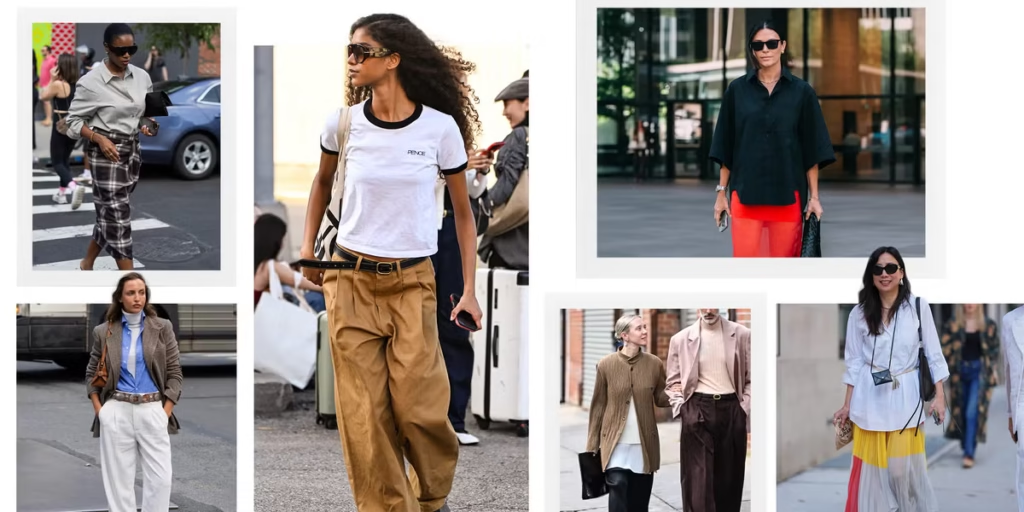
There’s a moment — and if you’ve experienced it, you know exactly what I mean — when you walk past a glass storefront, catch your reflection, and think: yes. That’s it. That’s the version of myself I’ve been trying to show up as.
It doesn’t happen on the days I’ve tried the hardest. It’s never when I’ve spent two hours planning an outfit or scrolled through a hundred Pinterest boards before getting dressed. It happens on the days when everything just clicks — when the coat fits right, when the trousers have that perfect weight, when the sneakers are worn in just enough to feel lived-in but still sharp. That’s the whole magic and mystery of what we’re calling elegant streetwear in 2026.
And I want to talk about it. Properly. Not in the way fashion content usually does — with a list of “must-have pieces” that feel like they were written by someone who’s never actually had to figure out what to wear on a Tuesday morning when you’re running late and your coffee is getting cold. I want to talk about it the way a real woman thinks about her wardrobe. With all the nuance, the emotional weight, the practical realities, and yes, the genuine joy that comes from discovering a way of dressing that finally makes you feel like yourself.
Because that’s what elegant women’s streetwear is really about. Not a trend. Not an aesthetic for your mood board. A way of moving through the world.
What Does ‘Elegant Streetwear’ Even Mean in 2026?
Let’s start here, because the phrase itself sounds like a contradiction if you haven’t been paying attention to where fashion has quietly landed this decade. Streetwear used to mean something very specific — oversized hoodies, chunky sneakers, graphic tees, the whole hypebeast vocabulary. And elegant used to mean something else entirely — structured silhouettes, pearl accessories, the kind of wardrobe that required dry cleaning every other week.
In 2026, those two worlds have not just collided. They’ve fully merged and created something entirely new.
The woman who wears elegant streetwear is not choosing between comfort and beauty. She’s not sacrificing her personal style for the sake of functionality, and she’s certainly not wearing something ‘dressed up’ when she’d rather be in joggers. She’s found the edit — the specific, curated version of casual dressing that has taste baked into every single seam.
Think about what’s been happening on the streets of Paris, London, Milan, and New York lately (and on your For You page, if we’re honest). The women who keep stopping you mid-scroll aren’t wearing complicated outfits. They’re wearing wide-leg trousers in muted tones with a cashmere knit tucked in and flat leather loafers. They’re layering a tailored trench coat over a simple ribbed tank and pairing it with minimalist sneakers that cost three hundred dollars and look like they cost three hundred dollars. They’re making soft suede bucket hats feel like a fashion statement without even trying.
That’s elegant streetwear. Intentional. Considered. Effortlessly cool in a way that doesn’t look like effort, even though — and this is the part nobody talks about — it absolutely is.
The effort just shifts. Instead of spending time getting dressed, you spend time getting your wardrobe right. And once you have that right? Getting dressed takes eleven minutes and you always look like you walked out of a Toteme campaign.
The Foundation: Building a Wardrobe That Works For You (Not Against You)
I want to be completely honest with you about something. I spent years buying things I thought I was supposed to want. Statement pieces that never went with anything. Trendy items that felt exciting in the store and awkward everywhere else. The kind of wardrobe that looks full but somehow leaves you feeling like you have nothing to wear.
The shift happened for me when I stopped thinking about individual pieces and started thinking about a system. Not a capsule wardrobe in the strict, rigid, five-items-only sense — I find that whole concept a little too ascetic for how I actually live my life. But a system of colors, silhouettes, and fabrics that genuinely work together, so that anything I pull out of my closet can theoretically go with anything else.
For elegant streetwear specifically, that system tends to orbit around a specific palette. Not black (though black always works). Not white (same). The palette I’m talking about is the one that’s been dominant on Pinterest for the past two years and shows absolutely no sign of stopping: the neutrals that feel warm and lived-in rather than corporate and cold. Camel. Oat. Warm grey. Chocolate brown. Ivory. Dusty rose that reads almost like a neutral. The kind of colors that photograph beautifully in both bright light and golden hour, which — if we’re being transparent about it — matters to us, whether we admit it or not.
These colors layer with each other seamlessly, they look expensive in even the most affordable fabrics, and they age incredibly well. A camel trench coat bought in 2022 doesn’t look dated in 2026. It looks like you have taste.
The Silhouettes That Define the Aesthetic
Silhouette is where elegant streetwear gets interesting, because it’s more specific than people realize. The proportions matter enormously.
The foundational principle is a kind of relaxed structure — pieces that have shape without being restrictive, that have volume in the right places, that suggest rather than conform. Wide-leg trousers are the backbone of this aesthetic right now, and have been for a while, but they’re not the wide-leg of the early 2000s. They’re cleaner, longer, with a break at the ankle. They move beautifully when you walk. They look slightly dressed up even when paired with a basic tee, which is genuinely useful.
Paired with those trousers, you want something that balances. A fitted ribbed knit. A slim-cut shirt, tucked or half-tucked. A cropped leather jacket that hits right at the waistband. The volume is on the bottom, so the top stays relatively streamlined. Or you flip it: an oversized blazer or a draped coat with something slim underneath — straight-cut jeans, a simple trouser, tailored shorts in summer. One piece does the talking. The other keeps quiet.
The one silhouette I’ve stopped wearing, and I’m not entirely sure when it happened, is the middle-ground shape. Not oversized, not fitted, just… there. That particular category — mid-length, mid-weight, medium everything — tends to read as shapeless rather than relaxed. The women who look the most chic in casual contexts have learned to commit. Go loose or go clean. The in-between is fashion purgatory.
Fabrics: Where Casual Meets Luxury
I think about fabric more than almost any other component of an outfit, which probably sounds obsessive, but once you understand what it does for you, you’ll understand why.
Fabric is how streetwear goes elegant. It’s the difference between a white T-shirt that looks like a white T-shirt and a white T-shirt that looks like it’s from The Row. The cut can be identical. The construction can be similar. But when the fabric has weight and drape, when it falls a certain way, when it looks almost like it’s been lit from within — that’s the elevation.
The fabrics that define elegant streetwear in 2026 include cashmere (obviously, but specifically fine-gauge cashmere that doesn’t pill after three wears), heavy cotton that has some structure to it, washed linen, matte leather and leather alternatives, crisp poplin for shirts, and fluid satin-back crepe for those pieces that are meant to look slightly dressed up in a casual context. What they all share is quality of hand — meaning the way the fabric feels in your hand and the way it behaves on your body.
The fabrics to avoid, or to be very strategic about, are anything that shines too much in the wrong light, anything that wrinkles by noon, anything that stretches out of shape with wear, and anything that pills. Life is too short and good style too hard-won to be undone by a fabric that doesn’t hold up to real life.
The Power Pieces: What’s Actually Worth Investing In Right Now
Every season, someone makes a list of ‘investment pieces’ and it’s usually a fairly predictable rotation of the same items. The handbag, the coat, the shoes. And those things do matter — I’m not going to pretend otherwise. But the investment pieces of elegant streetwear are slightly different from the investment pieces of traditional luxury fashion, and that distinction is worth talking about.
In elegant streetwear, you’re investing in versatility above almost everything else. The piece that earns its place in your wardrobe is the one that genuinely works across multiple contexts, multiple seasons, and multiple versions of your personal style. Not the statement piece that only goes with one other thing you own. The anchor.
The Perfect Trousers
I cannot overstate how transformative the right pair of trousers is. This is the piece I see making the biggest difference in how women dress, particularly in the shift from looking ‘put together’ to looking genuinely stylish. The right trousers elevate everything around them.
In 2026, the silhouettes worth paying attention to are wide-leg and straight-cut, in that order. Wide-leg trousers in a medium-weight fabric — wool, ponte, heavy cotton, or a quality synthetic blend — with a high waist and a clean, minimal finish at the hem. No embellishment, no visible branding, no unnecessary details. Just a great trouser.
The brands doing this particularly well right now range from genuinely accessible to properly aspirational. Arket and COS on the more accessible end, with beautifully minimal designs in good fabrics. Toteme and By Malene Birger for those willing to spend more on a trouser they’ll wear for years. And then The Row or Loro Piana if trouser investment is genuinely your priority — in which case, respect.
What I look for when I try on trousers is this: do they move with me, or do they fight me? Do they look as good when I’m standing still as when I’m walking? Does the waistband sit without gaping or digging? Does the break at the ankle feel intentional? If the answer to those questions is yes, I’ll spend more than I planned.
The Outerwear Equation
Outerwear might be the single most impactful purchase in the elegant streetwear wardrobe, because it’s what people see first. It’s the frame of the outfit. It’s what you’re wearing when someone spots you across a street or a café.
The trench coat has become a modern uniform, and for good reason — it solves practically every dressing problem simultaneously. It looks appropriate in practically every context. It adds polish to whatever is underneath. It works across seasons. A good trench coat in a classic camel or oat colour, properly tailored (meaning not too short, not too boxy, with a belt that actually sits at your waist), is worth more than ten other pieces in your closet.
Beyond the trench, the pieces worth considering are the oversized wool coat — not the maximum oversized of a few years ago, but a generous, slightly boxy coat with beautiful weight and structure. The leather jacket that fits so well it becomes like a second skin. The quilted puffer in a refined, sleek silhouette (not the sleeping-bag shape, but something more architectural). And, for the warmer months, the lightweight shirt jacket — something between a blazer and a shirt, in linen or a fine cotton, that sits just right over everything.
Shoes: The Final Edit
Shoes are where I see the most common mistakes in an otherwise strong elegant streetwear look, and they’re almost always mistakes of excess rather than simplicity. Over-detailed shoes fighting with a clean outfit. Platform sneakers that add too much volume to an already generous silhouette. Heavily embellished sandals paired with refined trousers.
The shoes that work hardest in this aesthetic are clean and deliberate. The leather loafer — particularly the slightly oversized, flat, or with a small heel version that’s been everywhere for two years and still looks relevant. The low-profile sneaker in a neutral: white, grey, cream, bone, or the colour of something found in a French pharmacy. The pointed-toe flat, which has made a genuine comeback and deserves its moment. Simple leather ankle boots for transitional weather. Clean leather sandals in summer.
What these have in common is restraint. They complete an outfit rather than competing with it. And they’re almost all comfortable, which, if we’re being honest about how women actually move through their lives, matters enormously. Looking elegant while visibly uncomfortable is not an aesthetic. It’s a compromise. And we’re done with compromises.
The Quiet Luxury Influence: How It Changed Everything and Where It’s Going
We need to talk about quiet luxury, because even though the trend cycle has tried to move on from it, it fundamentally reshaped how women with genuine taste dress. And the influence hasn’t left elegant streetwear — it’s baked into it now.
If you were paying attention during 2023 and 2024, you’ll remember when the term exploded across social media. Suddenly everyone was talking about ‘stealth wealth’ dressing, referencing Succession characters, and seeking out cashmere without logos and leather goods without visible hardware. The response was partly cultural — a rejection of the overt, branded luxury that dominated the previous decade — and partly aspirational. There’s something deeply appealing about the idea of clothes that signal taste to the people who know, rather than logos that signal spending power to everyone.
In 2026, quiet luxury has evolved from a trend into a sensibility. It’s become one of the primary lenses through which women think about getting dressed. And the specific way it intersects with streetwear is fascinating, because streetwear was originally the loudest possible form of fashion — all branding and visible references and cultural signaling. The quiet luxury aesthetic has essentially refined streetwear. It kept the comfort, the attitude, the city-readiness. It removed the noise.
What you get is a woman in perfectly cut trousers, a heavyweight cotton sweatshirt in the colour of warm stone, a camel coat, and sneakers so minimal they don’t even have a visible logo. Nothing shouts. Everything communicates. The sophistication is in the understanding that you don’t need anything to shout.
I love this evolution, personally. It suits the way I want to dress — which is comfortably, pragmatically, but with an awareness that how I present myself to the world matters to me. Not because I need external validation, but because dressing well is genuinely one of the small pleasures of my day. It’s a form of self-respect that doesn’t require anyone else to notice.
The Clean Girl Aesthetic: What It Got Right and What It Got Wrong
The clean girl aesthetic swept through every corner of social media a few years ago, and while it’s moved through its initial viral phase, its influence on how women approach their personal style — particularly the intersection of beauty and fashion — is genuinely lasting.
What it got right: the idea that looking polished isn’t about effort being visible. That slicked-back hair and dewy skin and simple gold jewelry and a well-cut blazer can communicate more sophistication than a complicated, maximalist look. That restraint is a skill. That showing up as a refined, simplified version of yourself is actually more powerful than wearing everything you own at once. That skin and posture and the way you carry yourself are as important to the ‘look’ as the clothes themselves.
These insights have genuinely changed how I think about styling, and I suspect they’ve changed how many women approach their mornings too. The question isn’t just ‘what am I wearing?’ It’s ‘how does everything — the skin, the hair, the accessories, the clothes — work together to create a coherent impression?’ That holistic thinking is the real gift of the clean girl moment.
What it got wrong, or at least what got oversimplified in the translation to mass social media content: the suggestion that ‘effortless’ is actually effortless. The women who look most effortlessly polished are, without exception, women who have thought very carefully about their choices. The glowy skin required a skincare routine. The perfectly slicked bun required the right products. The ‘simple’ gold hoops are often very good, carefully chosen gold hoops. The ‘basic’ white tee is a specific white tee that fits in a specific way.
Calling it effortless is a kind of shorthand, not a description. The real lesson is that when the effort goes into the right places — the foundational choices, the quality of individual pieces, the consistency of your overall aesthetic — the daily act of getting dressed can feel genuinely easy. That’s worth aspiring to. The shortcut version, where you just buy a gold necklace and call it elegant, is not quite the same thing.
Accessories: The Part Where Elegant Streetwear Gets Its Personality
Accessories in elegant streetwear are not decorative flourishes. They’re architectural. They’re the thing that takes a strong-but-neutral outfit and makes it distinctly yours. And they require a different kind of thinking than traditional accessorizing, because the temptation in a refined, neutral-palette wardrobe is to keep adding until something feels ‘interesting.’ That’s almost always the wrong instinct.
The accessories that work in this context are the ones that feel chosen rather than styled. There’s a difference. Chosen means this necklace is the necklace I actually love and I wear it almost every day. Styled means I put on a necklace because it felt like something was missing. The latter is detectable, somehow. It reads as an afterthought rather than a personal signature.
In 2026, the accessory signatures that define the elegant streetwear woman are largely consistent with what’s been building for the past two or three years. Fine gold jewelry — stacked rings, layered delicate chains, small hoop earrings or simple studs that you forget you’re wearing. The investment bag in a classic shape, whether it’s a structured tote, a flat shoulder bag, or one of the small shoulder bags that every luxury house seems to have pivoted toward. A single oversized watch that leans sporty-luxury rather than overtly dressy. A good scarf — silk, wool, or cashmere — worn loose, tied simply, or folded into a hair accessory on certain days.
Sunglasses deserve their own conversation. In a city outfit, sunglasses are essentially the face of the look — they sit front and center, they communicate something about your taste before anyone has really read the rest of you. The shapes dominating this space right now are the oversized rectangular frame, the slightly vintage-inflected round frame, and the narrow wrap-around that nods to the sporty-luxe crossover happening throughout fashion. Gold or silver hardware. Lenses in brown, grey, or green. Understated by design.
One thing I’ll add, because I think it’s worth saying: the best accessory in any look is always your posture and the way you inhabit your clothes. This sounds like something that gets cross-stitched onto a pillow, but it’s practically true. Clothes that are worn with ease and confidence read entirely differently than the same clothes worn with uncertainty. Part of building an elegant streetwear wardrobe is getting to a place where you genuinely feel comfortable in what you’re wearing, so that the wearing becomes invisible and what remains is just you.
Seasonal Dressing: How Elegant Streetwear Adapts Through the Year
One of the most practical questions about elegant streetwear — and one that doesn’t get asked enough in the aspirational fashion content space — is how the aesthetic adapts to real seasons. Because the fantasy version of this wardrobe is always shot in some kind of perfect transitional light, in weather that clearly requires nothing heavier than a good coat. Real life involves actual winters and actual summers and the genuinely uncomfortable experience of navigating both while still looking like yourself.
Autumn and Winter: When the Aesthetic Peaks
Autumn and winter are, without question, where elegant streetwear finds its fullest expression. The fabrics of the aesthetic — heavy wool, cashmere, leather, thick cotton — are inherently suited to cooler temperatures. The palette — camel, chocolate, oat, warm grey, burgundy, deep forest green as an occasional accent — resonates with the natural colors of the season. The layering that the aesthetic is built around becomes not just a style choice but a practical necessity.
A winter elegant streetwear look might be: straight-cut dark trousers in a heavy wool, a fine-gauge cream cashmere roll-neck tucked in, an oversized camel coat, the leather loafer with a low heel, and a small structured bag in a warm brown. The only jewelry visible — simple gold hoops, a slim ring. Nothing excessive. Everything harmonious. It is, objectively, one of the most satisfying dressing formulas I know.
The winter accessory evolution worth noting: the beret has maintained its position as the elegant streetwear hat of choice, particularly in Paris and London, and looks extremely well when worn with that instinctive slightly-off-center tilt that’s impossible to describe but immediately recognizable when you see it. The cashmere scarf folded in thirds and draped loosely over one shoulder. The leather gloves that you actually want to keep on when you step inside.
Spring: The Season of Transition and Unexpected Combinations
Spring is where elegant streetwear gets to play, because the in-between temperatures of the season invite combinations that wouldn’t make sense otherwise. A lightweight white linen shirt tucked into heavy wool trousers with the trench coat over the top. A floral slip dress — and yes, the slip dress is still very much alive and flourishing — worn with a structured knit cardigan and flat loafers. The slight mismatch of spring dressing, the sense of not quite having committed to summer yet, has its own quiet charm.
The palette shifts subtly in spring — more ivory, more warm white, dusty pinks, the particular blue-green that keeps appearing in capsule collections and doesn’t seem to have a name beyond ‘sage,’ even when it’s not technically sage. These lighter colors require slightly better fabrics, because there’s nowhere to hide. A cheap white linen shirt will look cheap. A beautiful one in the right weight and weave will look like a French woman’s Sunday best.
Summer: The Elegant Streetwear Challenge
Summer is where the aesthetic demands the most creativity, because the components that make it work — layering, structured outerwear, heavy fabrics — are mostly unavailable when it’s 32 degrees. What remains is the sensibility: the quality of fabric, the intentionality of the palette, the restraint in accessorizing.
The summer elegant streetwear look that I find myself returning to is built around wide-leg linen or light cotton trousers in a pale neutral, a simple tucked-in tank or a breezy camp-collar shirt, flat leather sandals, and a structured small bag. It’s the same language as the rest of the wardrobe, just spoken in a lighter register. On hotter days, a midi slip skirt in a matte silk or crepe becomes the easy option — it moves beautifully, it photographs even better, and it requires essentially no thought.
The thing I’ve noticed about summer dressing in this aesthetic: hair and skin become even more central, because there’s simply less clothing to carry the look. The dewy, glazed skin of the clean girl aesthetic and the slightly tousled, lived-in hair that communicates that you didn’t think too hard about it — these become as important as what you’re wearing, because they’re as visible.
The Beauty Connection: How Skin, Hair, and Makeup Complete the Look
I would argue — and I realize this might be contentious — that you cannot fully understand elegant streetwear without understanding the beauty context it exists in. Because this aesthetic is not just about what you wear. It’s about the total impression, the overall composition, the sense that everything has been considered together rather than assembled separately.
The beauty that lives alongside elegant streetwear is not the dramatic, editorial beauty of a fashion show look. It’s a different kind of polished. The skin takes center stage — not in the way of visible makeup, but in the way of obviously cared-for skin. The glazed, healthy, ‘I drink a lot of water and sleep well’ skin that requires, in reality, a consistent skincare routine and probably some well-chosen topicals.
The makeup philosophy is minimal and intentional. Tinted moisturizer or skin tint rather than full foundation. A bit of concealer where needed. A gentle highlight at the cheekbone and cupid’s bow. A mascara, usually brown-black rather than jet, that defines without dramatizing. A lip — either no-makeup-makeup in a sheer nude or glazed tint, or a genuine color in a deep berry or muted red that becomes a deliberate signature. The in-between makeup — the full face with no particular point of emphasis — tends to muddle the elegance rather than enhance it.
Hair in this aesthetic is about texture and ease. The slick bun and the slick ponytail remain entirely relevant, particularly for the more structured, tailored moments in the wardrobe. But so does lived-in, slightly undone hair — the slightly wavy blowout left to its own devices, the low bun with pieces intentionally loose, the off-duty ‘I just washed it and let it be’ texture that requires its own suite of products to pull off convincingly. What doesn’t fit is highly styled, overly finished hair that reads as effort. In elegant streetwear, the hair should look like it happened to you — in a good way.
Fragrance is the invisible accessory that nobody talks about enough in fashion content, possibly because it’s technically impossible to photograph. The woman who wears elegant streetwear smells like something that is not immediately identifiable, but is immediately interesting. Not the heavy, sweet florals of the early 2000s. Not the loud, assertive perfumes that announce you before you enter a room. Something that someone notices when you lean close, or after you’ve passed — woody, slightly musky, clean but complex. Byredo, Le Labo, Maison Margiela’s Replica line, Diptyque — these are the houses whose sensibility aligns with this aesthetic most naturally.
Social Media, Pinterest, and the Visual Language of Elegant Streetwear
I’d be slightly dishonest if I talked about elegant streetwear without acknowledging that social media has played an enormous role in shaping how this aesthetic has developed and spread. Not in the algorithmic, trend-chasing way — but in the deeper way that visual platforms have given us a shared vocabulary for a style that previously existed but had no name.
Pinterest, specifically, has become the moodboard for this aesthetic in a way that feels different from how fashion inspiration used to work. On Instagram, the pressure is for newness — the new outfit, the new location, the new combination of things. Pinterest rewards something different: the image that keeps being saved, the outfit that hundreds of women pin because it represents something they’re actually trying to achieve, not just something that looks exciting for thirty seconds. The elegant streetwear boards on Pinterest are full of women walking through unnamed European city streets in the kind of outfits we’ve been discussing — and those images have been saved millions of times not because they’re flashy, but because they’re aspirational in the truest sense. They look like a life.
On Instagram and TikTok in 2026, the creators who inhabit this space most naturally are not the ones who call themselves ‘fashion bloggers’ or who do ‘Get Ready With Me’ content. They’re the women who just document their actual lives, and their wardrobes are part of that documentation. The Parisian woman walking to her bakery in wide-leg trousers and loafers with a baguette visible in her tote bag. The New Yorker catching a cab in a beautiful coat and minimal jewelry. These images work because they’re not about the clothes in isolation. They’re about a life in which those clothes make sense.
There’s something important in this for how we think about elegant streetwear in practice. The goal isn’t to dress like someone else’s outfit post. It’s to build a personal version of this aesthetic that is genuinely yours — that fits your actual life, your actual daily contexts, the actual spaces you move through. The woman who works in a creative office has different needs than the woman who works from home and meets clients over coffee. The woman who travels frequently needs different pieces than the woman who lives in a walkable city neighborhood. The aesthetic is a framework, not a prescription.
Soft Glam Meets Street Chic: The Blurring of Day and Night Dressing
One of the more interesting developments in fashion over the past few years has been the near-disappearance of the hard line between day and evening dressing. In a previous era, there was an understood protocol: day clothes for day, evening clothes for evening, and a wardrobe that was necessarily twice as large to accommodate both. That protocol has almost completely dissolved for the women who dress in the elegant streetwear space, and I think it’s one of the most genuinely liberating things to happen in fashion in a long time.
The dissolution has happened partly because of how we live now — the post-pandemic blurring of contexts, the casualization of almost every social environment, the shift toward smaller, more versatile wardrobes. But it’s also happened because of how the aesthetic itself works. The pieces of elegant streetwear are designed to navigate between contexts without announcement.
The right wide-leg trouser and a silk or satin-finish blouse can go from a morning of working from home to a lunch meeting to an evening dinner without changing — just shifting the jewelry, perhaps refreshing the makeup slightly, swapping the flat loafers for a small heel. A midi skirt that reads effortlessly casual with a cotton tee in daylight takes on a different quality under warm evening lighting with a lightweight cashmere over the shoulders. The pieces do multiple jobs.
This is where ‘soft glam’ enters the elegant streetwear conversation. Soft glam — the beauty aesthetic that emphasizes a luminous, polished look with defined features but without heavy drama — maps almost perfectly onto the wardrobe aesthetic. Both prioritize the impression of effort without the appearance of effort. Both value the refined over the loud. Both understand that sophistication is about knowing when to stop adding things.
In practice, a soft glam evening look for the woman who dresses in this space might involve the same outfit she wore to lunch, with better jewelry, a more deliberate lip color, and perfume applied with intention. It doesn’t require a costume change. It requires a recalibration.
Sustainability and Conscious Dressing: The Ethics of Elegant Streetwear
This section might feel like a departure from the aesthetic conversation, but I genuinely believe it’s inseparable from it — especially for women who are building this kind of wardrobe thoughtfully.
Elegant streetwear, by its very nature, tends toward a more sustainable approach to dressing than trend-driven fashion. The emphasis on quality over quantity, on classic silhouettes over seasonal novelties, on buying fewer things but buying them better — these are all, incidentally, more sustainable practices. The camel coat you buy this year and wear for twelve years has a fundamentally different environmental footprint than the camel coat you buy every other year because the cheap version stops looking good after six months.
The move toward second-hand and vintage has also become a meaningful part of how women in this space shop. A 1990s cashmere blazer from a Paris thrift shop is often a better piece than what you’d find in a fast-fashion store today, in terms of fabric, construction, and character. Vestiaire Collective, The RealReal, Depop’s higher-end section, local vintage stores — these are now genuinely exciting places to find the kind of pieces that anchor elegant streetwear wardrobes. A vintage Burberry trench. A nineties-era Italian leather bag. A pair of barely-worn designer trousers at a fraction of their original price.
There’s also something to be said for the brands that are making conscious manufacturing part of their identity — not as a marketing strategy, but as a genuine operational commitment. Smaller labels that produce in limited quantities, that publish their supply chain, that use natural and sustainable materials. This is increasingly where the most interesting fashion is happening, and it aligns beautifully with the ethos of elegant streetwear: intentional, considered, worth keeping.
Building Your Personal Version: The Edit That Actually Works For Your Life
We’ve covered a lot of ground — the philosophy, the silhouettes, the fabrics, the accessories, the beauty connection, the cultural context. I want to bring it back to something personal before we close, because all of this is only useful if it actually translates into how you dress.
The question I’d encourage you to sit with is: what version of this aesthetic fits your life right now? Not your aspirational life. Not the life you’re planning to have when the house is cleaner or the career is more established or the weight is different. The life that exists on a Tuesday morning at seven-thirty when you’re drinking your coffee and trying to decide what to wear.
Because that life has specific demands that no fashion blog can fully anticipate. Maybe you walk a lot, and the loafers need to be genuinely comfortable rather than just beautiful. Maybe you work in an environment where wide-leg trousers aren’t practical and you need to find the version of this aesthetic that works in a more fitted silhouette. Maybe your climate means that half the wardrobe language I’ve described doesn’t translate to your reality, and you need to find the equivalent pieces that work in heat, or rain, or actual winters that require real thermal layers under everything.
Maybe you’re building this wardrobe on a genuinely limited budget, which means the choices have to be even more deliberate. One really good pair of trousers instead of three mediocre ones. A single beautiful coat that does all the work. Investment in foundational basics that will last — cotton T-shirts that hold their shape, simple ribbed knits in good fiber — rather than aspirational pieces that are out of reach right now.
All of that is valid. All of that is elegant streetwear. The aesthetic is not a rigid prescription. It’s a sensibility — a set of values about how to dress and why. Simplicity and quality and intentionality and the particular confidence that comes from wearing things you genuinely love. Those values scale across budgets, climates, lifestyles, and body types.
The Mindset Shift: Dressing for Yourself, Actually
I want to end with something that might sound simple but takes real practice: elegant streetwear is most powerful when it comes from the inside out.
This sounds like a platitude. Bear with me.
I spent a long time dressing for an imagined audience — the version of myself I wanted to be perceived as, rather than the version I actually was. I wore things that photographed well but didn’t suit my actual days. I bought pieces because they were aspirational rather than because they felt right when I put them on. The result was a wardrobe full of things that sort of worked, and a daily experience of getting dressed that felt vaguely dissatisfying even when the outfits were technically correct.
The shift happened when I started asking different questions. Not ‘does this look expensive?’ but ‘do I love wearing this?’ Not ‘will people notice this?’ but ‘do I feel like myself in this?’ Not ‘is this what someone with my taste should wear?’ but ‘does this feel true to who I actually am?’
Those questions seem straightforward. They’re not. They require you to actually know what you love, which takes time and experimentation and a willingness to make wrong choices and learn from them. It requires resisting the social media pull toward whatever everyone else seems to be wearing, which is hard when the content is designed to make you feel that pull. It requires trusting your own instincts about what feels right on your body, in your life, for your particular version of elegance.
But when you get there — and you will get there — the result is a wardrobe that doesn’t just look good. It feels good. It feels like you. And that quality, the quality of wearing things that feel genuinely, authentically yours, is what makes the difference between looking stylish and looking like yourself. Which is, in the end, the only version of stylish that actually matters.
Final Thoughts: The Woman Who Wears This Well
I’ve been thinking about the women who wear elegant streetwear the best — the ones whose outfits you remember, whose style you find yourself mentally referencing weeks after you’ve seen them. What they have in common is not the most expensive wardrobe, or the most ‘correct’ interpretation of the aesthetic, or even the most perfectly executed individual looks.
What they have in common is commitment. They’ve decided what they love and they wear it consistently. They’ve built a visual vocabulary that is distinctly theirs. They dress with intention without making a performance of that intention. They look like they’ve made peace with who they are, which is, when you see it up close, the most elegant thing in the world.
Elegant streetwear is ultimately just the external expression of that internal resolution. The answer to the question: who are you, and how do you want to show up?
If you’re building this wardrobe, or refining it, or just beginning to think about what your version of this might look like — go slowly. Choose carefully. Wear things before you decide if they belong. Pay attention to what you feel when you catch your reflection in a storefront window. Keep the things that make you think yes. Let go of the rest.
The glow that comes from dressing like yourself — the particular radiance of a woman who is comfortable and beautiful and entirely at ease in her own clothes — is something no specific item can create and no amount of money can buy. But with the right instincts, and a little patience, and the willingness to actually know yourself? It’s completely, inevitably yours.
About the Author
Sophia Laurent is a Paris-based writer and creative consultant with a decade of experience in luxury fashion and lifestyle editorial. She writes about beauty, personal style, and the quiet art of dressing well at Glow From Within.