
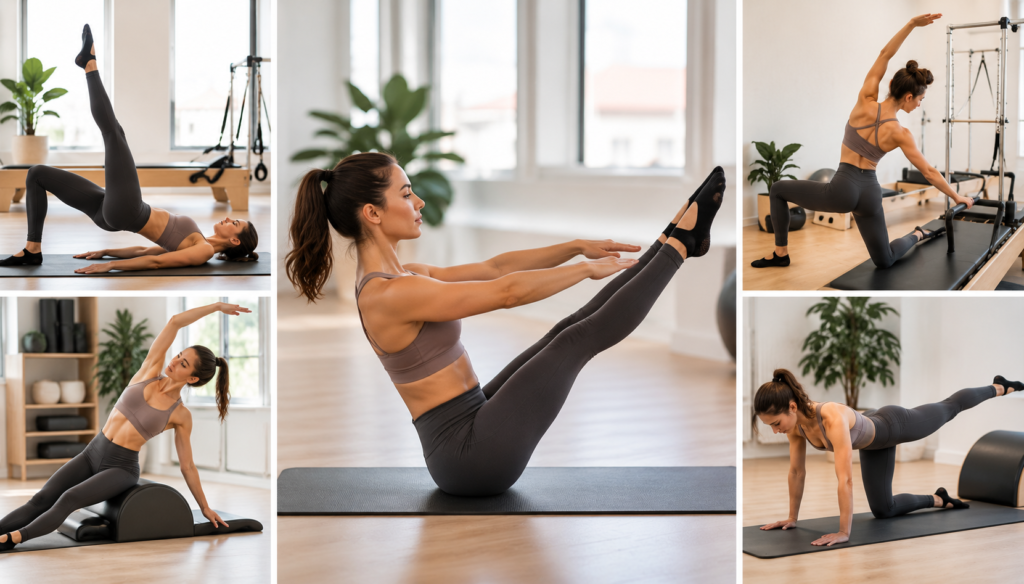
There’s something profoundly different about discovering Pilates at the right moment in your life. It wasn’t some viral TikTok trend that brought me to it, and it wasn’t the pressure of looking a certain way by summer. It was a Tuesday afternoon in early spring when I realized my body was whispering something I’d been ignoring for years—that I wanted to move with intention, with grace, with presence. That’s when Pilates found me. Or perhaps, more accurately, I finally stopped running from it.
For years, I was the type of woman who associated fitness with punishment. Running until my lungs burned. Lifting weights until I could barely lift my arms. High-intensity workouts that left me shaking and wondering why I felt more disconnected from my body afterward rather than stronger. There was this underlying belief that discomfort was the currency of transformation, that elegant femininity somehow required sacrifice of the “hard core” variety.
Then something shifted. Maybe it was getting older—there’s wisdom in thirty that you don’t have at twenty-five. Maybe it was the quiet luxury trend that started infiltrating every corner of wellness (because yes, fitness has trends too, and I’m here for the quiet revolution). Or maybe I finally understood what my grandmother used to say about beauty and strength: they’re not opposites; they’re dance partners.
Pilates became that dance for me. Not because it promised abs in thirty days or a lifted butt by bikini season, though those things have certainly been nice side effects. But because it offered something that felt revolutionary in its simplicity: the chance to build strength while honoring my body, to move with intention without guilt, to feel powerful without feeling destroyed.
If you’re reading this, I’m guessing you might be searching for something similar. You might be tired of fitness culture that makes you feel like your body is a project to be fixed rather than a home to be inhabited. You might want to move in a way that feels sustainable, elegant, and deeply nourishing. You might want that “clean girl” strength—the kind that shows not in aggressive bulk but in posture, presence, and the quiet confidence that comes from truly knowing your body.
Let me walk you through what I’ve learned about Pilates, why it changed everything, and how you can start building a practice that feels less like exercise and more like self-love in motion.
The Pilates Renaissance: Why Now?
Before we dive into the exercises themselves, let’s talk about why Pilates has become the fitness choice for women who care about their bodies as part of their whole lifestyle. Because that’s what I believe—your fitness practice isn’t separate from your fashion, your skincare, your overall aesthetic. It’s all woven together.
The fitness industry has spent decades selling us this binary: you’re either someone who does “real” exercise (which looks aggressive and performative) or you’re someone doing “light” exercise (which gets dismissed as not serious). Pilates exists in this beautiful third space that rejects that entire premise.
What appeals to me about Pilates, and what I think appeals to so many of us, is that it’s accessible without being easy. It’s elegant without being pretentious. It’s deeply effective without requiring you to punish yourself. The whole practice is built on something called “mind-body connection,” which sounds like wellness buzzword bingo until you actually feel it. And then you realize it’s just good design—your mind is already connected to your body; Pilates just helps you remember that.
The modern woman pursuing Pilates isn’t doing it because a fitness influencer told her to. She’s doing it because somewhere deep down, she knows that her relationship with her body matters. She knows that the way she moves through the world shapes not just how she looks but how she feels. She’s interested in the kind of strength that translates to real life—better posture, more energy, fewer aches—rather than metrics that only matter in a mirror.
This is the year 2026, and the aesthetic we’re drawn to is honest. It’s quiet luxury in its physical form. It’s the kind of beauty that comes from actually feeling good, not from performing goodness. Pilates is that movement practice. It’s what refined femininity looks like in motion.
Understanding the Pilates Fundamentals: The Language of Your Body
Before I started Pilates, I had to unlearn a lot of gym language. If you’ve spent time in other fitness environments, you might have too. The vocabulary around Pilates is different because the philosophy is different.
When we talk about Pilates, we’re talking about something that was designed by a man named Joseph Pilates in the early 1900s as a form of rehabilitation and strength building. He called it “contrology” because the whole practice is about controlled movement. That might sound boring, but it’s actually revolutionary. In a world that often prizes intensity and speed, Pilates asks: what if we got stronger through precision and intention?
The foundational principles of Pilates are worth understanding because they shape how we approach every single movement:
Breath is the first principle and remains the most important. In Pilates, we breathe intentionally, usually inhaling through the nose to prepare for movement, then exhaling to create length and engagement in the body. This isn’t just about oxygenation; it’s about creating a rhythm that keeps your mind present. When I’m doing Pilates and my mind starts to wander (to emails, to what I’m making for dinner, to that text I need to send), my breath goes shallow. Suddenly I’m reminded to come back to my body. It’s like a gentle anchor.
Centering is about finding your core—but not in the way fitness culture typically talks about it. Your core isn’t just your six-pack muscles (though those might tighten up, and that’s lovely). Your core is the deep stabilizing muscles that support your spine, your posture, and your entire physical presence. It’s literally the center from which all movement emanates. Every Pilates exercise begins from the center. You don’t move your limbs and then engage your core; you engage your center and let the movement flow from there.
Control is what distinguishes Pilates from just flailing around. Every movement is conscious, deliberate, and precisely executed. This is why Pilates might look “easy” when you watch someone doing it, but feels impossibly challenging when you try it yourself. You can’t fake your way through a Pilates session. Your body will tell you immediately if your mind isn’t in the room.
Concentration is the mental aspect that keeps everything together. Pilates requires that you show up fully. This is both the challenge and the gift—there’s no room for distraction, which means there’s no room for the critical voice in your head. When you’re truly concentrated on executing a movement with precision, you can’t simultaneously judge yourself for how you look doing it.
Flow refers to how movements transition into one another. Rather than discrete, separate exercises with pause in between, Pilates is performed in a way that’s almost dance-like—one movement flows into the next with rhythm and grace.
Understanding these principles changed how I approach Pilates. I stopped seeing it as a checklist of exercises and started seeing it as a practice—something I was building, deepening, refining over time. And that shift in perspective made everything more enjoyable and, paradoxically, more effective.
The Essential Pilates Exercises for Building Elegant Strength
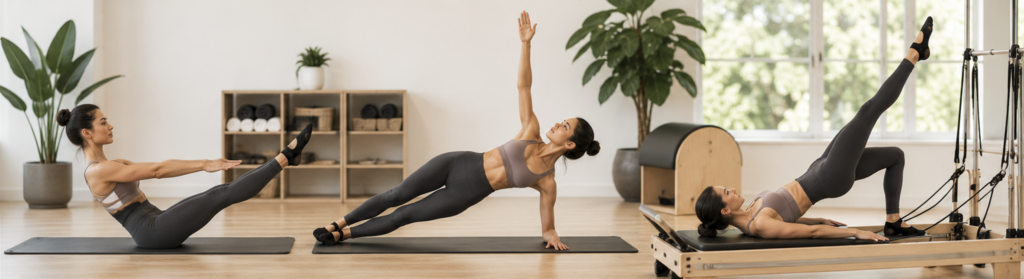
Now, let’s talk about the actual movements. I’m going to walk you through a series of foundational Pilates exercises that have become non-negotiable in my practice. Some of these I do every single day. Others, I rotate into my routine several times a week. Together, they create a comprehensive approach to building strength, improving posture, and developing the kind of physical confidence that radiates outward.
The Pilates Hundred: The Warm-Up That Teaches You Everything
We always begin with the Hundred, and there’s wisdom in that. This exercise teaches you almost everything you need to know about Pilates, condensed into about one minute of movement.
You lie on your back with your knees bent, feet flat on the floor, positioned hip-width apart. Your hands rest by your sides. From here, you engage your core, press your low back to the floor, and lift your shoulders and upper back off the mat, keeping your gaze downward (to protect your neck). Your arms lift just off the mat in front of you.
From this lifted position, you begin a specific breathing pattern: inhale for five arm pulses, exhale for five arm pulses. You continue this rhythm while your arms make these small, controlled movements—almost like you’re bouncing a balloon just slightly off the ground. You continue until you’ve done one hundred pulses (hence the name).
What makes this so special is that it’s simultaneously teaching your body core engagement, breath awareness, and control. Your core is literally holding you in this position the entire time, yet it feels almost meditative because of the rhythmic breathing. The first few times I did this, I thought, “Is this even a real workout?” By pump seventy-five, I understood—my entire abdominal wall was engaged, my shoulders were working, and my mind was entirely present in my body.
This is peak Pilates philosophy: maximum effectiveness through minimal fuss.
The Roll Down: Your Spine’s Love Letter
The Roll Down might be the most underrated exercise for addressing modern posture problems. We spend so much time hunched over phones and keyboards, creating this pattern of rounded shoulders and collapsed spine. The Roll Down begins to gently unwind all of that.
Stand with your feet hip-width apart, and imagine a crown at the very top of your head. From there, begin to nod your chin slightly toward your chest, allowing your cervical spine (neck) to gently flex. Then, one vertebra at a time, continue rolling your spine down. Your shoulders should roll back and down as you go. Let your head hang heavy at the end, your arms floating down. This isn’t about touching your toes (though you might), it’s about the quality of the spinal articulation—the way each vertebra sequentially flexes.
From this folded position, take several deep breaths. Feel the gentle stretch in the back of your body. Then, to return, you engage your core and slowly rebuild your spine, stacking each vertebra back on top of the one below it, until you’re standing tall again.
I do this every single morning, even before coffee. It wakes up my spine, reminds me of my posture, and sets an intention of care for my body before the day really begins. There’s something about the mindfulness of rolling down and back up that’s deeply grounding. Plus, over time, this exercise is magic for addressing that “tech neck” that so many of us are struggling with—you know, that position where your head juts forward and your whole upper back collapses. The Roll Down is the antidote.
The Single Leg Circle: Finding Your Center
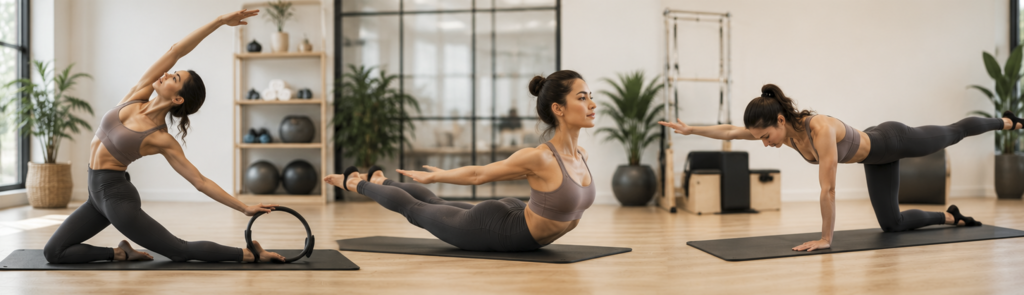
This exercise lives in a place that beginners often find frustratingly difficult, which is exactly why it’s so valuable. You lie on your back, one leg extended to the ceiling, the other bent with foot flat on the floor. Your arms press into the mat beside you for stability.
From here, using the muscles of your hip and keeping your core engaged (so the rest of your body doesn’t roll), you make small, controlled circles with the extended leg. You circle inward, down, out, and back up, about the size of a dinner plate. You do perhaps eight to ten in one direction, then reverse.
What makes this deceptively difficult is that your core has to work constantly to stabilize your pelvis while your hip does the moving. You can’t cheat. Your body will immediately tell you if your core isn’t engaged—your pelvis will tilt, your low back will sway, and the whole thing falls apart. This teaches profound body awareness. You learn exactly where your strength lives and where you have gaps.
I love this exercise because it’s small and precise. There’s no opportunity to use momentum or to “power through” it. It requires presence and control in equal measure, which is very on-brand for the kind of strength I’m building.
The Spine Stretch Forward: Strength Through Extension
While the Roll Down addresses spinal flexion (bending forward), the Spine Stretch Forward takes that motion and adds a control element that makes it remarkably effective for core strength and spinal mobility combined.
Sit on the mat with your legs extended in front of you (or if you have tight hamstrings, keep your knees slightly bent—this is a practice, not a performance). Your feet are about hip-width apart. Engage your core, roll your shoulders back and down, and lengthen through the crown of your head.
From here, you engage your core even further, drawing your navel toward your spine, and you begin to roll your spine forward, one vertebra at a time, leading with the crown of your head. The motion is fluid and controlled, with an inhale as you prepare and an exhale as you fold forward. You go only as far as you can control—maybe you’re resting your hands on your shins, maybe you’re just holding yourself in a folded position. The depth matters far less than the quality of the movement.
What I love about this version is that unlike a typical forward fold where you’re just stretching, here you’re actively engaging your core throughout the movement. Your abdominals are working to control the flexion of your spine. You’re building strength while you’re gaining flexibility, and that’s a beautiful efficiency that’s very Pilates.
The Single Leg Stretch: Core Engagement in Motion
Now we’re moving into dynamic core work, and this is where Pilates really starts to feel powerful. You lie on your back, your knees bent and pulled in toward your chest, your hands behind your head (or hands crossed over your chest if your neck is sensitive).
Engage your core so your low back is pressing into the mat. From here, you extend one leg to about forty-five degrees (not all the way straight, because remember—control matters more than range) while the opposite knee pulls deeper toward your chest. Then you switch, extending the other leg while pulling the opposite knee in. You continue this alternating motion for several repetitions, finding a rhythm with your breath.
What’s incredible about this exercise is that it’s building serious core strength while your body is in motion. Those muscles have to work constantly to stabilize your spine as you’re moving your legs. Over time, this is what gives you that beautiful, lengthened abdominal definition that doesn’t look bulky but looks strong. It’s the kind of strength that translates directly to better posture, less back pain, and the ability to sit, stand, and move through the world with ease.
The Pilates Bridge: Activating Your Posterior Chain
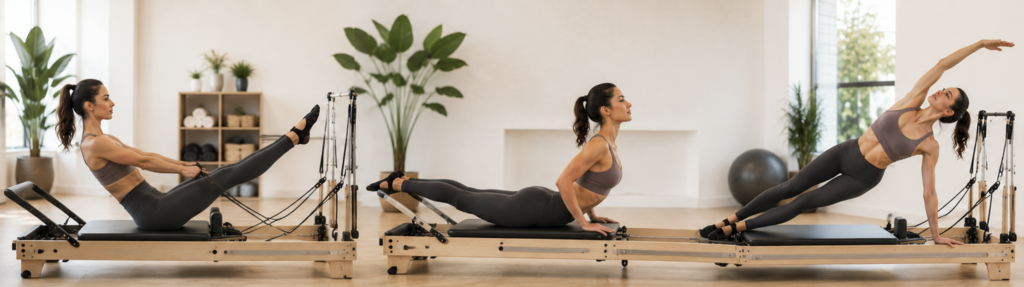
The bridge is one of my favorite exercises because it feels accessible yet is deceptively powerful. You lie on your back with your knees bent and feet flat on the floor, positioned about hip-width apart, with your feet parallel. Your arms rest by your sides, palms down.
From here, you press through your feet and lift your hips toward the ceiling, creating a straight line from your knees to your shoulders. Your core is engaged, your glutes are firing, and you’re pressing firmly through your heels. You hold this position for a moment, feeling the engagement in your posterior chain (your glutes, hamstrings, and the stabilizing muscles in your back).
The beauty of the Pilates version of the bridge is that you’re not just holding it; you’re maintaining constant tension and awareness throughout. Your breathing stays steady and controlled. After holding for several seconds, you lower down with control, one vertebra at a time, until your spine rests back on the mat.
This exercise is crucial because our modern lives have made us “glute dead.” We sit too much, and our glutes essentially forget how to work. The bridge wakes them up. Strong glutes support everything—your posture, your ability to walk without pain, the way your entire posterior chain functions. Plus, from a purely aesthetic perspective, active glutes change your silhouette. You stand taller, you move with more elegance, you feel more confident. It’s one of those exercises where the functional benefits and the aesthetic benefits are perfectly aligned.
The Side-Lying Leg Lift: Lateral Strength and Definition
Moving to the side, we now address the muscles on the sides of your body—your hip abductors and the lateral stabilizers that so many other exercises miss. You lie on your side with your body in a straight line. Your bottom arm is extended underneath you (or folded for support), and your top arm rests on your hip or extended in front of you for balance.
From this position, engage your core and lift your top leg, keeping it in line with your body (not rotating your hips forward or backward). The movement comes from the side of your hip, not from momentum or swinging. You lift for a count, hold for a moment, then lower with control. You repeat for several repetitions before rolling to the other side.
This exercise is subtle but transformative. These lateral muscles don’t get nearly enough attention in most fitness routines, yet they’re crucial for everything from balance to the way your legs look in clothes. Regular practice of side-lying leg lifts gives you beautiful hip and thigh definition that’s lean and elegant rather than bulky. Combined with all the core work we’ve been doing, you’re building strength that shows everywhere—in your posture, your silhouette, the way you move.
The Swimming Exercise: Full-Body Integration
By now, you’ve worked your front, back, and sides. Swimming brings it all together in a dynamic, flowing movement that requires coordination and body awareness.
You lie on your belly with your arms extended overhead and your legs extended behind you. Your forehead rests on a rolled towel or small pillow to keep your neck neutral. Engage your core (drawing your navel in toward your spine) and lift your arms and legs slightly off the mat.
From this position, you alternately lift and lower your right arm with your left leg, then your left arm with your right leg, creating a “swimming” motion. The movement is controlled and rhythmic, with your breath moving in a specific pattern (often inhaling for four movements, exhaling for four movements).
What I love about this exercise is that it requires your entire body to work in coordination. Your core is stabilizing your spine, your back muscles are engaged to keep your limbs lifted, and your mind is focused on maintaining the pattern. It’s meditative and challenging in equal measure.
Over time, this exercise transforms the entire back side of your body. You develop strength in your back muscles without the bulkiness that heavy rowing might create. You build muscular endurance. You improve your posture (because strong back muscles are the antidote to the anterior-heavy strength pattern that causes rounded shoulders). And you feel more energized—there’s something about activating the back body that makes you feel more upright and confident.
Building Your Pilates Practice: Making It Sustainable and Stylish
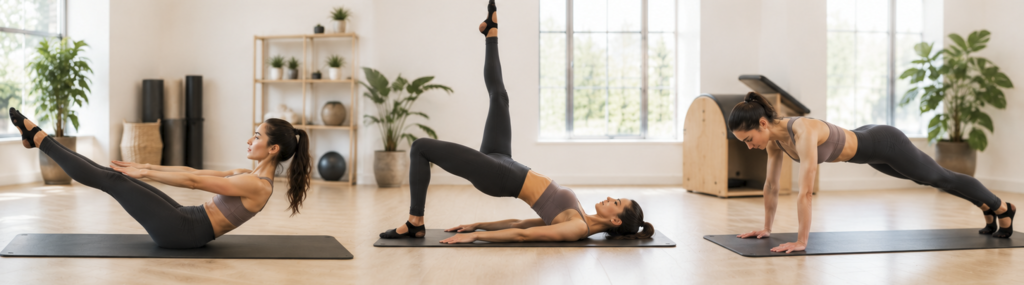
Knowing the exercises is one thing; building an actual practice that you’ll stick with is another. I want to share how I’ve integrated Pilates into my life in a way that feels sustainable, beautiful, and deeply nourishing.
The first thing I did was reframe what a “workout” looked like. Instead of thinking about Pilates as something I had to force myself through three times a week, I started thinking about it as a practice—something I could do daily, something that could look different depending on my energy and intentions.
Some days, I do a full, comprehensive Pilates session that lasts about forty-five minutes. I’ll do the exercises I’ve described, perhaps adding some advanced variations, moving at a pace that challenges my strength and endurance. These are the days when I have time and energy, when I want to really feel my muscles working and leave the session feeling energized.
Other days, usually in the morning when I’m still waking up, I do a fifteen-minute sequence. I might do the Pilates Hundred, the Roll Down, the Single Leg Circle, and the Bridge—just enough to activate my body, engage my core, and remind myself of good posture before the day begins. These shorter sessions are underrated. They’re not about building strength in those moments; they’re about maintaining awareness and consistency.
Then there are the days when I’m traveling or my schedule is particularly chaotic. On those days, I might do just five or ten minutes of Pilates, perhaps just the Roll Down and some gentle core work. The key is that I’m maintaining the practice. I’m not abandoning it entirely because of circumstance.
What I’ve discovered is that this consistency, even when the individual sessions are short, creates more real results than sporadic intense workouts. Your body adapts to the language it’s being spoken. If you do Pilates regularly, your posture improves, your core strength increases, and your movement quality transforms. You begin to move with more awareness and intention in all areas of your life.
The Aesthetic Benefits: How Pilates Changes Your Physical Presence
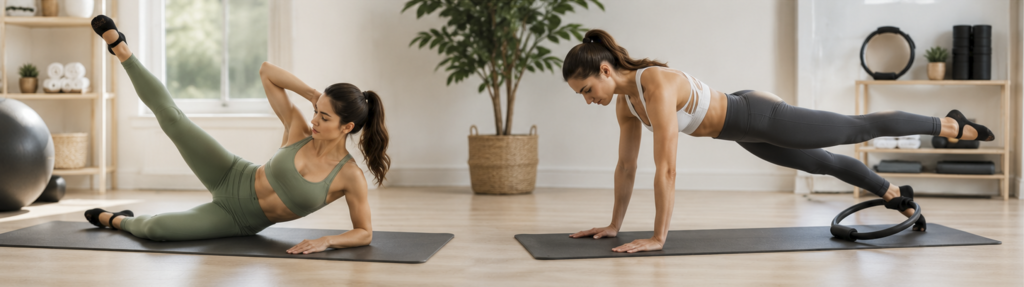
Let’s be honest—we care about how we look. That’s not shallow; that’s human. And one of the beautiful things about Pilates is that it delivers real aesthetic benefits, but in a subtle, sustainable way.
The changes aren’t dramatic or sudden. There’s no aggressive weight loss or sudden muscle explosion. Instead, there’s a gradual transformation in your overall presence. Your shoulders roll back naturally. Your posture elongates your spine, which makes you appear taller and leaner immediately, regardless of actual weight changes. Your abdominals become defined not from high body fat loss but from actual muscular development, which creates that subtle, elegant definition that doesn’t look extreme.
Your legs become more toned without becoming bulky. The focus on hip stabilizers and the smaller, more controlled movements of Pilates build lean muscle definition. Combined with the improved posture and the way your whole body learns to move more efficiently, this translates to looking more elegant and feminine.
Over several months of consistent practice, many women find their waist becomes more defined. Not because they’re necessarily losing weight, but because their core is strong and their posture is better, so they’re standing taller and more “gathered” through their midsection. Their whole silhouette shifts.
The face and skin also benefit, though this is often overlooked. With consistent Pilates practice, you’ll likely see improvements in your complexion and the clarity of your skin. This is partly because of the improved circulation that comes from regular movement, and partly because of the reduced stress—the meditative nature of Pilates actually lowers cortisol, which is fantastic for your skin. It’s one of those things where the inside changes are reflecting outward.
Making Pilates Part of Your Lifestyle Aesthetic
Here’s what I think gets missed in fitness conversations: your workout routine is a lifestyle choice, not separate from your other choices about how you want to show up in the world.
If you care about quiet luxury, if you’re drawn to the clean girl aesthetic, if you want your life to feel intentional and beautiful, then Pilates aligns with that vision. It’s not aggressive. It’s not performative. It’s not trying to prove anything. It’s simply good, consistent, thoughtful movement that builds real strength.
The way you practice Pilates can reflect your aesthetic, too. Invest in a beautiful mat—maybe something in cream or soft grey from a luxury wellness brand. Wear clothes that you feel good in during your practice—not necessarily expensive, but intentional. Soft, beautiful fabrics that allow you to feel your body moving. Consider practicing in a beautiful space, maybe with natural light, a plant or two, perhaps some subtle music. This isn’t about being pretentious; it’s about honoring the practice enough to create a space that feels special.
I often do my Pilates practice in the morning, after making tea but before I’ve checked my phone. There’s something about that window—still quiet, still peaceful, before the world has asked anything of me. I light a candle, maybe open a window, and move through my practice with intention. This small ritual has become one of my favorite parts of my day. It’s not exercise; it’s meditation that happens to be building strength.
Addressing Common Challenges and Breakthrough Barriers
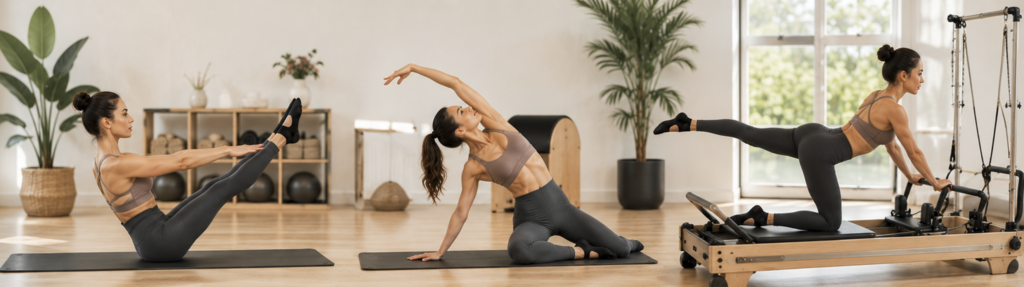
When I first started Pilates, I encountered resistance. Not from my body—which actually responded beautifully—but from my mind. There was an underlying belief that if I wasn’t suffering, I wasn’t really working. If the movement looked smooth and easy, then it must not be challenging my strength. It took time to release that belief and trust the process.
If you’re encountering similar resistance, know that this is normal. We’ve been conditioned by fitness culture to equate difficulty with results, but Pilates teaches us that precision creates results. A perfectly executed, controlled Pilates movement is infinitely more effective than a sloppy, aggressive version of the same exercise.
Another challenge many women face is impatience. You won’t see dramatic changes in two weeks. The transformation happens gradually, over months, often in ways that are subtle at first—maybe you realize you’re not getting that sharp pain in your lower back anymore, or you catch yourself standing taller without effort. These are huge wins. They’re just not the kind of wins that fitness culture usually celebrates.
There’s also the challenge of perfectionism. Pilates requires presence and attention, which means mistakes are immediately obvious to you. You might feel frustrated when you can’t execute a movement exactly as you see it performed. My advice: release that. You’re building a practice, not passing a test. Every single session, your body is learning. Every time you show up with intention, you’re winning. The quality of your movement will improve over time, but the benefit is coming whether it looks perfect or not.
Finally, there’s the challenge of finding the right environment or teacher. If you’re new to Pilates, working with a qualified instructor, at least initially, makes an enormous difference. They can help you understand the nuances, ensure you’re engaging the right muscles, and prevent you from developing compensatory patterns. Once you have the foundation, you can certainly practice at home, but that expert guidance at the beginning is invaluable.
Nutrition and Recovery: Supporting Your Pilates Practice
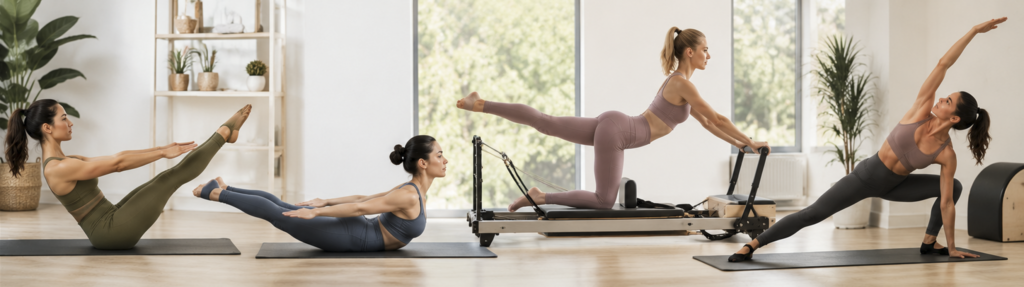
I want to address the broader context of supporting your body as you build a Pilates practice, because strength training (which Pilates is, despite being gentle) requires adequate fuel and recovery.
First, nutrition. Your muscles need protein to repair and build. This doesn’t mean you need to become obsessed with macros or count everything you eat, but it does mean being mindful that you’re eating enough protein-rich foods. I typically aim for protein at each meal—whether that’s eggs for breakfast, Greek yogurt as a snack, fish or chicken with dinner, or legumes if I’m eating vegetarian that day. It’s not complicated; it’s just intentional.
Hydration matters too. I find I need more water when I’m practicing Pilates consistently, especially because the mindful breathing increases my awareness of my body’s needs. I drink water throughout the day and particularly before and after my sessions.
Sleep is your actual secret weapon. This is where the transformation truly happens—in the hours when your body is recovering, when your muscles are repairing, when your nervous system is recalibrating. If you’re practicing Pilates, prioritize sleep like your life depends on it. Because actually, your physical transformation depends on it.
Recovery also means listening to your body. Some days, a full intense session makes sense. Other days, your body is asking for a gentler, more restorative practice. Honor that. Pilates is flexible enough to meet you where you are. You can adjust the intensity, the duration, the style of movement based on how you’re feeling.
Creating a Long-Term Relationship with Pilates
What I love most about Pilates is that it’s a practice you can return to for life. There’s no point at which you’ve “finished” Pilates, no graduation where you move on to something else. Instead, there’s endless depth. As your foundational strength builds, you can explore more advanced variations and exercises. You can move faster or slower. You can play with different styles—classical Pilates versus contemporary Pilates versus reformer-based work.
I’ve been practicing Pilates consistently for a few years now, and I’m still discovering new insights with exercises I’ve done hundreds of times. The other day, while doing the Single Leg Circle, I suddenly understood something about my hip mobility that I’d been missing. It wasn’t a new exercise; it was just a deeper awareness in a familiar movement. That’s the gift of depth.
A long-term relationship with Pilates also means you develop trust in your body. You know your patterns, your patterns, your strengths, and the areas where you want to keep building. You stop comparing your practice to other people’s practices and instead focus on your own evolution. You stop doing Pilates because you think you should, and you start doing it because you genuinely love it and love what it makes you feel.
Bringing It All Together: Your Pilates Life
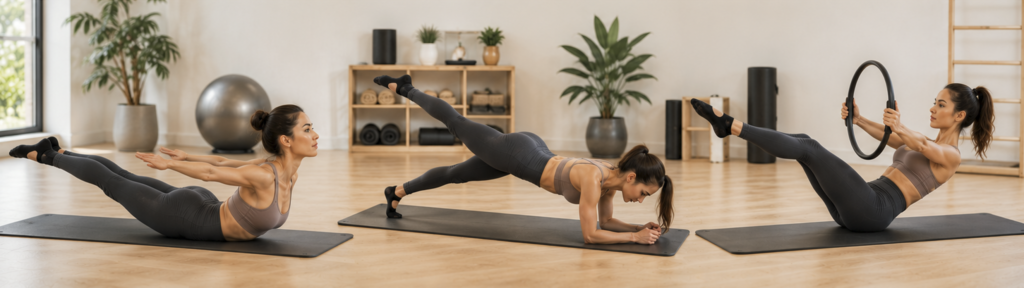
As I’m sitting here reflecting on my Pilates journey, what strikes me most is how it’s changed my relationship with my body. It’s no longer a project. It’s not a problem to be solved or a machine to be pushed to extremes. My body is a home, and Pilates is the way I’ve learned to tend to it with respect, attention, and love.
The strength I’ve built through Pilates shows up everywhere. In the way I stand. In the confidence I feel. In my ability to move through the world with ease and grace. In the way I’m not constantly sore or injured from punishing workouts. In my improved posture and the physical space I’m able to take up without apology.
But more than the physical changes, Pilates has shifted my mindset. It’s taught me that strength doesn’t have to be loud or aggressive. It doesn’t have to come at the cost of femininity or grace. Some of the most powerful women I know move like they’re doing Pilates—intentional, controlled, present. There’s a quiet confidence in that.
If you’re considering starting a Pilates practice, I encourage you with my whole heart. Whether you’ve always been intimidated by fitness or you’re looking for a change from your current routine, Pilates offers something unique. It’s a practice that respects your body, honors your mind, and builds real, functional strength that shows up in your daily life.
Start where you are. That might be a thirty-minute YouTube video. That might be a class at a local studio. That might be just a few of the exercises I’ve described, done with intention and care. There’s no “right” way to begin; there’s only your way.
As you build your practice, remember that it’s not about performance. It’s about presence. It’s about learning to move with intention. It’s about building a relationship with your body that’s based on respect rather than criticism.
Pilates has transformed my life in subtle but profound ways, and I genuinely believe it can do the same for you. It’s not a quick fix. It’s not a trend. It’s a timeless practice for building strength, improving posture, and cultivating a deeper connection with your body.
So take a breath. Engage your core. Show up with intention. And let Pilates be the practice that supports the elegant, strong, intentional life you’re building.