
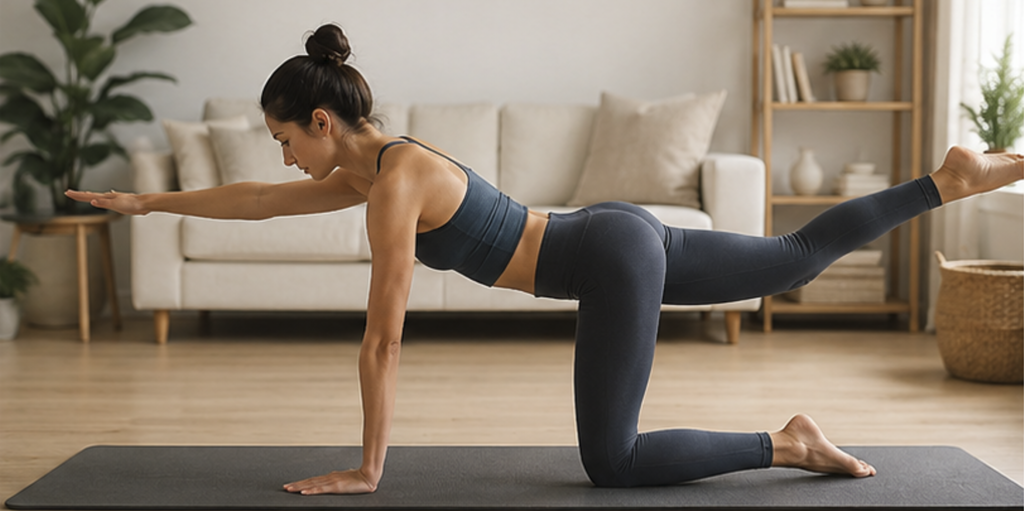
There’s a particular kind of magic that happens when you decide your home is worthy of being treated like a sanctuary. Not just in terms of décor and aesthetics, though certainly those matter. I’m talking about the deeper decision that your home is a place where you invest in yourself—where you move, where you care for your body, where you show up for your own transformation without needing permission from a gym membership or fancy equipment.
That’s what drew me to home Pilates in the first place, honestly. It wasn’t some grand epiphany about “working out at home.” It was actually quite mundane—a particularly busy season of life when getting to a studio felt like adding pressure rather than relief. I remember standing in my bedroom one morning, in those precious quiet hours before the world woke up, thinking: what if I just… did this here?
What started as a practical solution became something far more meaningful. Over time, I realized that practicing Pilates at home, without any equipment beyond what most of us already have, was actually more transformative than the fancy studio classes I’d been taking. There was something about the simplicity of it—just me, my body, and my intention—that made everything more potent.
Now, years into this practice, I couldn’t imagine doing Pilates anywhere else. My bedroom has become my sanctuary, my living room floor my studio. I’ve built serious strength with literally nothing but my own body weight and the commitment to show up consistently. And I want to share everything I’ve learned about how to make this work beautifully, practically, and in a way that actually fits into a real woman’s life.
If you’re reading this, you might be in that same place I was—intrigued by Pilates but intimidated by the studio culture, skeptical that you could get real results at home, or simply looking for a way to move that feels more aligned with your life. I’m here to tell you: not only is it possible, it’s actually one of the most elegant, accessible, and effective fitness practices you can build. And the best part? You need almost nothing to get started.
The Home Pilates Paradox: Less Is Truly More
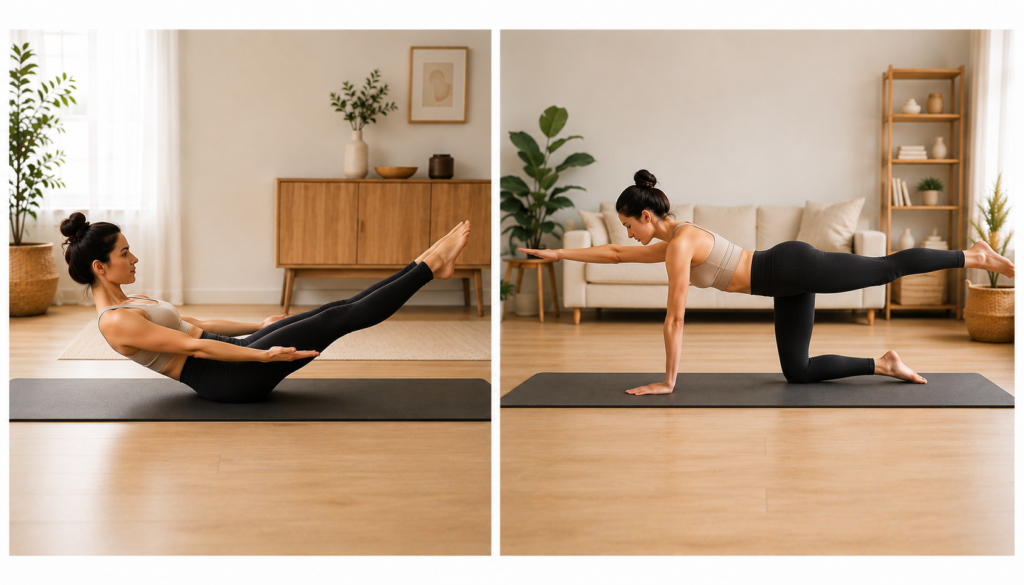
Before we dive into the specifics, I want to address something that might be holding you back. There’s this narrative in modern wellness culture that more is better. More equipment, more intensity, more complexity. We’ve somehow internalized the belief that the value of a workout is proportional to how much gear is involved.
But here’s what I’ve discovered: Pilates at home, without equipment, is deceptively powerful precisely because of its simplicity.
When you remove the props—the reformer, the resistance bands, the expensive equipment—you’re left with something purer. You’re forced to rely entirely on your own body awareness, your control, and your engagement. There’s no reformer machine doing part of the work for you. There’s no band providing assistance. It’s just you and gravity, and honestly? That’s when real transformation happens.
I think about this in the context of everything else I’ve chosen in my life lately. The quiet luxury trend, the clean girl aesthetic, the move toward minimalism in fashion and beauty—there’s this underlying philosophy that shows up in all of it. The most elegant, sustainable, truly powerful things are often the simplest. A perfect white linen shirt. A minimalist skincare routine with just the essentials. A home that’s curated rather than cluttered.
Pilates at home, without equipment, is that philosophy applied to fitness. It’s elegant. It’s accessible. It’s sustainable. And it works.
What You Actually Need: Creating Your Home Pilates Space
Let’s talk practically for a moment. While I said you need “almost nothing,” there are a few things that genuinely do make a difference. The good news? They’re inexpensive and probably things you already have.
First, you’ll want a yoga mat or something similar. I have a beautiful cream-colored Pilates mat that I invested in early on, and I genuinely love it. It’s thick enough to cushion my spine when I’m lying on my back, but not so cushy that it throws off my balance when I’m in standing positions. If you don’t have a mat, a firm towel or even a yoga towel works. The key is having something that gives you a bit of cushioning and a surface with some grip.
Second, consider your space. You don’t need a huge area—I do most of my practice in about six feet by four feet of floor space. But you do want somewhere that’s quiet, where you won’t be interrupted, and ideally, a space that feels good to you. This is actually important. If you’re practicing in a cluttered, noisy, chaotic corner of your home, you’ll feel chaotic. If you’re practicing in a space that feels intentional and clean, that energy will translate into your practice.
I prepared my bedroom for Pilates by clearing a corner, adding a small plant, and making sure the lighting was good. During the day, I practice with natural light from the window. In the evening, I have a soft lamp that creates just the right ambiance. These are small things, but they matter. They signal to your body and mind that this is a practice worth showing up for.
Third, consider your attire. And yes, I’m going there, because what you wear matters more than people typically admit. You don’t need expensive workout clothes, but you do want to wear something that allows you to move freely and that makes you feel good. I usually practice in soft leggings or shorts and a fitted top that I can see my body in—because body awareness is crucial in Pilates, and you need to be able to see your alignment.
Personally, I’ve built a small collection of beautiful, neutral-colored workout pieces from minimalist brands. Nothing fancy or expensive, but pieces that feel intentional and that make me want to show up on my mat. There’s something about wearing clothes you actually like that changes your relationship with movement. It stops feeling like exercise and starts feeling like self-care.
Finally, have water nearby. Pilates requires focus and breath awareness, and you want to stay hydrated. I keep a beautiful water bottle on the edge of my mat—nothing elaborate, just something that makes hydration feel like part of the ritual rather than an afterthought.
That’s genuinely all you need. No reformer. No resistance bands. No expensive equipment. Just you, your space, your intention, and these few simple things.
Building Your Foundation: The Non-Negotiable Pilates Basics
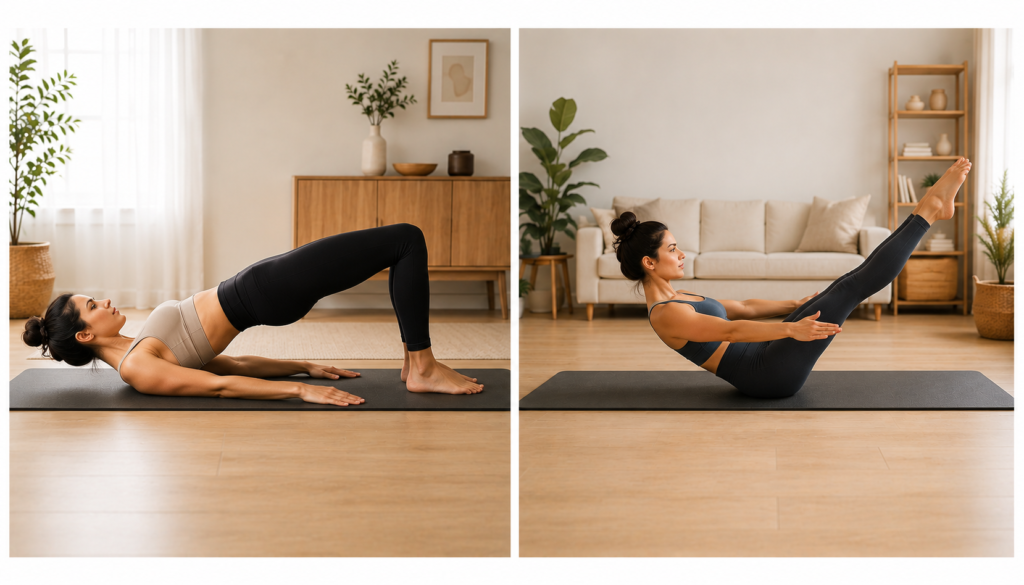
Before we jump into specific exercises, I want to establish the foundational understanding that makes everything else work. Because Pilates at home, without equipment, is entirely dependent on your understanding of the principles. When there’s no machine to guide you, it’s your knowledge that becomes your greatest tool.
Core Engagement is Everything
In Pilates, your core isn’t just your six-pack muscles. It’s your entire stabilizing system—your deep abdominal muscles, your pelvic floor, your back muscles, all working in coordination. The way you engage your core in Pilates is specific. It’s not a sucking-in feeling or a tensing feeling. It’s more like a gentle drawing in of your lower belly, as if you’re creating length in your spine.
When I first started learning this, my teacher used an image that stuck with me: imagine you’re wearing pants that fit perfectly, and you’re gently drawing your navel toward your spine to maintain that perfect fit. Not aggressively. Not intensely. Just present and engaged. That’s core engagement in Pilates.
This understanding is crucial when you’re working at home without a teacher correcting you. You need to be able to feel your own core engagement because it’s the foundation of every single movement you’ll do. Everything originates from your center.
Breath is Your Anchor
Pilates breathing is deliberate and specific, and it’s one of the most transformative aspects of the practice. Generally, we inhale through the nose to prepare, and we exhale through the mouth during the movement. The exhalation actually helps facilitate the core engagement—as you exhale, your pelvic floor naturally lifts and your deep abdominals naturally engage.
The rhythm of your breath keeps your mind present. When I’m doing Pilates and my mind starts to wander to my to-do list or something someone said to me, my breath goes shallow. Immediately, I’m reminded to come back. It’s a gentle anchor that keeps me in my body.
Beyond the mechanics, there’s something deeply calming about conscious breathing. In a world that constantly asks us to do more, be more, achieve more, the simple act of breathing intentionally is revolutionary. It slows everything down. It creates space. It’s meditative in the way that other workouts aren’t.
Alignment Matters More Than Range
This is something that took me a while to truly understand, but it’s crucial to nail when you’re working at home without a teacher. The depth of your movement is far less important than the quality of that movement. A smaller, perfectly controlled movement is infinitely more effective than a large, sloppy one.
I used to think that if I wasn’t getting a big range of motion, I wasn’t working hard enough. But that’s not how Pilates works. A tiny, perfectly executed movement with complete core engagement and control is actually more challenging and more effective than a large, loose movement done with momentum.
This reframes how you approach home Pilates. You’re not trying to achieve some external standard of what an exercise should look like. You’re cultivating your own awareness and control. You’re moving in the way that your body can move with precision, and you’re trusting that over time, your range will increase and your movement will deepen as your strength and body awareness improve.
Consistency Trumps Intensity
Here’s something that genuinely transformed my results: consistent, moderate practice beats sporadic intense practice every single time. I see so many women approach fitness like it’s all-or-nothing. They’ll do nothing for weeks, then do an intense workout, then do nothing again. The results they get are minimal compared to someone who does a gentle twenty-minute Pilates session four times a week.
Your body adapts to what you ask of it regularly. If you do Pilates regularly, your posture improves, your core strengthens, your movement quality transforms. If you do Pilates sporadically, your body doesn’t have time to adapt. It’s simple, but it’s profound.
This is actually good news if you’re worried about fitting Pilates into your life. You don’t need hour-long sessions. You need consistency. You need to show up regularly, even if it’s just for twenty or thirty minutes. That’s where the magic happens.
The Complete Home Pilates Sequence: Your Foundation Practice
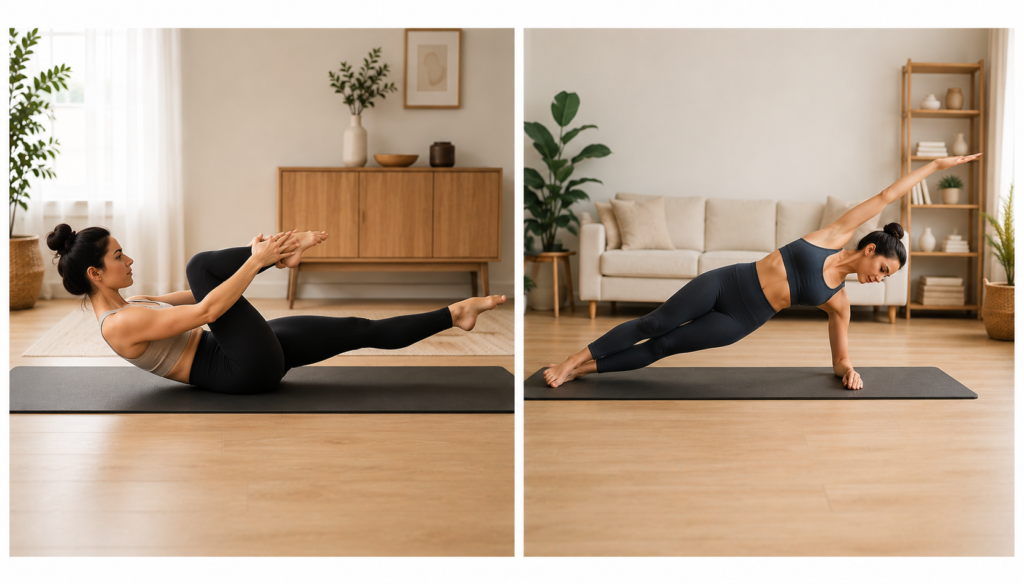
Now, let’s talk about actual movements. I’m going to walk you through a complete sequence that I do regularly at home, with no equipment beyond a mat. This isn’t meant to be exhaustive—there are hundreds of Pilates exercises—but it’s a comprehensive foundation that will build real strength.
Opening: The Breathing Preparation
I always start the same way. Lying on my back, knees bent, feet flat on the floor about hip-width apart. My arms rest by my sides, palms down. My shoulders relax away from my ears. My gaze is soft, looking straight up at the ceiling.
From here, I take several preparatory breaths, finding my body. I’m not doing anything fancy here; I’m just arriving. Inhaling through my nose, exhaling through my mouth. With each breath, I feel my body settling into the mat, my awareness expanding into the space around me.
This might seem unnecessary, but it’s not. This arrival is what transforms a workout into a practice. When you take time to actually show up, rather than just running through movements, everything changes. Your mind settles. Your body becomes more responsive. You get better results in less time because you’re actually present.
The Pilates Hundred
From my breathing position, I engage my core—that gentle drawing in of my lower belly that we talked about—and I lift my head and shoulders off the mat. My gaze is downward, protecting my neck. My arms lift just barely off the mat in front of me.
From this lifted position, I begin a very specific breathing pattern: I inhale for five small arm pulses, exhale for five small arm pulses. These aren’t big movements. My arms are bouncing maybe an inch off the ground. The work is in the core, holding this lifted position while my arms make these controlled movements.
I continue this for one hundred pulses (hence the name), which takes about two minutes. By the end, my entire core is engaged and working. It’s the perfect warm-up for the rest of my practice.
What I love about the Hundred is that it teaches me everything I need to know about Pilates, compressed into two minutes. It requires breath awareness. It requires core engagement. It requires control. And despite looking relatively easy, it’s genuinely challenging.
The Roll Up: Articulating Your Spine
From lying down, I transition into the Roll Up. This is one of my favorite movements because it feels so good and because it’s genuinely transformative for spinal health.
I’m lying on my back with my legs extended in front of me (if my hamstrings are tight, I might have my knees slightly bent—meet your body where it is). I take a breath, and as I exhale, I nod my chin toward my chest and begin to roll my spine up, one vertebra at a time. My arms float up as I do this, reaching toward my legs.
I roll all the way up until I’m folded forward, feeling the gentle stretch in my hamstrings and the extension in my spine. I take a moment here, breathing, letting my body settle into the stretch. Then, I reverse the movement, rolling back down one vertebra at a time until I’m lying flat again.
This movement is magic for spinal mobility and also for building core strength. Your abdominals are working the entire time to control the rolling motion. Over time, regular practice of this movement transforms your posture and the way your spine feels.
Single Leg Circles: Hip Stabilization
Now I’m lying on my back again, and I bring one knee toward my chest, then extend that leg toward the ceiling, keeping the other leg bent with foot flat on the floor. From here, I make small circles with my extended leg, about the size of a dinner plate.
The challenge here is keeping my pelvis completely stable while my hip does the moving. My core has to work constantly to prevent my lower back from arching or my pelvis from tilting. After about eight to ten circles in one direction, I reverse.
This movement teaches profound body awareness and builds hip stability. It also works my core in a way that’s very specific and very effective. I feel this everywhere—in my ability to stand well, to walk without strain, to move with ease through my daily life.
Single Leg Stretch: Dynamic Core Work
Back to lying on my back, I bring both knees toward my chest and place my hands gently behind my head (or crossed over my chest if my neck is sensitive). My core is engaged so my low back stays pressed into the mat.
From here, I extend one leg out to about forty-five degrees while the opposite knee pulls deeper toward my chest. Then I switch, extending the other leg. I continue this alternating motion for about ten to fifteen repetitions.
This is where things start to feel more dynamic. My core is working constantly to maintain the stability of my spine while my legs are moving. My breathing stays rhythmic and controlled. This movement builds serious abdominal strength, the kind that translates to better posture and a more defined midsection over time.
Double Leg Stretch: Building Core Endurance
From the same starting position on my back with knees bent toward my chest, I now extend both legs simultaneously while my arms reach overhead. So my body is in a big extended position, then I bring my knees back in and my arms wrap around my knees, hugging them toward my chest.
This is more challenging than the single leg version because your core has to stabilize for a larger movement. But the principle is the same: control, engagement, and precision matter far more than range of motion.
I do about ten to fifteen of these, feeling the burn in my core (in a good way—that deep muscular burn rather than a sharp pain).
Spine Stretch Forward: Flexibility with Strength
I’m sitting up now, legs extended in front of me. My feet are about hip-width apart. My posture is tall, shoulders relaxed away from my ears.
Taking a breath, I engage my core—that gentle drawing in—and I begin to fold forward from my hips, rolling my spine forward one vertebra at a time. My head comes last, hanging heavy. I go only as far as I can control—maybe I’m holding my shins, maybe I’m just in a gentle fold. The range doesn’t matter.
I take a moment here, breathing, feeling the stretch in the back of my body. Then I slowly roll back up, rebuilding my spine one vertebra at a time until I’m sitting tall again.
This movement is simultaneously building flexibility and strength. My core is engaged and working throughout to control the spinal articulation. Over time, this movement improves posture, spinal mobility, and core strength all at once.
The Bridge: Glute and Posterior Chain Activation
I’m lying on my back again, knees bent, feet flat and parallel, positioned about hip-width apart. My arms rest by my sides with palms pressing into the mat.
From here, I press through my feet and lift my hips toward the ceiling, creating a straight line from my knees to my shoulders. I engage my core, press my glutes, and feel the entire back side of my body working.
I hold this position for a few seconds, maintaining engagement and breath. Then I lower down with control, one vertebra at a time, until my spine settles back on the mat.
The bridge is crucial because our modern lives have made us “glute dead.” We sit too much. The bridge wakes up the glutes and the posterior chain, which is essential for good posture and a beautiful silhouette.
Side Leg Lifts: Lateral Strength
Now I’m lying on my side, my body in a straight line. My bottom arm is extended underneath me, my top arm is placed on my hip. My core is engaged.
From here, I lift my top leg, keeping it in line with my body (not rotating forward or backward). I feel the work in the side of my hip. I lift and lower with control, about ten to fifteen times, then roll to the other side and repeat.
These side leg lifts are often overlooked, but they’re essential. They address the hip abductors and the lateral stabilizers that shape your entire leg and hip area. Regular practice gives you beautiful, lean leg definition.
Swimming: Full Body Integration
I’m lying on my belly now, arms extended overhead, legs extended behind me. My forehead rests on a small towel to keep my neck neutral. My core is engaged.
From here, I alternately lift my right arm with my left leg, then my left arm with my right leg, creating a swimming motion. This is controlled and rhythmic, with specific breathing—usually inhaling for four movements, exhaling for four movements.
This exercise requires the entire back side of my body to work together. It’s building back strength, glute strength, hamstring strength, and core strength all at once. It’s meditative and challenging in equal measure.
I do this for about one to two minutes, finding a rhythm.
Pilates Pushup: Upper Body and Core
I’m standing now. I take a breath, and as I exhale, I roll my spine down from standing into a forward fold, then walk my hands forward until I’m in a plank position. My core is engaged, my shoulders are over my wrists, my body is in a straight line.
From here, I do a pushup—lowering my chest toward the floor with control, then pressing back up. I do about five to ten of these, depending on how my strength feels that day. Then I walk my hands back toward my feet and roll back up to standing.
This movement builds serious upper body and core strength. It’s a perfect example of how Pilates uses the entire body integrated, rather than isolating muscle groups.
Closing: The Roll Down Standing
I finish the same way most days: standing and doing a gentle Roll Down. From standing, I nod my chin to my chest and slowly roll my spine down, one vertebra at a time, until I’m folded forward. I hang here for a few breaths, then slowly roll back up.
This closing movement bookends my practice. It brings my awareness back to my entire spine, reminds me of my posture, and leaves me feeling lengthened and grounded.
I finish lying on my back, just breathing for a moment. Not doing anything. Just arriving in my body after the practice, noticing how I feel, expressing gratitude for what my body just accomplished.
Variations and Progressions: Growing Your Practice Over Time
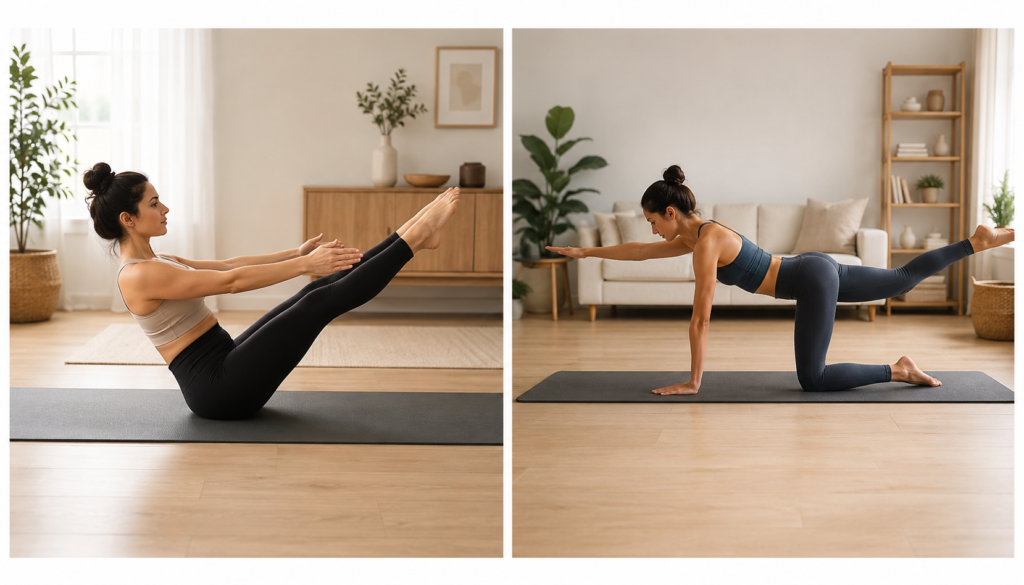
The sequence I’ve described above is solid and effective, but part of what makes Pilates so sustainable is that it grows with you. As your body gets stronger and your understanding deepens, you can explore variations and more advanced exercises.
Making Exercises Easier
Sometimes you need to modify. When I was first starting, the full Pilates Hundred was genuinely challenging. I would do it with my head and shoulders on the mat rather than lifted, which reduces the core demand. The work was still happening; I was just meeting my body where it was.
Similarly, when I’m tired or dealing with an injury, I might do the Single Leg Stretch with both legs extended (less challenging) rather than alternating. The principle remains the same; the intensity just adjusts.
Making Exercises Harder
As your strength builds, you can increase the challenge. Once the regular Roll Up feels relatively easy, you might add a pulse at the bottom, or hold the folded position for several breaths. Once the regular Bridge feels comfortable, you might do a Pulse Bridge where you lift and lower your hips in small movements while staying in the lifted position.
These progressions are subtle, which is very Pilates. You’re not doubling the weight or dramatically increasing the number of reps. You’re making the movement more challenging by adding precision demands or by reducing stability.
Exploring Advanced Variations
Once you’ve built a solid foundation, there are genuinely advanced Pilates exercises you can explore. The Teaser, the Swan, variations of leg circles—the list goes on. But these only make sense once your foundation is solid. Pilates wisdom says you should master the basics before moving to advanced work.
I’ve been practicing for years, and I still do the foundational sequence regularly. It never gets old because there’s always more depth to find.
The Lifestyle Element: Making Home Pilates Part of Your Aesthetic
Here’s something I think is important to talk about: the way you approach Pilates at home should align with your overall lifestyle aesthetic. It’s not separate from how you want to show up in the world.
If you care about quiet luxury, about intentional living, about creating spaces that feel like sanctuaries, then home Pilates is a natural extension of that. It’s not about spending money on expensive equipment; it’s about honoring your practice enough to create a space that feels worthy of it.
I think about my morning Pilates practice the same way I think about my morning skincare routine or my carefully curated closet. It’s a way of saying to myself: you’re worth this time, this intention, this care.
This is actually one of my favorite things about home Pilates. It’s so much more intimate and intentional than gym culture. There’s no comparison, no performance, no Instagram-worthiness required. It’s just you and your body, in a space you’ve created, moving with intention.
Over time, this practice has genuinely shifted how I show up in the world. My posture is better, my confidence is higher, my relationship with my body is so much more positive. And that translates to everything—how I wear clothes, how I move through space, how I feel about myself.
Overcoming the Common Obstacles: Real Talk About Home Pilates Challenges
I want to be honest about the challenges, because there are some. Home Pilates isn’t all beautiful aesthetic and easy transformation. There are real obstacles to navigate.
The Motivation Challenge
It’s easy to skip a workout when your gym is in your home. There’s no financial investment pulling you (you’ve already paid for your gym membership), no social accountability (no one is waiting for you in class), no external structure. When the workout is optional, it’s tempting to keep putting it off.
I’ve handled this by creating a non-negotiable ritual. I do my Pilates practice first thing in the morning, before I check my phone, before I eat breakfast, before I do anything else. It’s not negotiable in the way that brushing my teeth isn’t negotiable. I don’t wake up and decide if I feel like brushing my teeth; I just do it. Same with Pilates.
The morning timing is crucial for me because I have full energy and there’s less chance of something coming up to derail me. But you need to find your own non-negotiable window. Maybe for you it’s lunchtime or right after work. The specific time matters less than the consistency.
The Accountability Challenge
In a studio, you have a teacher checking your form. At home, you’re responsible for your own alignment and engagement. This can lead to developing bad habits or compensatory patterns if you’re not careful.
The solution is to invest in education. Watch quality Pilates videos. Read about the principles. Maybe work with a teacher online or in person for at least a few sessions to really understand the fundamentals. Once you have that foundation, you can practice at home with confidence.
I also recommend filming yourself occasionally to check your alignment. It sounds uncomfortable, but it’s genuinely helpful. Your body has patterns you can’t feel, and seeing yourself move can reveal them.
The Variation Challenge
It’s easy to get bored doing the same sequence at home. If you’re not challenged, you’re less likely to show up consistently.
I handle this by rotating exercises. I have a core sequence that I do all the time, but I also have variations that I rotate in. Some weeks I’ll add an advanced variation of a movement I know well. Other weeks I’ll explore a new exercise. The foundation stays consistent, but there’s enough variety to keep things fresh.
The Space Challenge
Not everyone has a dedicated space for Pilates. Maybe you live in a small apartment, or you have kids, or your home is just chaotic. This is real, and it’s valid.
I’ve adapted by being creative with space. I can do Pilates in my bedroom, in my living room, even in a hotel room when I’m traveling. You don’t need a gym-sized space. You need about six feet by four feet. That’s it. If you can create that—clearing a corner, moving some furniture—you’re golden.
If even that feels impossible, remember that a significant part of your practice can be done from standing. The Roll Down, the Bridge variations, the Swimming—all of these can be done in a very small space.
Making It Sustainable: The Long-Term Relationship with Home Pilates
What I love most about my home Pilates practice is that it’s sustainable. I can see myself doing this forever. I can do it when I’m traveling, when I’m busy, when I’m tired. I can adjust the intensity and duration to match my life. It’s flexible in a way that gym-based fitness isn’t.
This sustainability comes from a few things. First, it’s accessible. There’s no barrier to entry beyond showing up. Second, it’s adaptable. The practice can shift to meet my needs. Third, it’s intrinsically rewarding. It doesn’t rely on external validation or measurable progress to feel worthwhile.
I do Pilates because it makes me feel good. Because it makes me stronger. Because it helps me move through my day with more ease and confidence. Because it feels like taking care of myself. Those are sustainable motivations.
Over time, you’ll likely find that home Pilates becomes integrated into your identity. It’s not something you do; it’s something you are. You’re someone who moves intentionally, who takes care of her body, who shows up for herself.
The Results You’ll Actually Experience
I want to be realistic about what to expect from consistent home Pilates practice. You’re not going to transform overnight. But over months, the changes are real and significant.
Physical Changes
Your posture will improve. This is one of the first things people notice, and it happens relatively quickly. Within a few weeks of consistent practice, you’re standing taller, your shoulders are more relaxed, your entire presentation shifts.
Your core will be stronger. You’ll notice this in daily life—you have more endurance when sitting, you don’t get as tired standing, you don’t experience lower back pain with the same frequency.
Your body will become more toned. The combination of consistent Pilates and mindful eating creates definition that’s lean and elegant rather than bulky. Your legs will look more toned, your arms more defined, your midsection more streamlined.
You’ll move with more grace. This is subtle but real. There’s a way that Pilates practitioners move that’s distinctly different. It’s more fluid, more controlled, more intentional.
Mental and Emotional Changes
Your relationship with your body will shift. You’ll stop seeing your body as a problem to be fixed and start seeing it as a home to be honored.
Your stress will decrease. The meditative aspect of Pilates, combined with the physical benefits of movement, genuinely lowers stress and improves mental health.
Your confidence will increase. There’s something about knowing you’re strong, about moving with ease, about feeling good in your body that translates directly into confidence in other areas of your life.
Timeline
When can you expect to see these changes? This varies, but generally:
In the first two to three weeks, you’ll feel more energized and notice your posture starting to improve. You’ll feel stronger, even though the changes aren’t visible yet.
By four to six weeks, visible changes start appearing. Your posture has noticeably improved. Your clothes might fit differently. You might see definition starting in your abdominals or legs.
By three months, the changes are significant. If someone hasn’t seen you in a few months, they might comment that you look different. Your overall presence has shifted.
By six months and beyond, home Pilates has genuinely transformed your body and your relationship with it. The practice has likely become non-negotiable in your life.
Creating Your Pilates Home Practice Plan
So how do you actually start? Here’s what I recommend.
Week One: Learn the Basics
Watch some quality Pilates videos or read about the foundational principles. Understand what core engagement feels like. Practice breathing. Get your space ready. Do a short five or ten minute practice just to get a feel for it.
Weeks Two and Three: Build Your Foundation Sequence
Learn the foundational sequence I’ve described (or find another reputable one). Practice it three times in your first week, four times in the second week. You’re building consistency.
Month Two: Settle Into Your Practice
By now, the sequence should feel familiar. You’re doing it four to five times a week. You’re starting to feel stronger. You’re noticing your posture improving.
Month Three and Beyond: Deepen and Explore
Your foundation is solid. Now you can explore variations, slightly more advanced exercises, and play with your practice. You’re developing your own relationship with Pilates rather than just following instructions.
The Beauty of Simplicity
I keep coming back to this: the beauty of home Pilates without equipment is in its simplicity. In a world that constantly tells us we need more, more, more—more gadgets, more equipment, more intensity—Pilates says: you need yourself. That’s enough.
Your body is an incredible machine capable of extraordinary things. All it takes is the right intention, the right understanding, and consistent practice. You don’t need a fancy studio or expensive equipment. You just need to show up.
That’s the revolution of home Pilates. It’s democratic in the truest sense. Everyone has access to it. Everyone can do it. Everyone can get real, lasting results.
And I think that’s beautiful. The idea that you can transform your body, improve your health, build strength and confidence, all from your own home, in your own time, on your own terms. That’s power.
As I finish this, I’m sitting in my bedroom, where I’ve done countless Pilates practices over the past few years. The mat is rolled up in the corner, waiting for me. Tomorrow morning, I’ll unroll it and show up again. Not because I have to. Not because I’m chasing some external ideal of what my body should look like. But because I love the way it makes me feel. Because I love taking care of myself. Because I love the person I’m becoming through this practice.
That’s what I want for you too. Not perfection. Not a magazine cover body. But strength, confidence, presence, and the knowledge that you’re taking care of yourself in the deepest possible way.
Your home Pilates journey starts whenever you’re ready. The mat is waiting. Your body is ready. You’ve got this.