
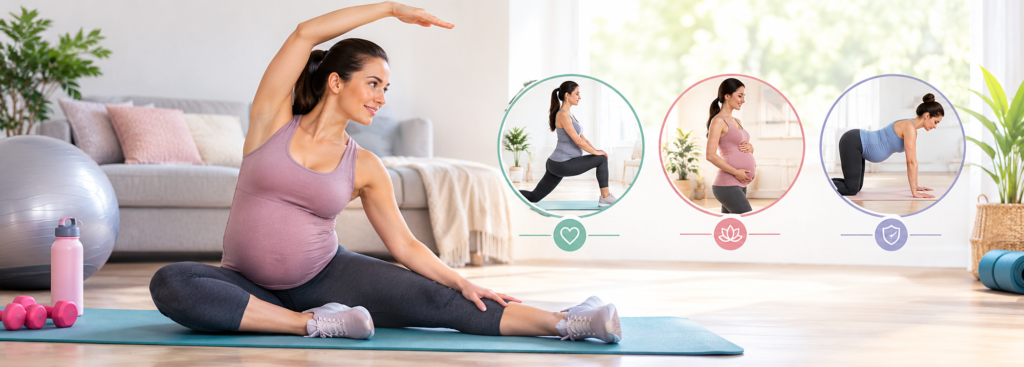
The question arrives almost as soon as the positive test does: is it still okay to work out? For most women, the answer is a reassuring yes — but pregnancy exercise isn’t quite the same as exercise at any other point in life, and understanding how and why it changes trimester by trimester makes the difference between confident, comfortable movement and unnecessary anxiety.
This guide walks through the full picture: why exercise during pregnancy is broadly beneficial, what changes as pregnancy progresses, which activities are considered safe, how to modify movement for your changing body, and — just as importantly — which warning signs mean it’s time to stop and call your provider. Every pregnancy is different, and this article is not a substitute for guidance from your own OB-GYN or midwife, who knows your specific health history. But for the vast majority of women with uncomplicated pregnancies, this is the practical, reassuring roadmap most people are looking for.
Why Exercise Can Be Beneficial During Pregnancy
Major medical organizations, including the American College of Obstetricians and Gynecologists (ACOG), actively recommend that pregnant women without contraindications get at least 150 minutes of moderate-intensity activity per week. The evidence behind this recommendation is substantial: regular exercise during pregnancy is associated with reduced risk of excessive gestational weight gain, lower rates of gestational diabetes, decreased back and pelvic pain, improved mood and reduced anxiety, better sleep quality, and in some research, shorter labors and reduced likelihood of cesarean delivery.
Beyond the measurable outcomes, there’s a psychological benefit that’s harder to quantify but very real: exercise offers a sense of control and normalcy during a period defined by rapid, often overwhelming physical change. For many women, a regular movement routine becomes one of the few things that still feels familiar as everything else transforms.
Important Considerations Before Starting
Before beginning or continuing an exercise routine during pregnancy, a conversation with your healthcare provider is genuinely worthwhile — not because most women need permission to move their bodies, but because certain conditions change the calculus meaningfully. These include a history of preterm labor, cervical insufficiency, certain heart or lung conditions, persistent vaginal bleeding, placenta previa after a certain gestational age, preeclampsia or pregnancy-induced hypertension, and severe anemia. If any of these apply to you, individualized guidance matters more than any general recommendation, including this one.
For women without these complications, most providers will simply confirm that continuing or starting moderate activity is appropriate and may offer specific guidance based on your fitness history and any symptoms you’ve experienced.
Exercise During the First Trimester
The first trimester often brings fatigue and nausea that can make even a short walk feel like a genuine effort — this is common and doesn’t reflect anything being wrong. If you were exercising before pregnancy, you can generally continue much as you were, adjusting for energy levels and avoiding overheating (hot yoga, saunas, and exercise in extreme heat are best avoided, particularly in these early weeks). If you’re beginning exercise for the first time, starting gently — brief walks, gentle stretching — and building gradually as tolerated is the sensible approach.
Hydration deserves particular attention here, since nausea can make it harder to drink enough fluids, and dehydration can worsen both nausea and fatigue.
Exercise During the Second Trimester
Many women describe the second trimester as their best window for exercise — nausea has often eased, energy frequently rebounds, and the belly hasn’t yet grown large enough to significantly limit movement. This is a good period to build a more consistent routine, though a few modifications become relevant: many providers begin advising against exercises performed flat on the back for extended periods after roughly 20 weeks, since the growing uterus can compress a major vein and affect blood flow in this position. Balance also begins shifting subtly as the uterus grows, which is worth factoring into activity choices.
Exercise During the Third Trimester
The third trimester calls for the most noticeable adjustments. Balance is more significantly affected, joints are looser due to the hormone relaxin, and simply moving through daily life takes more effort as the additional weight of pregnancy — often 25 to 35 pounds by this point — changes posture and biomechanics. Many women naturally shift toward walking, swimming, and prenatal yoga during this period, scaling back higher-impact or higher-balance-demand activities. Some women continue more vigorous exercise right up until labor and feel great doing so; others prefer to slow down considerably. Both are normal, and the right approach is the one that feels comfortable for your specific body.
Safe Forms of Exercise
Walking is perhaps the single most universally appropriate activity throughout pregnancy — low-impact, adjustable, and requiring no equipment or special training. Swimming offers a unique advantage: water buoyancy supports body weight, relieving joint pressure and making movement feel easier, particularly valuable in the third trimester. Prenatal yoga, taught by an instructor trained in pregnancy modifications, combines gentle strength, mobility, and breathing practice relevant to both pregnancy comfort and labor preparation. Stationary cycling provides cardiovascular benefit without the fall risk of outdoor cycling, which becomes more relevant as balance shifts.
Strength Training
Strength training can generally continue throughout pregnancy with sensible modifications: avoiding exercises performed flat on the back after roughly 20 weeks, moderating load somewhat as joint laxity increases, and paying attention to breathing — exhaling during exertion rather than holding the breath, since breath-holding increases intra-abdominal pressure in a way that’s best avoided during pregnancy. Compound movements like squats, modified deadlifts, rows, and presses remain broadly appropriate for most women, adjusted in weight and range of motion as comfort dictates.
Walking
Walking deserves its own mention because of how adaptable it is across all three trimesters. A daily habit — even broken into shorter segments later in pregnancy if a continuous walk becomes uncomfortable — supports cardiovascular health, mood, and digestion. It requires no special planning and scales naturally with however much energy is available on a given day.
Swimming
Swimming and water aerobics offer genuine relief from the physical weight of pregnancy, particularly valuable for women experiencing swelling, back pain, or general discomfort from carrying extra weight on land. The cardiovascular benefit is real, and the risk of falling or overheating is minimal, making it one of the more universally recommended activities throughout pregnancy.
Prenatal Yoga
Prenatal yoga classes are specifically designed to avoid poses involving deep twists (which can compress the abdomen), extended time flat on the back later in pregnancy, and overstretching that could strain already-loosened ligaments. The breathing techniques taught — slow, controlled patterns — have direct relevance to labor, where breath control is a genuinely useful coping tool.
Mobility and Stretching
Gentle mobility work remains valuable throughout pregnancy, though the approach to flexibility needs adjustment given increased joint laxity from the hormone relaxin. Rather than pushing into deeper stretches, pregnancy-appropriate mobility work focuses on maintaining comfortable range of motion and relieving tension, particularly in the hips, lower back, and upper back.
Core and Pelvic-Floor Considerations
As the abdominal muscles stretch to accommodate the growing uterus, the rectus abdominis naturally separates somewhat along the midline — a normal process called diastasis recti. Traditional crunches and sit-ups, which increase strain on this stretching tissue, are generally discouraged, particularly in the second and third trimesters. Instead, core training shifts toward deep stabilization exercises: modified planks, bird dogs, and breath-coordinated engagement.
The pelvic floor deserves specific, ongoing attention throughout pregnancy, since it bears increasing weight and will play a central role in labor. Practicing both pelvic floor contraction and, importantly, relaxation — coordinated with breath — builds a functional skill relevant to continence during pregnancy and to the pushing phase of labor.
Exercises That May Need Modification
As pregnancy progresses, certain exercises typically require adjustment: anything performed flat on the back for extended periods (switch to inclined, seated, or side-lying variations), exercises requiring significant balance (favor supported or stable positions as the belly grows), high-impact jumping movements (often reduced or eliminated in the third trimester), and any exercise involving a risk of abdominal trauma or falling (contact sports, downhill skiing, horseback riding).
Intensity and Listening to Your Body
A practical guideline for exercise intensity during pregnancy is the “talk test” — if you can hold a conversation while exercising, you’re likely working at an appropriate, moderate intensity. Fixed heart-rate targets, once commonly recommended, are now considered less reliable during pregnancy given how much cardiac output changes. Beyond the talk test, learning to interpret your body’s signals — unusual fatigue, shortness of breath that feels different from normal, or simply a sense that something feels off — matters more during pregnancy than it might otherwise.
Warm-Up and Cool-Down
A proper warm-up (5 to 10 minutes of gentle movement to gradually raise heart rate and warm the muscles) and cool-down (a similar period of slower movement and gentle stretching) remain just as important during pregnancy as at any other time, helping to reduce injury risk and support the body’s transition in and out of more demanding activity.
Hydration and Nutrition Considerations
Fluid needs increase during pregnancy, and dehydration can contribute to symptoms including headaches, dizziness, and in some cases, contractions — making consistent hydration, rather than drinking only when thirsty, particularly important. Nutritionally, exercise adds to the body’s energy demands on top of pregnancy’s own modestly increased caloric needs (roughly no increase in the first trimester, about 340 additional calories in the second, and about 450 in the third for most healthy-weight women), making adequate intake of protein, complex carbohydrates, and healthy fats a worthwhile focus around exercise sessions.
Warning Signs and When to Stop Exercising
Certain symptoms during exercise warrant stopping immediately and contacting your healthcare provider: vaginal bleeding, regular painful contractions, fluid leaking from the vagina, dizziness or feeling faint, chest pain, unusual headache, calf pain or swelling, muscle weakness affecting balance, and decreased fetal movement. These symptoms should never be pushed through or self-diagnosed.
How Pregnancy Changes Your Body and Affects Exercise
A few physiological shifts are worth understanding as background context. Blood volume increases by roughly 40 to 50 percent, meaning the heart works considerably harder even at rest. The hormone relaxin loosens ligaments throughout the body, not just the pelvis, affecting joint stability broadly. The growing uterus shifts the center of gravity forward, changing balance and posture. And later in pregnancy, the diaphragm’s range of motion becomes more limited as the uterus pushes upward, which can make breathing during exertion feel different than it used to.
Practical Sample Routines
First trimester (as energy allows): 20–30 minute walk most days; 2 sessions of gentle full-body strength work; stretching or restorative yoga 1–2 times weekly.
Second trimester: 30-minute walk or swim most days; 2–3 modified strength sessions per week; 1 prenatal yoga class.
Third trimester: Walking broken into shorter segments as needed; 2 gentle strength sessions emphasizing stability rather than intensity; prenatal yoga or stretching focused on comfort and breath work.
These are flexible templates, not prescriptions — adjust based on energy, comfort, and your provider’s specific guidance.
Common Questions and Misconceptions
A persistent myth holds that pregnant women shouldn’t raise their heart rate above a fixed number — this has largely been abandoned in current guidance in favor of the talk test. Another myth suggests women who didn’t exercise before pregnancy shouldn’t start during it; in fact, beginning moderate exercise during pregnancy is generally considered safe and beneficial for most women. And the idea that exercise increases miscarriage risk isn’t supported by evidence for women with uncomplicated pregnancies engaging in moderate activity.
Frequently Asked Questions
Can I start exercising during pregnancy if I’ve never exercised before? Yes, for most women with uncomplicated pregnancies. Start gently with walking or prenatal yoga and build gradually, ideally after discussing your plans with your provider.
Is running safe during pregnancy? Many women who ran before pregnancy continue throughout, adjusting pace and distance as comfort and balance change, particularly in the third trimester. It’s a decision to make with your provider.
How do I know if I’m overdoing it? The talk test is a reliable guideline — if you can’t hold a conversation, you’re likely working too hard. Dizziness, unusual shortness of breath, or a sense that something feels wrong are signals to stop.
Do I need to avoid all abdominal exercises? Traditional crunches are generally discouraged, but modified core stabilization work — like bird dogs and modified planks — is generally appropriate and beneficial throughout pregnancy.
When should I stop exercising and call my doctor? Immediately for vaginal bleeding, regular painful contractions, fluid leakage, dizziness, chest pain, severe headache, calf swelling, or decreased fetal movement.