
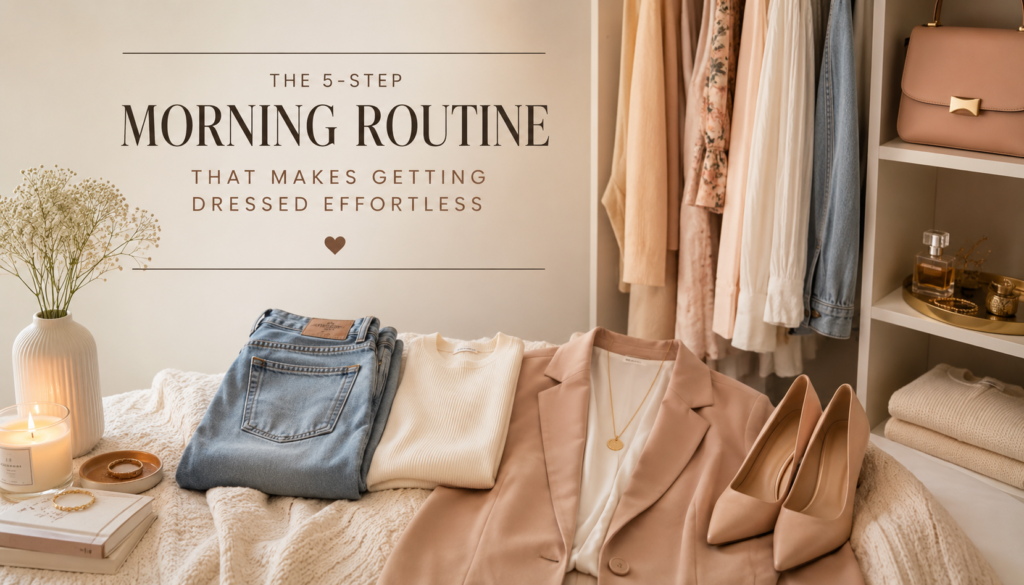
Elegance starts long before you open your closet. If your mornings feel rushed, cluttered, and reactive, even the most beautiful wardrobe can’t make your day feel truly polished. A graceful personal style is much easier to access when the fifteen minutes before you get dressed are calm instead of chaotic. Most women think the answer to “effortless” dressing is more clothes, a better closet system, or finally buying that capsule wardrobe course. It isn’t. The answer is a routine — a small, repeatable sequence that happens before you ever touch a hanger, so that by the time you’re standing in front of your closet, the decision has already half made itself.
I want to walk you through the exact five-step routine that changed how I get dressed, and how it can change yours too. Not a rigid checklist you’ll abandon by Thursday, but a rhythm you can bend to fit a Tuesday commute, a Saturday brunch, or a Monday that starts with a 7 a.m. school run. This is the difference between a woman who looks like she tried too hard, a woman who looks like she didn’t try at all, and a woman who looks like she simply knows herself. That third woman isn’t lucky. She has a system, and it starts the night before.
Why “getting dressed” is never really about the clothes
Here’s something worth sitting with: the outfit is the last five percent of the process. By the time you’re pulling something off the hanger, ninety-five percent of what will make you feel put-together has already happened — or already failed to happen. It happened in how you slept, how rushed you felt the moment your alarm went off, whether your bathroom counter was clear or cluttered, whether you knew what today required of you or were figuring it out in real time while also trying to find matching socks.
This is why two women can own the exact same blazer and one will look effortlessly chic in it while the other looks like she’s wearing a costume. It’s rarely the garment. It’s the twenty minutes before the garment went on. A woman who is calm, who has had a moment of stillness, who has already decided (even loosely) what she’s building toward — she wears clothes differently than a woman who is sprinting out the door with wet hair and a coffee in one hand. The fabric doesn’t change. The energy underneath it does.
So before we get to the five steps, let’s reframe the goal. We’re not trying to build “the perfect morning routine” as an aesthetic exercise, something to post about and never actually do. We’re building a small sequence of decisions that removes friction, so that dressing well becomes a habit instead of a performance. Real elegance is quiet. It doesn’t announce itself. It’s the woman who walks into a room looking finished without looking like she spent an hour finishing herself. That kind of ease is manufactured — just not in the way people assume.
The philosophy behind the five steps
SimEvery step in this routine does one of two things: it removes a decision, or it creates a moment of stillness. That's the whole framework. Decision fatigue is the actual enemy of an elegant morning, not a lack of good clothes. The average person makes hundreds of small decisions before 9 a.m. — what to eat, what to wear, whether to reply to that text, whether the weather calls for a coat. Every one of those decisions costs a small amount of mental energy, and by the time you're standing in your closet, you may have already spent most of your morning's decision-making budget on things that don't actually matter.<br>The five steps below are designed to front-load the important decisions to a calmer moment — usually the night before, or the first still minutes of the morning — so that the actual act of getting dressed becomes almost automatic. You're not deciding anymore. You're executing a decision you already made when you had more bandwidth and more patience.<br>Step one deals with the night before. Step two deals with the first ten minutes after you wake, before anyone or anything else has claimed your attention. Step three is about having a "uniform" — a small set of default combinations that require zero creative energy. Step four is the actual styling formula, the three-piece structure that makes any outfit look considered. And step five is the finishing layer — the small details that signal "this was intentional" rather than "this was whatever was clean."<br>Let's go through each one.ple Fitness and Wellness for Busy Women at Home.
Step One: The Night-Before Ritual
This is the step almost everyone skips, and it’s the one that changes everything. If you do only one thing from this entire article, do this: spend five minutes the night before deciding what you’re wearing tomorrow.
Not laying out a full outfit necessarily — though that helps — but at minimum, making the decision while your mind is calm and has context. At 9 p.m., you know what tomorrow actually requires. You know if it’s a client meeting or a laundry day. You know if the weather report says rain. You know if you’re exhausted and need something that takes zero effort to put on, or if you have a little more energy to play with texture and color. None of that is true at 6:45 a.m., when your brain is still catching up to being awake and every decision feels heavier than it should.
There’s a well-documented psychological reason mornings feel harder than they need to be: your prefrontal cortex, the part of your brain responsible for decision-making, doesn’t fully “wake up” the moment your eyes open. It takes time to come online. Which means the outfit decisions you make in the first thirty minutes of consciousness are being made by a brain that’s still partially offline. You’re not imagining it when your 7 a.m. self makes worse decisions than your 9 p.m. self. It’s neurological, not a character flaw.
So the ritual: before bed, take two minutes and look at tomorrow. Check your calendar. Check the weather. Pick your outfit — top, bottom, shoes, and one outerwear layer if needed — and physically set it somewhere visible. A chair, a hook, the top of your dresser. The physical act of setting it out matters more than people think, because it closes a mental loop. Your brain stops quietly working on the problem in the background (yes, it does this, even when you’re not consciously thinking about it) and that mental space frees up for sleep, or for whatever else deserves your evening attention.
I’d also encourage you to lay out one small accessory alongside the outfit — earrings, a scarf, a belt — because this is the piece most likely to get skipped when you’re rushed. If it’s already sitting there next to the outfit, you’ll put it on without a second thought. If it’s in a drawer three rooms away, it simply won’t happen, and it’s usually that one small accessory that pulls an outfit from “fine” to “finished.”
There’s a secondary version of this ritual for women who genuinely can’t predict their mornings — new mothers, people with unpredictable schedules, anyone whose 7 a.m. self might need three completely different outfits depending on how the night went. For you, the night-before ritual isn’t about picking one outfit. It’s about picking three “safe” combinations that live together in your closet, physically grouped, so that even on your worst morning, you’re choosing between three good options instead of scanning forty items and feeling nothing. This is a small act of kindness toward your future self, and it’s the single highest-leverage five minutes you can spend in your evening.
A quick script for how this actually sounds in your own head, since abstract advice is hard to apply at 9 p.m. when you’re tired: “Tomorrow’s an 11 a.m. call and then errands, weather’s cool and clear — the charcoal knit, cream trousers, brown loafers, and I’ll set out the gold hoops too.” That’s the entire internal monologue. It takes less time to think than it took you to read it, and once it’s decided, it’s decided — no revisiting it at 6:45 a.m. with a foggier brain and less patience.
One more layer to this step, and it’s the one that actually determines whether the previous four paragraphs matter at all: your closet has to be edited enough that “picking an outfit” is actually possible in five minutes. If you own ninety items and only wear twelve of them, the night-before ritual will take twenty minutes instead of five, because you’ll be sifting through clothes you don’t actually like, don’t actually fit, or don’t actually know how to style. This doesn’t mean you need a minimalist ten-item wardrobe — that’s its own kind of tyranny, and not everyone wants it. It means every item in rotation should earn its place. If something makes you hesitate every time you see it — too tight, slightly wrong color, never quite right with anything else — it’s not neutral. It’s actively costing you decision-making energy every single time you open that closet door, even if you don’t consciously register the hesitation. Clear it out. A smaller closet of things you actually love will always dress you faster and better than a large closet of things you’re lukewarm about.
Step Two: The First Ten Minutes
Once the outfit decision is handled the night before, the next lever is what you do in the first ten minutes after waking. This has almost nothing to do with clothes and everything to do with the state you’re in when you eventually get to them.
Here’s the pattern I want you to notice in your own life: on the mornings you feel most put-together, what actually happened in the first ten minutes? For most women, it wasn’t checking a phone. It was some small window of stillness — coffee in silence, skincare done slowly instead of rushed, a few minutes where nothing was being asked of you yet. On the mornings you feel most scattered, what happened? Usually, the phone came out within sixty seconds of the alarm, and by the time you stood up, you’d already absorbed six unrelated pieces of information — a work email, a group chat, a headline — none of which had anything to do with your actual day, and all of which put your nervous system into a slightly reactive state before you’d even brushed your teeth.
This matters for how you get dressed because a scattered nervous system makes worse aesthetic decisions. You second-guess things. You reach for the “safe” outfit out of anxiety rather than the considered outfit out of intention, and those can look identical on a hanger and completely different on a body. Confidence changes posture. Posture changes how clothes sit. This isn’t abstract — it’s the literal, physical reason the same dress can look incredible in one photo and forgettable in another. The dress didn’t change. The shoulders did.
So the second step is protecting those first ten minutes, structurally, so they can’t be hijacked. That might mean charging your phone across the room instead of on your nightstand, so reaching for it requires standing up and making a choice rather than a reflex. It might mean a skincare routine you do slowly rather than in a rush at the sink with the water running — even just washing your face with intention, feeling the water, noticing the texture of a cream as you apply it, rather than doing it while mentally drafting a text to someone. It might mean simply standing at a window with coffee for ninety seconds before checking anything. It doesn’t need to be elaborate. It needs to be protected.
I’ll say this plainly because it matters: this isn’t really a beauty routine tip. It’s a nervous-system tip that happens to show up in how you look. Women who move through their morning with even a small buffer of calm carry themselves differently by 8 a.m. than women who went from unconscious to inbox in ninety seconds. And clothes — any clothes — read as more elegant on a body that isn’t bracing.
Practically, here’s how to build this without adding twenty minutes to your morning: pick one part of your existing routine — the skincare, the coffee, the shower — and do it five percent slower than you currently do. Not longer. Slower. Notice one sensory detail while you do it. That’s it. That single shift in pace is often enough to change the tone of the rest of the morning, because it signals to your body that this isn’t an emergency, even if the clock says you’re running behind.
There’s also a wardrobe-adjacent piece to this step worth naming: whatever you put on your skin and hair in these first minutes affects how your clothes will sit later. A rushed, dry face under makeup looks different than a face that had two extra minutes of hydration. Hair that was towel-dried and left alone looks different than hair that got even sixty seconds of product worked through it before you moved on. None of this needs to be a full routine. It needs to not be skipped entirely, because skipping it entirely is usually what makes an outfit look unfinished even when the outfit itself was well-chosen.
Step Three: The Uniform Principle
Now we get to the actual dressing. And the biggest myth about elegant women is that they have endless creative range — a new, inventive outfit every single day, pulled together through sheer stylistic instinct each morning. Almost none of them do. What they actually have is a uniform: a small set of go-to combinations, in colors and shapes they know work on their body, that they return to again and again with minor variation. Think of the women whose personal style you actually admire, the ones who always look like themselves. Odds are, you could describe their “look” in one sentence. That’s not a lack of creativity. That’s the entire point.
A uniform removes the single hardest part of getting dressed, which is inventing something from scratch every single morning. Instead, you’re choosing from a short menu of combinations you already know work — on your body, with your coloring, for your actual life. This is different from wearing the exact same outfit every day (though some women do that too, and it works beautifully for them). It’s closer to having three or four “formulas” — a trouser-plus-blouse formula, a dress-plus-layer formula, a jeans-plus-structured-top formula — that you can execute in your sleep, and then varying the specific pieces and colors within those formulas so it never feels monotonous.
Building your own uniform starts with an honest audit, not of your closet, but of your last thirty days. What did you actually wear, repeatedly, that made you feel good? Not what you own — what you reached for. Most women, when they do this exercise honestly, find they’re already wearing a uniform without realizing it; they just haven’t identified it, refined it, or given themselves permission to lean into it fully. They’re still buying based on what they think they “should” want to wear, rather than doubling down on what has already proven itself to work.
Once you know your formula — say, wide-leg trouser, fitted knit, one structured layer — the actual daily decision becomes almost mathematical. You’re not asking “what should I wear today,” an open-ended and exhausting question. You’re asking “which trouser, which knit, which layer,” a closed and much smaller question. This is the difference between staring at a blank page and filling in a form. Both require some thought. Only one of them is genuinely hard.
There’s a deeper permission being granted here, too, and it’s worth naming directly: you are allowed to be a woman who wears versions of the same three outfits on rotation. That is not a failure of personal style — it is, quite literally, how personal style actually works at its most refined level. The women whose closets look effortlessly curated in photos are rarely wearing forty different looks. They’re wearing six or seven excellent ones, repeated with enough variation in color and texture that it never registers as repetition. Nobody clocks that you wore the same silhouette on Tuesday and Friday. They register that you looked like yourself both days, which reads as consistency, and consistency reads as confidence.
If you’re building this uniform from scratch, start narrower than feels comfortable. Pick one bottom silhouette that flatters you — not four, one — and build around it for a month. Notice what tops work with it, what layers extend it into cooler weather, what shoes change its formality. You’ll learn more about your actual personal style from wearing one good silhouette fifteen different ways than from owning fifteen different silhouettes you wear once each and then abandon in the back of the closet.
And a final note on this step, because it’s the one that trips people up: a uniform is not a cage. It’s a base camp. Once you have three or four combinations that never fail you, you actually have more room to experiment on the days you want to, because the experimentation is happening from a place of security rather than anxiety. You’re not trying a new silhouette because you have nothing else to wear — you’re trying it because you’re curious, with a fallback waiting if it doesn’t work. That’s a completely different emotional experience, and it’s the reason women with a defined uniform often end up looking more adventurous over time, not less. Security breeds experimentation. Chaos breeds retreat into whatever’s safest and least interesting.
Step Four: The Three-Piece Formula
Once you know your uniform, the actual act of assembling an outfit each morning benefits from one more piece of structure: a formula for how many “pieces” make an outfit look finished. My rule of thumb, and one that holds up across almost every context from client meetings to weekend errands, is three.
One piece is a statement — usually the piece you built the outfit around, the one with the most color, texture, or shape. One piece is a neutral base — something quiet that lets the statement piece do its job without competing. And one piece is a finishing layer — a jacket, a scarf, a bag, a shoe, something that adds a sense of “this was completed” rather than “this was assembled.”
Two pieces reads as unfinished, more often than not. A great top and great trousers, with nothing else, frequently looks like exactly what it is: a top and trousers. Add the third piece — even something as simple as a belt, a structured bag, or a cardigan draped rather than worn — and the outfit crosses a threshold from “clothes” to “a look.” This is the actual, structural difference between an outfit that photographs well and one that doesn’t, and it has nothing to do with the price of any individual item.
Where this formula becomes genuinely useful is on the mornings you have zero creative energy left, which — realistically — is most mornings. Instead of standing in front of your closet trying to conjure something original, you’re running a checklist: what’s my statement piece today, what’s my neutral base, what’s my third piece. Three questions, in order, each one narrowing the next. By the time you’ve answered all three, you’re dressed, and you didn’t have to invent anything — you executed a formula.
Let’s make this concrete with a few real combinations, because abstract formulas are hard to apply at 7 a.m. when you’re half-awake and the coffee hasn’t kicked in yet.
For a workday: a well-cut blazer in a rich, quiet color as your statement piece, a simple fitted top and tailored trouser as the neutral base, and a structured leather bag plus a single pair of well-chosen earrings as the finishing layer. Nothing in that outfit is unusual or difficult to source. The formula is what makes it look intentional.
For a weekend: a beautifully textured knit as the statement piece — something with visible weave, an interesting color, a relaxed but not sloppy shape — paired with straight denim as the neutral base, and a great pair of loafers or boots plus one substantial piece of jewelry as the finishing layer. Again: three pieces, each doing a distinct job, none of them fighting for attention with the others.
For an evening: a slip dress or a well-fitted knit dress as the statement piece, bare minimal layering as the neutral base since the dress is already doing the work, and a structured coat or blazer thrown over the shoulders plus a strong shoe as the finishing layer.
Notice that in every version, only one piece is doing the “interesting” work. The neutral base is intentionally quiet. This is the part people get backward when they’re first learning to dress with more intention — they try to make every piece interesting, and the outfit ends up feeling loud and competitive instead of elegant. Elegance is almost always about restraint in service of one focal point, not maximalism applied evenly across the whole outfit.
I’d also add a small caveat here for texture and color, since the three-piece formula works even better once you understand this layer: your statement piece and your neutral base should generally sit within one shared color family, even if they’re not matching exactly. Two colors from the same family — a cream and a warm beige, a navy and a soft gray-blue, a rust and a deep brown — will always look more expensive together than two colors that are technically “coordinated” by a color wheel but don’t share any warmth or coolness in common. This is a large part of why certain outfits look effortlessly expensive and others, made of similarly priced garments, look slightly off. It’s rarely the garments. It’s almost always the color relationship between them.
Step Five: The Finishing Touch
The last step is the one most often skipped when you’re running late, and it’s the one that does the most work per second invested. I call it the finishing touch, and it’s usually one of three things: scent, a final accessory, or a genuine look in the mirror before you leave.
Scent first, because it’s the most underused tool in a woman’s entire dressing routine. A signature scent, applied with intention rather than as an afterthought grabbed on the way out the door, changes how you carry yourself in a way that has nothing to do with how you look and everything to do with how you feel — and how you feel changes your posture, which changes how the clothes read. This isn’t superstition. It’s the same mechanism as step two: a small ritual that signals to your own body that you’ve arrived, that you’re dressed, that the day has officially begun. Applying it as one of the last things you do — after the outfit, not before — turns it into a closing bracket on the whole routine.
Second, the final accessory — and this is different from the accessory you laid out the night before as part of the outfit. This is the one you add at the very end, standing in front of the mirror, once you can actually see the whole picture. Sometimes it’s removing something rather than adding it — the necklace that seemed right on the hanger but is fighting with the neckline once it’s actually on. Sometimes it’s the opposite: noticing the outfit needs one more thing, a cuff, a scarf, a pair of sunglasses pushed up into your hair, to feel complete. This step only works if you build in the thirty seconds to actually look — genuinely look, not glance — before you leave.
Which brings me to the third piece: the mirror check itself, done properly. Not the reflexive glance most of us do while grabbing keys, but an actual thirty-second pause, front and back if possible, where you ask yourself one honest question: does this feel like me today? Not “does this look fine,” which is a low bar almost anything can clear, but “does this feel like me” — a question that catches the outfits that are technically correct but somehow off, the ones where every individual piece was a good choice but the whole doesn’t cohere.
This step is where confidence actually gets built into the outfit, physically. Women who skip the mirror check tend to spend the first hour of their day in low-grade doubt about how they look, checking their reflection in windows and screens, adjusting things reflexively. Women who do the check once, properly, before they leave the house tend to simply stop thinking about it — they made the decision consciously, confirmed it, and can now direct their attention elsewhere. The thirty seconds you spend at home saves you an entire day of low-grade self-monitoring, which is a remarkably good trade.
The mistakes that quietly undo an elegant morning
Even with all five steps in place, there are a handful of small habits that undercut the whole routine, and they’re worth naming because they’re common enough that you’ve probably done at least one this week.
The first is checking your phone before your feet touch the floor. I mentioned this above, but it’s worth repeating because it’s the single most common way an elegant morning gets derailed before it even starts. Whatever comes through that screen — a work message, a piece of news, someone else’s crisis — becomes the emotional tone of your first hour, before you’ve had any say in the matter.
The second is skipping the night-before decision and telling yourself you’ll “figure it out in the morning.” You won’t figure it out better in the morning. You’ll figure it out faster, under worse conditions, with a less capable brain, and you’ll usually land on whatever’s clean and closest rather than what’s actually right for the day.
The third is treating the finishing touch as optional. It is, in the sense that the outfit will still technically be “on” without it. But it’s the difference between dressed and finished, and most women who say they “don’t have a signature style” simply haven’t given themselves the thirty seconds to close the loop on outfits that were, in fact, well-chosen all along.
The fourth is buying for a fantasy wardrobe instead of a real uniform. This is a subtler one. Many closets are full of clothes bought for an imagined version of a life — the trip that didn’t happen, the event that got canceled, the “someday” version of yourself who is somehow always thinner, always more put-together, always living somewhere with better weather. Those clothes sit unworn because they were never actually built for your real, current life, and every time you see them in your closet, they cost you a small amount of decision-making energy without ever earning their place.
The fifth, and perhaps the most common, is confusing “more effort” with “more elegant.” An elegant morning is not the one where you spent the most time or tried the hardest. It’s the one where the decisions were made in advance, calmly, so that the execution felt almost automatic. Some of the most polished women I know spend less time getting dressed than women who are still second-guessing themselves in front of the closet twenty minutes later. Ease is the actual output of a good system, not a sign that you didn’t care enough.
Adapting the routine to your actual life
This five-step framework isn’t meant to be executed identically by every woman in every season of life, and I want to be honest about that rather than pretend a single routine fits everyone.
If you’re working from home, the finishing touch matters more than you’d think, not less. It’s tempting to skip dressing with intention entirely when no one’s going to see you, but the mirror check and the scent ritual do real psychological work regardless of audience — they signal to your own brain that the workday has started, which matters enormously for focus and mood even when there’s no commute to mark that transition.
If you’re a new mother or in a season where mornings are genuinely unpredictable, lean hardest into step one and step three — the night-before prep and the uniform. These are the steps that don’t require you to have any spare bandwidth in the moment; they’re front-loaded, done when you have a sliver of calm, so the actual morning execution asks almost nothing of you.
If your work involves travel, build a slightly more compressed version of the uniform — fewer pieces, more interchangeable — and treat every hotel room mirror check the same way you’d treat your home one. The routine isn’t about your bathroom. It’s about the sequence, and the sequence travels.
And if you’re simply in a season where you feel disconnected from how you look — after a life change, a move, a shift in your body, anything — start with step two alone. Just the first ten minutes. Don’t worry about the uniform or the formula yet. Rebuilding a sense of calm in those first minutes of the day tends to naturally restore your instincts about the rest, often faster than trying to force a new wardrobe strategy on top of a nervous system that isn’t ready for it yet.
Where to actually start tomorrow
If five steps feels like a lot to take in at once, here’s the honest, minimal version: tonight, before bed, spend two minutes deciding what you’re wearing tomorrow and set it out. Tomorrow morning, give yourself sixty extra seconds before you touch your phone. That’s it. That’s the entire routine, distilled to its two highest-leverage moments. Everything else in this article — the uniform, the three-piece formula, the finishing touch — builds on top of that foundation, but it’s the foundation itself that does most of the work.
Elegance was never really about having the right clothes. It’s about removing enough friction from your morning that the right clothes have a chance to actually land the way they’re supposed to. The wardrobe you already own is very likely more capable than you’re giving it credit for — it’s the twenty minutes before you touch it that need the attention.
Start there. The closet will follow.
A day inside the routine, start to finish
Sometimes a framework makes more sense lived out than explained in the abstract, so let me walk you through what this actually looks like on an ordinary Tuesday — not a curated, aspirational day, just a real one.
At 9:15 the night before, I check tomorrow’s calendar for thirty seconds. One client call at 11, nothing else fixed, likely errands in the afternoon. I check the weather — cool, clear. Two minutes later, I’ve pulled a fitted charcoal knit, wide-leg cream trousers, and my brown leather loafers, and hung them together on the back of my closet door. I set a pair of gold hoops on top of the dresser, next to them. That’s the entire night-before ritual: under four minutes, done while half-thinking about something else entirely.
The alarm goes off at 6:40. My phone stays on the dresser, across the room, still on silent. I get up, and the first thing I do is open the blinds and stand there for a minute with the light before anything else happens. Then coffee, made slowly, no phone in hand. I notice, mostly out of habit now, the temperature of the mug and the quiet of the kitchen before the day has any opinions about itself yet. This whole stretch is maybe eight minutes, and none of it is complicated — it’s simply protected.
Skincare comes next, and I do it at a normal pace rather than a rushed one, which in practice means about ninety seconds longer than if I were hurrying. I’m not doing anything different. I’m doing the same three products I always do, just noticing them rather than performing them on autopilot while thinking about something else.
Getting dressed, at this point, takes about four minutes, because the decision was already made the night before. Knit on. Trousers on. Loafers on. I glance at the outfit in the mirror — my statement piece is the knit, since it has the richest texture and the most interesting color; the trousers are the quiet base; the loafers and the earrings I set out are my third piece, the finishing layer. Three pieces, each with a distinct job, nothing competing.
Scent goes on last, after the outfit, not before — a habit that took a while to build but now feels like closing a door. I glance in the mirror one final time, front and back, and ask the actual question: does this feel like me today? It does. I add the earrings I set out the night before, notice the outfit needs nothing else, and I’m done. Door to done, roughly fifteen minutes, most of which wasn’t spent thinking about clothes at all.
That’s the whole system in practice. It isn’t more elaborate on paper than it is in real life — if anything, describing it takes longer than living it.
Building a wardrobe that supports the routine
None of this framework works particularly well if your closet is actively fighting you, so it’s worth spending a little time on how to build — or edit — a wardrobe that makes the five steps easy rather than aspirational.
Start with your neutral base pieces, not your statement pieces, which is the opposite of how most women shop. It’s tempting to buy the interesting knit, the bold color, the unusual cut first, because those are the pieces that feel exciting in a fitting room. But without a solid rotation of quiet, well-fitted neutral bases — trousers, simple knits, a good white shirt, a slip skirt — your statement pieces have nowhere to land. They end up sitting in the closet, worn once, because you don’t have the right “base” to pair them with. Buy the quiet pieces first. Let the interesting pieces be the minority of your closet, not the majority, because that ratio is what actually makes an outfit read as intentional rather than costume-like.
From there, build your finishing layer pieces — the jackets, the bags, the jewelry, the scarves — with an eye toward versatility rather than novelty. A single excellent leather bag in a neutral tone will do more work across your entire wardrobe than five trend-driven bags in seasonal colors. The goal isn’t to own less. It’s to own fewer things that each do more, so that step four’s three-piece formula has a wide bench to pull from without requiring you to own dozens of statement pieces you’ll wear twice.
When you do shop, shop with your uniform in mind rather than shopping reactively. Before you buy anything, ask: does this fit one of my existing formulas, or am I hoping it’ll create a new one I haven’t actually built yet? Most closet clutter comes from the second category — pieces bought on hope rather than on evidence, pieces that were meant to inspire a new version of your style rather than support the one you already have and already know works.
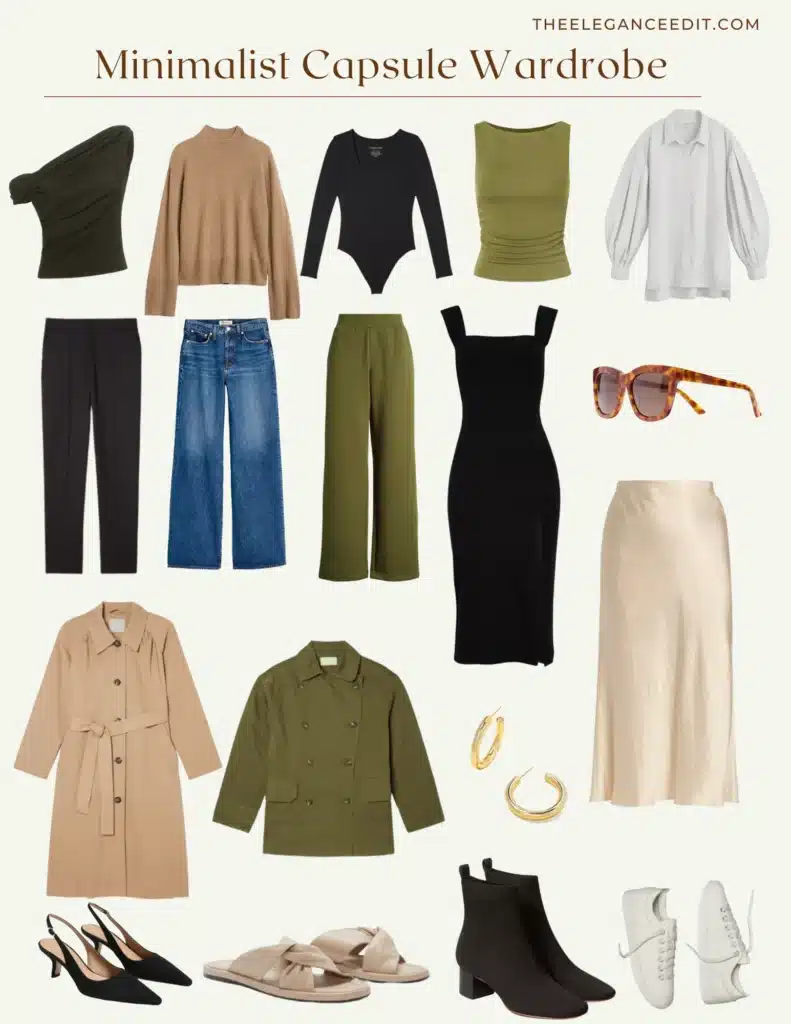
Fabric and color consistency matter more here than most people expect. A wardrobe built entirely in warm neutrals — creams, camels, chocolate browns, soft rusts — will mix and match itself almost automatically, because nearly everything shares an undertone. A wardrobe built with no color logic, where pieces were bought individually without any relationship to each other, will always require more mental effort to combine, no matter how nice any single piece is on its own. If you’re building from scratch, pick a palette of three to four core colors and let almost everything you buy live within that palette, with maybe one or two “wildcard” colors reserved for pieces you genuinely love regardless of whether they fit the system. This single decision does more to make mornings effortless than almost anything else in your control.
A short note on quality over quantity
It’s worth saying directly, because it changes how the whole system compounds over time: fewer, better pieces will always outperform more, cheaper ones, both practically and aesthetically. A well-tailored trouser in a quality fabric holds its shape after fifty wears in a way a fast-fashion equivalent simply won’t, which means your uniform stays reliable rather than degrading a little more every time you do laundry. A knit in a natural fiber drapes differently on the body than a synthetic blend, and that difference in drape is a large part of why some outfits look expensive regardless of what they actually cost, and others look cheap regardless of the price tag.
This doesn’t mean the routine requires an unlimited budget. It means that when you do spend, spending on the neutral base pieces that anchor your uniform — the trousers, the blazer, the knit you’ll wear fifty times a season — will earn its cost back in a way that spending the same amount on five trend pieces you’ll wear five times total never will. Build slowly. Replace one mediocre piece with one excellent piece at a time, rather than trying to overhaul the whole closet at once. The system improves gradually, and it rewards patience far more than it rewards a single big shopping trip.
Frequently asked questions about this routine
What if I genuinely don’t know my “uniform” yet? Start by tracking, not planning. For two weeks, simply note what you wore each day and how you felt in it — confident, comfortable, forgettable, uncomfortable. Don’t try to design your uniform from scratch; let it reveal itself from what already works. Most women are closer to having a uniform than they realize; they just haven’t given themselves permission to notice the pattern and repeat it on purpose.
Doesn’t wearing similar outfits get boring? In practice, less than you’d expect, because a well-built uniform has enough internal variation — different colors, different textures, different combinations of the same silhouettes — that it rarely reads as repetitive to anyone but you. And even to you, the sense of “sameness” tends to fade once you notice how much better you feel in clothes you’ve actually chosen with intention, rather than clothes you’re wearing simply because they were within reach.
What if my mornings are genuinely too chaotic for any of this? Start with the smallest possible version — just the night-before outfit decision, nothing else. Even that alone removes a significant amount of morning friction. The other four steps can be added slowly, one at a time, once the first one feels automatic rather than like one more task on an already full list.
Does this work for more casual or creative dress codes, not just polished office wear? Completely — the framework doesn’t dictate a specific aesthetic. Your “statement piece” might be a vintage band tee instead of a silk blouse, your “neutral base” might be well-worn denim instead of tailored trousers. The structure is aesthetic-agnostic. It’s a system for reducing decision fatigue and building intentional combinations, not a prescription for any single style.
Do I need to buy new clothes to start this routine? No — and this is worth emphasizing, because it’s tempting to treat a new system as an excuse for a new wardrobe. Almost everyone already owns the raw material for at least one solid uniform; the work in the first week is identifying it inside your current closet, not shopping for it. New pieces, when you do eventually add them, should fill specific gaps you’ve actually noticed through use — a missing neutral base, a finishing layer you keep reaching for and not finding — rather than being bought speculatively ahead of need.
How long does it actually take to feel automatic? Most women I’ve walked through this report that the night-before step feels natural within a week, simply because the payoff — a calmer morning — is immediate and reinforcing. The finishing-touch step, ironically the smallest one, tends to take the longest to stick, mostly because it’s the easiest to skip when running late. Give it a month of conscious effort before judging whether it’s “worth it.” By then, it usually isn’t a decision anymore. It’s just what you do.
Closing thought
None of this is really about achieving some external idea of “put together.” It’s about removing enough friction that getting dressed stops being a small daily source of stress and starts being a small daily source of ease — maybe even pleasure, on the mornings you have a little more time to enjoy it. The clothes matter. But they were never the hard part. The twenty minutes before you touch them always were, and now you know exactly what to do with them.
Adjusting the uniform across the seasons
A uniform that only works in one season isn’t really a uniform — it’s a summer outfit or a winter outfit wearing a bigger label. The most useful version of this system carries the same bones across the year and simply changes the materials and layers riding on top of them.
In warmer months, the three-piece formula still holds, but the “layer” piece often becomes the lightest element rather than the heaviest — a linen shirt worn open over a simple tank, a structured straw bag instead of leather, sandals instead of boots. The uniform’s silhouette can stay identical; only the weight and texture shift. This is a useful thing to know when you’re shopping seasonally, because it means you’re not actually rebuilding your wardrobe every few months — you’re re-fabricating the same three or four formulas you already trust.
In colder months, the layer piece becomes structural rather than decorative — a wool coat, a substantial knit, boots that change the whole silhouette’s proportions. This is often where women feel like their style “disappears” for winter, buried under layers that feel purely functional. The fix isn’t to abandon the formula; it’s to make sure at least one of your three pieces stays visually interesting even under a coat. A great scarf, a boot with real character, a coat in a color you actually love rather than the safest possible black — these are what keep a winter uniform from reading as purely protective rather than intentional.
Transitional seasons — the in-between weeks of early spring or late fall — are usually where the routine breaks down first, simply because the weather itself hasn’t decided what it wants to be, and that uncertainty bleeds into the outfit decision. The fix here is almost identical to the fix for unpredictable mornings generally: build two or three “transitional formulas” in advance, on a calm day, rather than trying to invent a solution each morning based on a forecast that might be wrong anyway. A knit with a light jacket that can come off by 10 a.m. Trousers that work with both boots and loafers depending on how the ground looks. None of this needs to be perfect. It needs to exist before the morning you actually need it.
Dressing for yourself, not for an audience
I want to close on something that sits underneath everything else in this article, because without it, the whole system risks becoming just another performance rather than an actual source of ease.
Every step in this routine works better, and feels better, when the underlying question is “does this feel like me” rather than “will this be well received.” Those two questions can produce identical outfits on some mornings and completely different ones on others, and the difference in how you feel wearing the result is enormous. An outfit chosen to be well received by an imagined audience tends to sit slightly wrong on the body — a little too aware of itself, a little too eager. An outfit chosen because it genuinely feels like you tends to sit easily, regardless of how “impressive” it is on paper, and ease is the actual visual signature of elegance, far more than any individual garment could ever be.
This is, in a strange way, the real reason the mirror check in step five matters so much. It’s not a vanity check. It’s a moment to confirm that the outfit in front of you is actually yours — that you’d have chosen it even if no one else were going to see it today. Outfits built on that foundation photograph well, hold up under scrutiny, and, more importantly, feel like relief rather than armor. That’s the entire point of a system like this: not to perform a version of elegance for an audience, but to remove enough friction that the truest, calmest version of your own style has room to actually show up, morning after morning, without a fight.
A simple checklist for the mornings you need one
Some mornings you won’t have the bandwidth to think through five steps in the abstract, and that’s fine — that’s exactly when a short, concrete checklist earns its keep. Keep something like this taped inside your closet door, or saved as a note on your phone, for the days your brain needs a shortcut rather than a philosophy.
Before bed: check tomorrow, check the weather, choose the outfit, set it out with one accessory. Four small actions, none of them requiring creativity, all of them requiring is five minutes and a willingness to think about tomorrow slightly before you have to live it.
On waking: phone stays put, light before screens, one slow ritual instead of a rushed one. This is less a checklist than a permission slip — permission to take the ninety seconds you almost certainly do have, even on a busy day, rather than assuming you don’t.
Getting dressed: statement piece, neutral base, finishing layer. Three questions, answered in order, each one narrower than the last, until the outfit is simply complete rather than agonized over.
Before you leave: scent last, one honest look in the mirror, one true question — does this feel like me today. If the answer is yes, you’re done. If the answer is no, you’ll usually already know exactly what small thing to change, because you gave yourself the moment to notice.
None of this checklist requires new purchases, a closet renovation, or a personality transplant. It requires believing that the twenty minutes before you get dressed are not a waste of time you’re too busy for, but the actual mechanism by which “effortless” gets manufactured in the first place. Effortless was never about doing less. It was always about deciding earlier, so that by the time the moment arrives, there’s nothing left to decide.
That’s the whole system. Five steps, most of them small, none of them requiring more time than you already have — just a slightly different place to spend it. Try it for a week before you judge whether it works. Most women who do find they can’t quite go back to getting dressed the old way, not because the old way was so terrible, but because this way is quietly, consistently easier, and ease, once you’ve felt it daily, is very hard to give up.
This is, at its core, what a considered personal style is actually built from — not a single dramatic wardrobe overhaul, but a hundred small, calm mornings stacked on top of each other, each one slightly easier than it would have been without a system underneath it. If there’s one thing worth carrying forward from all of this, let it be that: elegance is rarely the result of trying harder in the moment. It’s the quiet, compounding result of deciding earlier, so the moment itself can simply be lived, rather than managed.