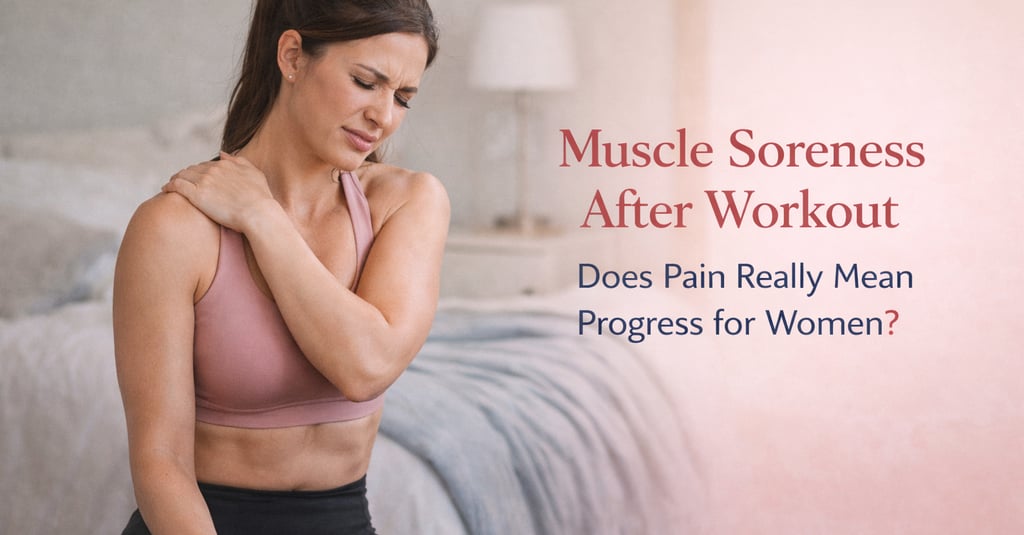
If I woke up the next morning and felt nothing, I was disappointed. Sometimes even a little annoyed at myself. I would think, “Did I even train properly?” If my legs didn’t burn when I walked down the stairs, or my arms didn’t ache when I lifted my coffee cup, I assumed something was missing. Somewhere along the way, many of us absorbed the idea that pain equals progress. No soreness, no results.
I hear this from women all the time. As a personal trainer, one of the most common worries my clients share is this: “I’m not sore at all. Does that mean the workout wasn’t effective?” Some even feel like they failed if they don’t experience muscle soreness the day after training. And I understand where this belief comes from. We scroll through social media, we see extreme workouts, we hear phrases like “no pain, no gain,” and slowly it becomes part of how we judge our own effort.
But the more I learned about the body – and the more I trained women consistently over time – the clearer it became that muscle soreness is a very poor indicator of training quality. In fact, it can be deeply misleading.
What feels logical at first glance doesn’t always reflect what’s actually happening inside the body. If soreness meant effectiveness, then the most painful workout would always be the best one. But we all know that destroying ourselves in training doesn’t automatically lead to better results. Sometimes it leads to burnout, injuries, or long breaks from movement. And sometimes the most effective training feels surprisingly “normal.” Challenging, yes. Stimulating, yes. But not necessarily painful the next day.
For a long time, people believed that muscle soreness was caused by lactic acid building up in the muscles. Lactic acid is a byproduct of carbohydrate breakdown under low-oxygen conditions, meaning it appears when the muscles work so intensely that oxygen delivery can’t keep up with the demand. This happens mostly during very high-intensity, short-duration efforts, like sprinting 400 to 1500 meters or performing near-maximal efforts without rest. In those moments, the body temporarily shifts to anaerobic energy production, and lactic acid accumulates. This can create a burning sensation during the activity itself.
But here’s the important part: lactic acid is cleared from the body relatively quickly, usually within about 20 minutes after the effort ends, assuming normal liver function and recovery. So the soreness you feel one or two days later simply cannot be caused by lactic acid. The timeline doesn’t match. This alone tells us that delayed muscle soreness and lactic acid are not the same thing, even though this myth still circulates widely.
Later, another explanation became popular: the idea that muscle soreness comes from microtears in the muscle fibers. According to this theory, intense or unfamiliar training causes tiny structural damage in the muscle tissue, leading to inflammation and pain, and during the repair process, muscles grow stronger and thicker. There is some truth here in the sense that mechanical tension and structural stress are part of muscle adaptation. Muscles do adapt to load. However, research has not been able to show a clear, direct relationship between the amount of soreness you feel and how effective the training stimulus actually was for building strength or muscle.
In other words, you can create the conditions for muscle adaptation without necessarily feeling sore, and you can feel very sore without triggering meaningful long-term progress. Soreness and results do not move in perfect harmony.
What’s even more fascinating is that more recent research suggests muscle soreness may not primarily come from muscle tissue damage at all. Instead, it may be more closely linked to the nervous system, specifically to sensory structures called muscle spindles. Muscle spindles run parallel to muscle fibers and play a key role in sensing stretch and changes in muscle length. They are part of how your nervous system controls movement and protects you from excessive strain.
Certain types of movements – especially slow, controlled, lengthening contractions, known as eccentric contractions – place unique stress on these sensory structures. Think of slowly lowering yourself down in a push-up, or carefully lowering a weight instead of dropping it. These controlled braking movements challenge the neuromuscular system in a different way than simple lifting or pushing. In people who are not accustomed to this type of load, or when the nervous system is not well adapted to the movement, these sensory fibers may experience microscopic compression or irritation. This neural irritation can contribute significantly to the sensation we label as “muscle soreness.”
This perspective helps explain something many of us have experienced: why certain types of workouts cause more soreness than others, even when the overall effort level seems similar. It also explains why beginners often feel much more soreness than trained individuals. The muscles themselves may be capable of handling the load, but the nervous system is still learning how to coordinate and tolerate that specific pattern of movement. Over time, as the nervous system adapts, soreness decreases – even if the training remains challenging and effective.
This is also why you might notice soreness appearing more in some body parts than others, even when you train your whole body in a balanced way. Different muscles and movement patterns stress the neuromuscular system differently. Novelty plays a big role too. The body reacts strongly to new stimuli. Do a new exercise, a new tempo, or a new movement pattern, and soreness is more likely to appear. Repeat the same type of training for a few weeks, and the soreness often fades, even though progress continues.
This is where many women get confused. They think, “I’m not sore anymore, so the workout must be too easy.” But what’s really happening is adaptation. The nervous system and muscles have learned how to handle that type of load more efficiently. That is a sign of progress, not stagnation.
One of the most interesting practical ways to feel this difference is by playing with movement tempo. If you take a simple exercise like a push-up and perform the lowering phase very slowly – for example, taking six seconds to lower your body and two seconds to push back up – you are emphasizing eccentric control. Many people feel more soreness after this kind of session, especially if they’re not used to slow, controlled movements. If you then repeat the same number of push-ups a few days later with a more natural tempo, lowering and pushing up at the same speed, you might notice far less soreness, even though the exercise is technically the same.
What changes is not just the muscle load, but how the nervous system experiences and manages the movement. This shows how misleading soreness can be as a marker of training quality. The same exercise can produce different soreness responses depending on how it’s performed, how familiar the movement is, and how adapted your nervous system is to that pattern.
From a long-term training perspective, this is freeing. It means you don’t need to chase soreness to make progress. Strength can improve without soreness. Muscle can grow without soreness. Fitness can improve without soreness. In fact, constantly trying to create soreness can be counterproductive. It may push you to train too aggressively, disrupt recovery, and make it harder to train consistently. And consistency, not soreness, is what actually drives results over time.
I’ve seen women who were constantly sore but stuck in the same place for months. I’ve also seen women who rarely felt sore but steadily became stronger, more confident, and more capable in their bodies. The difference was not pain tolerance. The difference was structure, progression, and consistency.
This also changes how we think about “effective training.” Effective training is not about how destroyed you feel afterward. It’s about whether the training stimulus matches your current level, whether it challenges you enough to promote adaptation, and whether it allows you to recover and come back again. Effectiveness lives in the balance between stress and recovery. Soreness is just one possible byproduct of that stress, not a reliable scorecard.
There is also an emotional layer to this. Many women feel that if training doesn’t hurt, they didn’t “earn” the right to feel proud of themselves. This belief is deeply ingrained. We’ve been taught to associate discomfort with worthiness. But movement doesn’t need to be punishment to be meaningful. Training can be challenging, focused, and purposeful without leaving you barely able to walk the next day. You don’t have to suffer to deserve progress.
Over time, I learned to shift my own internal measure of a good workout. Instead of asking, “Am I sore?” I started asking, “Did I show up with presence? Did I challenge myself appropriately? Did I move with good quality? Do I feel a little more capable today than I did a few weeks ago?” These questions tell me far more about the effectiveness of my training than soreness ever could.
If you’re someone who feels disappointed when you’re not sore after training, I gently invite you to reframe what success looks like. Soreness is not failure, but its absence is not failure either. Your body adapts. Your nervous system learns. That’s progress. The goal of training is not to shock your system over and over again, but to build a body that is resilient, capable, and sustainable in the long run.
Ironically, the more consistent and intelligent your training becomes, the less dramatic soreness often feels. And that’s a good thing. It means your body is learning how to handle load. It means you’re building capacity instead of constantly tearing yourself down.
So the next time you wake up without soreness after a workout, don’t assume the session “didn’t work.” Ask yourself how your body feels when you move, how your strength is changing over time, how your energy responds to training. Those are the quiet, reliable signs of effectiveness. Soreness is loud and dramatic, but progress is often subtle – and far more meaningful in the long run.