
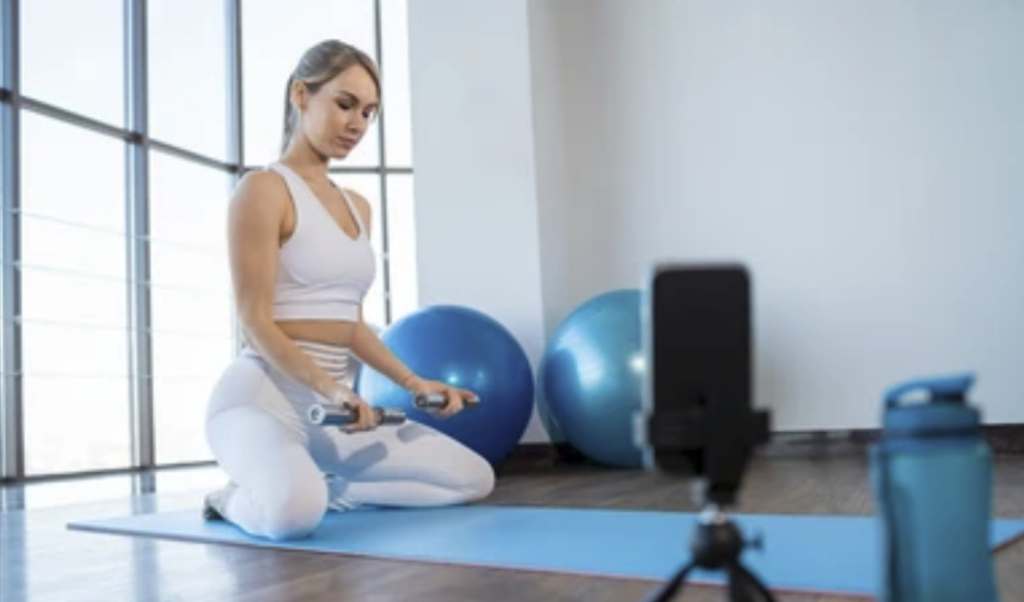
I didn’t plan to become someone who writes about fitness.
If you had met me years ago, you would have seen a woman constantly negotiating with her own energy. Some days I felt motivated, inspired even. Other days, the thought of moving my body felt like a chore I quietly avoided. Fitness wasn’t a lifestyle back then. It was something I dipped into, fell out of, tried again, doubted, restarted — a cycle that felt more emotional than physical.
The funny thing is, blogging entered my life the same way.
Unplanned. Slightly messy. Deeply personal.
I still remember the first time I opened a blank page and tried to write about my fitness journey. Not the polished version. Not the “after” photo version. Just the real one. The one where workouts were inconsistent, motivation fluctuated, and confidence came in fragile waves. My hands hovered over the keyboard longer than I want to admit, because writing honestly felt more vulnerable than showing progress photos ever did.
But that’s where my blog truly began — not in expertise, but in experience.
And maybe that’s why fitness blogging feels so intimate. It isn’t just about sharing routines or advice. It’s about letting someone quietly walk beside your journey. Letting them see the behind-the-scenes moments: the mornings when your alarm feels cruel, the afternoons when stress drains your energy, the evenings when a small workout feels like a victory no one else witnesses.
I think many women who blog about fitness understand this silent duality. We are both the storyteller and the subject. The coach and the learner. The confident voice and the self-doubting one.
There were days when I questioned whether my story was worth telling. The online space already seemed full of confident trainers, structured guides, transformation narratives that looked seamless. I worried that my experience — imperfect, emotional, nonlinear — might feel too ordinary to matter.
But ordinary is where most of us live.
Not in dramatic transformations, but in small, quiet choices. Choosing to move even when motivation is low. Choosing patience when results take time. Choosing self-compassion after setbacks. These moments rarely go viral, but they shape the relationship we build with our bodies.
And blogging gave me a way to hold those moments gently instead of rushing past them.
My early posts were awkward. Too long in some places, too careful in others. I tried to sound knowledgeable while hiding uncertainty. I worried about grammar, structure, whether my thoughts were “useful enough.” Looking back, I see a woman trying to prove something instead of simply sharing.
That changed gradually.
One evening, after a workout that felt emotionally heavier than physically challenging, I wrote about exhaustion — not muscle fatigue, but mental burnout. I wrote about how fitness can sometimes feel like another expectation instead of a refuge. How scrolling through social media can make progress feel insufficient. How rest can feel undeserved even when the body asks for it.
I almost didn’t publish that post.
But I did.
And the responses weren’t about workout tips or performance improvements. They were about recognition. Women sharing that they felt the same. That they loved movement but struggled with consistency. That they felt guilty on rest days. That they longed for a gentler approach to fitness.
That moment shifted something inside me.
I realized readers weren’t looking for perfection. They were looking for presence.
Fitness blogging, at its best, isn’t about demonstrating expertise from a distance. It’s about sitting beside the reader emotionally. Saying, without saying, I understand this feeling too.
And when writing comes from lived experience, that understanding naturally flows between the lines.
There’s a quiet intimacy in long-form blogging that shorter content often misses. Social media captures highlights — quick workouts, snapshots, captions. But a blog allows you to linger. To unpack thoughts slowly. To explore the emotional layers behind physical routines. To talk about what happens beyond the visible progress.
I began to lean into storytelling without even realizing it.
A post about strength training became a story about overcoming gym intimidation. A post about running turned into reflections on solitude and mental clarity. A post about meal prep transformed into memories of learning to nourish my body instead of restricting it.
Fitness stopped being the topic.
It became the setting.
The real subject was growth.
And growth, I’ve learned, is rarely dramatic. It’s subtle. Sometimes invisible. It shows up in mindset shifts more than physical changes. In the way you speak to yourself after a missed workout. In the patience you develop when results take time. In the quiet pride of consistency that no one else tracks.
Blogging allowed me to notice those shifts.
There’s something deeply grounding about writing after a workout — not to analyze performance, but to capture emotion. The warmth in your muscles. The calm in your mind. The sense of accomplishment that exists regardless of intensity. Writing about these feelings made me more present in my journey, more appreciative of the process rather than fixated on outcomes.
And over time, I started to understand my readers differently too.
They weren’t just visitors looking for information. They were women navigating similar questions. Women balancing responsibilities, emotions, expectations, and personal goals. Women trying to build strength while unlearning unrealistic standards. Women seeking not only guidance but reassurance.
That awareness shaped my writing voice.
I stopped positioning posts as instructions and started framing them as reflections. Instead of telling readers what they should do, I shared what I was learning. Instead of presenting routines as solutions, I described them as experiments. Instead of hiding struggles, I allowed them to exist openly.
Because honesty builds trust in ways polished perfection never can.
I remember a phase when my workouts felt repetitive and uninspired. The excitement that once fueled my routines faded, replaced by obligation. Writing about that boredom felt risky — as if admitting it might undermine my credibility. But the truth is, boredom is part of any long-term habit. Consistency doesn’t always feel exciting. Sometimes it feels quiet, even mundane.
When I shared that experience, readers responded with relief. They weren’t alone in feeling it. And suddenly boredom became less of a failure and more of a shared human experience.
That’s the quiet magic of blogging.
It transforms personal moments into collective understanding.
Over time, I also became more mindful of how a blog feels visually and emotionally. Reader experience isn’t just about words. It’s about rhythm. Space between paragraphs. Images that reflect mood. The emotional pacing of the story.
A photo of a sunrise before a run.
A candid gym mirror moment.
A cup of coffee beside a training journal.
A messy kitchen after meal prep.
A quiet stretch on the living room floor.
These images don’t just decorate posts. They create atmosphere. They invite readers into your world gently, allowing them to pause between thoughts. Sometimes a single photo carries emotion words struggle to capture.
I’m not a professional photographer, but I’ve learned to appreciate imperfection. Natural light, candid movement, genuine moments — they tell stories more authentically than staged perfection. Editing becomes less about altering reality and more about highlighting mood.
And mood matters in storytelling.
Because fitness isn’t lived in perfect lighting or controlled environments. It happens in messy living rooms, crowded gyms, quiet streets, unpredictable schedules. Capturing that reality makes a blog feel human.
There were moments when I doubted whether my blog had a place in such a saturated space. So many voices, perspectives, approaches. But eventually I understood something simple yet freeing.
No one else has lived your exact journey.
Not your relationship with movement.
Not your emotional landscape.
Not your personal history with your body.
Not your perspective on growth.
Your voice doesn’t need to be unique in topic.
It’s unique in experience.
That realization softened the pressure to stand out and replaced it with a desire to show up authentically. To write with sincerity rather than strategy. To trust that resonance matters more than reach.
As my blog evolved, so did my understanding of fitness itself.
It stopped being about chasing an ideal and became about building a relationship with my body. A relationship that required listening, patience, forgiveness. Writing about that relationship made me more compassionate toward myself. It turned setbacks into reflections instead of failures.
There were times when life disrupted routines — stress, emotional fatigue, shifting priorities. Instead of hiding those interruptions, I began to explore them through writing. What did inconsistency teach me? How did rest shape my mindset? What did returning to movement feel like emotionally?
These questions deepened my connection to fitness beyond performance.
And readers seemed to appreciate that depth. Not because it offered clear answers, but because it reflected real experiences. The kind that rarely fit into neat narratives.
Blogging also became a mirror for personal growth outside fitness. Writing about discipline led to reflections on boundaries. Writing about strength opened conversations about resilience. Writing about rest explored themes of self-worth. Movement became a lens through which I understood myself more clearly.
There’s something powerful about documenting growth in real time. It captures the evolution of thoughts, beliefs, and emotions. Looking back at older posts, I see not just physical progress but emotional maturity. Greater patience. Softer self-talk. A more balanced perspective on success.
And that’s what keeps me writing.
Not the idea of being an authority, but the opportunity to witness and share transformation in its quietest forms.
Some nights, after finishing a post, I sit with a sense of calm that’s hard to describe. Writing becomes a form of reflection, almost meditation. A way to process experiences instead of rushing through them. A way to honor small moments that might otherwise fade into routine.
And maybe that’s why long-form blogging still matters in a fast digital world.
It offers space.
Space to think.
Space to feel.
Space to explore complexity.
Space to connect without urgency.
When a reader spends time with a post, it feels less like content consumption and more like shared reflection. A silent conversation unfolding across distance. That intimacy is something I deeply value.
If there’s one thing I’ve learned from this journey, it’s that meaningful blogging doesn’t come from trying to impress. It comes from paying attention. To your experiences. Your emotions. Your questions. Your evolving perspective.
It comes from writing the post you needed to read at some point in your journey.
Tonight, as I write this, the house is quiet again. The familiar hum of everyday life surrounds me — distant sounds, soft light, the gentle fatigue that follows movement. My body feels grounded. My mind reflective. And there’s a quiet gratitude for the path that led me here, not perfectly but authentically.
Blogging didn’t give me all the answers about fitness. But it gave me a space to explore the questions. A space to document growth with honesty. A space to connect with women whose journeys intersect with mine in unexpected, beautiful ways.
And maybe that’s enough.
Maybe a fitness blog doesn’t need to be flawless or revolutionary. Maybe it just needs to feel real. To hold moments of vulnerability alongside strength. To celebrate progress while acknowledging struggle. To remind readers — and ourselves — that growth is rarely linear, but always meaningful.
I close my laptop slowly, not with the sense of finishing a task, but with the quiet satisfaction of having shared something true. Somewhere, someone might read these words and recognize a piece of their own journey. That recognition, subtle yet powerful, is what keeps me returning to this space.
Not to perform.
Not to prove.
But to connect.
And in that connection, fitness becomes more than movement. It becomes a shared story — imperfect, evolving, deeply human — one that continues unfolding, one post at a time.