
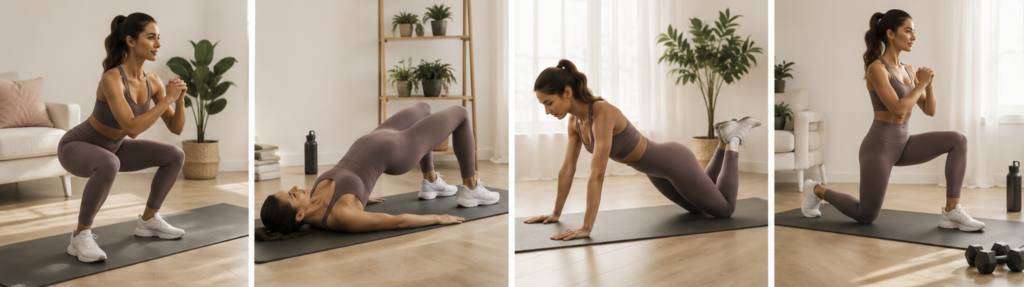
SIMPLE FULL-BODY EXERCISES AT HOME
A complete guide to moving your whole body with confidence, grace, and zero equipment — right where you already are
Because strength was always something you were building. You just hadn’t started yet.
There is a version of this story that I’ve heard from so many women that it’s starting to feel like a collective experience rather than a personal one. It goes like this: you decide you want to start working out. You buy something — trainers, a mat, a new set, maybe a subscription to something with a complicated app. You feel the genuine surge of beginning-energy that makes the first week feel effortless and the second week feel slightly less easy and the third week feel like the project has somehow ended without you deciding to end it. The mat is still there, in the corner. The trainers are still clean.
I’ve been this woman multiple times. The version of me who bought a gym membership and used it precisely four times. The version who downloaded three different workout apps in one month and abandoned each within a fortnight. The version who took one reformer Pilates class, found it unexpectedly difficult and slightly humiliating, and didn’t go back for six months.
What I didn’t understand for a long time — and what I want to tell you clearly at the start of this guide, before we get to a single exercise — is that all of those attempts weren’t failures of willpower or consistency or discipline. They were failures of fit. The format didn’t fit my life, the intensity didn’t fit where my body was, the environment didn’t fit my psychology. And when the format doesn’t fit, the most disciplined person in the world will eventually stop showing up.
Home workouts fit most women’s lives better than almost any other format. Not better than Pilates, not better than swimming, not better than running — those things are wonderful if they work for you. But home workouts remove the most significant friction points that cause women to abandon fitness practices: the commute, the cost, the schedule inflexibility, the social anxiety of a new environment, the requirement to have your life organized enough to arrive somewhere at a specific time in specific clothes. When none of those barriers exist, the bar for showing up drops dramatically. And consistency — not intensity, not perfection, not the most comprehensive programme — is what produces results.
This guide is a full-body beginner home workout programme, built specifically for women who are starting fresh or returning after a significant break. It covers every major muscle group, uses no equipment whatsoever, and is designed to be genuinely doable in the space and time most women realistically have access to. But it’s also more than a list of exercises. It’s a framework for understanding your body, building a relationship with movement, and developing the kind of consistent practice that actually sticks — not for three weeks, but for the long, beautiful, capable rest of your life.
Full-Body Training: Why Beginners Get Better Results Than They Expect
When I started training consistently at home — really consistently, not the aspirational kind but the actual showing up three times a week kind — I expected results to be slow. I expected the modest kind of progress that you hear about when people talk about ‘lifestyle changes’: subtle, gradual, requiring months of patience before anything visibly or perceptibly changes. What I got instead was a series of small, accumulating surprises that arrived faster than I’d anticipated.
The first was postural. Within three weeks of regular movement that included core and back work, I was holding myself differently. Not dramatically — I hadn’t transformed into someone who looked like they’d done ballet since childhood. But there was a quality of uprightness that started showing up in photographs, a slightly more open quality to my shoulders, a sense of my spine being longer than it used to be. My neck tension, which I’d attributed entirely to stress, reduced significantly. My lower back ached less.
The second surprise was energetic. The particular tiredness of being sedentary — that counterintuitive exhaustion that comes from not moving — started to lift. I slept more deeply. I felt more alert in the mornings. The mid-afternoon energy dip that had been a reliable feature of my days became less dramatic and more manageable. None of this was dramatic. All of it was real.
These early results are characteristic of full-body training specifically, and they’re why I believe a full-body programme is the right starting point for beginners rather than the split routines (training different body parts on different days) that advanced gym-goers use. When you train your entire body in each session, you’re creating a comprehensive stimulus that produces systemic adaptation — not just in the specific muscles you’re targeting, but in your cardiovascular system, your nervous system, your posture, your hormonal balance, and your overall energy. The whole-body approach is simply more efficient for women starting out, and the results show up more broadly and more quickly.
What ‘Full Body’ Actually Means in Practice
A full-body workout doesn’t mean doing every possible exercise for every possible muscle in a single session. It means ensuring that each session includes movement patterns that engage all the major muscle groups and joint systems: pushing movements (which train the chest, shoulders, and triceps), pulling movements (which train the back and biceps), lower body movements (which train the glutes, quadriceps, and hamstrings), core movements (which train the deep stabilizers and the superficial abdominal muscles), and some form of cardiovascular work (which trains the heart, lungs, and overall metabolic capacity).
In a bodyweight context, these patterns translate to push-ups and their variations (pushing), rows using a door or table edge (pulling), squats and lunges (lower body), planks and their variations (core), and jumping or higher-intensity movement patterns (cardio). Together, these patterns create a session that addresses the whole body and produces the kind of systemic adaptation I described above — not a narrow, specific adaptation to a particular machine or movement, but a broad, functional improvement in your general physical capacity.
For beginners, full-body sessions also have a pedagogical advantage: you learn to move in multiple patterns each session, building body awareness and movement vocabulary more quickly than you would if each session had a single focus. By the end of the first month of a full-body programme, most women have developed a significantly more sophisticated understanding of their own movement and muscle engagement than they would have from an equivalent time on gym machines.
The Science Behind Beginner Gains (And Why the First Few Months Are Special)
Here is something genuinely exciting that most fitness guidance doesn’t communicate clearly enough: beginners gain strength and fitness faster than intermediate or advanced exercisers. This sounds counterintuitive — shouldn’t experienced exercisers, with their better technique and greater capacity, make faster progress? — but it reflects a real physiological phenomenon called ‘newbie gains,’ and understanding it changes how you approach and experience your first months of training.
When you’re new to exercise, your initial strength gains come primarily from neural adaptation — your nervous system becoming more efficient at recruiting muscle fibers and coordinating movement patterns. This neural adaptation happens quickly, within the first four to eight weeks of consistent training, and produces rapid improvements in strength and movement quality that feel dramatic precisely because they’re not yet limited by the slower process of actual muscle tissue growth. You are literally getting better at using the body you already have, before you’ve even begun to change it.
The practical implication is that the first few months of a consistent home workout practice will feel like the most rapid period of improvement you’ll experience. Exercises that felt impossible in week one feel accessible by week three. The cardiovascular sessions that leave you breathless in the first fortnight feel manageable by week six. Every woman who has been consistent with a beginner programme reports this kind of telescoped progress, and it’s one of the most motivating features of being new to exercise — the return on each session is higher than it will ever be again.
You have never been better positioned to improve than you are right now, at the beginning of something.
◦ ◦ ◦
Your Space, Your Equipment, Your Ritual: Setting Up for Success
I want to spend real time on this before we get to the exercises, because the setup — the physical environment, the objects you use, the rituals you create around the practice — has an outsized effect on whether a home workout practice becomes permanent or remains aspirational.
There’s a reason that the wellness aesthetic has become so prominent across social media platforms in 2025 and 2026. The clean girl morning routine with its matching set and its rolled-out mat and its specific playlist isn’t just performative — it’s an expression of the truth that environment shapes behavior. When your workout space feels intentional and pleasant, you are more likely to use it. When the ritual around working out feels like something you’re choosing rather than something you’re forcing yourself into, the psychological resistance decreases.
This doesn’t require money or a large space. It requires thought and a little bit of care.
Creating a Space That Invites Movement
The minimum spatial requirement for the programme in this guide is a floor area of roughly two metres by one metre — enough room to lie down fully extended and to stand with arms raised overhead without hitting anything. In most homes this exists, whether it’s the end of a bedroom, a section of a living room with a coffee table moved, a hallway, or, weather permitting, an outdoor space.
What makes a space feel like a workout space rather than just a floor? The physical cues that signal ‘this is where I move’: a mat rolled out, a window opened, a specific object that you only interact with in the context of working out. These are tiny environmental prompts that, repeated consistently, become powerful behavioral anchors. Your brain, encountering these cues, begins to shift into the state that supports movement before you’ve done a single thing.
I keep a particular candle near my workout space that I light only during workouts. This is objectively a small and slightly ridiculous thing, and it works with a reliability that I find both amusing and instructive. The scent has become associated, through simple conditioning, with the state of being ready to move. Lighting it is the signal that the session is beginning. It has not once failed to create that shift.
Natural light makes an enormous difference if it’s available. Movement in natural light feels more energizing than movement under artificial light, and the psychological effect of a sun-lit space in the morning is real and well-documented. If your space has a window, exercise near it and keep the curtains open. If your space is naturally dark, consider the warmth and colour of your artificial light — cooler, brighter light is more activating for morning sessions than the warm, dim lighting that suits evenings.
The Activewear Conversation: Dressed to Move
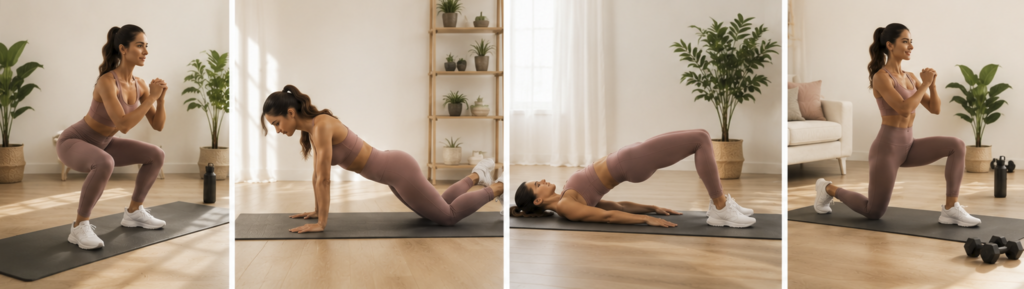
The intersection of fitness and fashion has never been more aesthetically rich than it is right now. The 2025 and 2026 activewear landscape has undergone a genuine aesthetic evolution: the neon, logo-heavy, performance-forward aesthetic of the 2010s has given way to something more considered, more wearable, and frankly more beautiful. The tone is quieter, the palette more nuanced — warm taupes, dusty mauves, sage greens, rich chocolates, soft creams — and the silhouettes have shifted toward fit that feels elevated rather than purely functional.
The matching set has become genuinely aspirational in a way that gym clothes never quite were before, and the brands driving this — along with a wave of contemporary European and Scandinavian activewear labels — have positioned their pieces as part of a broader lifestyle aesthetic rather than simply workout clothes. The woman in the coordinated earth-tone legging and sports bra set is not performing fitness. She is expressing a sensibility that happens to extend into how she moves.
I say all of this not to suggest that you need to spend significantly on activewear before you can start moving. You absolutely don’t. Your oldest, most comfortable clothes are perfectly valid workout clothes. But there’s something worth acknowledging: the psychology of dressing for a practice is real. When you put on clothes that make you feel good and that you associate with movement, the transition into workout mode happens more smoothly. A single piece of activewear that you genuinely love — not a full set, not an expensive wardrobe, just one thing that feels like yours — can function as a ritual object as powerful as the candle I described above.
What to look for practically: fabric that moves with you rather than against you, a waistband that stays in place during dynamic movement, a top that doesn’t ride up or get in the way during floor work, and enough coverage to allow you to exercise without self-consciousness. Bare feet are excellent for home workouts — they improve proprioception (your body’s sense of its own position in space) and are more stable than socks on most surfaces. Grip socks, if your floor is slippery, are the functional addition worth having.
◦ ◦ ◦
The Complete Full-Body Programme: Every Exercise, Fully Explained
What follows is a complete, structured full-body home workout programme for beginners. I’ve organized the exercises into three distinct workout sessions — Lower Body Focus, Upper Body and Core Focus, and Full-Body Circuit — each of which trains the entire body but with a different emphasis and energy. Together, they form a three-day weekly schedule that covers all movement patterns and provides balanced stimulus across the body.
Every exercise is described in enough detail to perform correctly without a mirror or an instructor, with specific attention to form cues, breathing, the specific muscles being trained, and the modifications available if the standard version is too challenging initially. This level of detail is intentional — form is the foundation of effective and safe training, and learning to move well from the beginning is far more valuable than moving fast and carelessly.
Before each workout, you’ll do a five-minute warmup. After each workout, a five-minute cooldown. Neither is optional if you want the sessions to feel good and produce the adaptation you’re working toward.
The Universal Warmup: Five Minutes That Change Everything
Every session begins here, without exception. The purpose of a warmup is threefold: to increase the temperature of your muscles (warm muscles are more elastic and less injury-prone), to lubricate the joints with synovial fluid, and to activate the nervous system for the movement patterns you’re about to use. A body that has been warmed up performs measurably better than a cold one — the exercises feel easier, the range of motion is greater, and the risk of the kinds of strains and pulls that make you reluctant to come back is significantly lower.
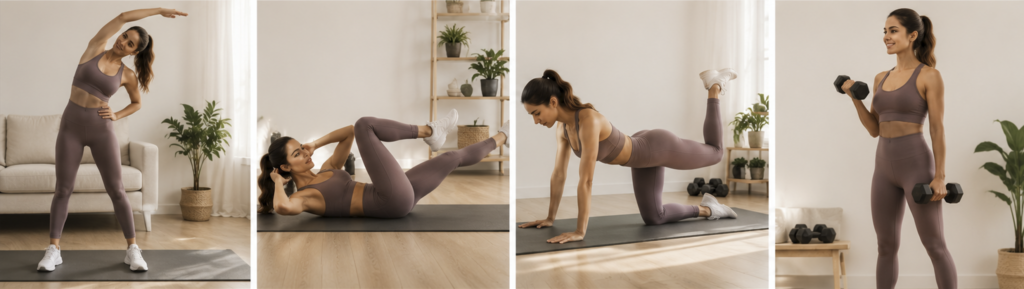
Neck Rolls · Drop your chin toward your chest and slowly roll your head from side to side, pausing wherever you feel tension. Eight slow rolls. This releases the neck and upper trapezius tension that most women carry from desk work and phone use, and prepares the cervical spine for any overhead or upper body movement.
Shoulder Rolls · Roll your shoulders backward in large, slow circles — ten times — then forward ten times. Feel the space opening in the front of the chest and the movement in the shoulder blade across the back. This mobilizes the entire shoulder girdle, which is involved in every upper body exercise.
Thoracic Rotation · Stand with feet shoulder-width apart and extend your arms at chest height. Keeping your hips square, rotate your torso to look over your right shoulder, then left. Twelve slow repetitions each direction. This mobilizes the mid-back, which stiffens significantly in women who sit for long periods, and prepares the spine for all movement.
Hip Circles · Hands on hips, feet hip-width apart. Slowly rotate the hips in large circles — ten in each direction. This movement lubricates the hip joint and activates the hip flexors, glutes, and the deep rotator muscles that stabilize the pelvis during lower body exercises.
Leg Swings · Hold a wall lightly for balance. Swing one leg forward and back in a controlled pendulum motion, gradually increasing the range. Ten swings, then switch legs. Then swing each leg laterally — across the body and out to the side — ten times. This dynamically warms the hip and hamstrings and improves the range of motion available for squats and lunges.
Inchworm · Stand tall, then bend forward and walk your hands out until you’re in a plank position. Hold one second, then walk your feet in to meet your hands. Stand and repeat. Six repetitions. This single exercise warms the hamstrings, shoulders, core, and wrists simultaneously, and is one of the most efficient warmup exercises that exists.
Jumping Jacks or Step Jacks · One minute of jumping jacks to elevate the heart rate and body temperature, completing the warmup. For low-impact, step one foot out at a time rather than jumping. By the end of this minute, you should feel warm, slightly breathless, and ready to work.
Workout One: Lower Body Focus
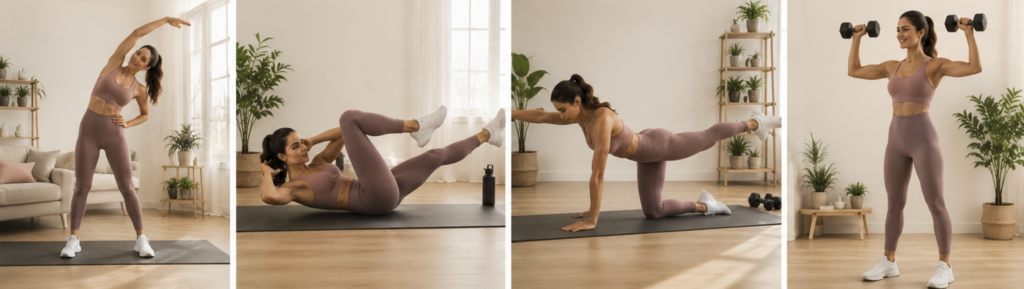
This session places its primary emphasis on the muscles of the lower body — the glutes, quadriceps, hamstrings, and calves — while also engaging the core throughout, because the core is involved in virtually every movement that keeps you upright. Lower body training is arguably the highest-return area of fitness for women: the large muscle groups of the legs and glutes are metabolically active, meaning they burn more energy than smaller muscle groups, they’re the primary drivers of functional movement in daily life, and they’re the area where women tend to see and feel the most significant visible results from consistent training.
The session consists of six exercises performed in three sets each, with sixty to ninety seconds of rest between sets. Adjust the rest time based on how you feel: if you’ve recovered your breath and the targeted muscles feel ready to work again, proceed. If you’re still significantly fatigued, take the full ninety seconds or slightly longer. Recovery is not weakness. It’s physiology.
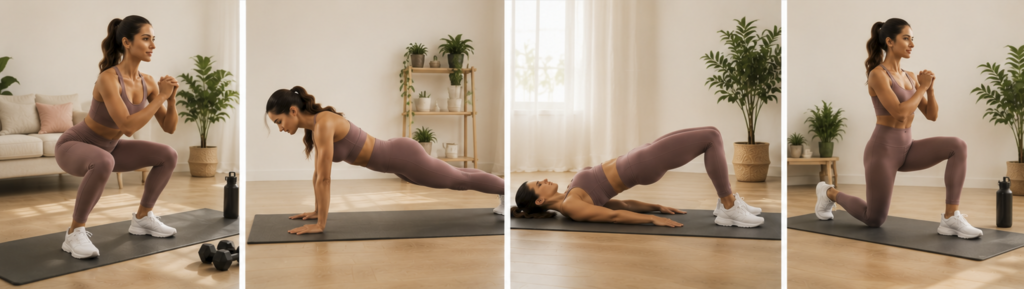
Bodyweight Squat · Stand with feet hip-to-shoulder-width apart, toes pointing slightly outward (the angle that feels natural to your hips — this varies between bodies). Keep your chest lifted and your weight distributed across your whole foot — not just the heels. Push your hips back and down as though you’re sitting into a chair behind you, lowering until your thighs approach parallel to the floor or as far as your current mobility allows. Drive through the whole foot to return to standing, engaging the glutes at the top. Three sets of fifteen to twenty repetitions. Breathe in as you lower, out as you rise. This is the foundational lower body exercise, training every major muscle from waist to ankle.
Reverse Lunge · Stand tall with feet together. Step one foot directly backward and lower your back knee toward the floor, stopping before it makes contact. Your front shin should be roughly vertical — check that your front knee isn’t caving inward or extending far past your toes. Press firmly through your front heel to return to standing. Three sets of twelve repetitions per leg, alternating sides or completing all reps on one side before switching. The reverse lunge prioritizes the glutes more than the forward lunge and is significantly kinder to the knee joint, making it the better choice for beginners.
Sumo Squat · Take a stance wider than your shoulders with your toes turned out to roughly forty-five degrees. Lower your hips straight down between your knees — not back as in a regular squat, but downward. At the bottom, your knees should be tracking over your toes. Squeeze the inner thighs and glutes to return to standing. Three sets of fifteen repetitions. The sumo stance shifts the emphasis from the quadriceps to the inner thighs and glutes, and the wider stance allows women with hip mobility limitations to squat more deeply than the standard position permits.
Glute Bridge · Lie on your back, knees bent, feet flat on the floor about hip-width apart and close enough to your glutes that you could almost touch your heels with your fingertips. Press firmly through both feet and lift your hips toward the ceiling until your body forms a straight diagonal from shoulders to knees. At the top, squeeze your glutes deliberately — really contract them, don’t just hold the position — then lower with control. Three sets of fifteen to twenty repetitions with a two-second hold and squeeze at the top. The glute bridge is the most direct exercise for the gluteus maximus available in bodyweight training. It is deceptively simple and profoundly effective.
Single-Leg Glute Bridge · Set up exactly as for the regular glute bridge, then extend one leg straight, hovering it above the floor at the same height as the bent knee. From this position, press through the planted foot to lift the hips. The demand on the working glute approximately doubles compared to the two-leg version. Three sets of ten to twelve repetitions per leg. This is the natural next progression when the standard glute bridge begins to feel manageable.
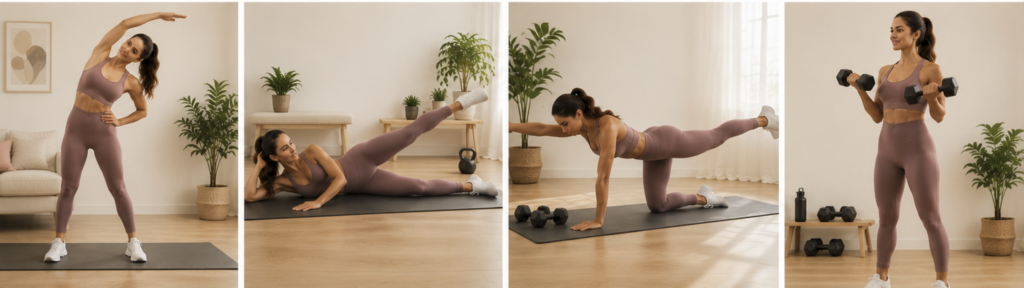
Calf Raise · Stand with feet hip-width apart, hands lightly on a wall for balance if needed. Rise onto the balls of your feet, lifting your heels as high as possible, then lower slowly — more slowly than you rose. The slow descent creates more tension in the calf muscles and produces more adaptation than a faster version. Three sets of twenty repetitions. For added challenge, perform on one foot. The calves are often undertrained in women’s programmes, and they’re critically important for ankle stability, circulation, and the reduced risk of injury in any walking or running activity.
Wall Sit · Stand with your back against a wall and lower your hips until your knees are at a ninety-degree angle, as though sitting in a chair that isn’t there. Your back should be flat against the wall, your thighs parallel to the floor, your feet flat. Hold for thirty to sixty seconds, working toward ninety seconds over time. Three rounds with forty-five seconds of rest between. The burning sensation in your quadriceps is the muscles working isometrically — maintaining tension without changing length — and is entirely expected and productive.
◦ ◦ ◦
Workout Two: Upper Body and Core Focus
The upper body workout is where I see the most resistance from women who are new to home training, usually for one of two reasons. The first is the fear of ‘bulking up’ — a concern so pervasive and so ungrounded in actual female physiology that I want to address it once and definitively. Women’s hormonal profile, specifically the significantly lower testosterone levels compared to men, makes the kind of muscle bulk that many women fear essentially impossible to develop through bodyweight training alone. What upper body training produces in women is strength, improved posture, a more defined appearance in the arms and shoulders, and the functional capacity to carry, lift, and move through life more easily. Not bulk. Capability.
The second reason for resistance is that upper body exercises tend to be more immediately challenging for women than lower body ones — particularly push-ups, which require bearing a significant proportion of your body weight in your arms. This is normal, expected, and temporary. The progression from wall push-up to incline push-up to floor push-up is one of the most satisfying progressions in beginner fitness, precisely because the starting point feels so modest and the endpoint — a clean, controlled floor push-up — feels so significant.
Core work is integrated throughout this session, both as a dedicated focus and as the stabilizing element of every upper body exercise. A strong core is the foundation of everything: good posture, reduced lower back pain, effective transfer of force in all movements, and the physical confidence that comes from feeling genuinely stable and connected in your body.
Wall Push-Up · Stand facing a wall at arm’s length. Place your hands on the wall at shoulder height and slightly wider than shoulder-width. Keeping your body in a straight line from head to heels, bend your elbows to lower your chest toward the wall, then push back to the starting position. Three sets of fifteen to twenty repetitions. This is the foundational starting point for women who find floor push-ups too challenging initially. The reduced load — because the closer to vertical your body is, the less bodyweight you’re pressing — makes this entirely manageable for almost everyone, while still producing the neural adaptations that prepare for more demanding versions.
Incline Push-Up · Find a stable elevated surface — a kitchen counter, a sturdy sofa arm, or a step. Hands slightly wider than the shoulders on the surface, body in a straight line, lower your chest toward the surface and push back. The elevation reduces the percentage of bodyweight you’re lifting compared to a floor push-up while teaching the same movement pattern. Three sets of ten to fifteen repetitions. When this feels consistently easy — when the last few reps aren’t particularly challenging — it’s time to move to a lower surface and eventually to the floor.
Floor Push-Up · Hands directly below or slightly wider than your shoulders, fingers spread, body in a straight diagonal from head to heels. If this position is too demanding, come to your knees — this is not a modification to be embarrassed about. It is a legitimate, productive exercise that builds toward the full version. Lower until your chest approaches the floor, elbows tracking at roughly forty-five degrees from your body rather than flaring directly to the sides. Push to full arm extension. Three sets of eight to fifteen repetitions. The floor push-up trains the chest, shoulders, and triceps simultaneously, and when done with proper core engagement, trains the abs isometrically as well.
Tricep Dip · Sit on the edge of a stable chair, hands gripping the front edge with fingers pointing forward. Slide your hips forward off the seat so that only your hands are supporting your upper body. Bend your elbows to lower your body straight down toward the floor, keeping your back close to the chair and your elbows pointing directly backward rather than flaring to the sides. Press to straighten. Three sets of twelve repetitions. This directly targets the triceps — the muscle on the back of the upper arm — and the front of the shoulders. It also requires considerable core engagement to maintain the position.
Superman with Hold · Lie face down on the floor with arms extended above your head in a ‘Y’ or straight overhead position. Simultaneously lift your arms, chest, and legs off the floor by engaging the muscles of your back and glutes. Hold for two to three seconds at the top, then lower. Fifteen repetitions, three sets. This is the most important postural exercise in the programme. The erector spinae muscles that run along the spine, the lower trapezius, and the gluteus maximus all contract strongly in this movement, and consistent training of this pattern directly counteracts the forward-rounding posture that desk work and screen use create.
Plank · Begin on hands and knees, then step your feet back and support your body on your hands and toes. Your hands should be directly beneath your shoulders, your body forming a straight line from head to heels, your core braced — imagine you’re about to receive a gentle punch to the stomach: that level of abdominal engagement, maintained throughout. Hold for twenty to forty-five seconds as a beginner. Three rounds. If the full plank is too demanding, perform with your knees on the floor. The plank trains the entire core as an integrated system — not just the superficial abdominals, but the deep transversus abdominis, the obliques, and the stabilizers of the lower back and hips simultaneously.
Side Plank · From your plank, rotate to face sideways. Stack your feet or place one foot in front of the other for a wider base. Support your body on one hand, arm extended, body in a straight line from head to heels. Lift your hips — they should not sag toward the floor. Hold for twenty to thirty seconds per side. The side plank directly trains the obliques and the gluteus medius — the hip abductor muscle that stabilizes the pelvis during walking, running, and single-leg movements — and is one of the few exercises that loads these muscles effectively without any equipment.
Dead Bug · Lie on your back with your arms extended toward the ceiling and your knees bent at ninety degrees, shins parallel to the floor — like a table-top position for your legs. Simultaneously lower your right arm overhead toward the floor and extend your left leg straight, hovering both just above the floor. Return slowly and switch sides. The challenge is to keep your lower back pressed flat against the floor throughout — the moment it arches, the core has disengaged. Ten repetitions per side, three sets. The dead bug is one of the most effective core exercises for developing the deep stability that protects the lower back, and it’s particularly valuable for beginners because it teaches the core engagement pattern that should underlie every other exercise.
Hollow Body Hold · Lie on your back and press your lower back firmly into the floor. Extend your arms overhead and your legs straight out, hovering both slightly off the floor. The lower your arms and legs hover, the harder the exercise. Hold for twenty to thirty seconds, maintaining the lower-back contact with the floor throughout. Three rounds. This trains the same deep core engagement as the dead bug in a static position, and is the foundational exercise for the core strength that makes all other movement more efficient and more protected.
◦ ◦ ◦
Workout Three: Full-Body Circuit
The third session of the week is the full-body circuit — a structured sequence of exercises that flows from one to the next with minimal rest, creating a cardiovascular and muscular training stimulus simultaneously. Circuits are efficient, meaning they produce significant adaptation in a relatively short time. They’re also, when built well, genuinely engaging — the variety of movement and the changing stimulus keep the session mentally interesting in a way that straight sets of a single exercise sometimes don’t.
This session is organized as three rounds of eight exercises performed one after another. Rest for sixty to ninety seconds after completing all eight exercises, then begin the next round. The exercises are arranged to alternate between upper body and lower body emphasis, allowing each area partial recovery while the other works. This sequencing is the key to maintaining quality and intensity throughout a circuit.
In the early weeks, some exercises will need to be performed at lower intensity or with modifications — that’s expected and correct. The goal is to complete all three rounds, even if the later rounds look slightly different from the first. Reduce the range of motion, reduce the speed, or take the low-impact modification option. Complete the session. That’s the whole thing.
Squat to Overhead Reach · Perform a bodyweight squat and as you rise to standing, reach both arms overhead. This combines the lower body stimulus of the squat with a shoulder mobility and stability element, and the reaching pattern adds a subtle cardiovascular element and increases the core demand. Fifteen repetitions. The upward reach also opens the chest and anterior shoulder — a meaningful postural benefit at the end of a long session.
Shoulder Tap Plank · In a high plank position, lift your right hand to touch your left shoulder, then replace and alternate. The challenge is in the resistance to rotation — keep your hips as level as possible throughout. Twelve taps per side. This trains shoulder strength, core stability, and the anti-rotation strength of the obliques, and it’s a genuine athletic movement that requires coordination and concentration.
Reverse Lunge with Knee Drive · From standing, step one foot back into a reverse lunge. As you return to standing, drive your back knee upward toward your chest in a controlled balance challenge. The knee drive activates the hip flexors and challenges single-leg balance, which trains the stabilizing muscles of the ankle, knee, and hip that basic lunges don’t reach. Ten repetitions per side.
Push-Up to Child’s Pose · Perform one push-up (at whatever level — wall, incline, or floor — is appropriate for your current strength). Then push your hips back toward your heels into child’s pose, resting for a breath, then walk your hands back out to the plank for the next push-up. The child’s pose between repetitions allows a brief recovery and a counter-movement that keeps the back decompressed. Eight to ten repetitions. This pattern teaches the push-up as a movement rather than a grind, which produces better form throughout.
Glute Bridge Marching · Set up in a standard glute bridge with hips lifted. Maintain the hip height as you slowly lift one foot off the floor, hold for two seconds, then replace and switch. The challenge is to keep the pelvis level as one leg lifts — the natural compensation is to drop the hip on the working side, which should be resisted. This trains single-leg stability in the glute bridge position and is significantly more demanding than the static version. Ten lifts per side.
Mountain Climber · In a high plank position, drive one knee toward your chest, then quickly switch feet in a running motion. The speed is what creates the cardiovascular element. For a lower-intensity version, slow the movement to a deliberate knee drive, hold one second, and switch. Twenty seconds at speed, then ten seconds slower — or thirty seconds of the slow version for complete beginners. Three sets within the circuit.
Side-to-Side Squat · Stand with feet together. Step wide to the right into a squat, then step back to centre and step wide to the left into a squat. This creates a lateral movement pattern that trains the outer glutes and inner thighs in addition to the standard squat muscles, and the stepping creates a light cardiovascular demand. Twelve repetitions per side. The side-to-side pattern is underrepresented in most beginner programmes and is directly relevant to the lateral stability required for everyday movement.
Plank Shoulder Press Simulation · In a plank position, reach one arm forward at shoulder height — extending it fully — then return and switch. This ‘anti-rotation’ press trains the shoulder stability required for overhead pressing movements while also maintaining plank position for core engagement. Twelve repetitions per arm. It is quieter than the dramatic exercises but produces specific adaptations in the shoulder stability muscles that nothing else in a bodyweight programme quite replaces.
◦ ◦ ◦
The Cooldown: Making Your Body Feel as Good Tomorrow as Today
The cooldown is the part most women skip when they’re busy, and the one I most consistently advocate for — not because skipping it will cause immediate harm, but because doing it consistently produces a quality of physical wellbeing in the twenty-four hours following a workout that is distinctly different from what you experience when you don’t.
Post-exercise stretching, done while the muscles are warm and pliable, improves flexibility over time in a way that cold stretching doesn’t replicate. It reduces the severity of delayed-onset muscle soreness, which means you’re less stiff the day after a workout and more likely to want to move again. It also creates a deliberate physiological transition from the activated state of exercise back toward a resting state — heart rate comes down, breathing slows, the nervous system downshifts. For women who work out in the morning, this transition makes the move into the working day feel more grounded. For those who work out in the evening, it supports the move toward rest and better sleep.
The sequence below takes approximately seven minutes and addresses the major muscle groups trained across all three sessions. It can be used after any of the three workouts.
Standing Figure-Four Stretch · Stand near a wall for balance. Cross your right ankle over your left knee, creating a figure-four shape. Bend your standing leg slightly to lower into the stretch, feeling it in the right hip and glute. Hold forty-five seconds per side. The piriformis and deep hip rotators tighten significantly during both lower body training and prolonged sitting, and this stretch is their most effective release.
Low Lunge Hip Flexor Stretch · Step one foot forward and lower your back knee to the floor. Shift your hips forward until you feel a stretch in the front of the back hip — not a sharp pain, a distinct tension. Keep your torso tall. Hold fifty seconds per side. This is the single most important stretch for women who sit, because the hip flexors — which must release for full hip extension in every squat, lunge, and glute bridge — are chronically shortened by the seated position. Consistent stretching here produces improvements in movement quality that affect every other exercise.
Seated Hamstring Stretch · Sit on the floor with both legs extended in front of you. Sit tall on your sitting bones rather than rolling back onto the tailbone, then reach forward as far as you can while maintaining a long spine. The stretch should be felt along the back of the legs, not primarily in the lower back. Hold sixty seconds. To deepen, gently flex the feet by pulling the toes back toward you.
Child’s Pose · Kneel and sit your hips back toward your heels. Walk your hands forward until your forehead rests on the floor or as close as comfortable. Let your back round and release. Breathe slowly and deeply for sixty to ninety seconds. This pose decompresses the lumbar spine, which bears significant load in both squat-pattern and core exercises, and stretches the entire back and hips simultaneously. The breathing in child’s pose activates the parasympathetic nervous system — the rest-and-digest state — accelerating the physiological recovery from exercise.
Thread the Needle · Begin on hands and knees. Slide your right arm under your left arm along the floor until your right shoulder rests on the floor. Feel the rotation through the mid-back and the stretch through the right shoulder. Hold thirty seconds, then move to the other side. This is one of the best releases for the thoracic spine and posterior shoulder that exists in a bodyweight context, and after upper body sessions in particular, it provides a release that is immediately and pleasurably perceptible.
Doorway Chest Opener · Stand in a doorway and place your forearms on the door frame at a ninety-degree angle. Step one foot forward until you feel a stretch across the front of the chest and the anterior shoulders. Hold thirty seconds. After push-up and plank-heavy sessions, the chest and front of the shoulders have worked hard in a shortened position. This counter-movement restores their resting length and reinforces the open, upright posture that consistent upper body training creates over time.
Legs Up the Wall · Lie on your back and swing your legs up to rest against a wall, bottom as close to the wall as comfortable. Stay for ninety seconds to two minutes, breathing deeply. This passive inversion returns blood from the legs to the circulation, reduces ankle and foot swelling, and creates a deeply restorative effect on the nervous system. It is the most pleasant way to end a workout that exists, and I say that having tried most of them.
◦ ◦ ◦
The Eight-Week Programme: Your Path from Beginning to Building
A workout guide that gives you exercises without a progression plan is like a recipe that gives you ingredients without quantities or method. The exercises are only as useful as the framework you put them in. What follows is a structured eight-week plan that takes you from first session to confident, intermediate-level beginner — with clear guidance on volume, intensity, and progression at each stage.
Weeks One and Two: Learning to Move
Your only goal in the first two weeks is to show up twice per week and complete the sessions without worrying about intensity, speed, or perfect form. You’ll do Workout One on one day and Workout Two on another, with at least one rest day between. Workout Three is not introduced until week three — this is intentional. Two sessions per week is sustainable for most beginners in a way that three sessions is often not, and building the habit of two is more valuable than struggling with three and abandoning the attempt.
In these first sessions, the exercises will feel unfamiliar. Your body hasn’t learned these movement patterns yet, and there will be moments of awkwardness and uncertainty that are entirely normal. The job is not to perform the exercises perfectly — it’s to do them enough times that they start to become familiar. Movement vocabulary is built through repetition, and these first sessions are the beginning of a long conversation between you and your body.
Reduce the sets if needed. Two sets of each exercise instead of three is completely acceptable for the first week. Reduce the repetitions. The session should leave you feeling like you’ve worked, not like you’ve been defeated.
Weeks Three and Four: Building the Habit
Three sessions per week begins here: Workout One, Workout Two, and Workout Three, each on non-consecutive days. The structure might look like Monday-Wednesday-Friday, or Tuesday-Thursday-Saturday, or any other arrangement that gives at least one day of recovery between each session.
By now, the warmup sequence should be feeling familiar. You should be able to move through it without having to think about what comes next, which is a milestone — it means the motor pattern is establishing itself. The exercises themselves are probably still somewhat challenging, but the challenge should be starting to feel productive rather than simply overwhelming.
This is also the week to start paying attention to form in a more detailed way. Now that the exercises feel slightly more familiar, you have more cognitive bandwidth to focus on the specific cues — keeping the chest lifted in squats, maintaining the lower-back contact in dead bugs, tracking the elbows correctly in push-ups. These details are where the significant improvements in both safety and effectiveness come from.
Weeks Five and Six: Adding Challenge
Maintain the three-session weekly schedule and begin to increase the challenge within each session in two ways: increasing repetitions (adding two to three more reps per set in the exercises you find manageable) and reducing rest time (from ninety seconds between sets to sixty seconds, where your recovery allows). These two adjustments produce a significant increase in training volume and intensity without changing the exercises themselves, and this kind of progressive overload is the stimulus that drives continued adaptation.
Week five is also the moment to honestly assess the push-up progression. If you’ve been doing wall push-ups, try the incline version. If you’ve been doing incline push-ups, try a lower surface, or attempt two or three floor push-ups within a set of incline push-ups. The progression doesn’t need to be complete — one floor push-up in a set of ten incline push-ups is meaningful progress, and it counts.
Weeks Seven and Eight: Consolidating and Exploring
By week seven, most women on this programme have developed a genuine relationship with the exercises. The movements feel like yours — you know how to do them, you know which modifications are currently right for you, you have preferences and opinions about which exercises you find most satisfying and which you find most challenging. This is the beginning of real fitness literacy.
In these final two weeks, focus on the quality of each session rather than adding more to it. Hold positions longer. Increase range of motion where you have it. Slow the tempo — particularly on the lower phases of each exercise, where gravity is assisting and you can control the pace — and notice how much more demand this creates.
After eight weeks, you have built sufficient foundation to take this practice in several directions: adding a fourth weekly session if your body and schedule support it, exploring Pilates or yoga as complementary practices, beginning to incorporate light resistance through bands or household objects, or simply continuing this programme and continuing to improve within it. All of these are good choices. The one that isn’t a good choice is stopping.
◦ ◦ ◦
The Mind-Body Connection: What Nobody Tells You About Getting Fit
There is a dimension of beginning a fitness practice that fitness guides almost never address, and that I think is actually one of the most significant things that happens when a woman starts moving her body consistently. It’s not the physical changes, which are real and which arrive in their own time. It’s the change in how you inhabit your body — in the relationship between your conscious self and the physical form that carries you through your life.
Most women, particularly those who have been largely sedentary, carry a relationship with their body that is primarily evaluative. The body is assessed — its appearance, its weight, its proportions, its comparison to various standards. It is looked at rather than lived in. It is a subject of judgment rather than a source of information and experience. This is not an individual failing; it’s the product of a culture that has consistently invited women to observe their bodies from the outside rather than experience them from within.
Movement changes this, over time, in a way that nothing else quite does. When you’re doing a squat with attention to form, you are not thinking about how your thighs look from the outside. You are thinking about how your thighs feel — the engagement of the quadriceps, the hinge of the hip, the pressure through the feet. You are inside your body, gathering information from it, responding to it, learning its language. This shift from observation to inhabitation is one of the most profound things that regular movement produces, and it arrives quietly, without announcement, usually around the four-to-six-week mark when the novelty has worn off but the habit is beginning to feel natural.
The Aesthetic of Moving Well
There is something genuinely beautiful about a woman who moves with strength and ease — and I don’t mean this in the performance-for-others sense. I mean the intrinsic quality of it: the particular grace that comes from a body that has been trained to move intentionally. It shows in posture. It shows in how a woman carries herself through a room, the ease with which she lifts and carries and navigates physical space. It shows in the way her clothes sit on her body, because a body with functional strength holds itself differently from one without it.
The clean girl aesthetic that has so powerfully shaped beauty and fashion culture in the mid-2020s is, in part, a posture aesthetic. The luminous skin and the minimal makeup and the carefully considered outfit are all enhanced by a quality of physical self-possession — the upright spine, the open chest, the ease of movement — that reads as confidence without trying to. This quality is not primarily genetic. It is built, through exactly the kind of consistent, thoughtful movement practice that this guide describes.
The Pilates influence on contemporary fitness culture has contributed significantly to this aesthetic conversation. The Pilates body — not the extreme, professional-dancer-lean version that occasionally appears in fitness media, but the accessible, genuinely achievable version of better posture, stronger core, and more graceful movement — has become culturally aspirational in a way that the muscles-for-display aesthetic never quite became for most women. This is partly because the Pilates aesthetic aligns with the broader quiet luxury sensibility: it’s not loud, it’s not extreme, it’s not performative. It’s the particular elegance of a body that has been well cared for.
The movements in this programme — the planks that build the core, the supermans that open the back and reverse the postural rounding of desk life, the hip bridges that activate the glutes and release the hip flexors — are building exactly this. Not the extreme, not the performative, but the quietly capable. The body that feels good to live in.
Journaling Your Practice: The Habit That Doubles Your Results
One of the most practically effective things you can do alongside this workout programme — and one of the most systematically undervalued tools in beginner fitness — is to keep a simple workout journal. Not an elaborate tracking system, not a calorie counter, not anything that requires significant time or effort. Just a note, after each session, of what you did, how it felt, what you noticed.
The reason a workout journal doubles results isn’t mysterious. It creates self-awareness about your progress that’s difficult to maintain through memory alone, because progress in fitness is often gradual and nonlinear — easy to miss if you’re comparing today to yesterday but unmistakable when you compare today to six weeks ago. It also provides accountability in the gentlest possible way: when you’ve written down that you completed three sessions this week for four weeks in a row, the motivation to not break that record is real and self-generated rather than externally imposed.
A workout journal entry might be three sentences: what workout you did, one thing you noticed physically, and how you felt overall. That’s it. Over eight weeks, those entries accumulate into a record of your own adaptation that is more motivating than any before-and-after photograph, because it captures the inner experience — the way a squat started to feel different once your glutes began to engage properly, the session where the plank suddenly held for sixty seconds when thirty had felt impossible two weeks before, the morning you woke up and your back didn’t ache the way it usually does.
◦ ◦ ◦
Common Beginner Mistakes and How to Sidestep Them Gracefully
There are patterns of error that appear so consistently among women beginning a home workout practice that addressing them directly feels more useful than hoping you’ll avoid them naturally. These aren’t character flaws or signs of being bad at this — they’re predictable responses to the specific challenges of beginning, and knowing them in advance means you can recognize them when they appear and make a different choice.
Doing Too Much Too Soon
The beginning-energy problem is one of the most common reasons fitness practices fail. It goes like this: the decision to start creates a surge of motivation that makes the first week feel effortless. This surplus of motivation leads to more sessions, longer sessions, higher intensity than the programme calls for — because if some is good, more must be better. The body, which has not yet adapted to the new demands, accumulates fatigue and often soreness much faster than expected. By the third week, the energy has collapsed entirely, the soreness is making everything feel harder, and the practice stops.
The prescription is simple but requires resisting a genuine impulse: do the programme as written, not as the surge of motivation suggests. Two sessions in the first two weeks. Three from week three. Rest days between sessions. Not because you can’t do more, but because consistent adherence to a moderate programme produces better long-term results than intense adherence to a demanding programme that eventually collapses.
Confusing Discomfort with Damage
Beginning a physical practice involves discomfort. This is not avoidable, and it’s actually the signal that adaptation is occurring. The burn in your quadriceps during a wall sit, the fatigue in your arms during the final push-up set, the breathlessness of the mountain climbers — these sensations are productive. They indicate that you are working hard enough to create the stimulus for improvement.
The mistake is treating all discomfort as a signal to stop, which prevents the training stimulus from accumulating and produces no adaptation. The distinction to develop is between productive discomfort (muscular fatigue, mild breathlessness, the sensation of a muscle working hard) and actual pain (sharp, joint-specific, worsening with continuation). Productive discomfort is the workout. Pain is the signal to stop and reassess.
This distinction becomes easier to make with time and practice — body awareness, like everything else in this programme, is a skill that develops through repetition. In the early sessions, when everything feels unfamiliar, err on the side of caution with anything that genuinely concerns you. Over time, you’ll develop the sensitivity to distinguish between the sensation of your glutes working (which is what you want to feel during a glute bridge) and actual discomfort in a joint (which means the form needs adjustment).
Neglecting the Rest Days
Rest days are an active component of the programme, not a concession to laziness. I’ve said this and I’m saying it again because I’ve watched enough women sabotage their own progress by treating rest days as failures or opportunities to make up for missed sessions. Your muscles grow and strengthen during rest, not during exercise. The exercise is the stimulus; the recovery is the response. Remove the recovery and the stimulus accumulates without producing adaptation — which is the definition of overtraining.
Rest days do not mean complete inactivity. A gentle walk, a restorative yoga session, swimming, cycling at low intensity — all of these support recovery and are appropriate rest-day activities. What is not appropriate as a ‘rest day’ is another high-intensity session or adding extra sessions to compensate for perceived inadequacy. Trust the programme. The schedule is built to produce results at exactly the frequency it specifies.
Waiting to Feel Ready
This is the subtlest and most persistent mistake, and the one most worth naming directly. The feeling of being ready to begin a fitness practice is not something that arrives before you begin. It’s something that develops because you began. The confidence, the competence, the sense that you belong in this practice — these are post-hoc feelings, not prerequisites. Every woman who has a consistent movement practice felt exactly as unprepared as you might feel right now at some point before she started. She started anyway. The feeling followed.
You do not need to feel ready. You need to begin. The feeling arrives approximately three to four weeks later, right around the time that the first sessions start to feel familiar rather than foreign. Until then, the action is the thing. Not the feeling.
◦ ◦ ◦
Nutrition for the Woman Who’s Just Started Moving More
I want to address nutrition in the context of a beginner home workout programme with a particular kind of care, because the fitness-nutrition conversation has, for a very long time, been entangled with diet culture in ways that have been harmful to women’s relationships with both food and their bodies. This is not a diet guide. I’m not going to suggest you restrict, track, or optimize your eating. What I am going to share is the specific, practical nutritional information that makes a beginning workout practice feel better, produce better results, and be more sustainable.
Eat Enough to Support Movement
The most common nutritional mistake made by women who start a new workout programme is reducing their food intake at the same time. This is intuitive — movement burns energy, so eat less to create a deficit. But the body doesn’t cooperate with this logic particularly well, especially for beginners. Movement requires fuel. Muscle repair requires protein. Energy production requires carbohydrates. Starting to train while simultaneously eating less than your body needs creates fatigue, poor performance, slower adaptation, and the kind of relentless hunger that eventually leads to the abandonment of both the workout and the eating plan.
The sustainable approach is to eat enough to support your new activity level — which, for someone adding three thirty-to-forty-minute sessions per week to a previously sedentary lifestyle, might mean eating slightly more than before, not less. Your body will tell you this through appropriate hunger signals if you listen to them. Feeling energized after a workout rather than depleted, recovering well enough to feel ready for the next session, and sleeping soundly are all signs that your nutritional intake is adequate.
Protein: The Non-Negotiable for Women Who Strength Train
Every session in this programme involves strength work — exercises that challenge the muscles to work harder than they’re used to, creating the microscopic damage that prompts repair and growth. Protein is the raw material of that repair, and without adequate protein, the adaptation process is significantly slowed. Women consistently undereat protein relative to what their level of activity requires, partly because protein-rich foods are culturally associated with masculine fitness culture and partly because many conventionally ‘healthy’ food choices — salads, low-fat options, fruit-heavy meals — are relatively low in protein.
The target for a woman doing three strength sessions per week is roughly 1.2 to 1.6 grams of protein per kilogram of body weight per day. For most women, this means making protein a deliberate component of every meal rather than an incidental one. Eggs at breakfast, a substantial protein source at lunch (chicken, fish, lentils, tofu, cottage cheese, Greek yogurt), protein at dinner. Snacks that include protein rather than being purely carbohydrate-based. This is not complicated, but it is intentional, and the difference between meeting this target and missing it is felt — in recovery, in energy, in the rate at which strength improves.
Before and After the Session
The pre-workout window — the two hours before a session — ideally contains some carbohydrate for energy and some protein for muscle protection, without being so heavy that exercising feels uncomfortable. A piece of toast with nut butter, a small yogurt with fruit, a banana with a handful of nuts — these are light, easily digestible combinations that provide the energy to work hard without the heaviness of a full meal.
The post-workout window — particularly the hour after a session — is when muscle repair begins, and providing protein during this window supports that process. A proper meal with protein and carbohydrates within an hour or two of the session is all that’s needed. No special ‘recovery’ foods are required — regular, balanced food, eaten in reasonable proximity to the session, is entirely sufficient.
Hydration, finally, is the element most directly and immediately relevant to how a workout feels. Mild dehydration — the kind that arrives before thirst becomes noticeable — reduces performance, increases the perceived difficulty of exercise, and prolongs recovery. Drink water before your session, have water available during it, and drink water after. The colour of your urine — pale yellow means well-hydrated, darker yellow means drink more — is the most reliable indicator of your current hydration status.
◦ ◦ ◦
Staying Motivated: The Honest Conversation About Consistency
I want to say something that runs contrary to most fitness content: motivation is not the thing that sustains a fitness practice. Motivation is lovely when it arrives, and its arrival makes beginning feel easy and the early sessions feel energizing. But motivation is unreliable. It comes and goes with your schedule, your mood, your sleep quality, your social life, your work stress, the weather. Building a fitness practice on motivation is like building a house on sand — beautiful in the right conditions, structurally precarious in the long term.
What sustains a fitness practice, in the long term, is something more structural and more achievable than motivation: habit, identity, and intrinsic reward. These three things build on each other over time, and they build most reliably when the beginning is modest enough to be genuinely sustainable.
The Habit Loop: Making Movement Automatic
Habits form through repetition in consistent contexts, and the research on habit formation is remarkably clear about what makes new habits stick: they need to be simple enough to do even on hard days, they need to be attached to an existing routine or cue, and they need to produce some form of immediate reward. The first two are controllable through good programme design. The third develops naturally through the intrinsic rewards of movement — the endorphin release, the sense of accomplishment, the physical feeling of having exercised — but only once the practice has been repeated enough times to produce those rewards reliably.
The practical implication is to attach your workout to an existing, established behavior. ‘After I make my morning coffee, I change into workout clothes’ is a more reliable habit trigger than ‘I’ll work out sometime in the morning.’ Specificity of cue is the key variable in habit formation. ‘After I shower and before I open my laptop’ places the workout in a specific slot that existing behaviors naturally create, rather than leaving it floating in a day where it can be displaced by whatever demands arise.
The Identity Shift: Becoming Someone Who Moves
One of the most powerful and least discussed elements of a sustained fitness practice is the gradual shift in identity that happens as the practice becomes established. In the first weeks, you are someone who is trying to work out. After two months, you are someone who works out. These feel like the same thing and they’re actually profoundly different — the second has become part of how you understand yourself, which creates a completely different relationship with consistency.
When movement is part of your identity rather than something you’re trying to add to your identity, missing a session feels wrong in the way that other identity-violations feel wrong. Not self-punishingly wrong, but like something’s slightly off, the way a day without coffee might feel if you’re genuinely a coffee person. The workout is no longer a task you’re completing. It’s something you do, because it’s who you are.
This shift happens gradually and somewhat quietly, usually between weeks six and twelve of consistent practice. You don’t decide to make it happen. You notice, one day, that you’re already thinking about your next session before the current one is over. That the question has changed from ‘will I work out this week’ to ‘when will I work out this week.’ When you notice this shift, mark it. It’s the most significant milestone in a beginning fitness practice, more meaningful than any visible physical change, because it means the practice is becoming permanent.
◦ ◦ ◦
The Body You’re Building, and the Life It Makes Possible
I want to close by stepping back from the exercises and the sets and the progression plan and talking about what all of this is actually building — because I think fitness is often discussed in terms too narrow to capture what genuinely changes when a woman starts moving her body consistently.
The physical changes are real: strength, improved posture, better cardiovascular capacity, the particular quality of body composition that comes from muscle development, the reduction in the chronic tension and ache that sedentary life accumulates in the back and hips and neck. These changes are meaningful and they’re motivating once they arrive. But they’re also the surface of what’s happening.
Beneath the surface, something more interesting is taking place. The relationship between a woman and her body shifts when she starts training it. The body stops being primarily an object — something to be managed, evaluated, adjusted, compared — and starts becoming a subject: something with its own language, its own capacities, its own surprising abilities. When you do your first proper floor push-up, or hold the plank for sixty seconds for the first time, or complete a circuit without needing to stop, you’re not just experiencing a physical achievement. You’re discovering something about yourself that you didn’t know before — specifically, that your body is more capable than you assumed, and that you are capable of building something over time through consistent effort.
This discovery extends outward. The discipline of showing up for three sessions a week, even on the days when motivation is absent, builds a specific kind of self-trust — evidence that you can make commitments to yourself and keep them. The body awareness developed through consistent movement makes you more present in your body throughout the rest of your life, more attuned to what it needs, more responsive to its signals. The postural changes that come from upper body and core training change how you move through the world — literally how you carry yourself in every environment, every photograph, every interaction.
Your body was always capable of this. The only thing missing was the beginning — and you’re reading the last page of that particular absence.
Every exercise in this guide is achievable. Every session in this programme is completable. Every progression from week one to week eight is possible. Not because I’m offering easy shortcuts or unrealistic promises, but because this programme is designed around what women who are genuinely beginning can actually do, and because the human body — your body — is an extraordinarily adaptive system that responds to consistent, appropriate stimulus in ways that are reliable and real.
You don’t need the gym. You don’t need equipment. You don’t need a perfect body to start, or a particular level of fitness, or the absence of self-doubt. You need the space your body already occupies and the willingness to use it. Everything else — the strength, the ease, the confidence, the particular quality of physical self-possession that makes a woman walk differently through a room — comes after. It comes because you began, and because you came back.
Roll out the mat. Open the window. Press play on the playlist. The only session that doesn’t count is the one you don’t do.
Begin.
◦ ◦ ◦
Complete Programme Reference Guide
Everything in this guide, organized for quick access as your practice becomes established.
THE UNIVERSAL WARMUP (All Sessions — 7 minutes)
Neck Rolls → Shoulder Rolls → Thoracic Rotation → Hip Circles → Leg Swings → Inchworm → Jumping Jacks or Step Jacks
WORKOUT ONE — LOWER BODY FOCUS
Bodyweight Squat · Reverse Lunge · Sumo Squat · Glute Bridge · Single-Leg Glute Bridge · Calf Raise · Wall Sit — Three sets of each exercise. Sixty to ninety seconds rest between sets.
WORKOUT TWO — UPPER BODY AND CORE FOCUS
Wall Push-Up (progressing to Incline and Floor) · Tricep Dip · Superman with Hold · Plank · Side Plank · Dead Bug · Hollow Body Hold — Three sets of each exercise. Sixty to ninety seconds rest between sets.
WORKOUT THREE — FULL-BODY CIRCUIT
Squat to Overhead Reach · Shoulder Tap Plank · Reverse Lunge with Knee Drive · Push-Up to Child’s Pose · Glute Bridge Marching · Mountain Climber · Side-to-Side Squat · Plank Shoulder Press Simulation — Three complete rounds. Sixty to ninety seconds rest after each full round.
THE COOLDOWN (All Sessions — 7 minutes)
Standing Figure-Four Stretch → Low Lunge Hip Flexor Stretch → Seated Hamstring Stretch → Child’s Pose → Thread the Needle → Doorway Chest Opener → Legs Up the Wall
EIGHT-WEEK PROGRESSION SCHEDULE
Weeks 1–2: Two sessions per week (Workouts One and Two). Focus on learning the movements. Weeks 3–4: Three sessions per week (all three Workouts). Build the habit. Weeks 5–6: Three sessions, begin increasing reps and reducing rest time. Progress push-up variations. Weeks 7–8: Three sessions, focus on movement quality, tempo control, and depth. Consider a fourth session if your body and schedule support it.
— With warmth, and the deep conviction that you are more capable than you know —
Your guide to a stronger, more capable, more inhabitable version of yourself
◦ ◦ ◦