
I remember the exact moment I stopped trying to look like someone in a fitness advertisement and started actually wanting to feel strong in my own body, and it had almost nothing to do with the way I looked in a mirror. I was carrying two overstuffed grocery bags up three flights of stairs to my old apartment, arms shaking, breath ragged, genuinely embarrassed by how much that ordinary, unremarkable task had taken out of me. And somewhere on that second flight, slightly out of breath and more than a little annoyed with myself, I thought, quite simply, I want to be stronger than this.
That’s really where this whole journey started for me, not in some glossy gym with mirrors on every wall, but in the very ordinary, very human realization that strength isn’t really about aesthetics at all. It’s about capacity. It’s about being able to lift the thing, carry the bag, chase after the dog, get up off the floor without that small, telling grunt that creeps in as we get a little older and a little less conditioned than we used to be. And once I started training with that goal in mind, rather than chasing some specific look I’d seen in a magazine or scrolling past on social media, everything about my relationship with exercise changed, slowly, then completely.
I want to walk you through the home workout approach that actually got me there, the one I still return to now, years later, on the mornings my schedule is too packed for anything more elaborate, or the evenings I simply don’t want to deal with a gym’s noise and crowds and self-consciousness. This is going to be a long, detailed, genuinely thorough conversation, because I think beginner fitness content online tends to either oversimplify dangerously or overcomplicate unnecessarily, and I want to give you something in between — real, useful, encouraging, and honest about both what’s achievable and what takes patience.
Before we go any further, I want to say clearly and honestly: I’m not a certified trainer or a medical professional, and nothing here replaces a real conversation with your doctor, especially if you’re managing any existing health condition, recovering from an injury, pregnant, or simply new enough to exercise that you want personalized guidance before starting. What I can offer is everything I’ve learned from my own genuine experience building strength from absolute scratch, at home, with very little equipment, and the encouragement I wish someone had given me back when I was standing breathless on that staircase, wondering if I even had it in me to change anything at all, let alone build a habit that would still feel meaningful to me years later.
Why Strength Training Deserves a Place in Every Busy Woman’s Life
I think there’s a persistent, lingering cultural message that women should exercise primarily to become smaller, to take up less space, to shrink rather than to build. I grew up steeped in that message without even fully realizing it, internalizing the idea that cardio was the “real” workout and that strength training was something else entirely, something a little more masculine, a little less aligned with whatever I was supposed to be working toward.
Unlearning that took genuine, deliberate effort, and I think it’s worth talking about honestly, because I suspect a lot of you reading this absorbed some version of the same message growing up. What actually shifted my thinking was paying attention to how strength training made me feel, separate entirely from how it affected my appearance. Stronger meant more capable. Stronger meant moving through ordinary days with more ease, more confidence, less of that quiet, nagging worry about whether my body could handle whatever physical demand showed up unexpectedly.
There’s also something I think connects beautifully to the broader quiet confidence, quiet luxury energy I’ve written about in other contexts. A woman who trusts her own physical strength carries herself differently, moves through the world with a particular kind of settled ease that has nothing to do with how she looks in any specific outfit and everything to do with how she feels in her own body, day after ordinary day. That feeling, more than any specific aesthetic goal, is genuinely what kept me consistent with strength training long after the initial motivation of that embarrassing staircase moment had faded into the background.
I also think it’s worth mentioning, gently, that building strength supports so much of what we already care about across every other part of wellness and beauty. Good posture, which makes every outfit look better regardless of what you’re actually wearing. The energy and stamina to actually enjoy an active weekend rather than just surviving it. The quiet, settled confidence that comes from knowing your body can do hard things, which tends to ripple outward into every other area of life in ways that are hard to fully articulate but easy to feel once you’ve experienced it consistently over time.
Why Home Workouts Are Having a Genuine Cultural Moment
I think it’s worth acknowledging how much the broader fitness conversation has shifted toward home-based training over recent years, and I don’t think this is purely a pandemic-era holdover that’s simply lingered out of habit. There’s something genuinely well-suited about home workouts to the particular demands and aesthetics so many of us are gravitating toward right now, the same quiet, intentional, less performative energy that’s reshaped how we think about fashion, beauty, and daily ritual more broadly.
A home workout strips away so much of what used to make exercise feel intimidating or performative for a lot of women, myself very much included in my early attempts at fitness. No mirrors lined up specifically to catch you mid-struggle. No sense of being watched, compared, or judged by strangers who are, in reality, almost certainly far too focused on their own workout to be paying you any attention at all, though that knowledge never quite stopped the anxious feeling itself. Just you, your own space, your own pace, building competence privately before, if you ever want to, taking that confidence into a more public setting.
This also fits beautifully into the broader soft living, slow mornings aesthetic that’s become so dominant across Pinterest boards and social media feeds dedicated to that particular vision of an elegant, intentional life. There’s something genuinely lovely about training in your own space, perhaps with natural light streaming through a window, a candle lit nearby, the same kind of considered atmosphere I’ve written about building into morning skincare and getting-dressed rituals elsewhere. Exercise doesn’t need to feel like punishment or obligation performed in a sterile, fluorescent-lit room. It can be woven into the same intentional, aesthetically considered version of daily life that so many of us are working to build across every other category of self-care.
I also think the accessibility matters enormously for genuinely busy women, the actual target audience I’m writing for throughout this entire piece. A home workout removes commute time, removes the need to pack a bag and shower somewhere unfamiliar afterward, removes the scheduling friction of trying to find a class time that fits around an already overstuffed calendar. Twenty minutes carved out of an ordinary morning, performed in your own living room, is so much more sustainable for most of us than the more elaborate version of fitness that requires leaving the house entirely.
What Beginner Strength Training Actually Means (And Why It’s Not What You Think)
I want to demystify something before we get into the actual structure of a workout plan, because I think the phrase “strength training” still carries a lot of intimidating baggage for a lot of women just starting out, conjuring images of barbells and chalk and intensely serious gym environments that feel worlds away from where most beginners are actually starting from.
Beginner strength training, in the way I’m going to walk you through it, is built almost entirely around bodyweight movements at first, meaning your own body provides all the resistance you need to start building genuine, foundational strength. This isn’t a lesser or less legitimate version of strength training compared to lifting heavy weights at a gym. For someone just starting out, bodyweight training provides genuinely substantial, meaningful strength gains, while also teaching your body the movement patterns and control that make adding external weight, if you ever want to, so much safer and more effective later on.
The core movement patterns I’m going to walk you through, squatting, hinging at the hips, pushing, pulling, and core stabilization, are the same fundamental patterns that underpin essentially all strength training, regardless of how advanced someone eventually becomes. Mastering these patterns with just your bodyweight first builds a genuinely solid foundation, and I think skipping straight to equipment or more complicated routines before that foundation is solid is one of the more common reasons beginners get discouraged, frustrated, or even injured early in their fitness journey.
I also want to gently push back against the idea that beginner workouts need to feel impossibly difficult or leave you flattened with soreness to be considered effective. Genuine strength gains happen gradually, through consistent, properly executed movement performed regularly over weeks and months, not through single, brutally difficult sessions that leave you too sore and discouraged to want to return the next day. I think this is one of the most important mindset shifts for anyone just starting out, and one that took me embarrassingly long to genuinely internalize myself.
Setting Up Your Space Without Needing a Home Gym
One of the loveliest things about beginning strength training at home is how little space and equipment it genuinely requires, especially at the start. I want to walk through what I think actually matters for setting up a workout space that feels inviting and functional, without falling into the trap of believing you need an elaborate, expensive home gym setup before you can begin at all.
A small, clear patch of floor, enough room to lie down and extend your arms and legs fully in every direction, is genuinely all the physical space most beginner bodyweight routines require. I did my earliest workouts in a corner of my bedroom, moving a single chair out of the way each time, and that was entirely sufficient for months before I ever felt the need for anything more elaborate.
A supportive, non-slip surface matters more than people often realize, particularly for anything involving floor work like planks or push-ups. A simple yoga mat, genuinely one of the lowest-cost, highest-value purchases in this entire category, provides cushioning for your joints and prevents the slipping that can make certain movements feel unstable or uncomfortable on a bare hardwood or tile floor.
Beyond that, I’d genuinely encourage beginners to resist the urge to invest in much additional equipment until you’ve built a consistent habit and have a clearer sense of what you actually enjoy and want to continue with long-term. A pair of light resistance bands, inexpensive and easy to store, can add helpful variety once you’re a few weeks in, but they’re genuinely optional for getting started rather than necessary from day one.
What I think matters more than any equipment is the atmosphere you create around this time, the same intentionality I’ve written about bringing to morning skincare and getting dressed. I light a candle, the same scent I use for my morning ritual elsewhere, and put on music with the right energy for whatever I’m about to do. This small, deliberate atmosphere-setting genuinely changes how I experience the workout that follows, transforming it from a chore I’m pushing through into something closer to a ritual I’m choosing, even on the days my motivation is otherwise running low.
The Five Foundational Movements Every Beginner Routine Should Include
I promised earlier that beginner strength training centers around a handful of foundational movement patterns, and I want to walk through each one individually now, explaining not just what they are but why they matter and how to approach learning them safely as a genuine beginner.
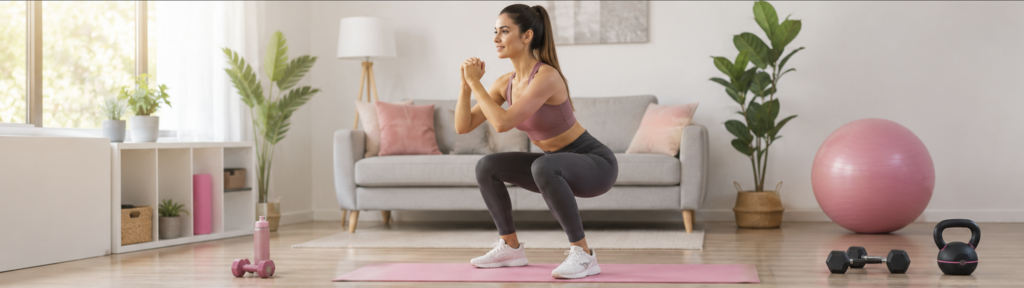
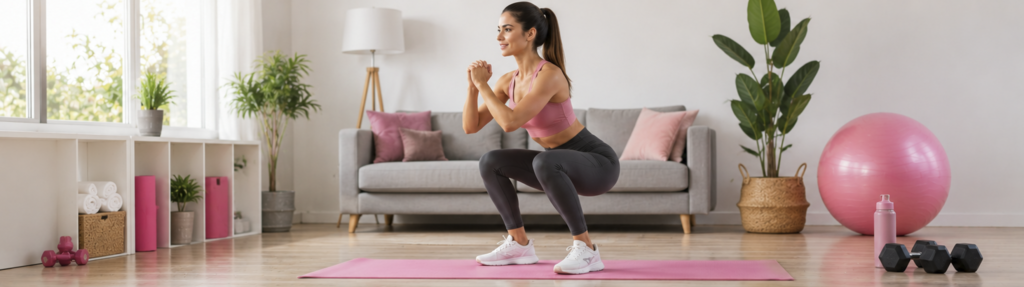
The squat pattern, essentially the movement of lowering your body by bending at the hips and knees the way you would to sit down into a chair, is foundational to so much of ordinary daily movement, from sitting and standing to picking something up off the floor. Learning to squat with proper form, weight settled back into your heels, knees tracking in line with your toes rather than collapsing inward, chest staying relatively upright rather than folding forward, builds genuine strength through your entire lower body while also reinforcing a movement pattern you’ll rely on constantly throughout ordinary life.
The hip hinge, a movement that looks deceptively similar to a squat but actually emphasizes bending primarily at the hips while keeping the knees only slightly bent, builds strength through your hamstrings and lower back in a way that genuinely protects against the kind of back strain so many of us experience from improper bending and lifting in everyday life. I think this particular movement pattern deserves more attention in beginner content than it typically receives, because so much everyday back discomfort comes down to never having learned to hinge properly rather than squatting when a hinge would serve better, or vice versa.
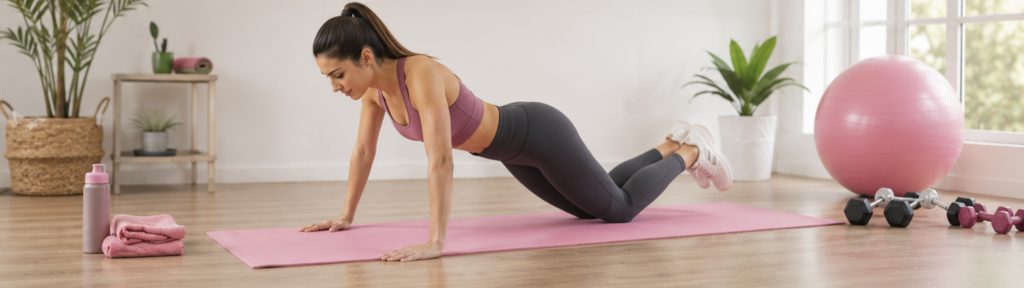
Pushing movements, most commonly represented by some variation of a push-up, build strength through your chest, shoulders, and the back of your arms, while also genuinely engaging your entire core to keep your body stable throughout the movement. I want to be honest that a full, traditional push-up is often not where beginners should start, and there’s nothing remotely lesser about beginning with modified versions, performed against a wall, an elevated surface, or with knees on the ground, while you build the foundational strength to progress toward a full version over time.
Pulling movements are the trickiest to replicate purely with bodyweight at home without any equipment, since most genuine pulling exercises require something to actually pull against. Resistance bands become genuinely useful here if you do decide to add minimal equipment, allowing you to perform rowing-style movements that strengthen your back and the muscles responsible for that confident, upright posture I mentioned earlier. Without bands, even simple movements like reverse snow angels performed lying face-down, or careful, controlled superman-style holds, can begin building some of that same back strength while you decide whether bands are worth adding to your setup.
Core stabilization, the final foundational category, is so much more than the traditional crunches most of us grew up associating with “ab workouts.” Genuine core strength is about your body’s ability to stay stable and controlled during movement, which is why planks, holding your body in a straight line supported on forearms and toes, tend to be so much more functionally valuable than repetitive crunching motions. A strong, stable core supports literally everything else, from how safely you can perform the squats and hinges I described earlier to how comfortably you move through ordinary daily life carrying bags, lifting children, or simply standing with good posture for extended periods.
Building Your First Few Weeks: A Genuinely Gentle Starting Point
I want to walk through what an actual beginner progression might look like, while being honest that this is a general framework rather than a precisely individualized plan, since everybody starts from a different baseline of fitness, mobility, and overall health. Please listen to your own body throughout this, and don’t hesitate to modify, slow down, or take additional rest if anything feels genuinely wrong rather than just unfamiliar or moderately challenging.
In your very first week, I’d encourage focusing entirely on learning the movement patterns themselves rather than worrying about volume, intensity, or anything resembling a real workout in the way you might picture one. Spend a few minutes most days simply practicing a bodyweight squat, paying attention to your form, your balance, how the movement feels in your knees and hips. Practice the hip hinge separately, perhaps using a broomstick held against your back to check that your spine stays relatively neutral throughout the movement rather than rounding excessively. This foundational week feels almost too simple to count as “real” exercise, and I think that’s exactly the point. Building genuine competence in these patterns before adding any real volume or challenge dramatically reduces the risk of developing bad habits or experiencing unnecessary discomfort once you do start training more seriously.
By the second and third weeks, once those movement patterns are starting to feel more natural and controlled, you can begin combining them into a simple, genuinely beginner-appropriate full-body routine, performed perhaps three times a week with rest days in between to allow your body to recover and adapt. A simple session might include a small number of bodyweight squats, a modified push-up variation, a hip hinge movement, and a plank held for whatever duration feels genuinely challenging but controlled, repeated for a couple of rounds with rest in between as needed. I’m deliberately avoiding giving you a precise prescription of exact numbers here, because what counts as appropriately challenging varies so widely between individuals, and I’d rather encourage you to find a starting point that feels genuinely doable while still asking something real of your body, gradually increasing from there as it starts to feel more manageable over successive weeks.
The principle I’d encourage trusting throughout this entire early period is gradual, patient progression rather than any kind of dramatic, all-at-once intensity. Your body adapts to consistent, moderate challenge over time far more effectively and far more safely than it does to occasional, overwhelming effort followed by days of soreness so severe it discourages you from returning at all.
Listening to Your Body: The Skill Nobody Teaches Beginners
I think one of the most genuinely valuable skills in this entire journey, one that took me embarrassingly long to develop, is learning to accurately distinguish between the normal, expected discomfort of building new strength and genuine pain signaling that something is actually wrong and needs immediate attention rather than simply pushing through.
Normal exercise discomfort tends to feel like a generalized burning or fatigue in the muscles you’re actually working, building gradually as you continue a movement and easing relatively quickly once you stop and rest. Delayed muscle soreness, the achy, tender feeling that often shows up a day or two after a new or particularly challenging workout, is also a generally normal part of adapting to new physical demands, though it shouldn’t be so severe that it prevents normal daily function or lasts for many days without any improvement.
Genuine pain, on the other hand, tends to feel sharp, localized to a specific joint rather than spread generally through a muscle, or accompanied by any swelling, instability, or a sensation that something has actually gone wrong rather than simply being challenged. This kind of pain genuinely warrants stopping immediately, resting, and consulting a medical professional if it persists or recurs, rather than pushing through under the assumption that all discomfort is simply part of the process.
I think this distinction matters enormously for beginners specifically, because so much of the broader fitness culture, particularly content circulating across social media, tends to glorify pushing through pain as some kind of badge of dedication or toughness. I genuinely believe this messaging does real harm, encouraging exactly the kind of behavior that leads to preventable injury and the discouraged abandonment of exercise altogether after a bad early experience. Listening to your body, respecting genuine warning signs, and adjusting accordingly isn’t weakness. It’s exactly the kind of intelligent, sustainable approach that actually keeps you training consistently for years rather than quitting in frustration after a single injury early on.
Warming Up: The Step Almost Every Beginner Skips
I want to spend real time on warming up properly, because I think it’s genuinely one of the most commonly skipped steps among beginners eager to get straight into the “real” workout, and also one of the steps that matters most for both safety and how good the actual workout ends up feeling once you get into it.
A proper warm-up gradually raises your heart rate, increases blood flow to the muscles you’re about to work, and improves the mobility of the joints you’re about to move through their range of motion, all of which genuinely reduces injury risk while also making the actual workout feel noticeably more comfortable and effective. Jumping straight into squats or push-ups on completely cold, unprepared muscles tends to feel stiff, uncomfortable, and genuinely riskier than taking even five unhurried minutes to properly prepare your body first.
My own warm-up, simple and consistent, includes some gentle movement to raise my heart rate slightly, perhaps marching in place or light jumping jacks, followed by some dynamic mobility work moving my hips, shoulders, and spine gently through their range of motion. I’ll do a few slow, controlled bodyweight squats without any added challenge, simply to prepare the specific movement pattern I’m about to train more intensely, the same logic behind a musician warming up scales before attempting a more complex piece.
I think this five-minute investment, easy to dismiss as unnecessary when you’re eager to get through a workout quickly on a busy morning, genuinely pays for itself many times over in how much safer and more comfortable the actual training session feels afterward. I’d encourage treating it as a genuinely non-negotiable part of your routine rather than an optional extra you skip whenever time feels tight.
Building Confidence Alongside Strength
I want to come back to something I mentioned at the very beginning, because I think it deserves more attention than a passing reference. The confidence that builds alongside physical strength is, for so many of us, just as meaningful as the strength itself, and I think it’s worth talking about honestly rather than treating it as some vague, secondary benefit barely worth mentioning.
There’s a particular feeling that comes from watching your own capability grow week over week, completing a movement that felt genuinely impossible a month earlier, or simply noticing that a previously challenging task in ordinary life, carrying groceries, climbing stairs, picking up something heavier than usual, suddenly feels noticeably easier than it used to. That feeling of growing competence builds a kind of quiet, settled confidence that I genuinely believe extends far beyond the physical, coloring how you move through entirely unrelated parts of your life with a little more steadiness and self-trust.
I think this connects beautifully to everything else I’ve written about quiet confidence and elegant self-possession across other areas of beauty and style. A woman who trusts her own physical capability carries herself with a particular kind of ease that’s genuinely visible to others, even if they couldn’t quite articulate why, the same understated confidence that radiates from someone dressed with intention or genuinely comfortable in her own well-cared-for skin. Strength training, approached patiently and consistently, becomes one more thread in that same larger fabric of quiet, settled self-assurance.
How to Actually Stay Consistent (The Hardest Part By Far)
I think the actual physical exercises, while genuinely important to learn correctly, are honestly the easier part of this entire conversation compared to the much harder challenge of staying consistent over the weeks and months it actually takes to see meaningful change. I want to talk honestly about what’s actually helped me maintain consistency, because I think most beginner fitness content underemphasizes this in favor of focusing almost entirely on the exercises themselves.
Scheduling specific times rather than vaguely intending to “exercise sometime today” has made an enormous difference in my own consistency. I treat my workout time the same way I’d treat an important meeting, blocked off on my calendar, protected from other commitments trying to creep into that space, rather than something I’ll get to if everything else somehow allows for it. This small shift in how I mentally categorize the commitment has done more for my actual consistency than any motivational mindset work ever managed on its own.
Starting genuinely smaller than feels impressive has also mattered enormously. I think a lot of beginners, myself absolutely included in earlier attempts, set ambitious initial goals, planning for daily, lengthy sessions that feel exciting in the planning stage but quickly become unsustainable once ordinary life’s genuine demands and exhaustion show up. Starting with something that feels almost too easy to skip, three shorter sessions a week rather than daily hour-long commitments, builds the actual habit far more reliably than an ambitious plan that collapses within the first overwhelmed, exhausted week.
I’ve also found enormous value in connecting this routine to the same broader self-care framework I’ve written about across skincare, dressing, and fragrance. Strength training isn’t separate from all of that; it’s one more thread in the same larger commitment to caring for myself with consistency and intention, rather than a separate, more demanding category requiring an entirely different kind of motivation and discipline than everything else I already try to bring to the rest of my daily rituals.
Dressing for Your Home Workout: Yes, This Actually Matters
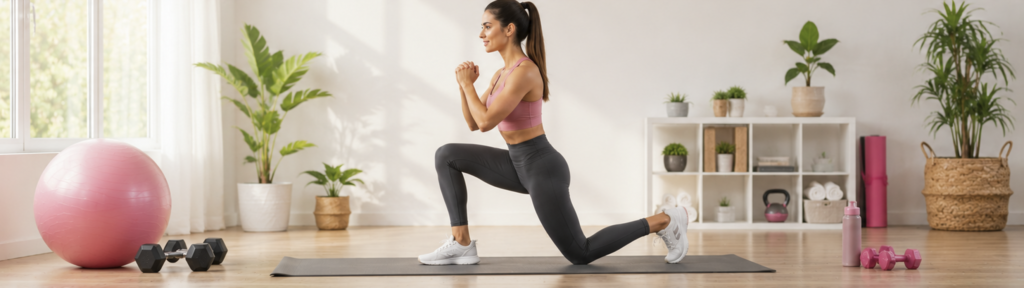
I know this might sound like an unusual thing to include in a fitness article, but I genuinely believe what you wear during your workout affects how you experience it, the same logic I’ve applied across everything else I write about regarding intentional dressing. There’s a reason the broader fitness and wellness aesthetic, so visible across Pinterest boards and social media right now, has embraced genuinely elevated, considered athletic wear rather than just whatever old t-shirt happens to be at the bottom of a drawer.
I’m not suggesting you need expensive, designer activewear to have an effective workout, not even slightly. What I am suggesting is that clothing you actually feel good in, that moves comfortably with you, that you’ve chosen with even a little intention rather than complete indifference, genuinely changes how present and motivated you feel walking into a workout. The same psychology I’ve described elsewhere, about how dressing with care affects your nervous system and your overall sense of capability, applies just as much here as anywhere else.
I’ve settled into a small rotation of leggings and supportive tops that I genuinely enjoy wearing, comfortable enough to move freely but considered enough that I don’t feel like I’m settling for whatever’s simply available. There’s something quietly motivating about feeling put-together even during a home workout nobody else is going to see, the same private confidence I’ve described in other contexts where the audience is really just yourself.
Building Toward More: What Comes After the Beginner Stage
I want to address honestly what happens once the genuinely beginner phase starts feeling more comfortable, because I think it’s worth having some sense of what progression actually looks like rather than staying in the exact same beginner routine indefinitely once your body has clearly adapted to it.
Progression in bodyweight training generally happens through a few different avenues. You can increase the number of repetitions you’re performing within a given exercise, gradually asking your body to sustain effort for slightly longer than it could when you first started. You can progress toward more challenging variations of the same movement pattern, moving from a modified, knee-supported push-up toward a full version, for instance, as your strength genuinely develops. You can also, if you choose to add minimal equipment, begin incorporating light resistance bands or hand weights, adding external resistance to movements your body has already mastered using just its own weight.
I’d encourage genuine patience with this progression, resisting the urge to rush toward more advanced versions before your form and control are truly solid with whatever you’re currently doing. I think this is another place where social media content can sometimes create unhelpful pressure, showcasing impressively advanced movements that took months or years of consistent training to develop safely, creating an unrealistic sense of how quickly beginners should expect to progress toward similarly advanced work.
If you do find yourself genuinely enjoying this process and wanting to progress further, I’d also encourage considering working with a qualified personal trainer, even for just a handful of sessions, to ensure your form is genuinely solid and your progression plan makes sense for your specific body and goals. There’s real value in personalized, professional guidance once you’re ready to move beyond the foundational, genuinely beginner-appropriate framework I’ve described throughout this article.
What I Wish Someone Had Told Me When I Started
If I could go back to the version of myself standing breathless on that staircase, embarrassed by how much an ordinary task had taken out of her, I think I’d tell her a few things clearly. I’d tell her that starting small, embarrassingly small by whatever standard she imagined “real” exercise required, was genuinely enough, and that consistency over months would matter infinitely more than intensity in any single session. I’d tell her that the soreness and awkwardness of those very first weeks, fumbling through unfamiliar movements, feeling far weaker than she’d hoped, was simply part of the process rather than evidence that this wasn’t going to work for her specifically.
I’d also tell her, gently, that this was never really about changing how she looked, however much that particular goal had originally motivated her up those three flights of stairs. It was about building a genuine, trustworthy relationship with her own physical capability, one that would quietly support her confidence and ease across every other part of her life in ways she couldn’t have fully predicted from where she was standing at the very beginning.
Quick Answers to the Questions I Get Asked Most About Starting Strength Training at Home
Do I need any equipment at all to get started? Genuinely no. A clear patch of floor and perhaps a mat for comfort is enough to begin building real strength through bodyweight movements alone, and equipment can be added later if and when it genuinely interests you, once you have a clearer sense of what you enjoy.
How many days a week should a true beginner be working out? Two to three sessions a week, with rest days in between for recovery, is a genuinely sustainable and effective starting point for most beginners, allowing your body real time to adapt without the burnout risk of daily intense training from the very start of this whole new practice.
Is it normal to feel really sore after starting? Some soreness in the days following a new or unfamiliar workout is genuinely normal, but it should ease within a few days and shouldn’t be so severe that it prevents normal daily movement; if soreness feels excessive or pain feels sharp rather than achy, that’s worth paying attention to and adjusting accordingly, including reaching out to a doctor if anything feels genuinely concerning rather than simply unfamiliar.
Should I exercise every single day to see results? Not necessarily, and in fact, adequate rest between sessions is genuinely part of how your body builds strength, since muscles adapt and strengthen during recovery as much as during the workout itself; daily training without rest can actually slow progress and increase injury risk for beginners who haven’t yet built up the underlying conditioning to handle that kind of frequency safely.
How long before I’ll actually feel stronger? Most beginners notice genuine improvements in strength and how exercises feel within the first several weeks of consistent training, though visible changes in appearance, if that’s part of what you’re hoping for, generally take longer and vary significantly between individuals depending on a whole range of factors specific to each person’s body, lifestyle, and starting point.
I hope, whatever stage you’re starting from, that something in this long, detailed conversation gives you the genuine encouragement and practical foundation to begin, or to keep going if you’ve already started. Strength, the kind that actually serves you in ordinary daily life, builds slowly, patiently, through consistent small efforts repeated over weeks and months rather than through any single dramatic transformation. I think that slow, patient process, more than any specific exercise or routine, is ultimately the real foundation this entire journey is built on, and I hope you find, the way I eventually did, that the strength you build along the way ends up mattering far more than whatever first got you started.
Rest Days: The Part of the Plan That Isn’t Optional
I think rest deserves its own real conversation, separate from the brief mention I gave it earlier, because I believe it’s one of the most misunderstood and most frequently neglected pieces of any beginner’s fitness journey. There’s a persistent, almost stubborn cultural belief that more is always better when it comes to exercise, that rest days represent some kind of weakness or lost opportunity rather than a genuinely essential part of how strength actually develops in the first place.
The physiological reality is that your muscles don’t actually get stronger during the workout itself. They get stronger during the recovery period that follows, when your body repairs and adapts to the demand you’ve just placed on it. Training the same muscle groups intensely day after day without adequate recovery time doesn’t accelerate progress; it genuinely interferes with it, leaving you perpetually fatigued, more prone to injury, and often less capable of giving your next session the genuine effort it deserves.
I learned this lesson the hard way during an earlier, more impatient phase of my own fitness journey, when I decided that if three sessions a week was good, then six or seven must surely be better, faster, more impressive. What actually happened was a steady accumulation of fatigue, a noticeable decline in how each session actually felt, and eventually a minor but genuinely frustrating strain that forced an unplanned break far longer than the rest days I’d been so determined to avoid in the first place. I think about that experience often now, as a useful, if slightly humbling, reminder that patience and rest aren’t the opposite of progress. They’re a genuine part of how progress actually happens.
On my actual rest days now, I’ll often still move my body in some gentle, low-intensity way, a slow walk, some easy stretching, nothing that asks for genuine effort or adds meaningful fatigue, simply because gentle movement tends to feel good and supports general circulation and mobility without interfering with the recovery my muscles genuinely need. But I’ve made peace, finally, with the idea that skipping a structured workout on a scheduled rest day isn’t laziness or lost progress. It’s quite literally part of the plan working exactly as it should.
Nourishing Your Body Without Turning This Into a Diet Conversation
I want to touch on nutrition here, carefully and briefly, because I think it’s relevant to this whole conversation about building strength, while also being genuinely cautious about how much specific guidance I offer, since individual nutritional needs vary so significantly and I’m not a registered dietitian qualified to give personalized advice on this topic.
What I will say, in the most general terms, is that your body genuinely needs adequate fuel to build and recover from the physical demands you’re placing on it through strength training. This isn’t a conversation about restriction or eating less; if anything, beginning a new exercise habit sometimes means your body needs slightly more, not less, particularly protein, which plays a genuinely important role in muscle repair and adaptation following exercise. I’d gently push back against any framing of strength training as primarily a tool for eating less or shrinking your appetite, because that mindset tends to work directly against the actual goal of building genuine strength and capability.
I’d also encourage paying attention to how you feel before and after workouts in relation to what and when you’ve eaten, since training on a completely empty stomach, or significantly under-fueled in general, tends to make sessions feel noticeably harder and less productive than they would with adequate, appropriate nutrition supporting them. Beyond these general observations, I think specific nutritional guidance genuinely belongs in the hands of a qualified professional who can account for your individual health history, goals, and circumstances, rather than generic advice offered in a fitness-focused article like this one, however well-intentioned that advice might be.
What I’d encourage most, honestly, is approaching this whole new habit from a place of genuinely caring for and fueling your body, rather than viewing food and exercise as opposing forces locked in some ongoing battle. That mindset shift, more than any specific nutritional rule, tends to support a far healthier, more sustainable long-term relationship with both movement and food.
The Mindset Shift That Made Everything Else Click
I think the single most important shift in my entire fitness journey wasn’t physical at all, and I want to spend real time on it because I genuinely believe it matters more than any specific exercise or routine I’ve described throughout this whole article. It was learning to measure success by consistency and effort rather than by any single session’s performance or any specific number on any specific day.
For years, I’d approach exercise with an almost binary mindset, treating each individual workout as either a success or a failure depending on how strong, energetic, or capable I felt that particular day. A session where I felt sluggish or had to modify an exercise more than usual felt like evidence that I was failing, rather than simply being recognized as the genuinely normal variation that happens across any long-term physical practice. This binary thinking made consistency nearly impossible, because the moment a single session felt disappointing, my motivation to continue at all would collapse along with it.
What actually changed this was reframing my entire relationship with the practice around showing up consistently rather than performing impressively. A modified, lower-energy version of my workout, completed on a day I genuinely didn’t feel like training at all, became just as much a success in my own mind as my strongest, most energized session of the week. This reframing took real, deliberate practice to internalize, and I won’t pretend it happened overnight. But once it did genuinely click, my consistency improved dramatically, precisely because I’d removed the all-or-nothing pressure that used to make any imperfect session feel like reason enough to quit entirely.
I think this connects to something I’ve written about elsewhere regarding self-compassion and avoiding harsh self-criticism across other areas of self-care. The version of this journey that actually works long-term is the one built on genuine kindness toward yourself, treating an imperfect or lower-energy session as simply part of the normal rhythm of consistent practice, rather than evidence of failure deserving harsh self-judgment.
A Sample Week to Help You Visualize the Whole Picture
I think it helps to see an entire week laid out together, rather than only discussing individual pieces in isolation, so let me walk through what a genuinely beginner-appropriate week might look like once you’ve spent that initial week or two simply learning the foundational movement patterns I described earlier.
On your first training day of the week, perhaps a Monday if that fits naturally into your schedule, you might spend five minutes on your warm-up routine, followed by your full-body sequence combining squats, a modified push-up variation, a hip hinge movement, and a plank hold, performed for a couple of rounds with rest between each exercise as genuinely needed. The day immediately following might be a true rest day, perhaps with a gentle walk if you feel like moving but nothing more structured or demanding than that.
Your second training day, perhaps a Wednesday, might repeat a similar structure to your first session, allowing you to notice, even within the same week, how the movements are already starting to feel slightly more familiar and controlled compared to just a few days earlier. Thursday becomes another rest day, and Friday or Saturday brings your third training session of the week, again following the same general structure, giving your body three total exposures to these foundational movements before a longer weekend stretch of rest heading into the following week.
I think the simplicity of this structure, the same basic session repeated three times across a week rather than constantly varying exercises in pursuit of novelty, genuinely serves beginners better than more elaborate, constantly changing programs might suggest. Repetition, in this specific context, builds genuine competence and confidence with these foundational patterns far more effectively than constant variety ever could, especially in these crucial early weeks when your body is still learning the basic mechanics of each movement.
When Motivation Inevitably Dips (Because It Will)
I want to address something honestly that almost no beginner fitness content seems willing to admit clearly enough: motivation, the genuine, eager enthusiasm that probably brought you to an article like this one in the first place, will not last indefinitely at the same intensity, no matter how committed you feel right now. This isn’t a personal failing unique to you. It’s simply the normal, expected trajectory of any new habit, and understanding this in advance genuinely helps you navigate the inevitable dip without abandoning the whole practice entirely once it arrives.
What actually carries you through the weeks when motivation has quietly faded isn’t more motivation, which tends to be a genuinely unreliable resource to depend on long-term. It’s the systems and habits you’ve built around the practice during the more motivated early weeks, the scheduled time blocked on your calendar, the simple, accessible home setup that removes friction, the reframed mindset around consistency over perfect performance that I described earlier. These structural supports keep you showing up even on the mornings you’d honestly rather stay in bed, carrying you through to the other side of that motivation dip until the habit itself becomes sufficiently established that it requires less active willpower to maintain.
I’ve found it genuinely helpful, during these lower-motivation stretches, to lower the bar for what counts as a successful session rather than abandoning the practice entirely. A shorter, gentler version of my usual routine, completed without much enthusiasm but completed nonetheless, keeps the habit and the identity of being someone who shows up for this practice intact, even when I’m not bringing my fullest energy and motivation to any individual session. I think this small act of grace toward myself during harder stretches has done more for my long-term consistency than any amount of forced enthusiasm or motivational self-talk ever managed during the times it simply wasn’t genuinely there.
Celebrating Progress That Doesn’t Show Up on a Scale
I want to close this practical section by talking about how to actually recognize and celebrate the progress you’re making, because I think so much of mainstream fitness culture trains us to look for evidence of progress in exactly the wrong places, specifically a scale or a mirror, rather than the much more meaningful, much more immediate signs of genuine strength development that show up far sooner.
Notice how a movement that felt genuinely difficult during your first week starts to feel slightly more controlled by your third or fourth week, even if you can’t yet perform a more advanced version of it. Notice if you find yourself completing an ordinary task in daily life, carrying something heavy, climbing a flight of stairs, getting up off the floor, with noticeably less effort or strain than you remember from before you started training. Notice your own posture, your own sense of physical confidence walking into an unrelated situation, the quiet, settled feeling of trusting your own body’s capability a little more than you did a month earlier.
These markers of progress, less visually dramatic than a before-and-after photo but genuinely more meaningful in terms of how they actually improve your daily life, deserve real celebration and acknowledgment as you notice them along the way. I think learning to recognize and value this kind of progress, rather than waiting for some more dramatic, visually obvious transformation that may take considerably longer to become apparent, if it ever fully aligns with whatever specific image you originally had in mind, is genuinely one of the most important skills for staying motivated and engaged with this practice over the long term.
Becoming Someone Who Trains, Not Just Someone Trying To
I think there’s a meaningful, often overlooked distinction between trying to start a fitness habit and genuinely becoming someone who trains consistently as a normal, settled part of who you are, and I want to spend a little time on this distinction because I think it’s where so much of the real, lasting transformation actually happens, far more than in any individual workout or specific exercise progression.
In the earlier, more effortful stages of building this habit, exercise tends to feel like something you’re actively doing, a deliberate choice requiring conscious willpower each time, something slightly separate from your default, natural way of moving through your days. There’s a shift that happens, gradually and somewhat quietly, where this practice stops requiring that same active, deliberate choice and instead becomes simply part of who you are, the same automatic, barely-considered habit as brushing your teeth or locking your front door on the way out.
I remember noticing this shift in myself somewhere around the four or five month mark of consistent training, realizing one ordinary Tuesday that I genuinely hadn’t had to talk myself into that morning’s session at all. It had simply happened, the way getting dressed or making coffee happens, without the internal negotiation and willpower that used to precede every single workout in those earlier, more effortful months, back when even the thought of starting felt like its own small, exhausting hurdle to clear before anything physical even began. That shift, from trying to be someone who exercises to simply being someone who trains, felt like genuinely the biggest, most meaningful milestone of this entire journey, far more significant than any specific physical strength gain I’d accumulated along the way.
I think this is ultimately what I most want you to take from this entire long conversation, more than any individual exercise, warm-up routine, or weekly structure I’ve described. The goal isn’t really to complete a successful eight-week beginner program and then move on to whatever comes next. It’s to gradually become a different kind of person, one who has a settled, consistent, genuinely caring relationship with her own physical strength and capability, woven into the same fabric as everything else you already do to care for yourself across every other part of your life.
A Final, Honest Word Before You Begin
I want to leave you with something genuinely encouraging rather than another reminder of everything you still need to learn or get right, because I think beginner fitness content can sometimes feel overwhelming in exactly the way that discourages people from ever actually starting at all. Here is what I genuinely believe, having walked this entire path myself from that breathless, embarrassed staircase moment to wherever I am now: you do not need to have any of this figured out perfectly before you begin. You simply need to begin, imperfectly, patiently, with whatever small amount of time and space and energy you genuinely have available today.
The woman who eventually feels strong and capable in her own body isn’t the one who started with the perfect plan, the ideal equipment, or unwavering motivation that never once wavered along the way. She’s simply the one who kept showing up, gently, consistently, forgiving herself for the inevitable imperfect sessions and missed weeks along the way, trusting that the slow, patient accumulation of small efforts would eventually add up to something genuinely meaningful. I believe that completely, because I’ve lived it myself, and I genuinely hope you’ll discover the exact same thing for yourself, one small, consistent session at a time, long after you’ve stopped needing an article like this one to talk you into beginning at all.