
How I went from avoiding movement entirely to genuinely looking forward to it — and how you can too, starting with your living room floor
No gym. No equipment. No excuses. Just you, some floor space, and the decision to begin.
Let me tell you about a very specific kind of shame that I don’t think women talk about enough. It’s the shame of standing in a gym — or even just imagining standing in a gym — and feeling like you don’t belong there. Like everyone can see that you don’t know what you’re doing, that the machines look like they require a degree you never got, that the women in the perfect gym sets doing perfect squats in front of the mirror are operating in a world that is simply not the one you live in.
I felt this way for most of my twenties. I’d buy a gym membership with genuine enthusiasm every January, attend approximately four times, feel profoundly out of place at each visit, and then quietly let the membership drain money from my account for six months while I told myself I’d go back when I felt less intimidated. I never felt less intimidated, because I never went back enough times to feel comfortable, and I never went back enough times because I always felt intimidated. It was a very elegant circle of avoidance.
What broke the cycle, in the end, had nothing to do with the gym. It had to do with my bedroom floor. Specifically, a period during which the gym was not an option — we were all suddenly at home, indefinitely, with no equipment and nowhere particular to be — and I discovered, in that enforced domestic situation, that movement could happen without a building, without equipment, without a class, without an instructor, and without feeling like a complete imposter. Movement could happen in pyjamas. Movement could happen in the twenty minutes between two video calls. Movement could happen here, now, with literally nothing but the space my body occupied and some idea of what to do with it.
What I’m going to share with you in this guide is everything I’ve learned since then — about how to move your body at home in ways that genuinely make you stronger and more energized, about the specific exercises that work best for women who are just beginning, about how to build a routine that actually sticks, and about the profound relationship between how you move your body and how you feel in it. Not the performative wellness version of this conversation. The real one, from someone who started with approximately zero fitness and worked her way, gradually and imperfectly, toward genuinely looking forward to moving every day.
You don’t need a gym membership. You don’t need equipment. You don’t need to be the person who does this perfectly, or consistently, or without stopping to check your phone. You need a little bit of floor space, a little bit of time, and the willingness to begin. Everything else grows from there.
Why Home Workouts for Women Are Having the Biggest Moment in Fitness History
The shift toward home workouts that accelerated dramatically in the early 2020s has not reversed itself, and I don’t think it will. What emerged from that period of forced domestic fitness was the discovery, for millions of women, that movement didn’t require the infrastructure we’d assumed it did. That a thirty-minute bodyweight session in a small living room could be more genuinely useful than an hour at a crowded gym that required thirty minutes of travel each way. That the absence of equipment didn’t mean the absence of effectiveness.
The data has caught up with the anecdote: research consistently shows that bodyweight training — exercises that use your own body as resistance rather than external weights or machines — is highly effective for building functional strength, improving cardiovascular fitness, increasing flexibility and mobility, and supporting the long-term health outcomes that matter most to women across every life stage. It is not a lesser version of ‘real’ training. In many respects, it’s the most honest version — movement that connects you directly to your body, that asks you to engage muscles in coordinated ways that machine-based training often doesn’t, and that builds the kind of practical strength that serves you in actual daily life rather than in the narrow context of a specific machine.
The wellness aesthetic that has dominated social media in 2025 and 2026 reflects this shift beautifully. The clean girl morning routine that everyone is building and refining includes some form of movement — Pilates, yoga, a walk, a home workout — as a foundational element. The quiet luxury lifestyle that has become the aspirational template for so many women includes intentional, consistent, non-punishing movement as a pillar of wellbeing. The women whose physiques and energy levels are most admired are not the women who do the most extreme training — they’re the women who move consistently, in ways that work for their bodies and their lives, without making it the central organizing principle of their existence.
Home workouts, in this context, are not a compromise. They’re an expression of exactly that philosophy: intentional, accessible, sustainable movement that fits inside a real life and makes that real life better. The woman who does a twenty-minute bodyweight session in her bedroom three times a week, consistently, for years, will be significantly healthier and more physically capable than the woman who does nothing for six months and then signs up for an intense gym program that lasts three weeks before collapsing under the weight of its own demands.
Consistency is everything. And home workouts, more than any other format, are the ones that support consistency — because they remove the barriers of commute, cost, schedule, and social anxiety that make gym attendance difficult to sustain.
What No-Equipment Training Actually Builds
Before we go any further, I want to address something that might be lingering in the back of your mind as a first concern: if I’m not lifting weights, am I actually doing anything? Will bodyweight training actually change my body and my fitness level, or is it just a nice way to feel like I’m doing something without the results to show for it?
The honest answer is: bodyweight training builds real strength, real cardiovascular fitness, real muscle endurance, and real body composition changes — when it’s done correctly and progressively. The qualifier matters: ‘correctly and progressively’ means using good form, working with enough intensity to genuinely challenge your muscles, and increasing that challenge over time as your body adapts. A bodyweight squat done sloppily for five repetitions is indeed not particularly useful. A bodyweight squat done with full attention to form, through a complete range of motion, for twenty repetitions with controlled tempo — that is a genuinely demanding exercise that builds the muscles of the lower body meaningfully.
The specific physiological benefits that research shows are associated with consistent bodyweight training include: increased muscular strength and endurance in the targeted muscle groups, improved balance and stability through the engagement of smaller stabilizing muscles that machine training often bypasses, better joint health and mobility through the full-range movements that bodyweight exercises naturally encourage, improved cardiovascular fitness when exercises are combined into circuits or performed at higher intensity, and a reduction in the chronic disease risk factors — insulin resistance, cardiovascular risk, bone density loss — that are particularly relevant for women as we age.
This last point is worth sitting with. Movement is not primarily aesthetic, though it has aesthetic effects. It is one of the most powerful interventions available to women for maintaining health, cognitive function, emotional regulation, hormonal balance, and quality of life across decades. The woman who moves consistently at 35 is making an investment in who she’ll be at 55 and at 75. The home workout is not just about how you look in the next six months. It is about how you live in the next forty years.
You are not working out to earn your body. You are moving to inhabit it more fully, more joyfully, for as long as possible.
— ✿ —
Before You Begin: Setting Yourself Up for Success
The most common reason home workout routines fail is not lack of willpower or motivation. It’s lack of setup. When you have to make fifteen micro-decisions before you can begin — what should I do, where should I do it, how long should it be, is this the right time, do I need to change clothes — the friction of beginning becomes high enough that it’s easier not to begin at all. Setting up your home workout environment and your routine structure in advance removes that friction almost entirely.
Creating Your Movement Space
You do not need a home gym. You do not need a dedicated room, a fancy mat, or any equipment whatsoever. What you do need is a space roughly the size of a yoga mat — about two metres long and one metre wide — where you can stand, lie down, and move with your arms extended without hitting anything. In most homes, this space exists in a bedroom, a living room, a hallway, or, on good days, a garden or balcony.
The space matters psychologically as much as practically. If your ‘workout space’ is also the space where you watch television, eat dinner, and generally exist in the most passive ways, your brain will not naturally associate it with movement and effort. Small signals to your nervous system that this is different — moving the coffee table, rolling out a mat if you have one, putting on specific music, opening a window for fresh air — create a context shift that makes beginning easier.
I do my morning movement in my bedroom, specifically in the space at the end of my bed, because that space is otherwise unused and has the quality of a dedicated zone. I move my phone charger so my phone is not within easy reach. I put on a playlist I use only for this. In five minutes, the space has been transformed from where-I-wake-up to where-I-move, and the transition is almost automatic. These are tiny things. Their cumulative effect on consistency is enormous.
If you want a yoga mat, get one — not because the floor requires it, but because the texture cues your brain toward movement and provides grip for exercises that would be slippery on hardwood. A non-slip mat in a colour or pattern you find beautiful is the kind of object that makes you want to use it. The clean girl aesthetic and its love of beautiful, functional objects extends to workout equipment: your mat can be gorgeous. It can match your interior. It can be something you look forward to rolling out rather than something you step over guiltily every morning.
The Wardrobe Question: What to Wear When You’re Working Out at Home
I’m going to spend a moment on this, because I think it matters more than people acknowledge. The clothes you move in affect how you feel while moving. They affect your body awareness, your comfort, and your willingness to do the full range of motion that most exercises require. They also affect the psychological transition into workout mode that I mentioned above.
The activewear market has evolved significantly in line with the broader aesthetic trends of the past few years. The matching set culture that exploded on social media — the Alo Yoga aesthetic, the effortlessly coordinated legging-and-sports-bra combination in muted, sophisticated tones — reflects the same quiet luxury sensibility that’s permeated fashion generally. Earth tones, chocolate browns, soft mauves, sage greens, warm creams: the colour palette of contemporary activewear has shifted away from the neon brightness of early 2010s gym culture toward something more wearable, more versatile, more aesthetically aligned with the broader sensibility of how women want to look even when they’re sweating.
The practical considerations are simple: wear something that moves with you rather than against you. Leggings or shorts that stay where you put them, a sports bra or tank with enough support for the level of activity you’re doing, and bare feet or socks with grip if the floor is slippery. The goal is clothing that you forget you’re wearing — clothing that never becomes the reason an exercise feels awkward or restricted.
What I’d specifically resist is the ‘I’ll work out when I have my proper workout clothes’ mentality. Your old university hoodie and a pair of cotton shorts are perfectly functional workout clothes. The aesthetics are a nice addition, not a prerequisite. If a beautiful matching set makes you more motivated to begin, invest in one — a piece of activewear you genuinely love, in a colour that makes you feel good, is a form of self-care investment that pays off in consistency. But don’t let the absence of perfect activewear be the reason you don’t start.
The Music Question: The Single Biggest Predictor of Workout Enjoyment
Research on exercise and music is quite clear: music you enjoy significantly increases workout duration, perceived exertion (you feel like you’re working less hard than you are), and overall enjoyment of the session. The specific genre matters less than the tempo — music with a beat per minute range between 120 and 140 is ideal for most workout formats — and the emotional response. If the music makes you want to move, it’s the right music.
Creating a workout playlist that you genuinely love is a small investment that returns significant dividends. Not the generic ‘workout hits’ playlist that streaming services suggest, but a collection of songs that are personally meaningful, that energize you specifically, that make the forty-five minutes feel shorter and more pleasurable than silence would. Mine has evolved significantly over time and includes things that would make a fitness influencer raise an eyebrow — theatrical musical numbers, French pop from the 1970s, several songs from films I love. The specific songs are irrelevant. The effect is immediate and significant.
Podcasts and audiobooks also work for the less intense portions of a workout, and some women find that a well-chosen podcast turns a workout into something they genuinely look forward to because it’s their dedicated listening time. The rule I’d suggest: music for the parts that require focus and intensity, audio content for the warmup and cooldown when your attention is more available.
— ✿ —
Understanding Your Body Before You Move It
One of the most meaningful gifts of home workouts — and one that genuinely distinguishes them from certain gym environments — is the opportunity for a real relationship with your body. Not a relationship mediated by machines that tell you how to move, or mirrors that direct your attention externally, or the ambient anxiety of being observed and judged. Just you, paying attention to how your body feels as it moves, developing the body awareness that makes movement both safer and more effective.
Body awareness is not something you either have or don’t have. It’s a skill, and like all skills, it improves with practice. As you begin a home workout practice, you’ll notice yourself becoming progressively more capable of identifying how different muscles feel when they engage, of noticing where tension accumulates, of distinguishing between productive discomfort — the kind that means you’re challenging a muscle — and pain, which means something is wrong and should be respected.
The Difference Between Soreness and Pain
This is the single most important piece of information for a beginner, because confusion between these two experiences leads either to unnecessary fear and avoidance or to the kind of willful ignorance that results in injury.
Muscle soreness — specifically the delayed-onset muscle soreness (DOMS) that typically appears twelve to forty-eight hours after a workout — is a normal, expected response to challenging your muscles in ways they haven’t been challenged recently. It feels like a dull ache in the worked muscles, a stiffness that’s worse when you’ve been still and improves with gentle movement, and a general sense of having ‘used’ those muscles. This soreness is not a sign of injury. It’s a sign of adaptation — your muscles are repairing themselves and building back slightly stronger, which is the entire physiological basis of training.
Pain is different in quality. It tends to be sharp rather than dull, localized to a joint or a specific point rather than distributed across a muscle, and it worsens with movement rather than improving. Joint pain, particularly in the knees, hips, lower back, and wrists, should always be taken seriously. If an exercise causes joint pain, stop doing it, identify what’s causing the pain (usually a form issue or a position that doesn’t suit your anatomy), and modify accordingly.
As a beginner, err significantly on the side of caution and lower intensity while you build body awareness. The first few weeks of a new workout practice are about learning to move well, not about pushing to your absolute limit. A lower-intensity session done with excellent form builds more useful strength and creates less injury risk than a higher-intensity session done with poor form and no body awareness. The intensity can increase over time. The foundation of good movement patterns needs to be built first.
Breathing: The Forgotten Element That Affects Everything
Most beginners hold their breath during exercise, and this single habit makes everything harder and less effective than it needs to be. Breathing correctly — specifically, exhaling on the exertion phase of an exercise and inhaling on the recovery phase — keeps the core engaged, maintains blood pressure at appropriate levels, and delivers oxygen to your muscles more efficiently.
The practical application is simple: if you’re doing a squat, inhale as you lower and exhale as you stand. If you’re doing a push-up, inhale as you lower toward the floor and exhale as you push back up. If you’re doing a plank, breathe slowly and rhythmically rather than holding. For cardio movements like jumping jacks or high knees, breathe in a rhythm that feels natural and sustainable rather than forcing a pattern.
The cue I find most useful for remembering to breathe: if you can’t talk while doing an exercise, you’re either working very hard (which is fine at the right intensity) or you’re holding your breath (which is not fine). Being able to say a few words, albeit with some effort, is a good indicator that you’re breathing well and working at a sustainable pace.
— ✿ —
The Warmup: The Part Nobody Wants to Do and Everyone Should
The warmup is the most consistently skipped element of a home workout, and it’s the one that makes the biggest difference to how the workout feels and how effectively your body performs during it. Skipping the warmup and launching straight into intense movement is the equivalent of trying to drive a car that’s been sitting in freezing temperatures without letting the engine warm up first. It works, after a fashion, but the performance is poor and the wear on the components is significantly higher.
A proper warmup doesn’t need to be long. Five to seven minutes is enough to meaningfully increase muscle temperature, improve joint lubrication and range of motion, activate the nervous system, and mentally prepare for the session ahead. It should involve movements that mimic what’s coming in the workout — if you’re going to be doing squats and lunges, your warmup should include hip mobility work and lower body activation. If there’s upper body work coming, shoulder circles and thoracic rotation belong in the warmup.
The specific sequence I use and teach consists of four to five minutes of joint mobilization — working systematically through the major joints — followed by one to two minutes of light cardiovascular activation like marching in place or gentle step-touches to bring the heart rate slightly up. It feels modest. It makes every exercise that follows significantly easier, more comfortable, and more effective.
A Five-Minute Warmup Sequence
Ankle Circles — Lift one foot slightly off the floor and rotate the ankle ten times in each direction. Switch feet. This mobilizes the ankle joint and prepares the lower body for any weight-bearing exercise.
Hip Circles — Stand with feet hip-width apart and hands on hips. Slowly rotate the hips in large circles — ten in each direction. This lubricates the hip joint, which is the primary joint engaged in most lower body exercises.
Spinal Rotation — Stand tall and extend your arms at shoulder height. Keeping your hips facing forward, rotate your torso gently left and right, letting the arms follow. Ten rotations each direction. This mobilizes the thoracic spine and activates the core stabilizers.
Shoulder Rolls and Arm Circles — Roll your shoulders backward ten times, then forward ten times. Then extend the arms and make small circles, gradually increasing to large circles. This mobilizes the shoulder joint and warms the upper body.
Cat-Cow Stretches — Come to hands and knees on the floor. Inhale and drop your belly toward the floor while lifting your gaze (cow). Exhale and round your spine toward the ceiling, tucking chin to chest (cat). Ten slow repetitions. This mobilizes the entire spine and activates the core.
March in Place — For ninety seconds, march in place with exaggerated arm swings, lifting your knees to hip height. This elevates the heart rate gently, increases blood flow, and signals the body that work is beginning.
— ✿ —
The Core Workout: Everything You Need in One Programme
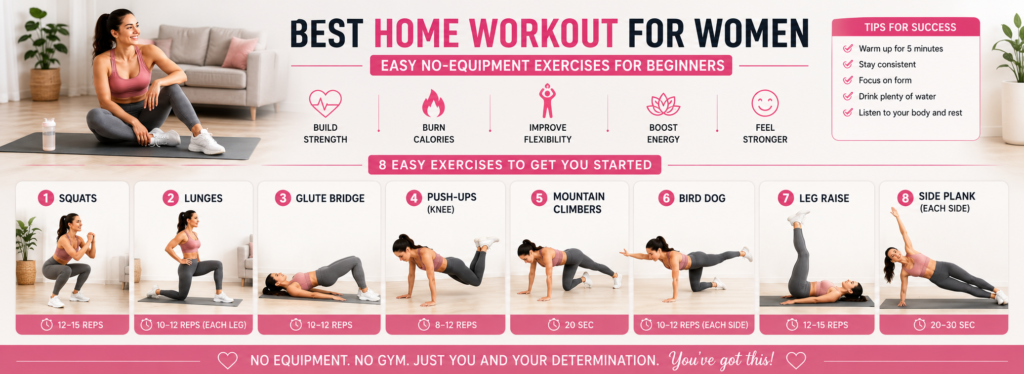
What follows is a complete beginner home workout programme — a set of exercises covering the major muscle groups, organized into sessions that can be done in thirty to forty-five minutes, with modifications for different fitness levels and clear guidance on form. I’ve arranged these into three workout types that together cover every major aspect of fitness: lower body strength, upper body and core strength, and cardiovascular fitness. The intention is to alternate between these, doing two to three sessions per week with at least one rest day between.
Before we get into the specific exercises, I want to say something about repetitions and intensity. Beginners often make the mistake of defaulting to low repetitions because high repetitions feel ‘too hard.’ But the right level of difficulty is one where the last few repetitions of a set genuinely challenge you — where you have to concentrate, where your muscles are fatiguing. If an exercise feels easy throughout, it’s not producing adaptation. If it feels impossible, the form will collapse. The sweet spot is ‘challenging but achievable,’ and finding that sweet spot requires some experimentation as you start.
Workout One: Lower Body and Glutes
The lower body is where the majority of your muscle mass lives, and training it consistently produces the greatest impact on your overall strength, your metabolism (more muscle mass means a higher resting metabolic rate), and your functional ability to move through daily life. The exercises in this session target the quadriceps, hamstrings, glutes, and the smaller stabilizing muscles of the hip and ankle.
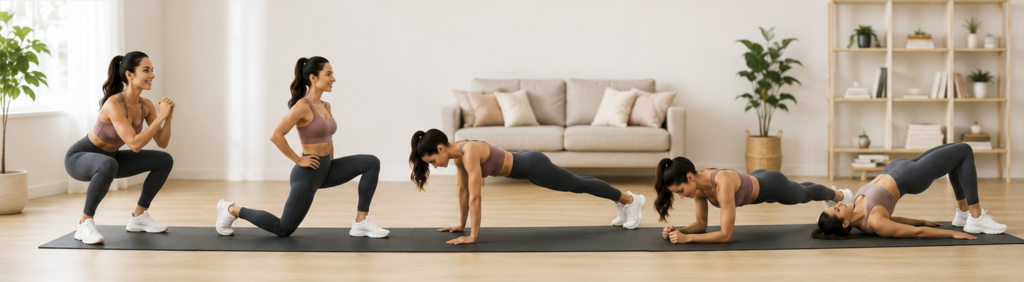
Bodyweight Squat — Stand with feet hip-to-shoulder-width apart, toes turned out slightly. With your chest lifted and your weight in your heels, lower your hips back and down as though sitting into a chair, until your thighs are as close to parallel to the floor as your range of motion allows. Press through the heels to stand. Three sets of fifteen to twenty repetitions. The single most important lower body exercise that exists — it trains virtually every muscle from the waist down.
Reverse Lunge — Stand tall, feet together. Step one foot backward, lowering your back knee toward the floor while keeping your front shin vertical and your torso upright. Push through your front heel to return to standing. Three sets of twelve repetitions per leg. The reverse lunge is kinder to the front knee than a forward lunge and equally effective at training the glutes and quadriceps.
Glute Bridge — Lie on your back with knees bent, feet flat on the floor about hip-width apart and close to your glutes. Pressing firmly through both feet, lift your hips toward the ceiling until your body forms a straight line from shoulders to knees. Squeeze the glutes at the top, then lower slowly. Three sets of fifteen to twenty repetitions, with a two-second hold at the top. This is one of the most effective glute exercises available at any level, including with weights.
Lateral Squat — Stand with feet wider than shoulder-width. Shift your weight to the right, bending the right knee and keeping the left leg straight, lowering as far as your inner thigh flexibility allows. Push back to centre and shift to the left. Twelve repetitions per side, three sets. This trains the inner and outer thighs and the gluteus medius — the muscle that stabilizes the pelvis during walking and running.
Single-Leg Glute Bridge — Same setup as the regular glute bridge, but extend one leg straight. From this single-leg position, lift the hips to full extension. This significantly increases the demand on the working glute and is the natural progression from the two-leg version. Ten to twelve repetitions per leg, three sets.
Wall Sit — Stand with your back against a wall and lower your hips until your knees are at ninety degrees, as though sitting in an invisible chair. Hold for thirty to sixty seconds. Three rounds. This is a deceptively simple exercise that builds significant quad endurance — the burning sensation you’ll feel in the front of your thighs is your quadriceps working isometrically, and it’s entirely normal and productive.
Workout Two: Upper Body, Core, and Posture
Upper body work for women sometimes suffers from the cultural mythology that training your upper body will make you ‘bulky’ — a concern so persistent and so scientifically unfounded that I want to address it directly. Women have significantly lower testosterone levels than men, which means the muscle-building process in the female body works very differently. Building visible, significant muscle bulk requires years of dedicated, heavy training and a specific nutritional approach. The upper body work in this programme will make you stronger, improve your posture, and create the toned appearance in your arms, shoulders, and back that is widely considered extremely appealing — not bulk in any sense you’d find concerning.
Posture deserves particular mention in the context of upper body training, because the specific muscle imbalances that most modern women develop — from desk work, from phone use, from the forward-rounded position most of us spend significant portions of our day in — create postural patterns that cause neck pain, shoulder tension, lower back discomfort, and a visual appearance of being smaller and less confident than you actually are. Strengthening the upper back, the rear shoulders, and the core is genuinely postural medicine. The woman who trains these muscles consistently stands differently — taller, more open, more present. The effect is immediately visible to the people around her.
Incline Push-Up — Place your hands on a stable elevated surface — a sofa arm, a sturdy chair seat, a kitchen counter, or a step. Walk your feet back until your body forms a straight line from head to heels. Lower your chest toward the surface by bending the elbows, then push back to the starting position. Three sets of ten to fifteen repetitions. The incline position reduces the percentage of your bodyweight that you’re lifting, making this the ideal starting point for women who find floor push-ups too challenging initially.
Floor Push-Up — The natural progression from the incline version. Hands directly under or slightly wider than the shoulders, body in a straight line from head to heels or, if needed, with knees down on the floor. Lower until your chest approaches the floor, elbows tracking at roughly forty-five degrees rather than flaring directly to the sides. Push back to the starting position. Three sets of eight to fifteen repetitions depending on your current strength level.
Superman Hold — Lie face down on the floor with your arms extended above your head. Simultaneously lift your arms, chest, and legs off the floor by squeezing the muscles of your upper and lower back and glutes. Hold for two to three seconds at the top, then lower. Fifteen repetitions, three sets. This directly targets the lower back, upper back, and glutes — the muscles most responsible for good posture and the ones most weakened by sitting.
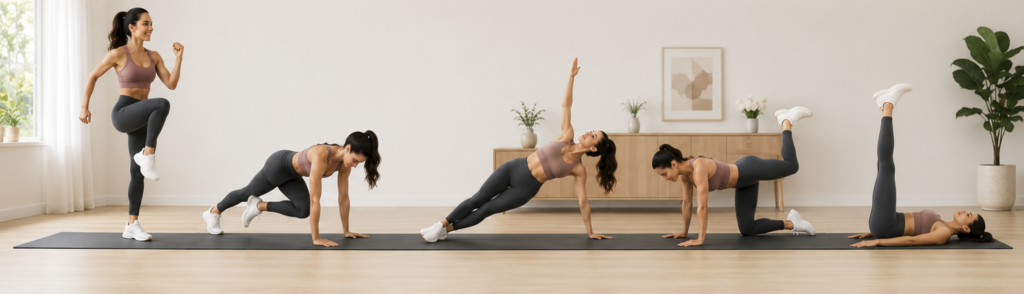
Plank — The foundational core exercise. Come to your hands and knees, then step your feet back until your body forms a straight line from head to heels. Your hands should be directly under your shoulders, your core braced as though you’re about to be punched, your hips neither raised nor sagging. Hold for twenty to forty-five seconds as a beginner, working toward sixty seconds over time. Three rounds. The plank is not primarily an abdominal exercise — it trains the entire core as a system, including the deep stabilizing muscles that nothing else quite reaches.
Side Plank — From the regular plank, rotate your body to face sideways, stacking your feet and supporting yourself on one hand with the other arm extended toward the ceiling. Your hips should be lifted high rather than sagging toward the floor. Hold for twenty to thirty seconds per side. Three rounds. This trains the obliques and the gluteus medius in combination — a pairing that’s crucial for spinal stability and a strong, sculpted waistline.
Tricep Dip — Sit on the edge of a stable chair or sofa with your hands gripping the front edge, fingers pointing forward. Walk your feet out slightly and lift your hips off the surface. Bend your elbows to lower your body toward the floor, then straighten to return. Three sets of ten to fifteen repetitions. This directly targets the triceps — the muscle on the back of the upper arm — which is one of the areas women most frequently mention wanting to strengthen and tone.
Shoulder Tap — In a high plank position (on your hands, not elbows), lift one hand to touch the opposite shoulder, then replace and alternate. The challenge is to keep your hips level and still throughout — the natural tendency is to rotate the entire body, which should be resisted. This builds shoulder strength, core stability, and the anti-rotation strength that protects the lower back. Three sets of twelve taps per side.
Workout Three: Cardio and Full Body
Cardiovascular fitness is the component of fitness that most directly affects your daily energy, your heart health, your mood, and your longevity. It’s also the component that beginners often find most daunting, because the sensation of being breathless and uncomfortable is unfamiliar and can feel alarming. The important thing to know is that cardiovascular capacity improves faster than almost any other aspect of fitness — the breathlessness you experience in week one of doing jumping jacks is significantly reduced by week four, simply because your cardiovascular system has adapted to the demand.
The cardio exercises in this session are designed to be high enough in intensity to elevate the heart rate meaningfully but modifiable for women who are very new to cardiovascular training. Every jumping exercise has a low-impact alternative — rather than jumping, you simply step quickly through the same movement pattern. The cardiovascular benefit is somewhat reduced, but the adaptation process begins, and the jumping version becomes possible as fitness improves.
Marching in Place — The low-impact warmup that becomes the low-impact modification for everything else. March with exaggerated arm swings and high knees for sixty seconds. This is your rest-in-motion option between higher intensity exercises.
Jumping Jacks / Side Steps — The classic. Jump feet out and swing arms overhead simultaneously, then jump back together. For the low-impact version, step one foot out at a time. Forty-five seconds on, fifteen seconds of marching in place. Three rounds.
High Knees / Marching High Knees — Run in place, driving your knees up toward hip height with each step. Pump your arms in opposition. For the low-impact version, march with very high knees rather than running. Forty-five seconds of work, fifteen seconds of rest. Three rounds. This is one of the most effective cardiovascular exercises available without equipment because it uses the large hip flexor muscles and elevates the heart rate rapidly.
Squat Jumps / Jump-Free Squats — Perform a squat, and at the top of the movement, jump explosively and land softly back into the squat position. For the low-impact version, simply stand with maximum speed after each squat rather than jumping. The explosive version trains power, which is a distinct aspect of fitness that regular squats don’t train — power training has particular benefits for bone density, which is important for women across all ages.
Mountain Climbers / Slow Mountain Climbers — In a high plank position, drive one knee toward your chest, then return and switch. The standard version is performed quickly, making it a cardiovascular exercise as well as a core one. The slow version, where each knee drive is deliberate and controlled, is a core exercise that’s also appropriate as a modification. Thirty to forty-five seconds, three rounds.
Burpee (Modified) — Stand tall, lower your hands to the floor, step your feet back to a plank, perform one push-up, step your feet forward, stand and reach your arms overhead. This is the modified version that removes the jumps and makes the movement accessible to beginners while still training the entire body in one continuous sequence. Five to eight repetitions, three rounds. This is the most comprehensive single exercise available in bodyweight training — it trains the cardiovascular system, the legs, the core, the chest, and the shoulders in one continuous movement.
Skaters / Side Steps — Jump laterally from one foot to the other, letting the non-weight-bearing foot sweep behind you as you land. The movement mimics the motion of a speed skater and trains lateral stability, the glutes, and the cardiovascular system simultaneously. For the low-impact version, step wide from side to side quickly. Forty-five seconds on, fifteen off. Three rounds.
— ✿ —
The Cooldown: The Investment in How You Feel Tomorrow
If the warmup is the most skipped element of a beginner’s workout, the cooldown is the second most skipped — and the two things are related. When something feels optional and is placed at the end of something that’s already required effort, the temptation to simply stop and move on with the day is strong. I understand this completely. I’ve ended many a workout by standing up from the last exercise, deciding that the shower was enough of a transition, and walking away.
What I’ve noticed, consistently, over years of workouts with and without proper cooldowns, is that the sessions with proper cooldowns produce significantly less next-day soreness, better range of motion in the days following, and a qualitatively better feeling of having properly completed something rather than having just stopped. The cooldown is not just stretching for the sake of it. It’s the transition back to a resting state that allows the physiological processes of recovery to begin in optimal conditions.
A cooldown of five to eight minutes of static stretching — holding each stretch for thirty to sixty seconds rather than bouncing — targeting the muscles used in the workout is the minimum. The breath naturally slows during static stretching. The heart rate comes down gradually rather than abruptly. The muscles, warm and pliable from the workout, are at their most receptive to being lengthened, which means the flexibility benefits of stretching are greatest immediately post-workout.
A Post-Workout Stretch Sequence
Standing Quad Stretch — Stand tall, bend one knee and bring the foot toward your glute, holding it with the same-side hand. Keep your knees together and stand tall. Hold thirty to sixty seconds per side. This stretches the quadriceps, which work hard in squats, lunges, and most lower body exercises.
Standing Hip Flexor Stretch — Step one foot forward into a gentle lunge position. Lower your back knee toward the floor and shift your hips forward until you feel a stretch in the front of the back hip. Keep your torso tall. Hold forty-five seconds per side. The hip flexors are chronically tight in most modern women due to prolonged sitting, and this stretch is arguably the most important one you can do for your posture and lower back health.
Seated Hamstring Stretch — Sit on the floor with both legs extended. Reach forward toward your feet, keeping your spine as long as possible rather than rounding dramatically. The stretch should be felt along the back of the legs, not in the lower back. Hold sixty seconds. If your hamstrings are very tight, bend the knees slightly and focus on keeping the spine long.
Figure-Four Glute Stretch — Lie on your back with knees bent. Cross one ankle over the opposite knee, creating a figure-four shape with your legs. Either stay here if you feel a stretch, or gently draw both legs toward your chest. This directly stretches the piriformis and deep hip rotators — muscles that often become tight during glute training and that, when tight, can contribute to sciatic nerve irritation. Hold sixty seconds per side.
Child’s Pose — Come to hands and knees, then sit your hips back toward your heels and walk your hands forward until your forehead rests on the floor (or as close as comfortable). Arms can be extended or resting alongside the body. Hold sixty to ninety seconds. This stretches the entire back, the hips, and the shoulders simultaneously and doubles as a moment of conscious breathing and rest.
Chest Opener — Sit comfortably or stand tall. Interlace your hands behind your back and squeeze your shoulder blades together, opening your chest toward the ceiling. Hold thirty seconds. After a session that includes push-ups and planks, this counter-movement releases the chest and front of the shoulders and reinforces good posture.
Neck and Shoulder Release — Sit tall. Drop your right ear toward your right shoulder and hold for twenty seconds. Then gently turn your chin toward your right armpit for a deeper stretch into the upper trapezius. Switch sides. This releases the neck and upper shoulder tension that accumulates not just during upper body exercise but during daily stress.
— ✿ —
Building Your Weekly Schedule: The Plan That Actually Sticks
Having the exercises is one thing. Knowing how to arrange them into a weekly schedule that’s realistic, progressive, and sustainable is another — and it’s the piece that determines whether your home workout practice becomes a permanent feature of your life or another thing you did for three weeks in February.
The principles of effective workout scheduling for beginners are simple: start with less than you think you need, rest more than you think you should, and increase gradually rather than dramatically. The most common beginner mistake is starting with too much — five sessions a week when three would be ideal, ninety minutes when forty minutes would produce the same or better results. Starting conservatively means the first weeks feel achievable rather than overwhelming, which builds the confidence and momentum that sustain the practice long-term.
A Beginner’s Eight-Week Progressive Plan
Weeks One and Two: Two sessions per week, choosing any two from the three workout types. Each session thirty to thirty-five minutes including warmup and cooldown. The goal of these weeks is simply to begin, to establish the habit of doing this twice weekly, and to learn the exercises without worrying about intensity or load. If you miss a session, don’t try to make it up — just continue with the scheduled session next time it falls.
Weeks Three and Four: Three sessions per week, one of each workout type across the week. Each session thirty-five to forty minutes. By this point the warmup sequence should feel familiar. Begin paying attention to which exercises you find most challenging and prioritize form in those specifically.
Weeks Five and Six: Three sessions per week, beginning to increase the challenge. Add one to two additional repetitions or sets to the exercises you find manageable. Reduce rest time between exercises from ninety seconds to sixty seconds if you’re recovering quickly. Replace the incline push-up with the floor version if you haven’t already. Begin experimenting with the more challenging variations of exercises — single-leg glute bridge instead of two-leg, full jumping versions of cardio exercises instead of step versions.
Weeks Seven and Eight: Three sessions per week, with the option to add a fourth if it genuinely feels right (not because you feel you should, but because you have the energy and desire for it). Focus on increasing the quality and depth of each exercise rather than adding new exercises. Hold the plank a few seconds longer. Lower deeper into the squat. Breathe more consistently. The workout doesn’t change dramatically in these weeks — the improvement comes from doing the same exercises better.
After eight weeks, you’ll have built sufficient foundation to begin exploring more advanced variations, adding a fourth weekly session if desired, or exploring other formats — Pilates, yoga, a structured HIIT programme — from a position of genuine fitness capability rather than starting from scratch.
The Rest Day: The Workout That Happens When You Stop
Rest days are not optional. This is not a flexibility statement — it is a physiological fact. Muscular adaptation, the process by which your muscles become stronger and more capable in response to training, happens not during the workout but during recovery. The workout is the stimulus; the rest is where the response occurs. Training without adequate recovery produces fatigue accumulation, overuse injuries, and eventually the kind of complete exhaustion that leads to long unplanned breaks from exercise — the very opposite of consistency.
Rest days for beginners mean genuinely reduced physical demand, not an alternative intense activity. Walking, gentle yoga, light stretching, or genuinely doing nothing physical at all — all of these are appropriate rest-day activities. What is not an appropriate rest day for someone doing three strength and cardio sessions per week is a four-hour hike or a ninety-minute intense dance class. Those are workouts, and they need to be counted as such in your scheduling.
Learning to appreciate rest days is one of the more sophisticated elements of fitness literacy. The rest day is the workout. It’s where the investment of your training sessions converts into actual physical improvement. Respecting it is not laziness. It is intelligent training.
— ✿ —
The Pilates Influence: Why the Most Elegant Fitness Trend Is Also the Most Effective
No guide to home workouts for women in 2025 and 2026 would be complete without an honest conversation about Pilates — because Pilates has become, in the current cultural moment, simultaneously the most aspirational fitness aesthetic and one of the most genuinely effective training methodologies available to women.
The Pilates aesthetic has become deeply embedded in the visual language of the clean girl and quiet luxury trends. The matching sets in muted tones, the reformer machine that’s appeared in the backgrounds of approximately half the aspirational home interiors on Instagram, the long, lean, controlled quality of movement that Pilates practitioners develop — it has the quality of something that is both beautiful to look at and genuinely beneficial to do, which is a rare and valuable combination in fitness culture.
But beyond the aesthetics, the methodology of Pilates — its emphasis on controlled movement from a stable core, on precise muscle engagement rather than momentum, on the connection between breath and movement, on quality of repetition over quantity — is exactly the approach that produces the most functional results for most women. The postural improvements, the core strength, the hip stability, the body awareness that comes from consistent Pilates practice are things that no other training methodology quite replicates.
The wonderful news is that Pilates principles are fully applicable in a home workout context without a reformer machine. Mat Pilates — the floor-based version of the practice that predates the reformer — is equally effective and requires only a mat and some floor space. Several of the exercises in the workouts I’ve described above are drawn from Pilates principles: the glute bridge, the single-leg variations, the plank and side plank, the Superman hold. If the Pilates approach resonates with you, it’s worth exploring mat Pilates content specifically, which is widely available across YouTube and various fitness platforms, and which can complement the programme above or eventually replace it as your practice evolves.
Incorporating Pilates Principles Into Your Home Workout
The core Pilates principles that you can apply immediately to any of the exercises described in this guide: move slowly and with control rather than using momentum. Engage the deep core — specifically the sensation of gently drawing your navel toward your spine — before and during every movement. Think about the quality of each repetition rather than racing through the count. Pay attention to the specific muscles that should be working and consciously engage them, rather than relying on the grosser movement patterns that often compensate for targeted muscle weakness.
Applied to a squat, this approach transforms a fairly casual exercise into something considerably more demanding and more effective: descend slowly with control, feel the glutes and quadriceps engage, pause briefly at the bottom with full attention to your alignment, then rise with deliberate power. The same number of repetitions takes three times as long and produces three times the training stimulus.
Applied to a push-up, Pilates principles mean: engage the core before you begin, move through the full range of motion with control (not bouncing off the bottom), feel the chest and triceps working on the push, maintain perfect alignment throughout. Five push-ups done this way are more effective than twenty done carelessly. This is the Pilates proposition, and it’s one that makes home workouts not just viable but genuinely sophisticated.
— ✿ —
Nutrition and Movement: The Partnership That Makes Everything Work
A home workout guide that doesn’t address nutrition would be incomplete, because movement and nutrition are not separate systems — they are deeply interdependent, and the relationship between them determines most of the outcomes that women care about when they start a fitness practice.
I want to be clear about what I mean and don’t mean here. I am not going to tell you to eat less, count calories, follow a specific diet protocol, or restrict yourself in any of the ways that fitness culture has historically tried to impose on women. The relationship between food and exercise that I’ve found most useful and most sustainable is not about fuel for performance, though that’s part of it, and not about earned indulgences, which is a framing I’d actively avoid. It’s about giving your body what it needs to do the work you’re asking it to do and to recover from it appropriately.
What Your Body Needs When You Start Moving More
Protein is the nutrient most directly relevant to exercise adaptation. When you strength train — which the lower body and upper body workouts in this guide absolutely are — you create small amounts of damage in the muscle tissue, which then repairs stronger. The raw material for that repair is protein. Women who strength train and don’t eat adequate protein will experience slower strength gains, more prolonged soreness, and more fatigue than those who are meeting their protein needs.
The specific recommendation varies by body weight and training intensity, but for a woman doing two to three strength sessions per week, a daily protein intake of roughly 1.2 to 1.6 grams per kilogram of body weight is well-supported by research. This is more than most women naturally eat, particularly those who have internalized messages about eating ‘lightly’ or prioritizing low-calorie foods. If you eat protein at every meal — eggs for breakfast, a substantial protein source at lunch and dinner — you’re likely in a reasonable range without needing to track anything.
Carbohydrates are your primary fuel for exercise, and reducing them significantly while simultaneously beginning a new workout programme is a combination that produces exhaustion, poor performance, and very unpleasant workouts. The common trend of very low carbohydrate diets and intense exercise simultaneously is not a comfortable experience and is not necessary for any health or body composition goal. Complex carbohydrates before and after a workout support energy and recovery.
Hydration is the element most directly connected to how you feel during a workout. Even mild dehydration — the kind you don’t particularly notice until you start moving — reduces performance, increases perceived exertion (everything feels harder), and increases recovery time. Drink water before, during if the session is longer than thirty minutes, and after every workout. The colour of your urine is the most useful indicator of hydration status: pale yellow means well-hydrated; dark yellow or amber means you need to drink more.
Eating Around Your Workouts
The specific question of when to eat relative to your workout is one of the most commonly asked and most unnecessarily complicated topics in fitness nutrition. The practical answer is: eat enough in total across the day to support your activity level, and specifically, don’t work out in a state of significant hunger, because hungry exercise is miserable exercise that leads to early session termination and a very large post-workout meal that often eliminates any caloric deficit created by the exercise.
For morning workouts, which many women prefer because the workout is done before the day’s demands arrive and derail plans: a small, easily digestible meal or snack about thirty to sixty minutes before is ideal if you’re doing anything longer or more intense than a gentle walk. Something that combines simple carbohydrate for quick energy and a small amount of protein — a banana with almond butter, a piece of toast with an egg, a small yogurt with fruit — provides enough energy for a forty-five minute session without the discomfort of exercising on a full stomach.
After a workout, eating a proper meal within an hour or two supports recovery. The post-workout meal should include both protein (for muscle repair) and carbohydrates (to replenish the glycogen that your muscles used during the session). A proper breakfast if you exercised in the morning, a proper lunch if you exercised mid-morning, a proper dinner if you exercised in the evening. Nothing complicated, no specific ‘recovery foods’ required, just a regular, balanced meal eaten in a reasonable timeframe.
— ✿ —
The Mental Side of Beginning: What Nobody Tells You About Starting a Fitness Practice
There’s a conversation that happens in fitness culture that I find deeply frustrating, and it goes something like this: just start, just do it, just show up, motivation is a myth, discipline is everything, the hard days are the ones that count. This framing is not entirely wrong — there is truth in the value of showing up when you don’t feel like it, and there is truth in the fact that motivation is unreliable as a foundation for behavior. But it misses something essential about the beginning phase of a fitness practice that I think deserves to be named.
The beginning is genuinely hard. Not because you’re weak or lacking discipline, but because you’re asking your body and brain to do something unfamiliar, which requires more effort than familiar things always do. The first few workouts will likely feel awkward. You won’t know the exercises well enough to feel fluid in them. The intensity will feel surprising. Your muscles will be sore in ways that make the next session feel daunting. All of this is normal, expected, and temporary. It is not evidence that you’re not cut out for this, that your body is wrong for exercise, or that the practice isn’t working.
Working Through the First Three Weeks
The first three weeks of any new exercise practice are the hardest, and they’re the point at which most beginners give up. The body hasn’t yet adapted to the movement, the practice doesn’t yet feel natural, the soreness hasn’t settled into the productive rhythm that experienced exercisers know as a positive sign of adaptation. Knowing this in advance — knowing that week one and two are going to be uncomfortable and that this is not a signal to stop — changes how you interpret the experience.
The heuristic I find most useful for the first three weeks: the workout is a success if it happened. Not if it was intense enough, not if you felt strong throughout, not if you kept up with whatever pace or repetition count you’d set yourself. If the session happened, it was a success. You moved your body. You showed up. The adaptation is beginning even if you can’t feel it yet. That’s enough.
By week four, something shifts for most women. The exercises start to feel more natural. The soreness is more manageable. The cardiovascular sessions feel less brutal. The body is adapting visibly — not in terms of appearance, which takes longer, but in terms of capability and comfort. And with that shift comes something that none of the ‘just discipline yourself’ advice quite captures: genuine enjoyment. The satisfaction of finishing a challenging session and feeling the endorphin wash that follows. The pleasure of noticing you can hold the plank ten seconds longer than last week. The sense of your body as a capable, interesting, changeable thing rather than a problem to be managed.
That’s the experience that sustains a long-term movement practice. Not discipline. Enjoyment. The discipline gets you to the enjoyment, which is why you need it most in the first few weeks — after that, the intrinsic rewards of movement itself begin to do the motivational work.
When You Miss Sessions (Because You Will)
The most important mindset tool in any fitness practice, and the one least likely to appear in the motivational content you’ll encounter, is this: missing sessions is normal, expected, and not evidence of failure. The question is not whether you’ll miss sessions — you will, everyone does — but what you do after you miss one.
The self-compassion response to a missed session is to notice it, release any associated guilt, and return to the schedule at the next scheduled time. Not to add an extra session to compensate. Not to castigate yourself with a narrative about willpower and failure. Not to conclude that you’re not the kind of person who can maintain a fitness practice. Simply to note that you missed Tuesday, and to show up on Thursday.
Women who maintain long-term fitness practices are not the women who never miss sessions. They are the women who return consistently and without drama after missing sessions. That’s the entire skill. The return, not the perfection.
— ✿ —
What Movement Becomes When You Do It Long Enough
I want to close with something that I couldn’t have written three or four years ago, because I hadn’t yet experienced it: what happens to your relationship with movement when you do it consistently for long enough that it becomes part of how you understand yourself.
Movement, practiced consistently and with growing body awareness, stops being something you do to your body and becomes something you do with it. The distinction sounds subtle and is actually profound. The early relationship with exercise is often adversarial, in ways that are rarely named but are immediately recognizable: the sense of the body as something that needs to be pushed, punished, or managed into a different shape. The workout as an act of correction. The calorie as an enemy. The sweat as penance.
None of that is what movement becomes when it’s been practiced with care and consistency for a year, or two, or five. What it becomes is a conversation. An ongoing dialogue between you and your body about what it’s capable of, what it needs, what it enjoys, where it’s changed, what it can do today that it couldn’t do before. The body becomes interesting rather than problematic. Its capabilities become a source of genuine pleasure rather than a source of shame.
The woman who has been moving consistently for two years can feel the specific muscles of her glutes engage when she walks up stairs. She can sense her core stabilize when she carries something heavy. She notices her posture in photographs and registers that it’s changed — that she holds herself differently, more open, more tall, more present. She wakes up in the morning with a relationship to her physical body that is, in small but meaningful ways, one of ownership rather than occupation. This body is hers. She has built it, deliberately, over time. She knows what it can do, and she intends to find out what else it’s capable of.
The workout is the beginning. The body you build through consistency, over time, with care and attention — that is the real destination.
Everything I’ve described in this guide is accessible to you, starting today, starting with the space your body occupies right now. You don’t need the gym. You don’t need equipment. You don’t need perfect motivation or perfect discipline or the perfect workout clothes or the perfect morning. You need to begin. And then to return. And then to return again.
What you’re building is not just fitness. It’s a relationship with the body that carries you through every experience you’ll ever have. It’s worth building carefully, with patience, with kindness, and with the understanding that every session — even the short ones, even the ones that don’t go perfectly, even the ones where you stop a set early because that’s all you have today — is a deposit into something real and lasting.
Roll out the mat. Turn on the playlist. Begin.
— ✿ —
Your Complete Quick Reference: All Exercises at a Glance
The full workout programme described in this guide, condensed for easy reference as you build your practice.
WORKOUT ONE — LOWER BODY AND GLUTES
Bodyweight Squat · Reverse Lunge · Glute Bridge · Lateral Squat · Single-Leg Glute Bridge · Wall Sit
Three sets of each exercise. Rest sixty to ninety seconds between sets. Total session time approximately thirty-five to forty minutes including warmup and cooldown.
WORKOUT TWO — UPPER BODY, CORE, AND POSTURE
Incline or Floor Push-Up · Superman Hold · Plank · Side Plank · Tricep Dip · Shoulder Tap
Three sets of each exercise. Rest sixty to ninety seconds between sets. Total session time approximately thirty-five to forty minutes including warmup and cooldown.
WORKOUT THREE — CARDIO AND FULL BODY
Jumping Jacks · High Knees · Squat Jumps · Mountain Climbers · Burpee (Modified) · Skaters
Forty-five seconds of work, fifteen seconds of rest, three rounds of each exercise. Total session time approximately thirty to thirty-five minutes including warmup and cooldown.
WARMUP (All Sessions)
Ankle Circles · Hip Circles · Spinal Rotation · Shoulder Rolls · Cat-Cow · March in Place · Five to seven minutes total.
COOLDOWN (All Sessions)
Standing Quad Stretch · Hip Flexor Stretch · Seated Hamstring Stretch · Figure-Four Glute Stretch · Child’s Pose · Chest Opener · Neck and Shoulder Release · Five to eight minutes total.
WEEKLY SCHEDULE (Beginner)
Weeks 1–2: Two sessions per week, any two workouts. Weeks 3–4: Three sessions per week, one of each workout type. Weeks 5–8: Three sessions per week, progressive intensity increases. At least one full rest day between any two workout days.
— With warmth, and the genuine conviction that your body is capable of more than you think —
Your guide to moving beautifully, in the space you already have
— ✿ —