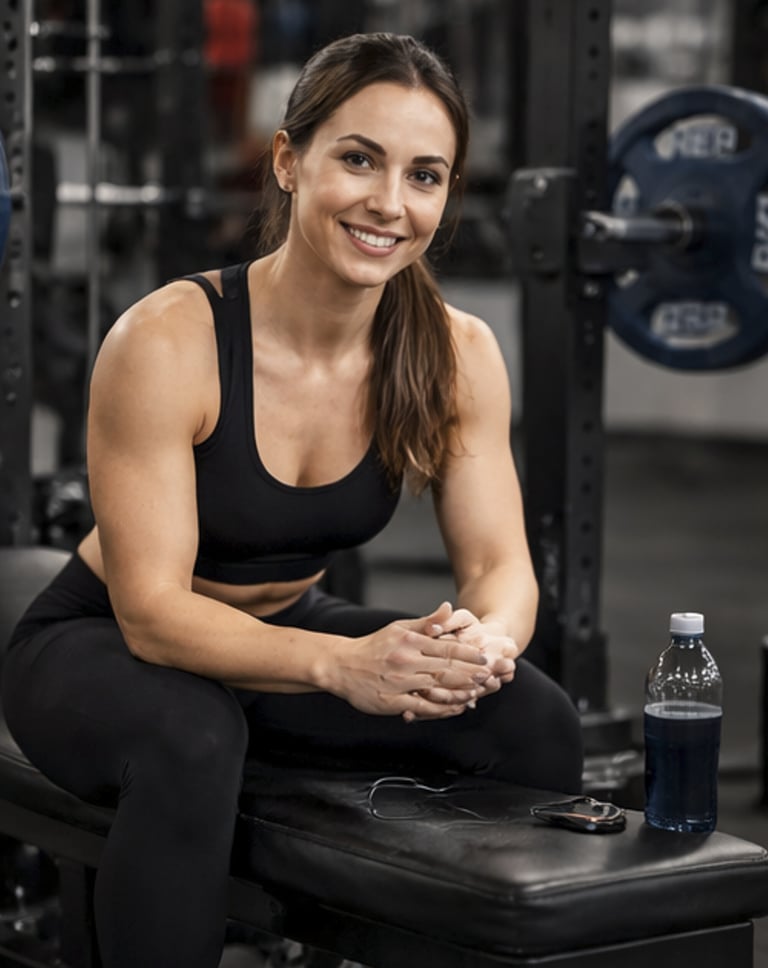
I didn’t fall in love with the bench press the first time I tried it. In fact, if I’m honest, I avoided it for months. Not because I didn’t understand its value—I knew very well that it’s one of the most effective upper-body strength builders—but because of how it felt to approach it as a woman in a space that often feels dominated by comparison, noise, and unspoken expectations.
The bench press area has a certain energy. Plates clanging, people watching, numbers being discussed like currency. And there I was, someone who just wanted to get stronger, move better, and feel more confident in her own body—not compete in an invisible contest.
But curiosity has a way of pushing you forward. And one day, I decided to stop overthinking and just try.
The first thing that surprised me wasn’t the weight. It was how technical the movement actually is. From the outside, it looks simple: lie down, lower the bar, press it back up. But once you’re under the bar, you realize quickly that every small detail matters. Where your feet are, how your shoulders sit, the angle of your elbows, even how tightly you grip the bar—it all changes the experience completely.
I remember lying down and placing my eyes under the bar, just like I had seen others do. My feet felt awkward at first. I wasn’t sure how wide they should be or how firmly they needed to press into the ground. But once I planted them properly and kept them still, I noticed something immediately—my body felt more stable. That stability travels upward. It’s subtle, but it matters.
Then came the upper body setup, which, in my experience, is the most overlooked part for beginners. I used to just lie flat and start pressing. What I didn’t realize is how important it is to pull your shoulder blades back and down. That one adjustment changed everything for me. Suddenly, my chest was lifted, my shoulders felt safer, and the movement became smoother.
There’s also this natural arch in the lower back that people often misunderstand. It’s not about forcing an extreme position—it’s about allowing your body to settle into a strong, supported posture. When I stopped trying to flatten my back completely, I actually reduced the strain on my shoulders and felt my chest engage more effectively.
Grip was another learning curve. I started too wide because I thought that’s what I was supposed to do. But it didn’t feel right. My shoulders felt uncomfortable, and I couldn’t control the bar properly. So I began adjusting—slightly narrower, then slightly wider—until I found a position where my wrists stayed straight, my elbows tracked at a natural angle, and I could feel a deep stretch in my chest at the bottom of the movement.
That’s something I wish more people talked about: the importance of finding what works for your body. There is no one-size-fits-all grip or stance. The goal is to feel the right muscles working without joint discomfort.
Lowering the bar was another turning point. At first, I rushed it. Like many beginners, I thought faster reps meant better training. But when I slowed down—really controlled the descent over two or three seconds—I felt a completely different level of muscle engagement. The chest stretch became more noticeable, and I had more control over the entire movement.
Adding a brief pause at the bottom made it even more effective. No bouncing, no relying on momentum—just a controlled stop and a strong press upward. It’s humbling, but it builds real strength.
Over time, I started to understand how the bench press truly works the body. Yes, the chest is the primary muscle, but it’s far from working alone. The triceps play a huge role in pressing the weight back up, especially near lockout. The front shoulders assist throughout the movement. Meanwhile, your upper back and core are constantly stabilizing you, even if you’re not consciously thinking about them.
It’s a full system working together, not just a chest exercise.
Before I committed to the barbell, I spent a lot of time using dumbbells. And looking back, that was one of the best decisions I made. Dumbbells taught me control and balance. They forced each side of my body to work independently, which helped me build a solid foundation.
There’s also more freedom with dumbbells. You can adjust your arm path naturally and often get a deeper stretch at the bottom of the movement. For muscle development and joint comfort, they’re incredibly effective.
But when I transitioned to the barbell, I understood why it’s so popular. The ability to progressively add weight in small increments makes it ideal for building strength over time. It’s structured. Measurable. Satisfying.
That said, the transition wasn’t instant. Even though I was comfortable with dumbbells, the barbell felt different. Less forgiving. More technical. I had to lower the weight significantly and focus on mastering the movement.
I started with light loads, sometimes just the bar, and worked on consistency. Touching the same point on my chest every time. Keeping the bar path controlled. Maintaining proper tension throughout the lift. Progress came gradually, but it was consistent.
One of the biggest lessons I learned was the importance of training frequency. At one point, I was only benching once a week and wondering why I wasn’t improving. Once I increased it to two or three sessions per week—while managing volume properly—I saw real progress.
Strength is a skill, and like any skill, it improves with practice.
Of course, there were moments where progress stalled. It happens to everyone. Instead of getting frustrated, I started making small adjustments. I focused on improving my technique, added accessory exercises to strengthen weak points, and varied my training slightly when needed.
Exercises like close-grip presses helped build triceps strength for the lockout phase. Movements that emphasized a deeper chest stretch helped improve power from the bottom. These small changes made a noticeable difference over time.
But beyond the physical progress, there was something else that kept me coming back to the bench press.
Confidence.
Not the loud, attention-seeking kind. A quieter, more grounded confidence. The kind that comes from doing something you once avoided and realizing you’re capable of more than you thought.
The first time I lifted a weight that used to intimidate me, it wasn’t about proving anything to anyone else. It was a personal moment. A realization that growth doesn’t happen in comfort zones.
And that’s really what the bench press became for me. Not just a strength exercise, but a reminder that stepping into uncomfortable spaces often leads to the biggest changes.
If there’s one thing I would say to any woman who feels hesitant about trying the bench press, it’s this: you don’t need permission. You don’t need to wait until you feel “ready.” And you definitely don’t need to compare yourself to anyone else in the gym.
Start where you are. Use a weight you can control. Focus on learning the movement properly. Pay attention to how your body feels.
And give yourself time.
Because strength isn’t built in a single session. It’s built over weeks, months, and years of consistent effort.
Today, the bench press is a regular part of my training. Not because I feel like I have to do it, but because I genuinely enjoy it. It challenges me, keeps me focused, and reminds me of how far I’ve come.
I still use dumbbells. I still switch up my routine. I still have days where the weight feels heavier than it should. But that’s part of the process.
Progress isn’t linear. And it doesn’t have to be perfect.
What matters is showing up, doing the work, and trusting that every rep—no matter how small it feels—is moving you forward.
And sometimes, that’s the most powerful thing of all.