
A room-by-room guide to building a home office that feels as good as it works.
I worked from a card table for the first eight months of remote life, and I told myself it was temporary. It wasn’t uncomfortable exactly — I just didn’t feel anything about the room. No pull toward it in the morning, no reluctance to leave it at night. It was furniture arranged near an outlet, and I treated it accordingly: I sat down, did the work, and left as soon as I could. Productivity, in that setup, was something I had to force. Willpower did all the heavy lifting a good room should have been doing for me.
Then I moved the desk eighteen inches to face a window, hung one shelf, and bought a lamp that didn’t look like it came from a hospital supply catalog. That’s not a metaphor for some bigger transformation — it’s literally what happened, and it’s the reason I now think “cozy” and “productive” aren’t opposites you have to trade off against each other. They’re the same problem solved from two directions. A space that feels good to be in is a space you don’t have to white-knuckle your way through. You stay in it longer, you return to it more willingly, and — this is the part nobody expects — you get distracted less, because you’re not spending mental energy resenting your surroundings.
This is the case for treating your home office like an actual room in your life, not a workstation you tolerate. Not a minimalist showroom, not a Pinterest board that photographs beautifully and functions terribly. Something closer to a good reading chair: inviting enough that you want to be there, structured enough that you can actually get things done once you are.
Why “cozy” keeps getting left out of productivity advice
Most home office advice splits into two unhelpful camps. One is pure ergonomics — chair height, monitor distance, wrist angles, all correct and all sterile. The other is pure aesthetics — mood boards, matching accessories, a workspace styled for a photo rather than for eight hours of actual use. Neither camp asks the more basic question: does this room want you in it?
That sounds soft, but there’s real psychology under it. Environmental cues shape behavior more than most people give them credit for. A cold, under-furnished room reads to your nervous system as temporary, unimportant, not worth settling into — and you behave accordingly, checking your phone more, finding excuses to leave, treating the space with the same low commitment it seems to have toward you. A room with warmth, texture, and a few signs of actual life in it reads as a place worth being. You settle. Settling is underrated. It’s the difference between forcing two hours of focus and falling into two hours of focus.
There’s also a simpler, less academic reason cozy matters: you’re going to be in this room a lot. If you work from home even three days a week, that’s roughly 1,500 hours a year in one spot. Compare that to how much thought most people put into a hotel room they’ll sleep in once. The mismatch is strange when you say it out loud.
What this actually looks like in practice
None of this requires a renovation or a four-figure budget. Some of the most effective changes I’ve made — and the ones I hear about most often from other people who’ve done this well — cost very little: a warmer bulb, a rug that covers the cold floor near the desk, a shelf at eye level with two or three things on it that aren’t work-related. Cozy is not the enemy of function. Clutter is the enemy of function. Those are different things, and conflating them is why some people avoid softening their workspace at all — they’re worried “cozy” means “cluttered,” when really the goal is a room that’s warm and still clear-headed.
The rest of this piece walks through the pieces that actually move the needle: where to put the desk in the first place, how to build in a spot for thinking that isn’t the desk, lighting that doesn’t leave you squinting by 4 p.m., color and texture choices that make a room feel finished instead of half-decorated, the personal objects worth making room for, how to stay organized without turning the room sterile again, and the smaller sensory details — sound, scent, temperature — that most guides skip entirely.
I’m not going to pretend there’s one correct formula. A cozy office for someone who works in short, high-focus sprints looks different from one built for someone who spends six hours a day on video calls. What follows are the choices that consistently work, with enough explanation of *why* they work that you can adapt them instead of copying them wholesale. Start with whichever section solves the problem bothering you most right now — you don’t need to overhaul the whole room in one weekend, and honestly, you shouldn’t. The best home offices tend to be assembled slowly, one useful decision at a time, which is also roughly how you end up liking a room instead of just owning it.
Finding Your Spot — Light and Layout Before Anything Else
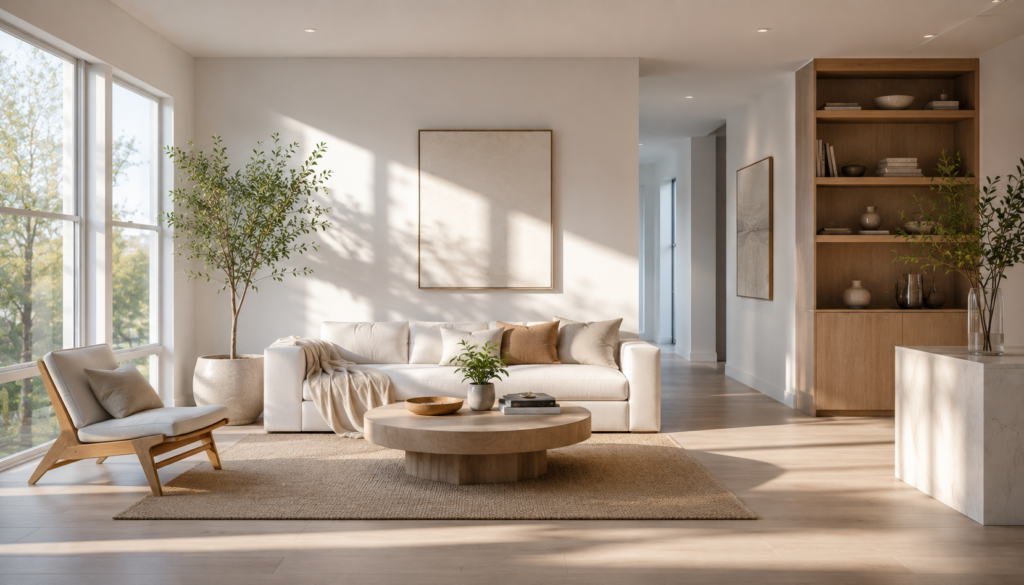
Before you buy a single thing, figure out where the desk actually goes. This is the step people skip because it feels like it doesn’t cost anything, so it can’t be that important — but bad placement will undermine every other choice you make. I’ve seen beautifully decorated offices that were miserable to work in because the desk faced a blank wall two feet away, or sat directly under a ceiling light that turned the laptop screen into a mirror by 2 p.m.
Chase the natural light, but don’t face it head-on
Natural light is the single biggest lever for how a room feels, full stop. A dim room reads as gloomy no matter how nice the furniture is, and a well-lit one reads as pleasant even with mismatched secondhand pieces. So put the desk near a window if you can. The catch is *orientation*: facing directly into a window means glare and a washed-out screen for half the day, and facing directly away from one means a bright rectangle behind you on every video call, silhouetting you like a witness giving testimony. The fix is almost always to angle the desk perpendicular to the window — light falls across the desk and across your face on calls, without blasting the screen. If you only have one wall option and it’s directly opposite the window, a sheer curtain solves most of the glare problem for the cost of a curtain rod.
If you don’t have great natural light — an interior room, a basement corner, a windowless nook — don’t force it. Compensate with layered artificial light instead (more on that shortly) and don’t spend energy fighting the room’s actual conditions. A north-facing window with soft, consistent light all day is honestly better for screen work than a south-facing one that floods the room with harsh direct sun for three hours and leaves you fighting blinds.
Give yourself something to look at
Staring at a wall for eight hours a day is a genuinely bad experience, and yet it’s the default setup in a huge number of home offices, usually because the wall happened to be the spot with an outlet nearby. If you can angle the desk toward a window, a doorway, or even just the rest of the room instead of a blank wall, do it. Peripheral movement and a view — even a mundane one, like watching the street or a pet wandering through — gives your brain small breaks that don’t count as distraction the way a phone does. It’s a release valve. Staring at drywall for eight hours has no release valve, so your brain manufactures one, usually in the form of checking your phone.
If a wall-facing desk is genuinely your only layout option, break it up. A piece of art at eye level, a small shelf, even just a different paint color on that one wall changes the experience meaningfully. The goal isn’t to eliminate the wall — it’s to give your eyes somewhere to land that isn’t a screen.
Think about the room, not just the desk
A cozy office needs at least one zone that isn’t the desk. This sounds like a small point but it changes how the whole room functions. If the only furniture in the room is a desk and a chair, then every task — thinking, reading, a phone call, a moment of just sitting with a problem — happens in the same physical spot, in the same posture, facing the same direction. Your brain starts to associate that one spot with the low-grade tension of “still working,” even during the parts of work that should feel different from grinding through email.
Even a small second zone helps: a chair in the corner, a windowsill wide enough to perch on, a floor cushion if that’s your style. When you need to think through something rather than execute on it, you move. That physical shift — even six feet across the same room — creates a mental shift too. It’s a cheap trick and it works.
Respect the walk-in test
Here’s a practical check I use: stand in the doorway of the room and just look at it for a second, the way you would if you were walking into someone else’s home office for the first time. What do you notice first? If the honest answer is “cables” or “the back of a monitor” or “a pile of mail,” that’s useful information, because that’s also the first thing you notice every single morning when you sit down to start work. First impressions compound daily in a room you use every day, in a way they don’t in a room you visit once.
This doesn’t mean everything has to be hidden or staged. It means the sightline from the door should include at least one thing that isn’t purely functional — a plant, a stack of books with decent spines, a piece of art, anything that signals “a person lives here” rather than “equipment is stored here.” That one adjustment does more for how a room feels than most people expect, and it costs nothing beyond rearranging what you already own.
The desk itself: bigger than you think, but not too big
One layout mistake worth calling out specifically: undersized desks. People downsize because a smaller desk looks tidier in photos, then spend every working day with a laptop, a mug, and a notebook fighting for the same eight square inches. You want enough surface that your primary work zone and your “personal” zone — the mug, the plant, the notebook — don’t compete. That said, a desk that’s too large for the room just becomes a flat surface that collects clutter faster than you can clear it. As a rough guide, look for a desk where you can comfortably rest your laptop and one other object at arm’s reach without rearranging anything. If you can’t, size up. If there’s constant empty real estate you’re not using and it’s making the room feel unfinished, consider sizing down or adding a shelf instead to reclaim floor space for that second zone mentioned above.
Get this part right first. Everything else in this piece — the lighting, the color palette, the personal objects — works so much better once the bones of the room are actually laid out well.
Building a Second Zone — the Chair That Isn’t the Desk Chair
I mentioned in the last section that a good office needs a spot that isn’t the desk. I want to slow down on that idea, because it’s the single change people are most surprised by once they actually make it — and the one most often skipped for lack of space.
Why the second seat matters more than it sounds like it should
Desk chairs, even good ergonomic ones, are built for one posture: upright, forward-facing, task-oriented. That’s correct for typing and calls. It’s completely wrong for the parts of knowledge work that don’t look like typing — reading something slowly, thinking through a problem before you write a word of it, taking five minutes to reset after a hard conversation. If the desk chair is the only option, people either skip those activities (bad) or do them hunched at the desk anyway, associating the one chair in the room with every flavor of mental effort, pleasant and unpleasant alike (also bad, just slower to notice).
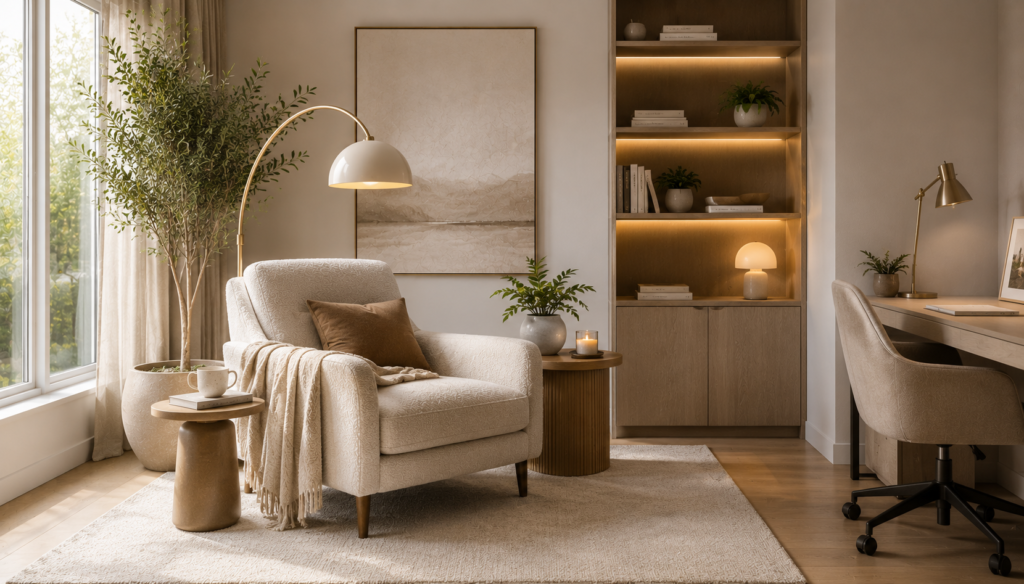
A second seat — an armchair, a papasan, a simple slipper chair, even a well-placed floor cushion with back support — breaks that association. It gives your brain a second setting. Sit-down-and-execute happens at the desk. Sit-down-and-think happens somewhere else. That distinction sounds minor until you’ve lived with it for a month, at which point it starts to feel obvious in retrospect, the way a lot of good environmental design does.
You don’t need much space
The word “nook” makes people picture a bay window with cushions and good architecture, which not everyone has. What you actually need is a chair, roughly three feet of clearance to sit down and stand up comfortably, and something soft nearby. That’s it. I’ve seen this work in a literal closet with the door removed, in the dead corner behind a bedroom door, in the six inches of unused space beside a bookshelf. If your home office is a single small room and the idea of fitting a second chair feels impossible, look at corners first — corners are almost always underused, and a chair angled into one takes up less visual and physical space than it would placed against a flat wall.
If floor space is truly nonexistent, a wide, deep windowsill with a cushion does the same job. So does a daybed or bench if the room is shared with another function, like a guest room. The point isn’t the specific furniture — it’s having a second physical position in the room that’s associated with a different mode of working.
What makes a chair actually cozy, not just present
A chair that’s technically in the room but never gets used isn’t doing its job. A few things make the difference between a chair people sink into and one that becomes a place to pile laundry:
*Depth and give.* A shallow, firm chair reads as “sit here briefly.” Something with a bit of depth and a soft cushion reads as “stay a while.” You don’t need an expensive piece — a firm chair with a good throw or an extra cushion added does the same work as a chair that costs three times as much.
*A blanket within arm’s reach.* This is a small thing that punches well above its cost. A folded throw over the arm of the chair does two jobs: it makes the chair look intentional rather than incidental, and it actually gets used on the days the room runs cold or your energy runs low. Texture reads as warmth even before anyone touches it — this is a big part of why the “cozy” feeling exists at all, and it’s one of the cheapest tools available to create it.
*Something within reach that isn’t a screen.* A small side table, a stack of two or three books, a notebook. The chair should have its own tiny ecosystem, separate from the desk’s. If the only thing near the second chair is a charging cable, you’ve just built a second desk, not a second zone.
Using it deliberately, not just having it
Furniture alone doesn’t create the habit — you have to actually use the second seat for it to earn its place in the room. A few natural moments to build this in: read the first email of the day from the chair instead of the desk, to ease into the day rather than starting cold at the workstation. Take phone calls that don’t require a screen from the chair. When you’re stuck on a problem and find yourself staring blankly at a document, physically get up and sit in the other chair for five minutes before going back. That small relocation does more for a stuck brain than another five minutes of staring at the same monitor from the same angle ever will.
Some people worry a second chair invites distraction — that having a comfortable spot in the office just becomes an excuse to not work. In practice it’s closer to the opposite. The chair being available and used for its intended purpose reduces the pull toward genuinely distracting behavior, like wandering to another room or picking up a phone, because the room itself already offers a legitimate break. A five-minute sit in a good chair, staring out a window, resets attention far more effectively than five minutes of scrolling — and it happens inside the room you’re supposed to be working in, so returning to the desk afterward doesn’t require re-entering the space at all.
A note on shared and small spaces
If your “home office” is a corner of the bedroom or a shared multi-purpose room, this section might feel like it doesn’t apply — there’s simply no room for a second chair. In that case, look for a piece of furniture already in the room that can do double duty. The end of a bed. A bench at the foot of it. A reading chair that’s already there for evening use. The goal isn’t to add furniture for its own sake; it’s to make sure there’s *some* physical location in the room, other than the desk chair, associated with slower, quieter modes of thinking. If that already exists, even informally, you’re most of the way there — you just need to use it on purpose instead of by accident.
Getting the Lighting Right
Lighting is the most underrated variable in how a room feels, and it’s not close. You can get the furniture, the color palette, and the layout all correct and still end up with a room that feels clinical and exhausting, purely because of the bulbs. And you can take a fairly plain, unstyled room and make it feel genuinely warm just by fixing the light. If I had to recommend exactly one change from this entire piece, this would be it.
The problem with a single overhead light
Most rooms, home offices included, are lit by one ceiling fixture and nothing else. This is the least flattering, least comfortable way to light almost any space. A single overhead source casts light straight down, which flattens the room, creates hard shadows under everything (including your own face on video calls), and produces the specific flat, shadowless brightness that reads as “office” in the worst sense — the fluorescent, institutional sense, even if the bulb isn’t technically fluorescent. It’s the lighting equivalent of eating every meal standing at the counter. Functional, joyless.
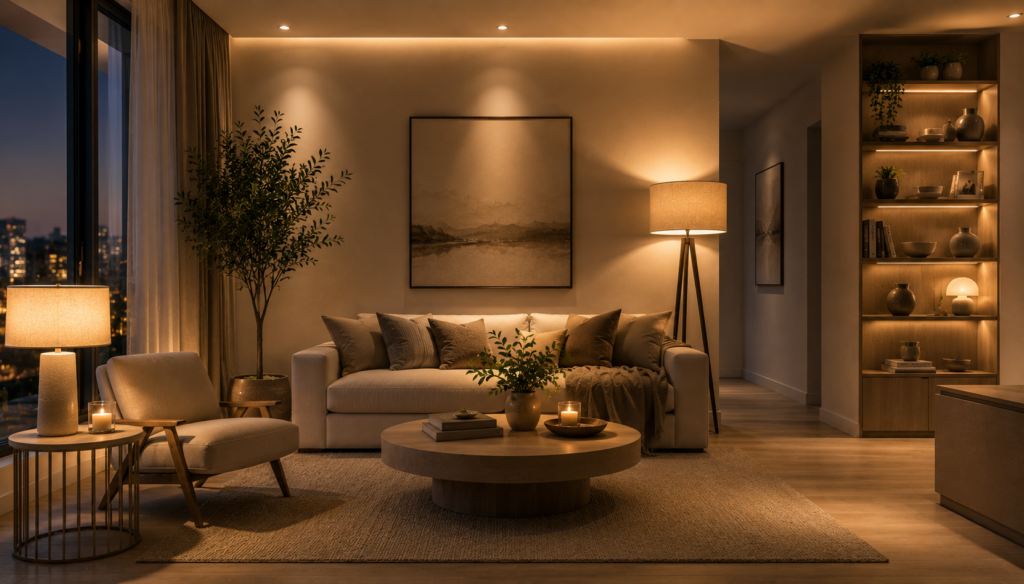
The fix is layering: instead of one strong source, use two or three weaker ones at different heights and angles. A desk lamp at surface height. A floor lamp or sconce somewhere else in the room. Maybe a small accent light on a shelf. Layered light creates depth — some areas brighter, some dimmer, shadows falling naturally instead of straight down — and depth is what makes a room feel three-dimensional and lived-in rather than like a display case.
Warm versus cool: this matters more than people think
Light bulbs are rated in Kelvin, and the number matters enormously for how a room feels, not just how bright it is. Anything above about 4000K starts to read as clinical — that bluish-white light you associate with hospitals, office parks, and big-box retail. Anything in the 2700K to 3000K range reads as warm, closer to candlelight or an incandescent bulb, and this is almost always the right call for a room you want to feel cozy. Some people default to cooler, brighter bulbs for a workspace because they associate cool light with alertness and focus, and there’s a little truth to that for very specific tasks — but for the vast majority of home office work, warm light at a slightly higher overall brightness does the job just as well without making the room feel like a waiting room.
If you’re not sure what temperature your current bulbs are, check the packaging or the base of the bulb itself — it’s usually printed right there. Swapping a cool bulb for a warm one is a five-minute fix and one of the highest-value changes on this entire list, price included. A pack of warm bulbs costs less than almost anything else mentioned in this piece and changes the room more than most of it.
Task lighting: don’t skip this even if the room is bright
Ambient warmth is about how the room feels; task lighting is about not straining your eyes for eight hours. Even in a bright room, having a dedicated light source pointed at your actual work surface reduces eye strain and makes fine detail work — reading small text, handwriting, anything with contrast — noticeably easier. A simple adjustable desk lamp does this. Position it so it’s lighting your work surface, not shining into your eyes or reflecting off your screen; a lamp angled slightly to the side of your dominant hand, rather than directly in front of you, usually avoids both problems.
If you’re on video calls often, task lighting does double duty: a light source in front of you, roughly at or slightly above eye level, does more for how you look on camera than any webcam upgrade. Backlighting from a window with no light in front of you turns you into a silhouette; a small light facing you, even a cheap one, fixes this instantly.
Natural light and dimmers
Circle back to the window conversation from earlier: natural light changes dramatically over the course of a day, and a room set up for 10 a.m. light can feel completely different — often worse — by 4 p.m. A dimmer switch or a lamp with adjustable brightness lets you compensate as the day shifts, instead of the room slowly going gloomy around you without you noticing why your energy is dropping. Smart bulbs that adjust automatically by time of day do this without you having to think about it at all, and they’ve gotten cheap enough that this is a reasonable option even on a tight budget.
Candlelight and low-stakes light sources
This might sound like it belongs in the “personal touches” section rather than here, but I’d argue it’s still fundamentally a lighting choice: a candle, an actual flame, on a desk or side table during a slow afternoon changes the character of a room more than its size would suggest. It’s not meant to be your primary light source — obviously — but as an accent during a call-free stretch of work, it does something no bulb quite replicates. If open flame isn’t practical in your space, a flameless candle or a small warm-toned accent light does a reasonable approximation.
Putting it together
A well-lit cozy office usually has three light sources working at once, not one: warm ambient light filling the room generally, a task light pointed at the actual work surface, and one accent source — a lamp in the second-zone chair, a candle, a small light on a shelf — doing nothing but making the room feel finished. None of these need to be expensive. What matters is the layering and the color temperature, not the price tag on any individual fixture. Get those two things right and the room will feel meaningfully warmer within the same afternoon, without moving a single piece of furniture.
Color, Texture, and the Fabric Choices That Do More Than You’d Expect
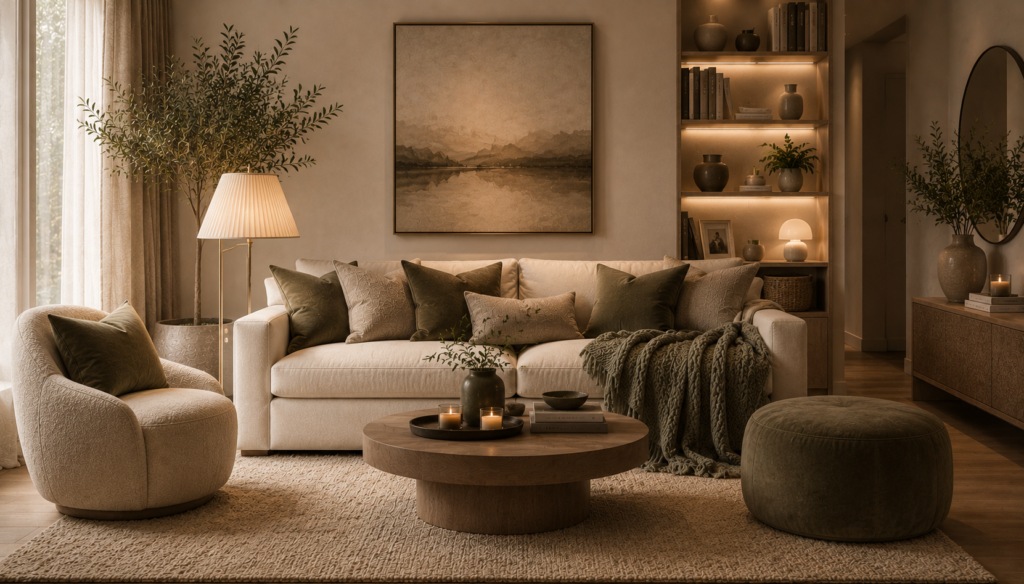
There’s a specific kind of home office that looks fine in a photo and feels cold in person, and almost every time, the reason is texture — or the lack of it. Hard surfaces everywhere: a laminate desk, a mesh chair, bare walls, a bare floor, maybe a metal shelf. Nothing in the room absorbs sound or light or invites touch. It photographs as clean and minimal. It feels, physically, like sitting in an empty box.
Texture is doing more work than color
People default to thinking about color first when they think about making a room feel warmer — paint the walls a warm tone, done. Color helps, but texture is doing more of the actual emotional labor, and it’s cheaper to fix. A room with a neutral, even slightly cool color palette but genuine texture — a woven rug, a nubby throw blanket, a wood desk with visible grain, a ceramic mug instead of a plastic one — will feel warmer than a room painted terracotta with nothing but flat, smooth surfaces in it. Texture is what your body registers as “soft” or “inviting” before your eyes even finish processing the color.
The fastest way to add texture without a renovation: a rug under the desk area, even a small one. Bare floor, especially anything hard like wood, tile, or laminate, reads as cold literally and figuratively — cold underfoot, and visually stark. A rug grounds the space, muffles the click of a chair rolling around, and gives the eye a soft surface at floor level to balance out all the hard right angles of desks and shelves. This is one of the single highest-impact, lowest-effort changes available, on the same tier as fixing the lighting.
After the rug: fabric on the seating. A throw blanket, a textured cushion, upholstery instead of bare wood or mesh on at least one chair in the room. Curtains instead of bare blinds, even sheer ones, add texture at the window and soften the transition between wall and glass. None of this needs to be expensive or matched as a set — in fact, a room where every textile came from the same three-piece set tends to feel more staged than cozy. A little variation in texture and pattern, as long as the colors stay in a coherent family, reads as a room that was built up over time rather than purchased in one trip.
Choosing a palette that actually holds together
You don’t need a professional color consultation to get this right. A simple, reliable approach: pick two or three colors from the same “temperature” family — warm earth tones (terracotta, caramel, warm brown, cream) or cool muted tones (sage, dusty blue, warm gray) — and let one of them dominate while the others accent. The trap most people fall into is mixing warm and cool tones without a bridge color between them; a cream wall with a bright cool-blue accent chair and no other blue anywhere in the room reads as random rather than intentional, even if both colors are individually attractive.
If you’re starting from a rental with white walls you can’t paint, you can still build a real palette through everything else in the room — rug, curtains, desk accessories, the frame around a piece of art. White walls with a coherent warm palette layered on top read as calm and intentional, not as an unfinished room waiting for paint. Paint helps, but it’s not required, and it’s usually the last thing worth doing, not the first — get the textiles and accessories right first, and you’ll have a much better sense of whether paint is even necessary.
Wood tones matter more than people expect
If your desk, shelving, and any other furniture in the room are all different, competing wood tones — one piece orange-toned pine, another gray-washed oak, another dark walnut — the room will feel visually noisy even if every individual piece is nice. This is an easy thing to overlook because furniture gets acquired over time, not all at once, and wood tone rarely gets considered as a factor when a single new piece is purchased. It’s worth a five-minute audit: stand in the room and look specifically at every wood surface. If they clash, you don’t need to replace anything — a can of wood stain or a furniture-safe wax can shift an off-tone piece close enough to the others that it stops standing out. This is a small, unglamorous fix that quietly improves a room more than people expect from something this cheap.
A word on “matching” versus “coordinating”
Matching means everything is literally the same color or from the same collection. Coordinating means everything belongs to the same family without being identical. Cozy rooms are almost always coordinated, not matched — that’s part of what makes them feel like they evolved rather than got installed. A terracotta mug, a rust-toned cushion, and a warm-brown desk aren’t the same color, but they belong together. If your instinct is to buy a matching three-piece desk set because it’s simpler, resist it a little — a room built from pieces that coordinate but weren’t bought together almost always ends up feeling more genuinely cozy than one bought as a kit, because it looks like it reflects actual choices rather than a single checkout page.
Small texture wins if you’re not ready for a rug or new furniture
Not every change needs to be structural. A wool or cotton desk mat instead of a plastic one changes what your hands touch all day. A ceramic pen cup instead of a plastic organizer. A woven basket for cables or loose supplies instead of a plastic bin. Ordinary objects that already do a job can usually be swapped for a textured version without changing their function at all, and swapping five or six small things like this adds up to a genuinely different-feeling room, even before you touch the big-ticket items like a rug or reupholstered chair.
The Personal Touches Actually Worth Making Room For
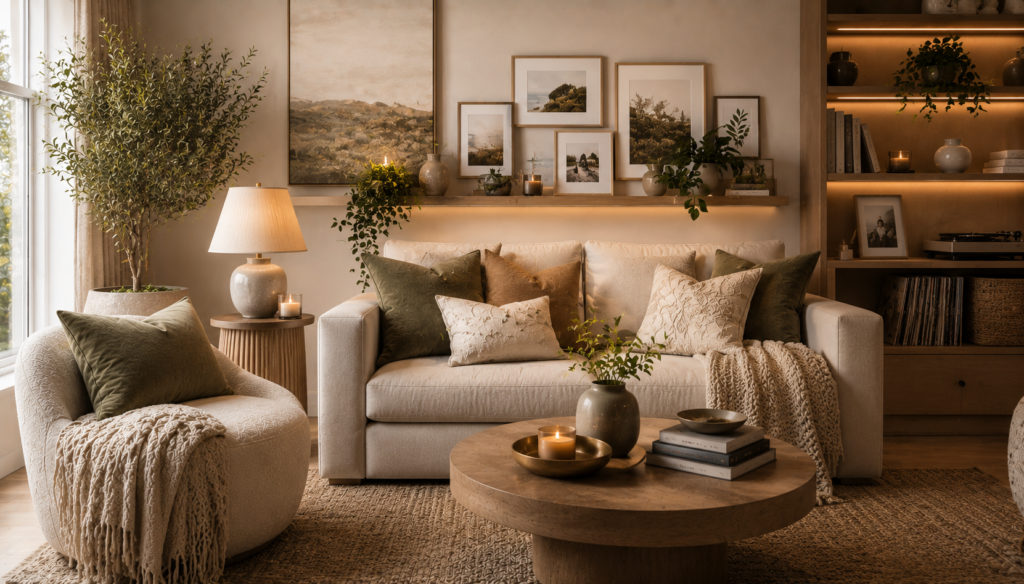
Every home office guide tells you to “add personal touches,” and then gives you the same three suggestions — a plant, a photo, some art — without explaining why those specific things work or how to choose ones that will actually matter to you six months from now instead of blending into the background by week three. So let’s be more specific about it.
The test for whether something belongs on your desk
A personal object earns its spot in your workspace if looking at it produces some actual response — a memory, a small lift in mood, a reminder of something outside work. If an object is there purely because “offices are supposed to have a plant” or “you’re supposed to have a photo,” it’s decoration, not a personal touch, and decoration fades into the visual background almost immediately. The distinction matters because desk space is limited and cluttering it with generic decor crowds out the few things that would actually do something for you.
A useful exercise: look at what’s currently on your desk and ask, for each object, “would I notice if this specific item disappeared?” If the honest answer is no, it’s taking up space that a more meaningful object could use instead.
Plants, because they actually do work — with caveats
Plants deserve their reputation, but not for the reason most people think. It’s not really about air quality (the effect there is real but small in a typical room). It’s that a living thing in the room changes the room’s character in a way nothing static can. A healthy plant grows, needs occasional attention, and visibly responds to the room’s light and care — it makes the space feel inhabited rather than furnished, in a way that’s hard to replicate any other way.
The caveat: a dying or struggling plant does the opposite, and does it more strongly than people expect. A brown, drooping plant on a shelf is a small but persistent signal of neglect, and it undercuts the exact feeling you’re going for. If you don’t have a track record with plants, start with something genuinely hard to kill — a pothos, a snake plant, a ZZ plant — rather than something finicky that requires a light meter and a watering schedule. One thriving low-maintenance plant beats three unhappy high-maintenance ones, every time, and it’s not close.
Photos and art: fewer, chosen more deliberately
The instinct with photos is often to put up a gallery wall’s worth all at once. A more effective approach, especially in a small room, is one or two images that you actually chose for their content, not just because they were available — a photo from a specific trip, a piece of art that means something rather than something that matched the room’s color scheme when you bought it. A single meaningful photo does more for a room than six generic ones, and it also avoids the cluttered, over-decorated look that undermines the calm you’re trying to build.
If budget is a factor — and it usually is — a nicely framed print of something you already have costs very little compared to buying new art, and it tends to matter more anyway, because it’s actually yours in a way a purchased print never quite is.
Books, but arranged like you use them
A shelf of books says something different depending on how it’s arranged. Books organized purely by color, spine facing whichever way looks best, reads as staged — nice to look at, but obviously arranged for appearance rather than use. Books grouped loosely by subject or by how often you actually reach for them reads as lived-in, because it is. If you have books you genuinely reference for work, keep them close and visible; it’s both practical and a quiet signal that this room does real things. Mix in a couple of objects between the books — a small frame, a candle, a plant — rather than lining every shelf edge to edge with spines. Full shelves everywhere start to feel like a library storage room rather than a personal space.
Objects with a story, even a small one
Some of the best desk objects aren’t decorative at all in the traditional sense — a rock from a specific hike, a mug a friend made, a small notebook that’s been through several jobs with you. These things rarely photograph as “office decor” and that’s exactly the point. They’re not there to be admired by a visitor; they’re there because they mean something to you specifically, and that’s a different and more durable kind of cozy than anything bought to match a color scheme.
Where the line is: too much becomes clutter
Personal touches lose their power if there are too many of them competing for attention. A desk with fifteen small trinkets doesn’t feel more personal than a desk with three — it feels cluttered, and clutter reads as visual noise regardless of how meaningful each individual item is. A rough guideline: pick your three to five most meaningful objects and give them real visual space — not crammed together, but placed with enough room around them that each one can actually be seen and register. Everything else, even if it’s meaningful too, can rotate through a drawer or a box and get swapped in occasionally. A desk that changes slightly over time stays more interesting than one that’s permanently maxed out with everything you own that has sentimental value.
Seasonal and rotating touches
One underused trick: don’t treat your personal object selection as permanent. Swap a couple of things seasonally — a different photo, a small object that matches the time of year, fresh flowers when they’re in season. This keeps the room from going stale in a way a permanent, “finished” arrangement eventually does, and it gives you small, low-stakes moments of caring for the room throughout the year rather than one big decorating push that you never revisit. A room you tend to occasionally feels more like yours than a room you decorated once and then stopped noticing.
Staying Organized Without the Room Going Sterile
There’s a tension running through this whole piece that’s worth naming directly: cozy usually means more — more texture, more personal objects, more layers. Organized usually means less — fewer things out, fewer visual distractions, a clear surface. Push too hard toward the first and you end up with clutter that undermines focus. Push too hard toward the second and you end up back at the cold, empty room this piece opened by arguing against. The actual goal is a room that’s warm and clear at the same time, and that’s a matter of where things go, not how much stuff exists.
Clutter and coziness are not the same thing, even though they get confused
This is worth restating because it’s the single biggest reason people avoid softening their workspace: they worry that adding texture and personal objects will tip into mess. But clutter isn’t defined by quantity — it’s defined by things being out of place, without a home, accumulating because nobody decided where they go. A shelf with fifteen deliberately placed, meaningful objects isn’t clutter. A desk with three random items that don’t belong there and no obvious place to put them — a stray charging cable, a stack of unopened mail, a coffee mug from two days ago — is clutter, even though it’s technically less stuff. Coziness comes from intentional objects in defined spots. Clutter comes from things with no spot at all.
Give everything a home, even the ugly stuff
The most effective organizational move for a cozy room is also the least visually interesting: make sure every category of object you actually use — cables, notebooks, mail, office supplies — has an assigned spot, even if that spot is a drawer or a covered basket rather than an open shelf. Visible storage should be reserved for things you’d actually want to look at; everything else goes somewhere closed. A woven basket with a lid, a drawer organizer, even a simple box that matches your color palette does the job of hiding functional clutter without making the room feel sterile the way a bare, empty desk would.
This is the real secret behind offices that look effortlessly put-together: it’s not that the owner has less stuff, it’s that everything they own has a designated location, so the surfaces that are visible stay visible on purpose, not by accident.
Cable management, because it undermines everything else
Cables are the fastest way to make an otherwise cozy room feel like a mess of wires and hardware. A tangle of cords behind or under a desk doesn’t just look bad — it visually competes with every other choice you’ve made in the room, pulling attention toward chaos even if everything else is arranged well. This doesn’t require an elaborate setup: cable clips along the back edge of the desk, a small basket or box to corral the power strip and excess cord length, and a little time spent bundling cords with velcro ties solves most of the problem in under an hour. It’s unglamorous work and it makes a disproportionate difference.
The rotating pile problem
Almost every home office develops a “pile” somewhere — mail, papers to deal with later, things that don’t have a home yet. The mistake is treating the pile as a permanent feature of the room rather than a temporary holding zone that needs regular clearing. Give the pile a defined container — a tray, a small basket — rather than letting it spread across the desk surface, and set a recurring time, even just once a week, to actually process it down to zero. A pile that’s contained in a tray reads as “in progress.” A pile spread loose across the desk reads as “out of control,” even if it’s the exact same stack of paper.
Vertical space is your friend in small rooms
If your office is small, the instinct is often to keep everything low and minimal to avoid a cramped feeling, but this frequently backfires — it just pushes more stuff onto the one horizontal surface you have, the desk. Shelving that goes up the wall, rather than out into the room, gives you storage without eating floor space, and it also gives you a place to put the personal, decorative objects from the previous section without crowding the actual work surface. A small room with good vertical storage often feels more spacious than a small room with a bare shelf-free desk buried in everything that has nowhere else to go.
A weekly reset, not a daily one
Trying to maintain a completely clear desk every single day is a good way to build a habit you’ll abandon within a month — it’s simply more maintenance than most people will sustain. A more realistic approach is a short weekly reset: ten or fifteen minutes, once a week, to clear the pile, put stray objects back in their homes, and generally return the room to its intended state. This is enough to prevent the slow creep toward chaos without requiring constant vigilance, and it has the side benefit of being a natural, low-stakes moment to notice what in the room isn’t working and adjust it — a plant that’s not thriving in that spot, a basket that’s too small for what you’re putting in it, an object that’s stopped meaning anything to you and could be swapped out.
Organized enough is the actual goal
Perfectly organized and genuinely cozy tend to be in tension with each other — a room that’s rigidly minimal in the name of organization often loses the warmth that comes from a bit of visible, intentional stuff. The goal isn’t maximum tidiness. It’s organized *enough* that functional clutter doesn’t undercut the deliberate, meaningful objects you’ve chosen to have out. Get that balance right and the room reads as calm rather than sparse, and warm rather than messy — which, when you put it that way, is really the whole point of everything in this piece.
Sound, Scent, and the Small Comforts Most Guides Skip
Everything so far has been visual — what you see when you look at the room. But a huge amount of how a space actually feels to spend time in has nothing to do with sight, and almost every home office guide ignores it entirely. Sound, smell, and temperature shape your experience of a room constantly, in the background, whether or not you’re consciously paying attention to them, and getting them right closes a gap that no amount of visual styling can fill on its own.
Sound: the most underrated comfort factor
A room with hard, bare surfaces doesn’t just look cold — it sounds cold. Sound bounces off bare walls, bare floors, and bare windows, creating a slight echo and a harshness to ordinary noise: keyboard clicks, a chair rolling, your own voice on a call. You might not consciously register this as a problem, but your nervous system does, and it contributes to a low-grade tension that’s hard to pin down. This is, conveniently, solved by most of the same texture choices from earlier — a rug, curtains, upholstered seating, a few books on a shelf. Soft surfaces absorb sound. A room with genuine texture in it is measurably quieter and less harsh-sounding than the same room stripped bare, even before you add any deliberate sound source.
Beyond acoustics, think about what you actually want to hear while working, and build for that intentionally rather than by accident. Some people work best in near silence and benefit from noise-canceling headphones or added soft furnishings to dampen a noisy household. Others do better with a low layer of sound — instrumental music, ambient background noise, a white noise machine — that fills the silence enough to prevent every small sound in the house from becoming a distraction. Neither is more correct than the other; the mistake is not choosing deliberately and just absorbing whatever the room happens to produce.
If you share a home with other people, a small speaker for low background sound does double duty: it makes the room feel more like a considered space rather than a bare cell, and it masks enough ambient household noise that a closed door isn’t your only defense against interruption.
Scent: the fastest mood shift available
Smell is tied to memory and mood more directly than almost any other sense, and it’s also the sense most completely ignored in home office setups. A room that smells like nothing — or worse, like stale air from being closed up all day — feels exactly as flat as it sounds. This is an easy, cheap fix: a candle, a reed diffuser, a small stick of incense if that’s your preference, or simply cracking a window for ten minutes each morning to reset the air. You don’t need anything elaborate. Consistency matters more than intensity — a specific scent that shows up reliably in your workspace starts to function almost like a ritual cue, signaling to your brain that it’s time to focus, the same way a specific playlist or a particular mug does for other people.
Be conservative with intensity, especially if you’re on video calls in the room or share the space with others — a subtle, consistent scent works better than an overpowering one that becomes its own distraction. Warm, low-key scents — wood, warm spice, something closer to a candle than a perfume counter — tend to fit the cozy aesthetic better than sharp or overly sweet ones, though this is genuinely down to personal preference more than any hard rule.
Temperature: the comfort factor everyone notices and nobody fixes
A room that’s slightly too cold or too warm undermines focus more than almost anything else on this list, and yet it’s the thing people are most likely to just tolerate rather than fix, because the fix feels like it should be as simple as adjusting a thermostat and somehow never quite is. Home offices are frequently converted spaces — a spare bedroom, a section of a basement, a nook that wasn’t originally designed to be occupied for eight hours a day — and they often run colder or warmer than the rest of the house as a result.
A small space heater or a fan dedicated to the room solves this more reliably than fighting with the whole house’s central system, and it’s worth the modest cost given how much time you spend in the room. On the cozy side specifically: a blanket in reach (mentioned earlier for the second chair, but just as useful at the desk itself) and warm socks or slippers do more for comfort than people expect, especially in a room with hard flooring. Cold feet are a surprisingly effective way to make an otherwise pleasant room feel uninviting, and it’s one of the easiest problems on this entire list to solve.
A warm drink as a ritual, not just a beverage
This is a small thing, but it’s worth naming because of how consistently people mention it when asked what makes their workspace feel good: a specific mug, a particular tea or coffee, a small ritual of making and bringing a warm drink to the desk at the start of the day or after a break. It’s not really about the caffeine. It’s a physical, sensory marker that separates “about to start” from “already going,” the same function a commute used to serve for a lot of people who now work from home without one. A good mug — one that’s actually pleasant to hold, not just functional — is a small purchase that gets used daily and contributes more to how the room feels than its size would suggest.
None of this needs to happen at once
The point of this section isn’t that you need candles, a white noise machine, a space heater, and a specific mug ritual all at the same time to have a functional office. It’s that sound, scent, and temperature are real variables in how a room feels, exactly as real as the visual ones covered earlier, and they’re consistently the last things anyone thinks to adjust. If the room looks right but still feels slightly off, one of these three is usually why.
Putting It Together
Go back to that card table for a second. What actually changed when I moved the desk and hung one shelf wasn’t the square footage or the budget — it was that the room stopped being neutral. It started expressing an opinion about how I wanted to spend eight hours a day, and once it did, I stopped fighting it.
You don’t need every idea in this piece. Pick the one that’s bothering you most right now — the glare on your screen, the bare floor, the desk facing a blank wall — and fix that first. Notice how the room feels afterward before moving to the next thing. Most of the offices I’ve seen that actually work, the ones people are visibly glad to sit down in every morning, weren’t finished in a weekend. They were built the way most good rooms are: one honest decision at a time, each one solving an actual problem instead of chasing a look.
The card table is long gone. What replaced it isn’t fancy — a secondhand desk, a lamp that cost less than a nice dinner out, a chair in the corner I actually use. But I look forward to sitting down in it, most days, and that’s really the only metric that was ever worth optimizing for.