When I think about my twenties, I picture myself in constant motion. Running shoes by the door. A yoga mat permanently unrolled in the corner of my apartment. Gym clothes draped over the back of a chair because they were never really “put away” — they were always about to be used again. I moved my body almost every day, sometimes twice a day, and I wore that consistency like a badge of honor.
I ran several days a week, always chasing a slightly faster pace. If I finished a loop in 52 minutes, the next time I wanted 50. If I could hold a plank for a minute, I tried for ninety seconds. My yoga classes were intense — the kind that left sweat pooling at the base of the mat. Even my home practices weren’t gentle. I flowed hard. I pushed deep into poses. I equated shaking muscles with success.
On the surface, I looked like the picture of health. I was lean. I was disciplined. I was “fit.” But underneath that carefully curated image was a woman who was quietly at war with her own body.
I’ve always loved movement. As a little girl, I danced around the living room in socks that slid across the hardwood floors. I took dance classes for years — ballet, jazz, anything that allowed me to express myself without speaking. In high school, I joined the volleyball team and started running, partly to manage stress and partly because I liked how strong it made my legs feel. In college, I found yoga and felt something shift inside me. It wasn’t just exercise; it was grounding. It was ritual.
But somewhere along the way, joy and control became tangled together.
In my early twenties, living in New York City, I belonged to a gym. I mostly stuck to the cardio machines — the treadmill, the elliptical, occasionally the stair climber if everything else was taken. The weight room felt like foreign territory. I didn’t know how to use most of the machines, and I was too self-conscious to ask. The free weights area seemed intimidating and loud. I told myself I didn’t need it. Running and yoga were enough.
If I’m honest, cardio felt safer. It burned calories in a way that was easy to quantify. Miles run. Minutes logged. Sweat equaled virtue. Lifting weights, on the other hand, carried an unspoken fear: What if I got bigger? What if my thighs thickened? What if my arms stopped looking “lean”?
This was the mid-to-late 2000s, when the cultural ideal of thinness was relentless and unforgiving. I absorbed it without even realizing how deeply it was shaping me. I didn’t consciously think, I must be as small as possible. But I absolutely believed that smaller meant better. More disciplined. More attractive. More worthy.
So I did what so many active women do: I moved a lot and ate very little.
You would think that someone running miles each week and taking high-intensity yoga classes would fuel like an athlete. I didn’t. I under-ate. I restricted calories. I skipped snacks. I told myself I was being “healthy.”
And yes, it worked — at least in the way diet culture defines success. I made myself smaller. My clothes fit loosely. People commented on how fit I looked.
But my body was sending distress signals that I ignored. My skin was dull and reactive. My nails were brittle. Sometimes my heart would flutter in a way that made me pause mid-sentence. I often felt lightheaded when I stood up too quickly. I was hungry — ravenously, persistently hungry — but I treated hunger like a weakness to overcome rather than a message to heed.
I remember lying in bed at night with my stomach growling and telling myself I would “be better” tomorrow. As if hunger was a moral failure.
The irony is painful now. I loved movement. I genuinely loved how it felt to run through the city at dawn or sink into a deep lunge in a heated room. But I was also using movement as a tool to control my body’s size. I wasn’t fueling performance; I was trying to shrink.
It didn’t occur to me then that strength could be something other than endurance. That power could be more than pushing through fatigue.
That idea didn’t fully enter my life until after I became a mother.
Pregnancy humbled me in ways I didn’t expect. I had always thought of myself as strong. I could run six miles without stopping. I could hold a handstand against the wall. I could stay in Warrior II until my legs trembled. But growing a human being inside my body and then giving birth to her redefined strength entirely.
After I delivered my first child, I felt undone. My core felt soft and disconnected. My hips ached. My shoulders were tight from nursing and carrying and rocking. I felt overstretched, wobbly, tender. The physical intensity of birth had stripped away my illusion of invincibility.
And I was hungry. Constantly hungry. Nursing is an endurance sport in its own right. My body demanded fuel in a way that was impossible to ignore.
I tried to return to my usual routines — running, yoga — but they didn’t land the same way. My body felt different. Weaker in some places, tighter in others. I didn’t feel powerful; I felt fragile.
Almost on a whim, I signed up for a high-intensity interval training class. It still had cardio elements, which felt familiar, but there were dumbbells involved. Light ones at first. Five pounds. Eight pounds. Ten.
The first time I finished a workout that included actual resistance training, I felt something I hadn’t felt in a long time: grounded power. Not the airy, floaty strength of holding a yoga pose, but something dense and solid. I felt like I occupied space.
That feeling surprised me. It also unsettled me.
On the days I did HIIT workouts, my hunger skyrocketed. I would finish a session and feel like I could eat everything in the kitchen. At first, I tried to fight it. Old habits die hard. But eventually, sheer physical need won. I started eating more on workout days.
The problem was, I still clung to the idea that I needed to “balance it out.” If I ate more after a hard workout, I would compensate on a rest day. I didn’t realize it at the time, but I was still operating under the belief that food had to be earned.
That mindset is so deeply ingrained in so many of us. It sounds rational on the surface — burn more, eat more; move less, eat less. But bodies aren’t that simple. Recovery doesn’t happen in a single afternoon. Muscle repair continues long after the sweat dries. Hormones don’t reset at midnight.
I was inconsistent. Some days I fueled well; other days I slipped back into restriction. I wasn’t thinking about protein intake or muscle synthesis or long-term bone health. I was thinking about not gaining weight.
Still, something was shifting.
Over the next few years, strength training became less of a novelty and more of a staple. I gradually moved from light dumbbells to heavier ones. I learned how to hinge properly. I learned what it felt like to brace my core with intention. I discovered that my body could adapt in ways that had nothing to do with becoming smaller.
As I entered my forties, the conversation in my head began to change. Instead of asking, How can I stay thin? I started asking, How do I want to feel at 60? At 70? At 80?
I don’t want to spend the second half of my life shrinking — not physically, not metaphorically. I don’t want to be afraid of carrying groceries or lifting a suitcase into an overhead bin. I don’t want aching joints to be my default setting.
Strength, I began to realize, is not about aesthetics. It’s about autonomy.
Research backs this up in ways that feel both empowering and urgent. After our mid-thirties, we naturally begin to lose muscle mass — a process known as sarcopenia. Bone density also declines, particularly for women after menopause. Resistance training is one of the most effective ways to counter both trends. Lifting heavy — truly challenging loads — stimulates muscle protein synthesis and signals bones to adapt and strengthen under stress.
You can build muscle with moderate weights and high repetitions, but progressive overload — gradually increasing the weight you lift — is one of the most efficient strategies. And efficiency matters. I don’t have hours a day to train. I have work. I have children. I have a life.
But lifting heavy requires fuel. You cannot build tissue out of nothing.
When I committed to strength training more seriously, my appetite changed again. It wasn’t just that I was hungrier on lifting days. I was hungrier in general. My body was asking for more — more energy, more protein, more consistency.
That scared me.
Even after years of personal work around body image, I am not immune to cultural messaging. There is still a small voice that whispers: Be careful. Don’t get too big. Don’t lose control.
But there is a louder voice now, one that says: Feed yourself. You deserve to feel strong.
I eat a plant-based diet, which I genuinely love. But I had to admit that I wasn’t prioritizing protein in a meaningful way. Protein needs for active women are often higher than we assume — generally around 1.2 to 2.0 grams per kilogram of body weight per day, depending on training intensity and goals. I didn’t start weighing my food or tracking macros obsessively; given my history with disordered eating, that path felt risky. Instead, I made simple shifts.
I started including a clear protein source in every meal. Tofu, tempeh, lentils, beans, edamame, plant-based yogurt, nuts and seeds. I added protein powder to smoothies when it felt helpful, not mandatory. I paid attention to how I felt after eating — energized or sluggish, satisfied or still searching.
Some days I eat before a workout; other days I don’t, depending on timing and hunger cues. I aim for a solid meal within a couple of hours after lifting. I snack when I’m hungry without turning it into a negotiation.
And yes, my body has changed.
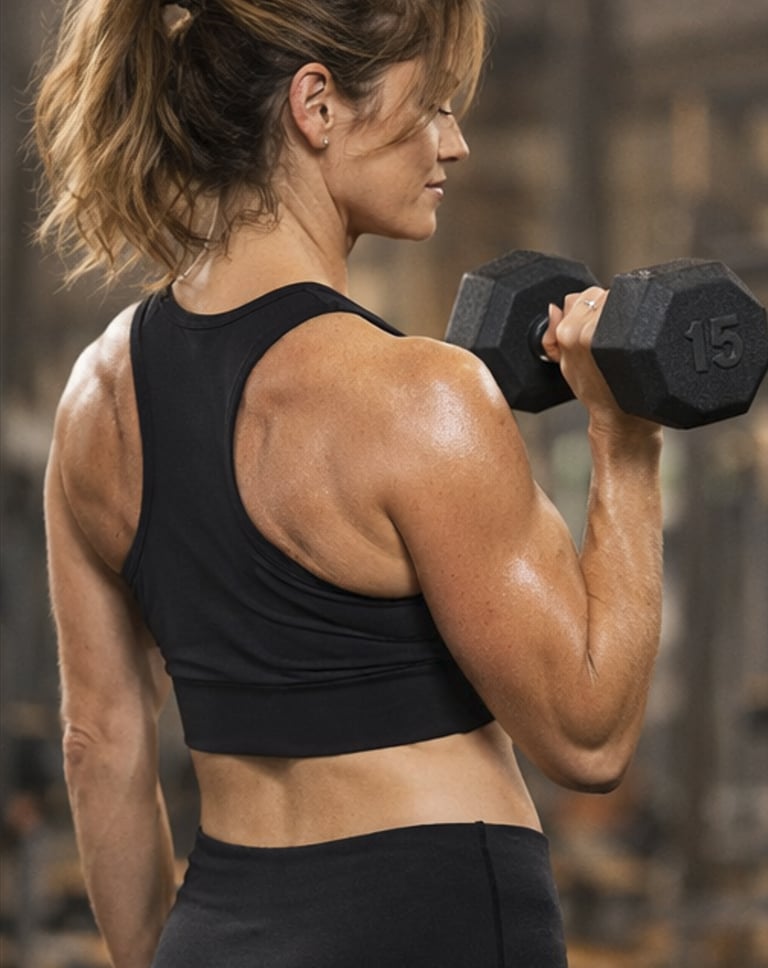
It is not the same body I had at 25. It is softer in some places and more muscular in others. My thighs are strong. My shoulders are defined. I take up space differently.
There are moments when I catch my reflection and feel a flicker of the old anxiety. But more often, I feel gratitude. This body carried children. It has run countless miles. It has endured under-fueling and still shows up for me every day.
I no longer believe that I have to earn my food. I no longer treat hunger as an adversary. I see it as information.
The biggest shift, though, has been internal. Strength training has changed how I inhabit my life, not just my workouts. There is something profoundly empowering about loading a barbell with more weight than you thought you could handle and then standing up with it. It recalibrates your sense of what is possible.
When I deadlift a heavy weight off the floor, I feel capable. When I press a barbell overhead, I feel steady. That feeling follows me out of the gym. It shows up in hard conversations. In setting boundaries. In saying no without apology.
Strength is not just physical; it’s relational and emotional.
If I could speak to my younger self — the one counting calories in a tiny New York apartment, the one forcing herself to ignore hunger pangs — I wouldn’t tell her to stop moving. I would tell her to eat. To trust that her body deserves nourishment. To understand that shrinking is not the same as thriving.
I would tell her that thinness is not a prerequisite for worthiness. That the cultural ideal she is chasing will shift and morph and remain forever out of reach. That what will remain, if she cares for it, is her capacity to feel strong in her own skin.
I don’t train because I hate my body anymore. I train because I respect it. I don’t eat to control it. I eat to support it.
There are still imperfect days. Days when I skip a workout because life is overwhelming. Days when I eat past fullness because I’m stressed. Days when that old voice resurfaces and I have to consciously choose not to listen.
But the arc of my story has bent toward strength.
If you are a woman who has spent years equating health with smallness, I see you. If you have ever felt silly walking into the weight room, unsure of where to start, I’ve been there. If you have ever tried to out-exercise your hunger, I understand.
You are allowed to take up space. You are allowed to be hungry. You are allowed to prioritize muscle and bone and longevity over the number on a clothing tag.
Choosing strength in midlife is not about chasing a new aesthetic. It’s about claiming the years ahead of you. It’s about building a body that supports the life you want to live — one that can carry groceries, lift grandchildren, hike mountains, or simply get up off the floor without hesitation.
I still run sometimes. I still roll out my yoga mat. But those practices are no longer about burning off dessert or proving discipline. They are part of a broader landscape of movement that includes barbells and kettlebells and the quiet satisfaction of progressive overload.
I am stronger now than I was in my twenties — not just in pounds lifted, but in perspective. I no longer measure my fitness by how small I can make myself. I measure it by how resilient I feel.
And that, to me, is a far more powerful metric.