You know the vibe. The corner of the gym with the smaller weights, the place you go when you don’t feel brave enough for the barbell racks or when you’re short on time and just want to move your body a little. I’d grab the same pair of dumbbells every workout, float through my sets, feel a mild burn, wipe my forehead like I’d really done something… and then wonder why my body never seemed to change.
For a long time, I blamed my genetics. Or my schedule. Or the fact that I wasn’t one of those women who “naturally loves lifting heavy.” But the truth was simpler and more uncomfortable: I wasn’t actually challenging myself. I was moving weights, not training.
Dumbbells are sneaky like that. They feel friendly. They’re accessible. They don’t scream “intimidating gym equipment.” But that’s exactly why so many of us end up underusing them. We treat dumbbell workouts like a warm-up instead of a serious tool for building strength, muscle, and confidence.
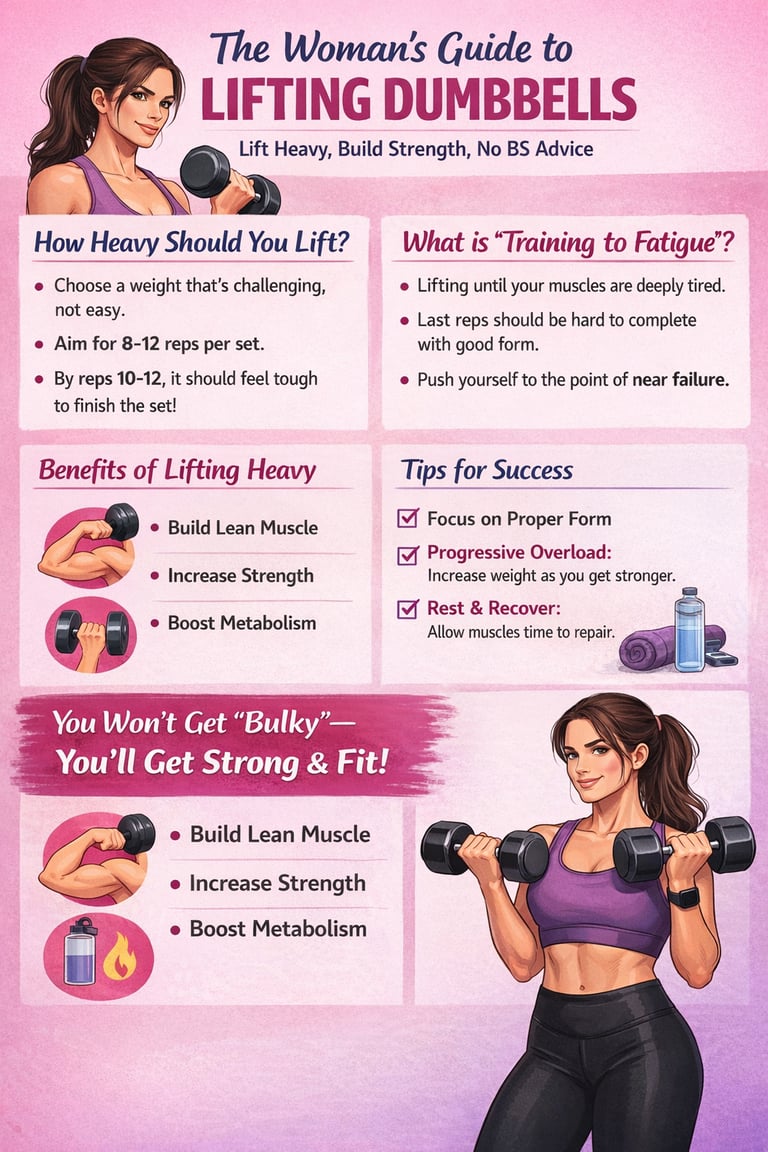
What changed everything for me wasn’t a new program or some hyper-complicated routine. It was understanding one simple principle: real progress happens when you train close to fatigue. Not when you stop the set because you’re bored. Not when you stop because the rep count is done. But when you stop because your muscles are genuinely close to their limit.
And yes, that applies to dumbbells just as much as it does to barbells, machines, or any other piece of equipment.
One of the most freeing things I learned is that there isn’t one magical rep range for results. For years, I heard that “8 to 12 reps is for muscle” and “higher reps are just cardio.” I tried to force myself into perfect rep numbers, even when it didn’t match how my body felt. But newer research has started to show something much more practical and empowering: what really matters is how close you get to fatigue or failure, not whether you did 8 reps or 18.
In one study, two groups followed different lower-body training plans for six weeks. One group did sets of around 10 reps, the other around 20. Both groups trained to concentric failure, meaning they kept going until they physically couldn’t complete another rep with good form. When researchers measured muscle growth, strength gains, and even how efficiently the muscles used oxygen, the results were surprisingly similar. Different rep counts, similar results. The common denominator wasn’t the number on the page—it was how hard they actually worked during each set.
This was such a relief for me. It meant I could stop obsessing over perfect numbers and start paying attention to what my body was telling me. Some days, I feel strong and powerful, and I hit fatigue in fewer reps with heavier dumbbells. Other days, especially when I’m tired or stressed, it takes more reps with lighter weights to reach that same point. Both are valid. Both can build strength and muscle if I’m honest about effort.
But here’s where most dumbbell workouts go wrong, especially for women: we underestimate how strong we actually are.
I see it in gyms all the time, and I used to be the same. Women grabbing weights that barely challenge them, flying through sets with perfect posture and zero struggle, then wondering why their arms, shoulders, or glutes don’t seem to change. There’s this quiet fear of “lifting too heavy” — as if one tough set is going to suddenly turn you into a bodybuilder overnight. Spoiler: that’s not how bodies work. Muscle takes time, consistency, and intention to build. You don’t accidentally wake up jacked because you chose slightly heavier dumbbells.
The real risk isn’t lifting too heavy. The real risk is lifting too light for months (or years) and convincing yourself that you’re training hard when you’re actually just moving.
Finding the right weight is part science, part self-trust. There’s no universal number that works for everyone. What matters is how the set feels in your body. If you finish your reps and you could easily keep chatting, scrolling on your phone, and repeating the set without any change in your breathing or focus, the weight is probably too light for that goal. If there’s no burn, no fatigue, no sense of effort, you’re not giving your muscles a reason to adapt.
On the other hand, heavier isn’t always better either. If your grip gives out way before the muscle you’re trying to train, if your range of motion shortens dramatically, or if your form starts to fall apart halfway through the set, the weight is likely too heavy for now. That’s not strength training anymore—that’s just surviving the movement.
The sweet spot is that space in between. The reps feel intentional. Your breathing picks up. There’s a slight tremble in your muscles near the end of the set. You know you could maybe squeeze out one or two more reps if you absolutely had to, but you’d have to dig for them. That’s the zone where change happens. That’s where dumbbells stop being “cute” and start being powerful.
One of the biggest mindset shifts for me was learning to respect fatigue instead of fearing it. For a long time, I thought feeling tired meant I was doing something wrong. I’d stop sets early because the burn was uncomfortable. I’d interpret shaking muscles as weakness. Now I see those sensations as information. They’re feedback from my body telling me I’m actually working in the zone where adaptation happens.
This doesn’t mean every workout has to be brutal or that you should push to absolute failure on every single set. There’s room for lighter days, technique-focused sessions, and workouts that simply help you move and feel better. But if your goal is to build strength, muscle tone, or that grounded, powerful feeling in your body, some of your sets need to feel hard. Not punishing. Not chaotic. Just honestly challenging.
Dumbbells are especially beautiful for this because they demand more from your stabilizing muscles. Each arm or leg has to work independently. There’s nowhere to hide. Your weaker side can’t secretly let the stronger side do all the work. This is one of the reasons dumbbell training can create such noticeable changes in how your body feels and moves. You don’t just get stronger; you get more coordinated, more balanced, more aware of your own body.
Over time, I noticed something surprising: the physical changes were nice, but the mental shift was even bigger. Choosing heavier dumbbells when I was capable of them felt like choosing to believe in myself. Finishing a hard set reminded me that discomfort isn’t danger. It’s just a temporary sensation that passes. That lesson started to spill into other parts of my life. Hard conversations. Setting boundaries. Showing up for myself even when it felt awkward or uncomfortable. Strength training, in a quiet way, trained my nervous system to stay present in effort instead of running from it.
If you’re new to dumbbell training or coming back after a break, give yourself permission to start where you are. You don’t need to “prove” anything on day one. But also give yourself permission to grow. Try weights that feel slightly intimidating. Let your body surprise you. Pay attention to how many reps it takes before your muscles start to feel tired. Notice your breathing. Notice when your focus sharpens because the set actually demands your attention.
Progress with dumbbells isn’t about perfection. It’s about honesty. Honest effort. Honest feedback from your body. Honest curiosity about what you’re capable of when you stop playing it safe.
And maybe that’s the real gift of dumbbell workouts. Not just stronger arms or more defined legs, but a quieter confidence that builds every time you choose a weight that challenges you and stay with the discomfort long enough to change.