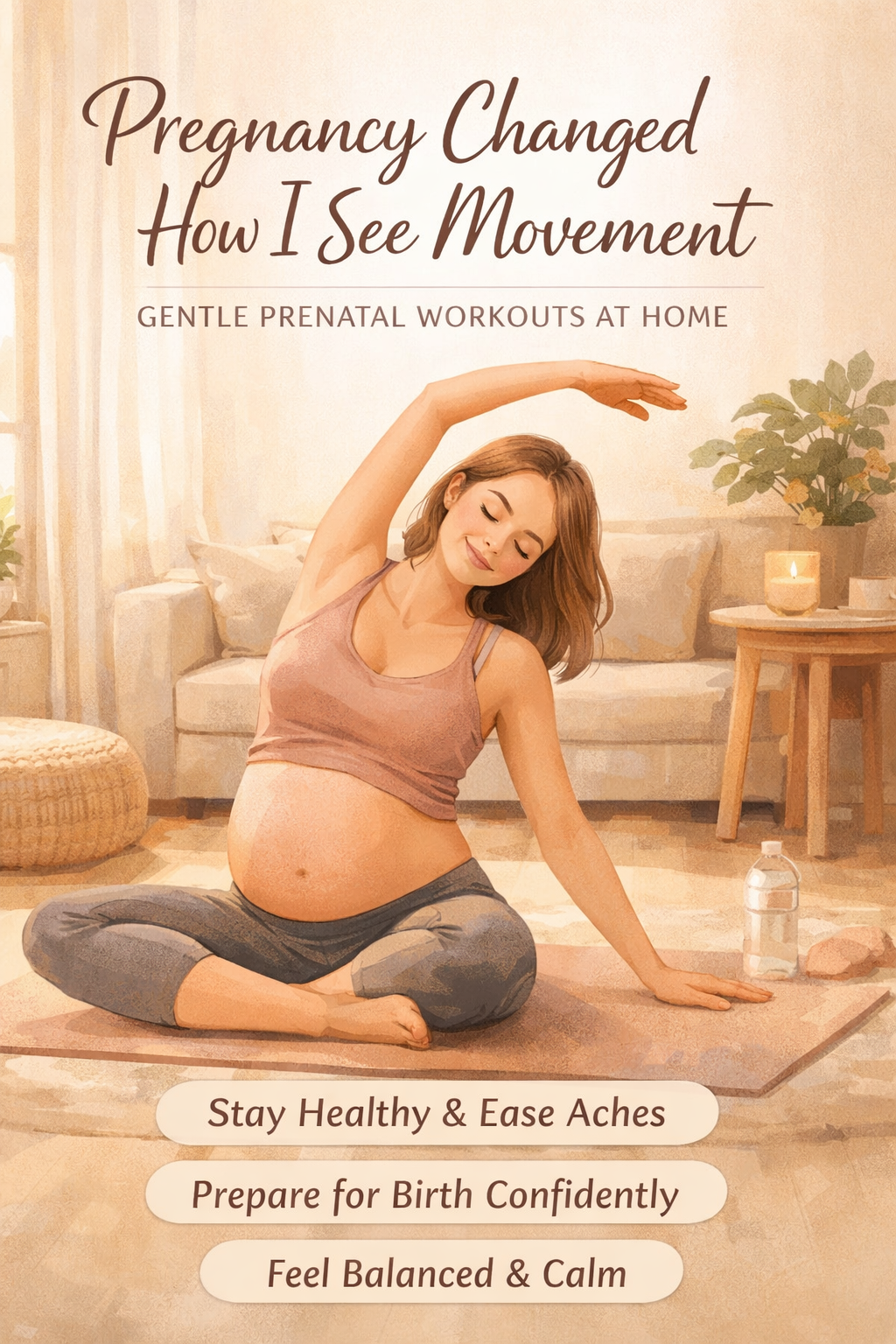
I used to think movement meant pushing through. Faster, stronger, more sweat, more “results.” Before pregnancy, I measured a good workout by how tired I felt at the end. If my muscles burned and my heart was racing, I felt accomplished. Then pregnancy arrived, and quietly, gently, it rewrote everything I thought I knew about my body and movement.
At first, I tried to move the way I always had. I told myself I would “just slow down a little.” But my body had other plans. My heart started beating faster with much less effort. I felt out of breath climbing stairs I had walked up a hundred times before. My joints felt softer, almost looser, and sometimes unstable in a way I had never experienced. Even on days when I did nothing special, I felt like my body was already working harder than usual. It took me a while to understand that pregnancy itself is not a passive state. My body was already doing a kind of quiet, constant workout just to support this new life growing inside me.
Once I began to notice these changes instead of fighting them, something shifted in the way I approached movement. I realized that during pregnancy, movement is not about performance. It is about support. Support for circulation, for breathing, for posture, for tired muscles, for emotions that rise and fall with hormones and fear and excitement. It is about preparing the body gently for birth, not forcing it into shapes it is not ready for.
One of the first things I became aware of was how different my breathing felt. As my belly grew, my diaphragm had less space to move downward. Sometimes I felt like I couldn’t take a deep breath the way I used to. I would start a simple movement and feel my breathing speed up faster than expected. At first, this made me anxious. I worried something was wrong. But then I learned that this is a normal part of pregnancy. My body was adapting. My blood volume was increasing, my heart was working harder, my circulation was changing. Even at rest, my body was functioning as if it were already doing light physical activity.
Understanding this helped me stop judging myself for feeling tired more easily. It also helped me choose movement more wisely. Instead of intense workouts, I began to look for forms of movement that felt like a conversation with my body rather than a command. Walking became my anchor. Some days it was a slow walk around the block, noticing how my feet touched the ground. Other days it was a longer, more energetic walk that made me feel alive again. The key was that I could still breathe comfortably and talk while moving. If I couldn’t say a full sentence without gasping, I knew I was pushing too hard.
Another big change I noticed was in my joints and muscles. There were days when my hips felt unfamiliar, as if the structure of my body was subtly shifting. Later I learned that hormones during pregnancy cause the connective tissues to soften, preparing the body for birth. This is beautiful and necessary, but it also means that the joints are more vulnerable. Suddenly, movements that used to feel stable felt wobbly. Quick direction changes, deep stretches, or sharp movements no longer felt safe in my body.
This taught me to slow down not just in speed, but in intention. I started paying attention to how I moved from sitting to standing, how I turned in bed, how I carried groceries. Movement during pregnancy is not only about “exercise sessions.” It is about how you move through your entire day. I learned to avoid sudden twisting, to keep my movements smooth and controlled, and to support myself when standing up or changing positions. These small changes made a surprisingly big difference in how my body felt at the end of the day.
One area that I had never really thought about before pregnancy was my pelvic floor. Suddenly, it became very real. I could feel the weight of my growing belly, the pressure downward, the subtle tension and fatigue in muscles I had never consciously connected with before. I realized that movement during pregnancy is not only about arms and legs or staying “fit.” It is deeply connected to the muscles that will support birth and recovery afterward.
Instead of intense core workouts, I learned to focus on gentle core awareness. Breathing into my ribcage, feeling my belly rise and fall, sensing the support of my deep abdominal muscles without pulling them in aggressively. I practiced simple pelvic floor awareness, not forcing contractions, but learning to feel when those muscles were working and when they needed to relax. This kind of subtle movement felt very different from what I used to call exercise, but over time, I noticed how much more connected I felt to my body. I wasn’t just moving my body. I was listening to it.
There were also emotional changes that movement helped me navigate. Pregnancy is not only physical. It is deeply emotional. Some days I felt strong and grounded. Other days I felt fragile, anxious, or overwhelmed by how much my life was changing. Gentle movement became a way to come back to myself. Not to distract from my feelings, but to move with them. On days when I felt heavy, slow stretching and breathing helped me feel held by my own body. On days when I felt restless, a gentle walk or simple mobility exercises helped me release nervous energy without exhausting myself.
One of the most important lessons I learned was that consistency matters more than intensity. There were weeks when I didn’t feel like “working out” at all. My energy was low, my body felt heavy, and the idea of a structured session felt like too much. But I learned that even ten minutes of gentle movement could change how my body felt for the rest of the day. A few minutes of breathing, some slow hip circles, a short walk in fresh air – these small choices added up. They kept my body from becoming stiff and my mind from feeling trapped inside physical discomfort.
Of course, not every day was easy. There were days when my lower back ached no matter how carefully I moved. Days when my legs felt heavy, my feet swollen, and my motivation low. On those days, I had to practice kindness toward myself. Pregnancy is not a time for perfection. It is a time for responsiveness. Some days my body needed more movement. Other days it needed more rest. Learning to tell the difference was part of the journey.
What helped me most was reframing movement as preparation, not performance. Every gentle movement was preparing my body for birth by improving circulation, maintaining mobility, and supporting my posture as my center of gravity shifted. Every conscious breath was preparing me to stay calm and present when my body would later do something intense and powerful. Every small effort to move with awareness was also preparing me for recovery, reminding my body that movement is safe, supportive, and part of healing.
I also realized that safety is not just about avoiding “dangerous exercises.” It is about respecting the reality of what the pregnant body is going through. High-impact, extreme-intensity workouts may look impressive, but they do not match the physiological state of a body that is already working harder at rest, whose joints are softer, whose balance is changing, whose core is adapting to make space for new life. Low-load, low-intensity movement is not “less.” It is appropriate. It is intelligent. It is compassionate.
Over time, I stopped asking myself, “How hard should I push today?” and started asking, “What does my body need today?” Some days the answer was a gentle prenatal workout at home, focused on mobility, breathing, and posture. Other days the answer was a slow walk and a nap afterward. And sometimes the answer was simply sitting quietly, placing my hands on my belly, and breathing, feeling the rhythm of my own heart and the quiet presence of the life growing inside me.
Looking back, pregnancy changed how I see movement forever. It taught me that movement does not have to be loud or dramatic to be meaningful. It can be soft, slow, and deeply supportive. It can be a way of building trust with your body at a time when your body is changing faster than your mind can keep up with. It can be a daily reminder that you are not separate from your body, but in constant conversation with it.
If you are pregnant and wondering how to move safely, my biggest advice is this: let your movement come from care, not pressure. Choose low-intensity, gentle forms of movement. Breathe. Pay attention to how your body responds. Allow your definition of “a good workout” to change. In doing so, you may discover that movement becomes not just something you do, but something that supports you – physically, emotionally, and quietly preparing you for the moment when your body will do the most powerful movement of all: bringing new life into the world.