
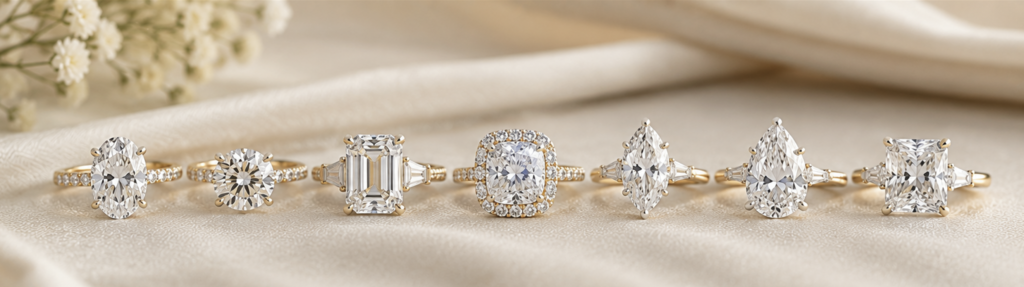
There is a very specific kind of quiet, electric feeling that happens when you slide onto Pinterest at 11:47pm, tell yourself you’re “just looking,” and then resurface two hours later with forty-three tabs open, a heart rate that suggests cardio, and a newfound, deeply personal opinion about bezel settings. If that sentence made you laugh a little too knowingly, welcome home. You’re exactly who I wrote this for.
I’ve been obsessed with engagement rings the way some women are obsessed with handbags or the way my best friend is obsessed with finding the “perfect” white tee (a myth, Claire, it’s a myth, and I love you). For me it started years before I was even in a relationship worth thinking about rings for — I’d sit in the back of lecture halls sketching oval halos in the margins of my notebooks, completely unbothered by the fact that I had, at the time, a grand total of zero prospects. It wasn’t really about the guy. It was about the object. The way a ring can hold a whole story in something smaller than a sugar cube. The way it can be quiet and loud at the exact same time.
So when people ask me — and they ask me a lot, because apparently once you become “the ring girl” in your friend group there’s no going back — what the most timeless engagement ring cuts are, and how to get something genuinely beautiful without needing a second mortgage, I get a little giddy. Because here’s the truth nobody tells you upfront: you do not need $30,000 to have a ring that looks expensive, feels significant, and ages like the best kind of vintage Chanel. You need taste. You need a little bit of insider knowledge. And you need to stop scrolling influencer content that’s secretly sponsored by a lab-grown mega-brand pretending to give “unbiased advice” (we see you, and we are not fooled).
This is going to be long, because I have a lot of feelings about this, and because I want you to actually walk away from this article knowing something — not just feeling vaguely inspired for twenty minutes before you close the tab and forget everything. Get a cup of something warm. Curl up. Let’s talk about rings.
Why “Timeless” Actually Matters More Than “Trendy” Right Now
We’re living through a very particular cultural moment in jewelry, and if you’ve been paying even loose attention to the girls on your feed, you’ve probably felt the shift. The maximalist, stack-everything, diamond-tennis-bracelet-with-six-rings-on-one-hand era hasn’t disappeared exactly, but it’s been quietly nudged aside by something calmer. Call it quiet luxury. Call it the “old money” aesthetic everyone became obsessed with a couple of years ago and never really let go of. Call it the clean girl aesthetic finally growing up and getting engaged. Whatever label you slap on it, the vibe is the same: fewer, better things. Pieces that whisper instead of shout. Jewelry that looks like it was passed down rather than picked up from a display case an hour ago.
And engagement rings are the ultimate expression of that shift, because unlike a bag or a blazer, this is the one accessory you’re wearing forever. You don’t retire an engagement ring when the season changes. You don’t donate it when a new trend cycle rolls in. It sits on your hand through job interviews and hospital visits and your best friend’s wedding and every single grocery run for the rest of your life. Which means the stakes for getting it right are completely different than any other purchase you’ll make.
I think about it like this: a trendy ring is a really good outfit for a party. A timeless ring is the coat you’ll wear for the next twenty years and somehow still look chic in every single time you put it on. One of these things gets photographed once and forgotten. The other becomes part of your personal mythology.
The good news? Timeless doesn’t mean boring, and it definitely doesn’t mean expensive by default. Some of the most breathtaking rings I’ve ever seen in real life — not on a screen, in actual candlelit restaurant lighting, on an actual human hand reaching for an actual glass of champagne — cost far less than people assume. The cuts and settings I’m about to walk you through are proof of that. They’ve survived decades, sometimes centuries, of changing fashion because they’re built on proportion, light, and restraint rather than gimmick. That’s what makes them safe bets even under a $10,000 budget, and often, dramatically under it.
A Quick, Honest Chat About Budget (Because Nobody Else Will Have This Conversation With You)
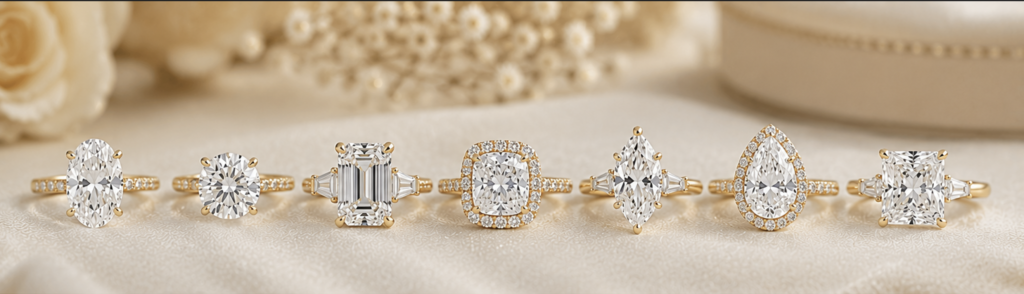
Before we get into the dreamy part, I want to have a slightly less glamorous but genuinely important conversation, because I think the ring industry does women a real disservice by making this whole process feel shrouded in secrecy.
Under $10,000 is actually a wide, wide range. A ring at $3,000 and a ring at $9,500 can both be objectively gorgeous, but they’re going to get there through very different combinations of carat weight, cut quality, metal choice, and stone origin (natural versus lab-grown). None of this is a moral hierarchy, by the way — I know there are strong opinions floating around about lab-grown diamonds, and I’ll share mine later, but at the end of the day this is your ring, your hand, your love story, and there is no wrong answer as long as it’s an informed one.
Here’s the framework I always give friends: think of your budget as being split, loosely, into three levers you can pull — the stone, the setting, and the metal. You can’t max out all three under $10,000 (unless you’re going lab-grown, in which case, congratulations, the math gets a lot friendlier). So the real skill is figuring out which lever matters most to you. Some women are stone-obsessed and would rather have a smaller diamond with flawless clarity than a bigger one with visible inclusions. Some women are setting girls through and through — they want the drama of a halo or the architecture of a three-stone design, and they’re happy to compromise slightly on carat size to get it. And some women, myself included on my more romantic days, care more about the metal and the feeling of the ring than almost anything else — there’s something about warm rose gold or soft, buttery yellow gold that just feels like a hug for your hand.
Knowing which lever is yours before you start shopping will save you actual hours of decision fatigue, and probably a few tears in a jewelry store parking lot. Ask me how I know.
The Round Brilliant Cut: The Little Black Dress of Engagement Rings
We have to start here, because there’s a reason nearly two out of every three engagement rings sold feature a round brilliant cut. It’s not lack of imagination. It’s math, physics, and just enough emotional resonance to make your chest tighten a little every time you catch it under a restaurant candle.
The round brilliant was engineered — genuinely engineered, with mathematical formulas — to maximize light return, which is a fancy way of saying it sparkles more than almost any other shape. Fifty-eight facets, all angled with obsessive precision, working together so that light bounces around inside the stone and shoots back out at you in this dizzying, fractured way. It’s the reason a well-cut round diamond can look bigger and brighter than a fancier shape of the exact same carat weight.
There’s something almost architectural about how classic this cut is. It doesn’t try to reinvent itself every few years because it doesn’t need to. I think of the round brilliant as the little black dress of the jewelry world — the thing you can put on absolutely anywhere, in any decade, with any outfit, and it simply works. Your grandmother’s ring might be round. Your future daughter’s ring, if she wants your blessing on a design one day, will probably still be round, because taste comes back around but this particular cut never really left.
Under $10,000, a well-cut round brilliant in the one-to-one-and-a-half carat range on a simple, elevated solitaire setting is achievable and, in my humble but very confident opinion, stunning. If you go lab-grown, you can stretch toward two carats and still have room in the budget for a genuinely beautiful band — think a hidden halo underneath the center stone, or delicate pavé running halfway around the shank for a little extra shimmer when you’re not even trying.
My personal styling note: if you’re someone who wears rings and other jewelry every single day — someone who doesn’t take things off to shower, garden, or type furiously on a laptop at 2am finishing a deadline — the round brilliant is genuinely one of the most durable shapes, because it doesn’t have delicate pointed corners that can chip or catch on things the way, say, a marquise or pear cut can. Practical and gorgeous. My favorite combination in literally any category of life.
The Oval Cut: For the Woman Who Wants Drama Without Announcing It
If the round brilliant is your classic black dress, the oval is your tailored trench coat — effortlessly elongating, quietly commanding, and somehow always looking a little more expensive than it actually is.
I have a genuine soft spot for oval cuts, and I think it comes down to one very simple visual trick: because of its elongated shape, an oval diamond appears noticeably larger than a round diamond of the exact same carat weight. We’re talking sometimes as much as 10 to 15% larger looking, just from the way the shape stretches across your finger. If you are, like me, someone who wants maximum visual impact without necessarily paying for maximum actual carat weight, this is basically a cheat code, and I say that with zero shame.
There’s also something incredibly flattering about the way an oval sits on the hand. It elongates your fingers in this soft, graceful way that reads as feminine elegance rather than costume jewelry. You’ll notice this cut has become an enormous favorite among the “old money aesthetic” and quiet luxury crowd over the last couple of years, and honestly? It makes sense. The oval doesn’t scream. It doesn’t need a dramatic halo or a colored stone accent to feel special. It just sits there, long and lovely, catching light in this soft continuous way rather than the sharp fireworks of a round brilliant.
One thing worth knowing before you fall in love with an oval, though, because I wish someone had told me this before I started obsessively researching: ovals can sometimes show a “bowtie effect” — a subtle darker shadow that runs across the center of the stone, shaped a little like, well, a bowtie. It’s not a flaw exactly, and honestly a soft bowtie can even look intentional and beautiful, almost like a design detail. But it does vary a lot from stone to stone, so if you’re shopping in person (which I always, always recommend for colored or fancy-shaped stones), tilt the ring under different lighting before you commit. A subtle bowtie is charming. A harsh, dark one can be distracting.
Under $10,000, an oval in the one-and-a-half to two carat range, especially lab-grown, set on a simple thin gold band with a delicate hidden halo, is one of the most elegant combinations I’ve styled for friends. It photographs beautifully too, for what it’s worth, which matters more than we like to admit in the era of every proposal ending up on someone’s Instagram Stories within the hour.
The Emerald Cut: Old Hollywood Glamour, Reinvented for 2026
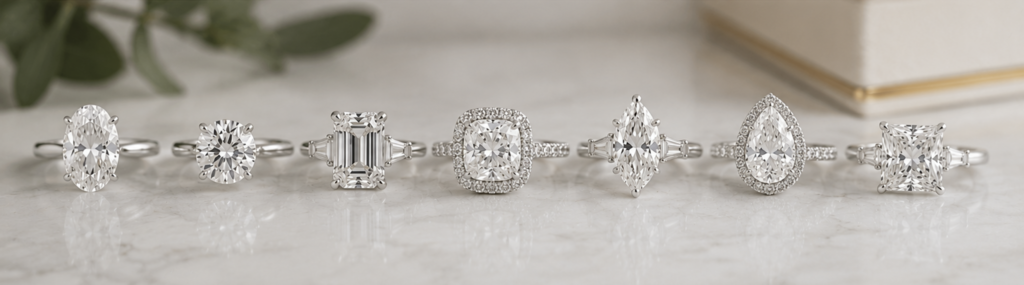
Okay. Deep breath. Let’s talk about the emerald cut, because this is the one that makes me a little emotional, if I’m being fully honest with you.
The emerald cut is technically a step cut, not a brilliant cut, which means instead of dozens of tiny triangular facets bouncing light everywhere, it has long, rectangular facets that run parallel to each other, creating this open, hall-of-mirrors kind of effect. It doesn’t sparkle in that aggressive, fireworks way — it flashes. Big, wide, deliberate flashes of light, almost like the stone is winking at you rather than shouting.
This is the cut Grace Kelly wore. This is the cut that has quietly threaded through nearly a century of the most photographed hands in the world, from old Hollywood premieres to modern-day red carpets. And I think that history is exactly why it’s having such a massive resurgence right now, especially among women who are drawn to that “your ring looks like a vintage heirloom” energy — the same instinct that has us thrifting old Cartier tank watches and hunting down deadstock silk scarves instead of buying whatever’s trending on a fast-fashion app this week.
Because the emerald cut is so open and transparent, clarity actually matters more here than it does with, say, a round brilliant, which can hide small inclusions in all that dazzling sparkle. An emerald cut has nowhere to hide. Every little inclusion, if there is one, is basically framed and spotlighted like it’s on a stage. This is one of the few places I’d tell you to genuinely prioritize clarity over carat size if your budget is tight — a smaller, cleaner emerald cut will always look more luxurious than a larger one with visible flaws you can spot from across a dinner table.
The proportions matter enormously too. A well-cut emerald has this elegant, elongated rectangle silhouette with gently clipped corners — not too square, not too long and skinny. I always tell friends to look at the length-to-width ratio; something around 1.3 to 1.5 tends to hit that sweet spot of looking sophisticated rather than either stubby or overly narrow.
Styling-wise, emerald cuts pair unbelievably well with a simple, thin platinum or white gold band if you want that crisp, cool, old-money look, or with warm yellow gold if you’re leaning into the softer, romantic vintage revival that’s everywhere on Pinterest boards right now — the ones tagged things like “coquette vintage” or “old world romance.” Either way works. It really comes down to whether your personal style skews cooler and more architectural, or warmer and more romantic.
Under $10,000, a two carat lab-grown emerald cut with excellent clarity, set simply, is completely within reach, and will look — I say this with total confidence — like an absolute treasure.
The Cushion Cut: Soft Edges, Serious Sparkle
There’s a reason the cushion cut has been quietly beloved for literally hundreds of years, showing up again and again through different eras of jewelry history under slightly different names and proportions. It’s essentially a rounded square or rectangle with soft, pillow-like corners (hence the name), combining the fire of a brilliant cut with a shape that feels a little more unique than a straightforward round.
I always describe the cushion cut to friends as the round brilliant’s more romantic, slightly softer sister. It has that same dazzling, scattered sparkle — lots of little facets doing lots of little flashing — but the rounded corners give it a gentler, more vintage-leaning silhouette. If you love the idea of a diamond that photographs like a soft, sparkly cloud rather than a hard geometric shape, this is probably your cut.
There are actually two main styles worth knowing about here: the classic cushion cut, which has slightly larger, chunkier facets and can sometimes show a bit of a “crushed ice” look (fans of this look absolutely adore it, it’s very texture-forward and interesting up close), and the cushion brilliant, which has smaller, more numerous facets for a more traditional, uniform sparkle closer to what you’d expect from a round diamond. Neither is objectively better — it genuinely comes down to personal taste, and I’d encourage you to look at both in person if you can, because photos really don’t do the difference justice.
Cushion cuts tend to be a little more budget-friendly per carat than round brilliants, partly because they retain more of the rough diamond material during cutting, which is a small but real advantage if you’re trying to maximize size within a set budget. Under $10,000, you can often land somewhere in the two carat range with a beautiful cushion cut, especially if you go lab-grown, paired with a delicate split-shank band or a soft halo that echoes the pillowy shape of the stone itself.
This cut also has a particular kind of romance to it that I associate with that whole “soft glam,” feminine, almost fairytale aesthetic that’s been dominating mood boards lately — think candlelit dinners, ivory silk slip dresses, loosely curled hair, everything just slightly softened at the edges. If that’s the energy you’re building your whole life around (no judgment, it’s a very good energy to build a life around), the cushion cut fits right in.
The Pear Cut: Confidence in the Shape of a Teardrop
Let’s talk about the cut that scares people a little, and shouldn’t: the pear.
A pear-shaped diamond — sometimes called a teardrop cut — combines a rounded end with a single point, essentially merging the sparkle of a round brilliant with the elongating elegance of a marquise. It’s a genuinely striking shape, and I think that’s exactly why some women hesitate on it. It feels bold. It feels like it’s making a statement, and a lot of us were quietly raised to believe that engagement rings should be safe, should be inoffensive, should never risk anyone having an actual opinion about them at brunch.
I want to gently push back on that instinct, because some of the most confident, self-possessed women I know wear pear-shaped rings, and there’s a reason for it. This cut requires you to actually decide something about yourself. It says: I know what I like, and what I like isn’t necessarily what everyone else has. There’s a kind of quiet main-character energy to choosing a pear shape that I find really compelling, especially in a cultural moment where so much of what we buy is dictated by algorithm rather than instinct.
Practically speaking, a pear can be worn with the point facing toward your fingertip, which elongates the finger dramatically and creates this lovely, elegant taper, or with the point facing toward your wrist, which is a less common styling choice but has its own understated appeal — a friend of mine wears hers this way and it looks like the diamond is quietly cradling her knuckle.
One technical thing worth knowing: symmetry is everything with a pear cut. Because it’s not a naturally symmetrical shape the way a round or square stone is, any unevenness — one side slightly bulkier than the other, the point sitting slightly off-center — becomes really noticeable really fast. This is a case where I’d strongly encourage seeing the actual stone rather than buying based on a certificate and a stock photo, because grading reports don’t always capture subjective symmetry issues the way your own eye will the moment you look at it in person.
Under $10,000, a lab-grown pear in the one-and-a-half to two carat range, set on a simple solitaire with a slightly cathedral-style setting (meaning the band rises up slightly to cradle the stone, giving it a bit of lift and presence), is an absolutely showstopping option, and one I don’t think gets nearly enough love in mainstream engagement ring content.
The Radiant Cut: For the Woman Who Refuses to Choose Between Sparkle and Structure
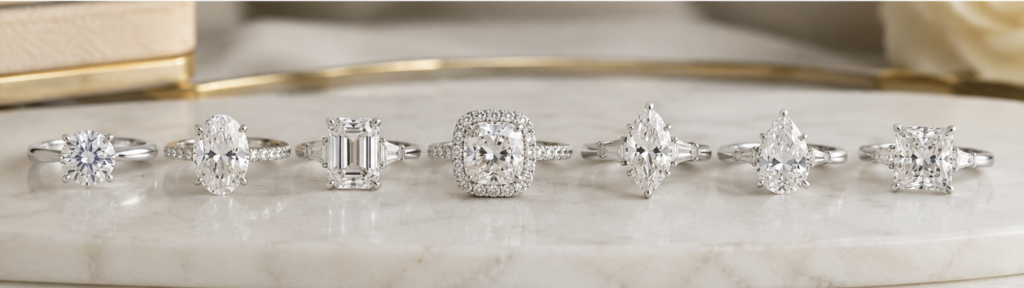
If you’ve ever looked at a round brilliant and thought “I love the sparkle but I wish it had a little more edge,” and then looked at an emerald cut and thought “I love the shape but I wish it had more fire,” the radiant cut exists specifically to solve your very particular problem.
The radiant cut takes the rectangular or square silhouette of an emerald cut and gives it the multi-faceted brilliance of a round cut, with trimmed corners that soften the overall look just slightly. It’s genuinely the best of both worlds, and I think it’s a little underrated compared to some of the other cuts on this list, possibly because it doesn’t have quite the same centuries-old romantic backstory as an emerald or a cushion. But give it time. I have a feeling the radiant cut is about to have a real moment, especially among women who want something that photographs as brilliantly under flash photography (hello, every proposal video that’s ever gone semi-viral) as it does under soft, ambient restaurant lighting.
The radiant cut also tends to hide inclusions and color tint better than an emerald cut, thanks to all those extra facets doing their sparkly camouflage work, which can actually make it a smart budget move — you can sometimes get away with a slightly lower clarity or color grade here without it being visually noticeable, freeing up more of your budget for carat size or a more elaborate setting.
Under $10,000, a two carat radiant cut, lab-grown, on a simple platinum or white gold band with maybe a whisper of pavé along the shank, is an incredibly polished, modern-feeling ring that still nods to classic proportions. I’ve started noticing it more and more on the hands of stylish women in that whole “your girlfriend who works in fashion but never posts about it” aesthetic — quiet confidence, expensive-looking without being flashy, the kind of ring that gets complimented by people who actually know jewelry rather than people who just recognize a giant rock.
The Marquise Cut: Vintage Romance Making an Undeniable Comeback
I need to talk about the marquise cut with the enthusiasm of someone who watched this shape go from “your great-aunt’s ring” to genuinely one of the most requested cuts among stylish twenty- and thirty-something women, seemingly overnight, and honestly? I called it years ago, and nobody believed me.
The marquise — sometimes called the navette cut, which is just a prettier French word for “little boat,” referring to its long, pointed-oval silhouette — has this incredible elongating effect on the finger, similar to the oval and pear, but even more dramatic because of its pointed ends on both sides rather than just one. It has serious old-world romance built into it. Think candlelit European countryside, think 1970s glamour, think the specific kind of jewelry your most stylish relative kept in a velvet box and only wore on days that mattered.
There’s a fun bit of jewelry lore attached to this cut too, which I love to share at dinner parties whether or not anyone asked: the marquise shape is said to have been commissioned by King Louis XV of France, who wanted a diamond cut to resemble the smile of his mistress, the Marquise de Pompadour. Whether that’s fully historically accurate or has been embellished over centuries of retelling, I honestly don’t care, because it’s a genuinely lovely story and it makes the ring feel like it’s carrying a little secret with it.
Because of its narrow, elongated shape, a marquise diamond looks significantly larger per carat than almost any other cut on this list — sometimes appearing 25-30% bigger visually than a round of the same weight. If maximizing perceived size on a fixed budget is your main priority, this is genuinely one of your best options.
The one thing I’ll flag honestly: the pointed tips on a marquise are more vulnerable than the rounded edges of other cuts, so if you’re rough on your hands — gardening, workouts, a job that involves a lot of manual tasks — you’ll want to make sure your setting includes protective prongs (V-shaped prongs specifically designed to cradle and protect those delicate points) and you’ll want to be a little more mindful day-to-day than you might be with a round or cushion cut.
Under $10,000, a marquise in the one-and-a-half to two carat range, lab-grown, on a simple east-west or traditional north-south setting, is a ring that feels like it’s stepping straight out of a very expensive vintage jewelry box, and I say that as someone who has spent an unreasonable number of hours browsing actual vintage jewelry boxes.
Bonus Cut: The Asscher, for the Architecturally Minded Romantic
I said 7+ in the title and I meant it, because I could not, in good conscience, leave out the Asscher cut.
Think of the Asscher as the emerald cut’s more geometric, more dramatic cousin — a square step cut with deep, cropped corners and larger step facets that create this almost hypnotic, layered look, like looking down into a square hall of mirrors. It has serious Art Deco energy, all sharp lines and old-world glamour, and it’s been beloved by a very specific kind of woman for over a century — the kind who loves architecture, loves clean geometry, and wants her ring to feel a little bit like wearable art rather than just a sparkly rock.
Because it’s so structurally distinct and a little rarer than some of the other cuts on this list, an Asscher cut ring tends to read as extremely intentional. Nobody accidentally ends up with an Asscher. You have to actually seek this cut out, which means everyone who sees it on your hand will clock, correctly, that you have Opinions About Jewelry, in the best possible way.
Under $10,000, a lab-grown Asscher in the one-and-a-half to two carat range on a simple, low-profile setting is an incredibly chic, slightly editorial choice — the kind of ring I could picture on the hand of a woman who reads actual books instead of just buying them for her coffee table, who has a signature scent, who owns exactly one very good trench coat instead of five mediocre ones.
Let’s Talk Settings, Because the Stone Is Only Half the Story
I could talk about diamond cuts forever (clearly, given the last several thousand words), but a stunning stone in the wrong setting is a little like a beautiful painting in an ugly frame — it just doesn’t land the way it should. So let’s talk settings, because this is where a lot of the timelessness actually comes from.
The solitaire setting is, unsurprisingly, the most enduring choice, and there’s real wisdom in that endurance. A single stone, held up by simple prongs, with nothing else competing for attention. It’s the setting equivalent of a perfectly tailored white shirt — endlessly versatile, endlessly elegant, and it lets the stone itself do all the talking. If you’re someone who changes your personal style fairly often — one year you’re leaning into soft romantic dressing, the next you’re in a minimalist tailored phase, the next you’ve discovered a love of statement earrings and boho textures — a solitaire is the safest long-term bet, because it never clashes with wherever your aesthetic evolves to next.
The hidden halo has become one of my personal favorite modern updates to a classic look. Instead of a visible ring of smaller diamonds surrounding the center stone (which can sometimes read as a little busy or dated depending on execution), a hidden halo tucks that extra sparkle underneath the main stone, invisible from a straight-on view but catching the light beautifully whenever you move your hand. It’s a little secret built into the ring — extra sparkle for you and only you to notice most of the time, which feels very in line with that whole “quiet luxury” ethos of having beautiful things that don’t need to announce themselves.
The three-stone setting carries gorgeous symbolic weight — past, present, and future, traditionally — and it’s having a real resurgence right now, especially with a larger center stone flanked by two smaller stones in a complementary or contrasting shape. I’ve seen some absolutely gorgeous versions pairing an oval center with two small pear-shaped side stones, or a cushion center with trapezoid baguettes on either side. This setting does tend to eat into your carat budget a little more than a solitaire since you’re paying for three stones instead of one, but the visual payoff, especially in terms of how much light and movement it creates on the hand, is genuinely worth considering.
And then there’s the pavé band, which I think of as the setting equivalent of a really good highlighter on the cheekbones — it’s not the main event, but it elevates everything around it. A thin line of small diamonds set into the band itself, running partway or all the way around, adds a continuous shimmer that catches light even when your hand is just resting, not actively moving under a chandelier. It’s subtle in the best way.
Metal Choices: Yellow Gold, White Gold, Rose Gold, or Platinum?
This is one of those decisions that feels small until you’re standing in front of a display case with the exact same ring in four different metals and suddenly your brain short circuits. So let’s simplify it.
Yellow gold has had the biggest resurgence of any metal in the last several years, and I don’t think it’s a coincidence that it’s happening alongside the broader cultural shift toward warmth, softness, and a kind of unfussy femininity — the same instinct behind the popularity of warm, buttery cashmere and gold-toned everything on our Pinterest boards. Yellow gold feels romantic and a little vintage without trying too hard, and it photographs beautifully in warm, golden-hour light, which, let’s be honest, is how most engagement photos end up looking anyway.
White gold and platinum both give you that cool, crisp, “quiet luxury” look — think cool-toned minimalism, the kind of aesthetic you see in a very expensively decorated, mostly-beige apartment. Platinum is the more premium and more durable of the two (it doesn’t need replating over time the way white gold does, since white gold is typically a yellow gold alloy plated with rhodium to achieve that white shine, and the plating does wear down eventually). Platinum will cost more per gram, so if you’re working within a strict budget, this is one area where I’d actually suggest white gold as the smarter money move without any real sacrifice in appearance, at least for the first several years.
Rose gold is the wildcard, and I say that with total affection because it’s genuinely one of my favorite metals. It has this soft, romantic, slightly retro warmth to it that pairs beautifully with almost every skin tone, and it has a way of making a diamond look ever so slightly warmer and pinker in the best possible way. It’s less traditional, which means it won’t be for everyone, but if you’re someone whose whole personal aesthetic already leans soft, romantic, a little bit “coquette” — lots of soft pinks, delicate florals, that whole dreamy energy — rose gold might be the metal that makes your ring feel like the truest expression of you.
My honest advice: try all four on your actual hand before deciding, in person, under a few different types of lighting if the store will let you (a good jeweler will). Skin tone matters here more than most people realize, and the metal that looks incredible on your best friend’s hand might look completely different on yours.
The Lab-Grown Diamond Conversation, Because We Need to Have It
I promised I’d share my honest take on this, so here it is: I think lab-grown diamonds are one of the best developments to happen to the engagement ring world in decades, and I say that as someone who genuinely loves the romance and history of natural stones too.
Lab-grown diamonds are chemically, physically, and optically identical to natural diamonds — same crystal structure, same sparkle, same hardness, same everything, just grown in a controlled lab environment over weeks rather than formed underground over billions of years. The only real difference is origin, and, significantly, price. A lab-grown diamond typically costs somewhere between 60-80% less than a natural diamond of the same size and quality, which means your $10,000 budget stretches dramatically further.
This is exactly how you get to wear a two, sometimes even three carat, beautifully cut stone in a gorgeous setting, all within a budget that would only get you a much smaller natural stone in a very basic setting. For a lot of women, myself very much included, that trade-off is an easy yes.
I know there’s still a segment of the population that has feelings about “real” versus “lab” diamonds, and if that matters deeply to you or your partner, that’s a completely valid thing to prioritize — this is your ring and your story, not anyone else’s. But I’d gently push back on the idea that lab-grown diamonds are somehow less meaningful or less “real.” The meaning in an engagement ring has never actually come from the geological process that created the stone. It comes from what the ring represents, who gave it to you, and the life you’re building around it. A lab-grown diamond catches light exactly as beautifully as a natural one, because, chemically, it is one.
If you do want a natural stone but still want to maximize your budget, I’d suggest leaning slightly lower on the color and clarity scale than you might initially assume you need to. Something in the G-H color range and SI1-SI2 clarity range will look completely eye-clean and beautifully white in almost all cases, and the savings compared to a flawless, colorless stone are significant enough to fund a noticeably larger carat size or a more elaborate setting instead.
How to Actually Shop for This (Without Losing Your Mind)
Here’s my real, practical advice, gathered from years of obsessive research and from watching several close friends go through this process themselves.
Start with inspiration, not decisions. Before you or your partner walk into any store or browse any website with intent to buy, spend some real time just looking — Pinterest boards, Instagram saves, screenshots of hands you love the look of. Notice patterns in what you’re drawn to. Are you constantly saving oval rings? Do you keep gravitating toward yellow gold? This unconscious pattern will tell you more about your actual taste than any quiz or questionnaire ever could.
See stones in person whenever humanly possible, especially for fancy shapes like pear, marquise, and emerald cuts where symmetry and proportion vary so much from stone to stone. Photos and even video can be deceiving, and the way a diamond looks under a jeweler’s carefully calibrated lighting is not always how it’ll look under your kitchen lights at home. If you genuinely can’t see it in person before purchase, at minimum request a video of the actual specific stone, not just a stock photo of “similar” stones.
Ask about the return and resizing policy before you buy anything, always. A good jeweler will offer a reasonable return window and complimentary resizing, because ring sizes can shift with weather, weight changes, and just general life. This isn’t a red flag to ask about — it’s standard practice, and any jeweler who acts weird about the question is telling you something important.
Get an independent appraisal after purchase, particularly for anything over a couple thousand dollars. This protects you for insurance purposes and gives you real peace of mind that what you paid for is what you actually received.
And please, please don’t let anyone rush you, including yourself. This is one of the only purchases in your entire life where taking an extra few weeks to feel completely confident is not just acceptable but genuinely wise.
Matching the Cut to Your Actual Life, Not Just Your Mood Board
Here’s something I wish more articles talked about honestly: the “right” cut for you isn’t only about which shape makes your heart skip a beat on Pinterest. It’s about which shape makes sense for the actual hands you’ll be living in for the next fifty-plus years — the hands that type, garden, knead bread dough, lift weights, and occasionally punch a pillow after a long week.
If you work with your hands constantly — nurses, teachers who are always at the whiteboard, anyone in a hands-on creative field like pottery or floral design — I’d gently steer you toward the more protected shapes. Round brilliants and cushion cuts tend to be the most forgiving here, since they don’t have delicate pointed tips that can catch on gloves, snag on sweaters, or chip against a doorframe you weren’t paying attention to. If you’re set on a pear or marquise despite a hands-on lifestyle, just make sure your jeweler uses protective V-tip prongs, and get in the habit of doing a quick visual check on those points every so often, the way you’d check the sole of a favorite pair of shoes.
If your days are more desk-bound, more boardroom, more “laptop and lukewarm coffee,” you have a lot more freedom to lean into the more delicate, dramatic shapes without worrying quite as much about daily wear and tear. This is where I see the marquise, pear, and Asscher cuts really shine, because they get to just exist as beautiful objects rather than functional tools that also happen to be beautiful.
And if you’re someone who takes rings off constantly — for the gym, for cooking, for skincare routines, for reasons I genuinely cannot always explain even to myself — consider a slightly lower-profile setting regardless of cut. A ring that sits closer to the finger is less likely to get knocked around when it’s living in the little dish by your bathroom sink or the pocket of whatever bag you grabbed on your way out the door.
What’s Actually Trending Right Now, and What I Think Has Real Staying Power
I try to hold two things in my head at once when I look at what’s trending in engagement rings currently: what’s genuinely beautiful and likely to age well, and what’s a fleeting, of-the-moment thing that’ll look a little dated in a decade the way certain overly ornate halo rings from a few years back already do (I say this with love — we’ve all made choices).
The biggest trend I’m seeing that I think has real, lasting power is the return to warmer metals and softer settings overall. Yellow and rose gold have overtaken the cooler, more clinical white gold and platinum-dominated years of the recent past, and I think this tracks with a broader cultural mood — after a long stretch of very minimal, very stark aesthetics everywhere from interior design to fashion, there’s a collective craving for warmth, texture, and softness again. Think the difference between a stark white minimalist kitchen and one with warm wood tones and a little bit of imperfection built in. That’s the emotional shift happening in jewelry too.
Elongated cuts — oval, marquise, pear — continue to dominate, and I don’t think that’s going anywhere anytime soon, because the “look bigger for your budget” appeal is just too practical to fade, especially as more women are actively involved in choosing their own rings rather than being surprised by a partner’s solo decision. When you’re the one doing the research, you tend to gravitate toward the shapes that offer the best visual return on investment, and elongated cuts consistently deliver that.
I’m also seeing a genuine uptick in colored gemstone engagement rings and colored diamond accents — soft sapphires, subtle champagne diamonds, the occasional deep emerald green stone worked into a three-stone setting alongside a white diamond. This isn’t new exactly, but it feels particularly of-the-moment right now, tied into that broader appetite for individuality within an otherwise classic framework. A woman can have a completely timeless silhouette — say, a three-stone oval setting — but make it entirely her own with a soft blue sapphire in place of a traditional white side stone.
What I don’t think has staying power, gently: oversized, cluster-style halos that essentially try to fake a much bigger center stone through sheer volume of tiny surrounding diamonds. They can look a little busy in a decade the way certain overly ornate rings from years past already do. If you love the extra sparkle a halo provides, I’d point you back toward the hidden halo option I mentioned earlier — you get the added shimmer without the risk of the whole thing reading as dated once trends shift again, because it stays quiet and secondary rather than becoming the main visual event.
Caring for Your Ring So It Looks Beautiful for Decades, Not Just Days
Nobody talks about ring maintenance in the dreamy, romantic content, and I understand why — it’s not exactly the stuff of Pinterest boards. But if you want your ring to genuinely look as breathtaking at your twentieth anniversary as it did the day you got engaged, a little bit of unglamorous upkeep goes a long way.
Get your setting checked once a year, ideally by the jeweler who sold it to you or made it, or any reputable jeweler if you’ve moved since. Prongs loosen slowly over time from just the ordinary friction of daily life, and catching a loose prong before it lets your stone slip out is infinitely better than the alternative, which I promise you does not need further explanation.
Clean your ring more often than you probably think you need to. A simple mixture of warm water and a small amount of mild dish soap, with a soft-bristled toothbrush reserved specifically for this purpose, will keep most rings looking genuinely sparkling. Skincare products, lotions, and the natural oils from your skin build up on the underside of a stone faster than you’d expect, quietly dulling the sparkle without you necessarily noticing the gradual change day to day.
Take it off for genuinely rough activities — heavy cleaning with harsh chemicals, intense workouts involving a lot of hand-gripping equipment, gardening, anything involving a hammer or a wrench. This isn’t about being precious or paranoid. It’s just common sense maintenance, the same instinct that has you taking off a good silk blouse before doing dishes.
And get it properly insured, separately from a general renters or homeowners policy if needed, so that in the rare, unfortunate case something does happen, you’re not left devastated on two fronts at once.
Questions I Get Asked Constantly (So Let’s Just Answer Them Here)
Is $10,000 actually enough for a “real” statement ring? Genuinely, yes. I know the number can feel small when you’re bombarded with images of five-carat celebrity rings, but those images represent a tiny, unrepresentative sliver of what most engagement rings actually look like in real life. A well-chosen cut, a smart setting, and a little flexibility on natural versus lab-grown will get you something that looks — and more importantly, feels — like a genuine statement, every single time you glance down at your hand.
Should the ring match my everyday jewelry style, or can it be totally different? I’d lean toward at least loosely matching your everyday metal tone, purely for practical reasons — stacking a warm yellow gold ring next to cool white gold pieces you wear daily can look a little mismatched over time, though plenty of women do mix metals beautifully on purpose these days, so this is really more of a gentle suggestion than a rule. Where I’d encourage you to feel free to diverge is in the overall style. Your everyday jewelry might be delicate and minimal, but your ring can still have a little more presence, precisely because it’s meant to be the one piece that stands slightly apart from the rest of your rotation.
What if my partner is choosing the ring without me and has no idea what any of this means? Send them this article, honestly, or at minimum, casually leave a few specific screenshots lying around in shared photo albums or group chats you know they’ll see (we’ve all done a version of this, no shame). If you want to keep some surprise involved but still guide the outcome, focus your not-so-subtle hints on shape and metal tone specifically, since those two factors matter more to your long-term happiness with the ring than carat size or brand name ever will.
How long should I expect the whole shopping process to take? For most of my friends, somewhere between four and twelve weeks from first serious research to final purchase, especially if any custom setting work is involved, which typically adds two to four weeks of production time on top of the decision-making itself. If there’s a specific date in mind — a trip, an anniversary, a holiday — I’d build in extra cushion time, because the very last thing you want is to feel rushed into a decision on something you’ll be looking at for the rest of your life.
Is it tacky to be involved in choosing my own ring? Not even slightly, and I’d argue the opposite is actually becoming more old-fashioned by the day. More couples than ever are shopping together, or one partner is quietly doing extensive research and sharing specific preferences well ahead of time, precisely because everyone involved wants the end result to be something the person wearing it daily for decades genuinely loves, rather than a surprise that might miss the mark on shape, size, or style. There is nothing unromantic about wanting to be thrilled with your own ring.
A Few Final, Slightly Sentimental Thoughts
I think what I love most about this whole topic — beyond the sparkle, beyond the Pinterest boards, beyond the genuinely fun process of comparing cuts and settings — is what an engagement ring quietly represents. It’s one of the very few objects most of us will ever own that’s meant to last an entire lifetime, worn through every single kind of day: the boring ones, the hard ones, the ones you’ll actually remember forever.
That’s exactly why timelessness matters so much more here than in almost any other category of fashion. You can experiment endlessly with trends in your clothes, your makeup, your home decor, and if something goes out of style in two years, you simply move on. But this ring is going to be on your hand while you hold your morning coffee for the next fifty years. It deserves a little more thought than a fast-fashion impulse buy, and it deserves to be chosen for reasons that go beyond whatever’s trending on your feed this particular month.
The cuts I’ve walked you through here — round, oval, emerald, cushion, pear, radiant, marquise, and Asscher — have all, in their own way, survived the test of actual time. Decades of it, sometimes centuries. They’ve been worn by women whose names we know and women whose names history simply forgot, all of them reaching for the exact same thing: something beautiful, something meaningful, something that would still feel special to look down at years and years later.
You genuinely do not need to spend a fortune to have that. You need clarity about what you love, a little bit of insider knowledge about proportion and setting, and the confidence to trust your own taste over whatever’s algorithmically being pushed at you this week. Under $10,000, with the right combination of cut, setting, and metal, you can absolutely have a ring that feels like a piece of quiet, elegant history — one that just happens to be starting with you.
So go back to that Pinterest board. Save a few more. Notice what keeps catching your eye. And when you finally see the one — you’ll know. That part, at least, never seems to change, no matter what year it is or what’s trending.