
Some drinks belong so deeply to a celebration that imagining the festival without them feels almost incomplete.
Hot chocolate belongs to winter evenings. Mulled wine feels inseparable from Christmas markets. Lemonade somehow tastes better in peak summer heat.
And when it comes to Holi, there is one drink that holds almost iconic status: thandai.
You can hear the word and immediately picture the atmosphere.
Bright powders in the air. Music that somehow gets louder as the day goes on. Laughter coming from every direction. Clothes that began the day white and are now completely beyond saving.
And somewhere nearby, often slightly hidden from the chaos but equally essential to the celebration, there is always a tray of chilled glasses waiting.
Thandai has been part of Holi celebrations for generations, and for good reason.
It is cooling, aromatic, festive, indulgent, and unmistakably linked to the season.
But traditions have an interesting way of evolving.
Not disappearing.
Not being replaced.
Just adapting slightly to new tastes, lifestyles, and curiosities.
That is exactly where matcha enters the conversation.
At first, matcha and thandai might sound like an unexpected pairing.
One is deeply rooted in Indian festive culture, rich with nuts, saffron, cardamom, fennel, and rose.
The other is associated with Japanese tea culture, minimalist rituals, earthy green powders, and wellness cafés.
On paper, they seem worlds apart.
In practice, they work surprisingly well together.
In fact, matcha adds something thandai sometimes needs: freshness, subtle bitterness, a cleaner finish, and a more modern energy.
The result is a drink that still feels unmistakably festive, but lighter, brighter, and slightly more contemporary.
Not less traditional.
Just newly interesting.
Why Thandai Became the Drink of Holi
Before talking about matcha, it helps to understand why thandai matters so much in the first place.
Thandai is more than a beverage.
It is part of the atmosphere of Holi itself.
Traditionally made with milk, nuts, seeds, spices, and floral elements, thandai is designed as a cooling drink.
This matters because Holi arrives during a seasonal transition in India, when temperatures begin rising and the weather starts shifting toward early summer heat.
The ingredients in traditional thandai are not random.
Almonds add richness and body.
Fennel contributes cooling freshness.
Cardamom adds warmth and fragrance.
Saffron brings depth and luxury.
Rose introduces floral sweetness.
Poppy seeds, melon seeds, black pepper, and other spices create layers of flavour that make thandai taste far more complex than a simple sweet milk drink.
It is rich, yes.
But it is also aromatic, textured, and deeply celebratory.
That complexity is exactly why it remains timeless.
A good thandai does not feel like a novelty.
It feels ceremonial.
Comforting.
Generous.
A little indulgent.
Everything festive drinks should be.
Why Matcha Works Surprisingly Well in Thandai
At first, adding matcha to thandai sounds like a trendy experiment designed more for Instagram than actual flavour.
But once you think about the flavour profiles, the pairing becomes quite logical.
Traditional thandai is creamy, nutty, floral, mildly spiced, and naturally sweet.
Matcha is earthy, grassy, slightly bitter, subtly sweet, and rich in umami.
These profiles complement rather than compete.
The earthiness of matcha grounds the sweetness of thandai.
Its mild bitterness adds structure.
Its vegetal freshness cuts through richness.
Instead of making thandai feel heavier, matcha often makes it feel more balanced.
That balance is valuable.
Traditional festive drinks can sometimes become overwhelming after a few sips, especially in warm weather.
Matcha introduces freshness without stripping away indulgence.
The drink still feels festive.
Still rich enough for celebration.
Just lighter on the palate.
More modern.
A little cleaner.
Matcha Changes the Energy Experience Too
Taste is only part of the story.
The other reason matcha fits well into Holi drinks is functional.
Holi is not exactly a quiet festival.
It is long, energetic, loud, social, physically active, and often slightly chaotic.
There is dancing.
Walking.
Hosting.
Cleaning.
More dancing.
General overstimulation.
Festive food and drinks often lean heavily toward sugar, dairy, and richness.
Delicious? Yes.
Always energising in a useful way? Not necessarily.
This is where matcha becomes especially appealing.
Matcha contains caffeine, but unlike coffee or highly sweetened beverages, its energy profile is smoother.
This is largely because of L-theanine, a naturally occurring amino acid in tea that helps moderate caffeine’s effects.
The result is often described as calm alertness.
Steady energy.
Less jittery.
Less abrupt.
That makes matcha thandai feel unexpectedly practical.
You still get the indulgent festive experience, but with an added layer of smoother energy support.
In other words: slightly better odds of surviving the full Holi day.
A modest but respectable achievement.
The Classic Matcha Thandai Version
The easiest way to experiment with matcha thandai is not by reinventing the drink completely.
It is simply by layering matcha into a traditional base.
This keeps the identity of thandai intact.
You still want the familiar flavour notes.
Milk or plant milk.
Soaked almonds and cashews.
Fennel.
Cardamom.
A little saffron.
Rose water.
A gentle sweetness.
The only addition is matcha.
Usually, a small amount is enough.
Too much matcha can dominate the spice balance.
The goal is integration, not takeover.
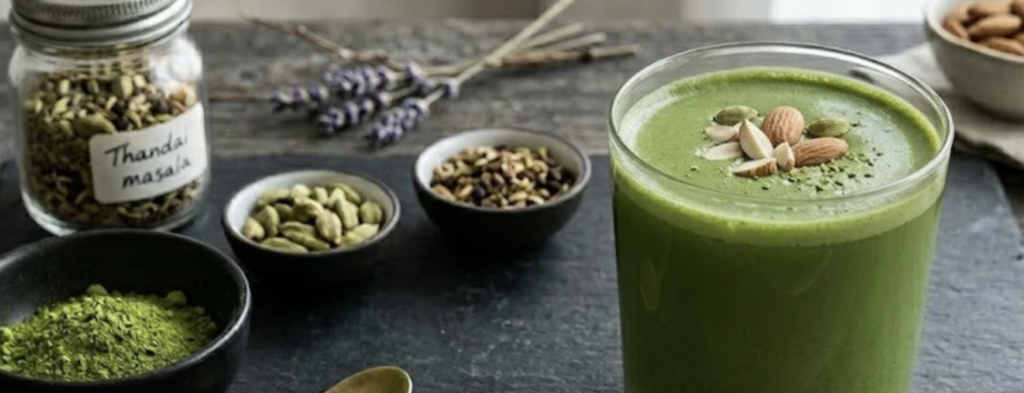
When done well, the drink becomes pale green, creamy, fragrant, and noticeably fresher.
Still recognisably thandai.
Just with more dimension.
Fruit Variations Work Surprisingly Well
One of the advantages of matcha is flexibility.
It pairs surprisingly well with fruit, which opens interesting possibilities for Holi drinks.
Mango matcha thandai is perhaps the most obvious festive upgrade.
Mango already feels culturally and seasonally appropriate.
Its sweetness and texture pair naturally with milk and nuts.
Adding matcha introduces contrast that prevents the drink from becoming excessively rich.
The result is tropical, creamy, slightly earthy, and far more balanced than expected.
Strawberry matcha variations are also visually striking.
The pink-green contrast alone makes the drink feel festive.
Flavour-wise, strawberries add acidity and brightness that soften both dairy richness and matcha earthiness.
This version feels especially playful.
Slightly less traditional.
Very party-friendly.
Mint and Coconut Make It Even More Refreshing
For warmer Holi afternoons, freshness becomes even more valuable.
This is where mint and coconut versions work beautifully.
Mint introduces a cooling dimension that naturally complements thandai’s fennel and cardamom notes.
It makes the drink feel even lighter and more hydrating.
Particularly useful after several hours outside.
Coconut milk versions create a dairy-free option that still feels indulgent.
This is important because traditional thandai can be quite heavy.
Coconut softens the texture while introducing tropical sweetness.
Combined with matcha, the result is creamy but cleaner.
Rich without being exhausting.
Which is honestly an underrated holiday beverage quality.
Matcha Thandai Fits Modern Hosting Culture
Part of what makes matcha thandai appealing is not just taste.
It also fits the way people increasingly host and celebrate.
Many modern gatherings blend tradition with experimentation.
People still want familiar festive elements.
But they also enjoy introducing small twists.
A traditional dish with updated plating.
A classic dessert with new flavour pairings.
A nostalgic drink with a modern ingredient.
Matcha thandai fits perfectly into this pattern.
It respects the original while making it feel slightly refreshed.
Not disruptive.
Not gimmicky.
Just updated.
That balance matters.
Festive innovation works best when it feels thoughtful.
Not forced.
Presentation Matters More Than Ever
Let’s be honest.
Drinks today are not only consumed.
They are also photographed.
Particularly during visually expressive celebrations like Holi.
Matcha helps tremendously here.
Its natural green colour immediately creates visual interest.
Against saffron garnish, rose petals, pistachio dust, or crushed nuts, the contrast is striking.
Served in clear glasses, the pale green tones feel vibrant and seasonal.
It looks festive without requiring artificial colour.
Which feels appropriately poetic for a festival built around colour itself.
Choosing Better Matcha Actually Matters
Not all matcha is ideal for drinks like thandai.
Since the drink itself is already layered and aromatic, harsh or low-quality matcha can disrupt the balance.
Poor-quality matcha tends to be overly bitter, dull in colour, and sometimes muddy in flavour.
A better-quality powder offers:
brighter colour,
smoother flavour,
less bitterness,
cleaner finish.
You do not necessarily need the highest ceremonial grade.
But using better matcha noticeably improves both flavour and appearance.
Given how central aesthetics and taste are here, it is usually worth it.
Tradition Doesn’t Have to Stay Frozen
Sometimes people treat tradition as something fragile.
As if changing even one detail risks ruining the whole experience.
But the strongest traditions are rarely static.
They evolve.
They absorb.
They adapt.
They remain recognisable while making room for new expressions.
Thandai itself has likely seen countless variations across regions, households, and generations.
Adding matcha is simply another expression of that living tradition.
Not a replacement.
Not a rebellion.
Just a creative continuation.
And honestly, that feels very aligned with Holi itself.
Holi is joyful, playful, colourful, energetic, and expressive.
A festival that celebrates vibrancy is naturally open to experimentation.
A greener version of thandai somehow feels right.
Final Thoughts
Holi is already full of sensory richness.
Colour, music, sweets, spices, movement, sunshine, conversation, nostalgia, and chaos all happening at once.
The drinks should feel worthy of that atmosphere.
Traditional thandai will always deserve its place.
Its cultural presence is too strong, too comforting, and too beloved to replace.
But matcha offers something genuinely interesting.
A fresh twist.
A cleaner finish.
A more balanced flavour.
A calmer, steadier energy.
And perhaps most importantly, a small sense of novelty without sacrificing what makes the original drink special.
That is usually the best kind of festive update.
Something familiar, seen from a slightly new angle.
So if this year’s Holi menu needs one unexpected addition, matcha thandai might be exactly the kind of experiment worth trying.
After all, if there is any celebration designed for bold colour choices, it is probably this one.
And matcha does arrive very confidently in green.