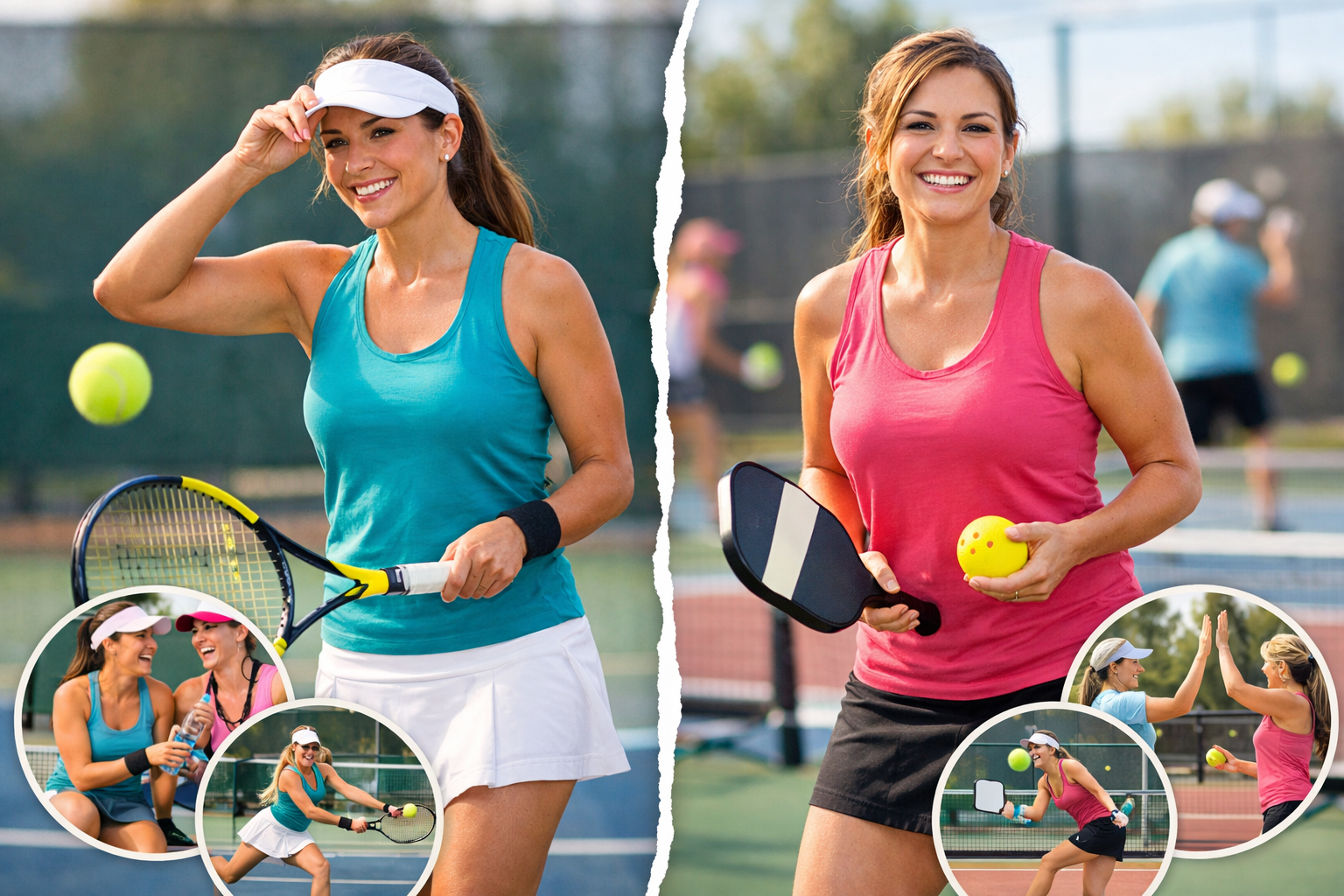
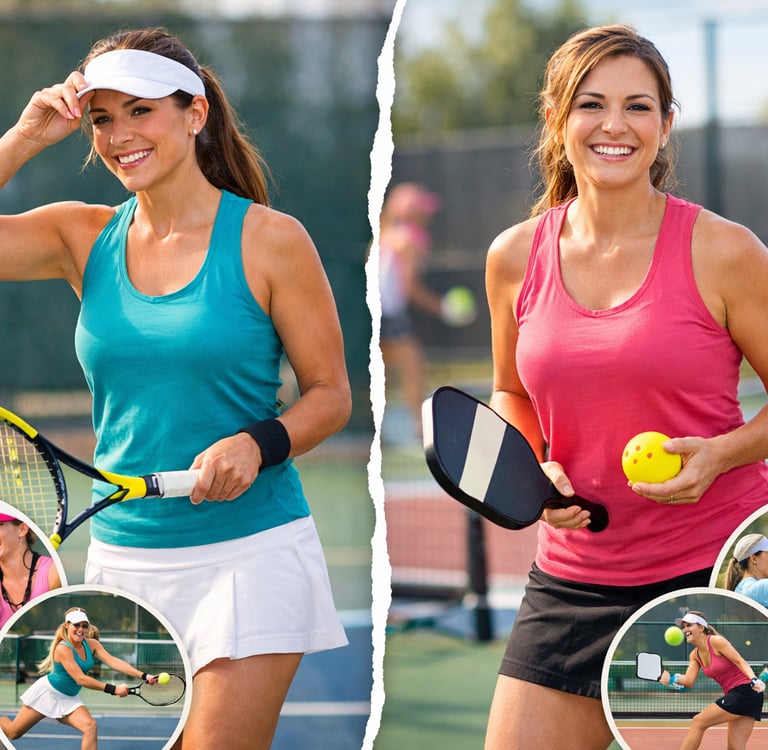
There’s something poetic about the sound of a ball meeting a racket. It’s sharp, confident, almost cinematic. For most of my life, that sound meant one thing: tennis. Specifically, long summer afternoons inspired by watching Wimbledon on television, strawberries and cream on the table, and the quiet elegance of players dressed in white moving across perfectly cut grass courts in London. Tennis felt sophisticated, powerful, a little intimidating — and I loved that about it.
But recently, another sound has entered my life. A lighter pop. A hollow, almost playful echo. That sound belongs to pickleball.
If you had told me five years ago that I would seriously consider choosing between tennis and pickleball, I probably would have laughed. Tennis was the “real” sport in my mind — demanding, technical, and glamorous. Pickleball sounded like something invented at a backyard barbecue. Yet here I am, genuinely torn between the two. And if you’re reading this, maybe you are too.
From a woman’s perspective — balancing fitness, work, social life, and the constant negotiation between pushing myself and protecting my body — the question isn’t simply “Which sport is better?” It’s “Which one fits my life right now?”
When I first started playing tennis consistently, I was drawn to the intensity. A standard tennis court is 78 feet long. In singles, it’s 27 feet wide; in doubles, 36 feet. That’s a lot of ground to cover. And you feel every single foot of it. Tennis is explosive. You sprint, stop abruptly, pivot, stretch, lunge. Your heart rate climbs quickly, and it stays there. The ball is heavier, pressurized, and it bounces high. To return it effectively, you need timing, strength, and technical precision.
There’s something deeply satisfying about striking a clean forehand. The vibration travels through the stringed racket into your arm, and when you hit the sweet spot, it feels powerful and controlled. But let’s be honest: it’s not easy. Tennis demands conditioning. It asks for stamina. It exposes weak footwork immediately. After a competitive singles match, my legs feel like jelly, and my shoulders remind me that I am no longer twenty.
And yet, that challenge is addictive.
Tennis has history. It carries prestige. When I step onto a court, especially a well-maintained hard court, I feel like I’m entering a tradition that stretches back centuries. There’s a mental element that fascinates me too. The scoring — 15, 30, 40, game — is quirky and almost theatrical. You don’t just win points; you build momentum. You manage pressure at deuce. You fight through break points. It’s strategic in a way that feels almost psychological. You learn patience. You learn resilience.
But here’s where pickleball surprised me.
The first time I played pickleball, I expected something light and casual — maybe even boring. Instead, I found myself smiling constantly. The court is significantly smaller: 44 feet long and 20 feet wide. Compared to a tennis court, it feels intimate. You’re closer to your opponent. You see their reactions. You talk between points. There’s less distance, physically and socially.
The paddle feels different immediately. It’s solid, without strings, and paired with a lightweight plastic ball full of holes — almost like a wiffle ball. The ball doesn’t bounce as high as a tennis ball, and the game emphasizes placement over raw power. At first, I missed the dramatic swing of tennis. But then I discovered the beauty of soft shots, especially near the non-volley zone — the “kitchen,” as players affectionately call it.
Pickleball is strategic in a quieter way. It’s about angles, control, and patience. You can’t simply overpower your opponent. You have to outmaneuver them. And because the court is smaller, rallies can be surprisingly fast — not because you’re sprinting long distances, but because reaction time matters.
From a fitness perspective, the difference is noticeable. Tennis feels like high-intensity interval training disguised as a sport. It’s cardiovascular. It’s anaerobic bursts followed by brief recovery. In singles especially, it’s demanding. Pickleball, on the other hand, feels more moderate. You move constantly, but you rarely have to sprint across large distances. My knees appreciate that. My lower back appreciates that.
As a woman in my thirties (and very aware that recovery time matters more than it used to), I can’t ignore the impact factor. Tennis involves powerful serves and overheads that stress the shoulders. Quick lateral movements can strain ankles. With proper conditioning and technique, injuries are manageable, but the risk is there. Pickleball tends to be gentler on the joints because of the smaller court and lighter ball. That doesn’t mean it’s injury-free — any sport involving quick changes of direction carries some risk — but it generally feels more forgiving.
Socially, the contrast is fascinating.
Tennis clubs often have a structured atmosphere. There’s etiquette, dress codes in some places, ranking systems, lessons, leagues. It can feel exclusive, especially for beginners. Walking onto a tennis court as a novice can be intimidating. The learning curve is real. Serving consistently alone can take weeks of practice.
Pickleball, in contrast, feels welcoming almost immediately. The rules are simpler. Games are typically played to 11 points, and only the serving side scores. Within an hour, most people can sustain a rally. Doubles play dominates, which means constant interaction. You rotate partners. You laugh. You celebrate small wins. The atmosphere is often more communal than competitive — although at higher levels, pickleball becomes extremely fast and tactical.
I’ve noticed something interesting in mixed-age groups too. In tennis, physical differences can create clear gaps in play. In pickleball, because power is less dominant and placement matters more, age and gender differences feel less pronounced. I’ve seen women outmaneuver stronger male players through precision and patience. That’s empowering.
Emotionally, tennis makes me feel strong and ambitious. It challenges my endurance. It pushes me. When I win a tough tennis match, I feel accomplished in a way that’s deeply satisfying. It’s a test of conditioning and mental toughness.
Pickleball makes me feel connected. It’s playful. It reminds me that sport doesn’t always have to be grueling to be meaningful. Sometimes it’s about rhythm, laughter, and shared moments on a sunny afternoon.
There’s also the practical side. Tennis requires more space. Courts are larger, and availability can sometimes be limited depending on where you live. Pickleball courts take up about a third of the space of a tennis court, which means communities can fit multiple pickleball courts into one tennis footprint. That accessibility partly explains its rapid growth in recent years.
Financially, both sports require equipment, but neither is excessively expensive compared to other athletic pursuits. A quality tennis racket can be an investment, and restringing is an ongoing cost. Pickleball paddles range widely in price, but there’s no restringing required. Shoes, of course, matter in both — lateral stability is essential.
So which is better?
The honest answer — the one that feels truest to my own experience — is that it depends on what season of life you’re in.
If you crave intensity, if you love testing your stamina, if you enjoy mastering technical skills over time and competing at a high level, tennis might be your sport. It rewards discipline. It builds cardiovascular fitness and muscular endurance. It feels powerful.
If you want something social, accessible, strategic without being overwhelming, and easier on the joints, pickleball may fit beautifully. It offers movement, coordination, and mental engagement without the same physical toll.
I’ve stopped thinking of it as a competition between the two. Instead, I see them as different expressions of movement. On days when I feel strong and ambitious, I reach for my tennis racket. On days when I want connection and lighter energy, I grab my pickleball paddle.
And maybe that’s the real point.
As women, we often juggle multiple roles — professional, partner, mother, friend, caregiver. Our energy fluctuates. Our bodies change. What we need from sport at twenty-five is not necessarily what we need at thirty-five or forty-five. The beauty of having both tennis and pickleball available is that we can choose based on how we feel — not on external expectations.
Sometimes empowerment looks like a powerful serve down the T. Sometimes it looks like a perfectly placed soft dink into the kitchen.
Both sports build coordination, balance, and confidence. Both challenge the mind as much as the body. And both, in their own ways, offer community.
If you’re trying to decide, my advice is simple: try both. Notice how your body feels the next day. Notice your mood. Notice whether you leave the court energized or drained — and whether that’s the kind of fatigue you enjoy.
For me, the answer isn’t fixed. It evolves. And that’s okay.
At the end of the day, the best sport is the one that keeps you moving, keeps you smiling, and makes you feel at home in your own strength. Whether that sound is the sharp crack of a tennis ball or the playful pop of a pickleball paddle, what matters most is that you’re on the court — fully present, fully alive.