
For Women Who Want More Thickness, More Length, and More of Everything
A Complete Personal Guide · 2026 Edition
elegantstreetwearblog.com
Let’s Talk About the Hair Obsession Nobody Admits To
There is a specific kind of longing that lives quietly in the back of every woman’s mind — the kind she doesn’t exactly announce at dinner, but the kind that shows up every single morning when she stands in front of her bathroom mirror. It’s the longing for more hair. More length. More body. More of that thick, glossy, effortless curtain of hair that seems to cascade off the heads of every woman on your Pinterest board.
I know this longing intimately because I lived with it for years. My hair was fine, flat, and somehow always hovering at that frustrating not-short-not-long length that doesn’t style well and doesn’t photograph beautifully and just sort of… exists. I tried volumizing shampoos that smelled like artificial watermelon. I tried biotin supplements that gave me breakouts. I tried rice water rinses, castor oil, and an embarrassing number of hair masks that I let sit for too long while watching reality television.
Some things worked. Some things did nothing except make my shower smell like a spa. And somewhere in the middle of all that experimenting — all those quiet Saturday mornings of deep conditioning and scalp massages and googling “why is my hair not growing” — I figured out what actually moves the needle.
This guide is everything I know about growing longer, thicker, more beautiful hair. It’s written the way I would explain it to a friend over coffee — honestly, specifically, with no fluff and no promises I can’t keep. Because your hair is worth more than generic advice, and you deserve to actually understand what’s happening on your scalp and why.
So settle in, because we’re going deep.
The Basics: Understanding How Hair Actually Grows
Before you can grow hair strategically, you have to understand what hair even is and why it behaves the way it does. I know — science isn’t exactly the most glamorous place to start a beauty guide. But stay with me, because once this clicks, everything else starts to make so much more sense.
The Hair Growth Cycle (And Why It Matters More Than You Think)
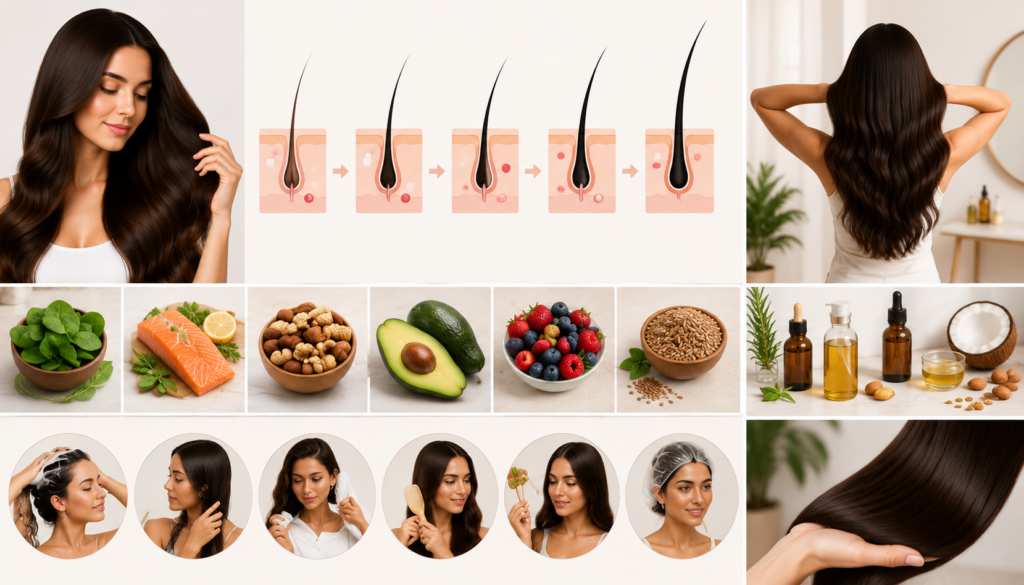
Every single strand of hair on your head is on its own independent timeline, moving through three distinct phases: the anagen phase, the catagen phase, and the telogen phase. These are not just technical terms — they are the actual reason your hair grows, rests, and sheds the way it does, and understanding them is genuinely game-changing.
The anagen phase is the growth phase, and it’s the one we care most about. This is when the hair follicle is actively producing new cells, pushing the strand upward and outward from the scalp. The length of your anagen phase is largely genetic — it can last anywhere from two to seven years, which is why some women can grow their hair to waist length while others seem to plateau at collarbone no matter what they do. The longer your anagen phase, the longer your terminal length — the maximum length your hair can reach before it naturally cycles out.
Then comes the catagen phase, a brief transitional period lasting only a couple of weeks, where the hair follicle shrinks and detaches from the blood supply. The hair stops growing, but it hasn’t shed yet. It’s just… waiting.
Finally, the telogen phase is the resting phase. The old hair sits in the follicle while a new one begins forming beneath it. Eventually, the old hair sheds — which is completely normal. On any given day, it’s entirely healthy to lose between 50 and 100 strands. When that number climbs significantly higher, that’s when we start looking at what might be disrupting the cycle.
“Your hair isn’t broken. It’s just on a cycle that needs the right conditions to thrive.”
What Controls Hair Growth Speed?
Hair grows at an average rate of about half an inch per month — roughly six inches per year. That’s the baseline. But “average” is a word that means very little when it comes to individual bodies, because your actual growth rate is influenced by a constellation of factors: your genetics, your hormones, your nutrition, your stress levels, your scalp health, and even the seasons (yes, hair grows slightly faster in summer — something to do with increased circulation and vitamin D, though researchers are still studying the mechanisms).
The good news is that while you can’t dramatically alter your genetic potential, you absolutely can create the conditions that allow your hair to reach its full potential — which, for most women, is significantly more than they’re currently experiencing. The goal of everything in this guide is to optimize those conditions: to keep your follicles healthy, your hair in the anagen phase for as long as possible, and your strands protected enough to actually retain the length they’re producing.
Because here’s something that took me a long time to internalize: hair retention is just as important as hair growth. Your hair might be growing six inches a year and you might still feel like it isn’t going anywhere, because you’re losing just as much to breakage, split ends, and damage at the other end. Growth and retention work together. You need both.
The Scalp Is Everything: Why Your Foundation Matters
If I had to choose just one thing to tell every woman who wants better hair, it would be this: stop thinking about your hair and start thinking about your scalp. The scalp is where everything begins. It is the soil in which your hair grows, and just like a garden, the quality of what grows above depends entirely on the health of what’s happening below.
I know that scalp care has had a moment in recent years — and rightly so. The clean girl aesthetic that dominated 2024 and has continued evolving through 2025 and 2026 brought with it a genuine shift in how we think about beauty from the roots up. We’re less focused on the decorative surface level and more interested in the underlying wellness. And nothing embodies that better than the scalp conversation.
What a Healthy Scalp Actually Looks Like
A healthy scalp isn’t something you see so much as something you feel. It’s comfortable — not itchy, not tight, not excessively oily or so dry it flakes. It breathes. It moves a little when you massage it, which indicates good tissue health and circulation. The skin is neither inflamed nor congested with product buildup.
An unhealthy scalp, on the other hand, can manifest in all sorts of ways that directly impact your hair growth. Chronic inflammation — often caused by harsh sulfates, overwashing, or a compromised moisture barrier — can constrict the follicle and slow growth. Excessive sebum buildup can clog the follicle opening, smothering new hairs before they have a chance to emerge properly. Dandruff and seborrheic dermatitis, if left untreated, create an environment that is hostile to healthy hair growth. And scalp tension — the kind that builds from stress, poor posture, or tight protective styles worn for too long — can literally reduce blood flow to the follicles.
None of this is meant to alarm you. It’s meant to redirect your attention. Because if you’ve been spending money on expensive hair oils and growth serums and you’re not also taking care of your scalp, you are building on an unstable foundation.
The Art of the Scalp Massage
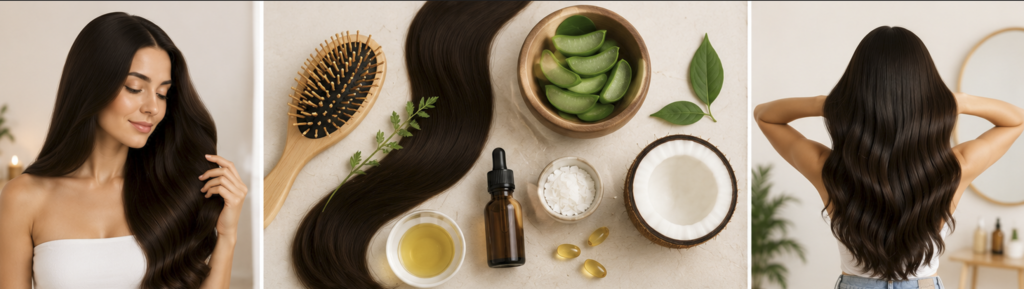
Let’s talk about scalp massage, because it is one of the most underrated, completely free, and genuinely effective tools in the hair growth toolkit — and I say that not just from personal experience but from the research that backs it up. A 2016 study published in ePlasty found that four minutes of scalp massage per day over 24 weeks resulted in measurably thicker hair strands. Four minutes. Daily. That’s it.
The mechanism is circulation. When you massage your scalp, you increase blood flow to the follicles, which means more oxygen and more nutrients delivered directly to the site of hair production. Think of it as watering your garden more efficiently.
The way I do it: fingertips (not nails) pressing firmly against the scalp, moving in small circular motions starting at the nape of the neck and working forward toward the hairline. I do this for five to ten minutes a few times a week, sometimes with a rosemary oil blend and sometimes completely dry. The scalp should feel warm when you finish — that’s the circulation working. Some women use a silicone scalp massager brush, which feels absolutely wonderful and does a nice job of loosening buildup as well.
Consistency matters more than intensity here. A gentle daily massage beats an aggressive once-a-week session. Work it into your existing routine — in the shower while shampooing, in the evening while watching something on your laptop, on the weekends as part of a longer self-care ritual. It should feel luxurious, not like a chore.
Scalp Serums, Exfoliants, and Treatments Worth Knowing
The scalp care category has exploded in the past few years, and the options can feel overwhelming. So let me give you a framework for thinking about what’s actually worth adding to your routine.
Scalp serums formulated with ingredients like niacinamide, salicylic acid, zinc, and peptides are genuinely useful for addressing specific concerns — oiliness, inflammation, follicle stimulation. Niacinamide in particular has good research behind it for improving scalp circulation and reducing inflammation. Look for lightweight, fast-absorbing formulas that won’t weigh down your roots or leave residue.
Scalp exfoliation, done once every one to two weeks, helps remove the dead skin cells and product buildup that can block follicles. You can use a dedicated scalp scrub (sugar or sea salt based physical exfoliants work well) or a chemical exfoliant containing salicylic acid or AHAs. Be gentle — the goal is to clear the surface, not irritate the skin below.
And please, please patch test anything new you put on your scalp. The skin there can be reactive, and the last thing you want is to introduce a new product that triggers inflammation just when you’re trying to optimize your environment.
Nutrition and Hair Growth: The Inside Story
I want to say something that might be slightly controversial in a world full of hair growth supplements and miracle serums: no topical product will ever compensate for poor nutrition. Your hair is made of protein. It is fed by your bloodstream. What you eat is not a peripheral factor in hair health — it is the central factor. Everything else is supportive.
Now, I’m not saying you need to overhaul your entire diet or start tracking macros or give up the things you love. I’m saying that if your body is chronically depleted of certain key nutrients, your hair will be the first system to feel it. The body is intelligent about prioritization — it will always direct available resources toward vital organs before directing them toward hair follicles, which are biologically considered non-essential. So hair thinning or slowed growth is often an early signal that something in your nutritional landscape needs attention.
The Nutrients That Matter Most for Hair Growth
Protein is the foundation. Hair is almost entirely made of keratin, which is a protein, so chronically low protein intake will directly impact hair growth and strength. You don’t need to become a protein-obsessed person, but making sure you’re consistently eating enough complete protein sources — eggs, fish, poultry, legumes, quality dairy — is genuinely important. Most nutritionists suggest that somewhere around 50-60 grams of protein daily is a reasonable minimum, and women who are very active or in periods of hormonal change may benefit from more.
Iron deficiency is one of the most common and most overlooked causes of hair loss in women, particularly those who menstruate heavily or follow plant-based diets. Low ferritin — the stored form of iron — is especially problematic for hair, because ferritin is required for proper cell division in the follicle matrix. The frustrating thing about iron-related hair loss is that it can persist for months even after you start supplementing, because the body needs time to rebuild its stores and the hair cycle needs time to correct. If you’ve been experiencing diffuse shedding with no obvious cause, please ask your doctor to check your ferritin specifically, not just your hemoglobin.
Biotin has become the celebrity of hair growth supplements, and while it is indeed important, the picture is more nuanced than the marketing suggests. Biotin deficiency can absolutely cause hair loss and brittle nails, but true biotin deficiency is actually relatively rare in people eating a varied diet, because it’s present in so many foods. If you’re supplementing with biotin and seeing results, that’s wonderful. But if you’re not, it may be because biotin wasn’t the limiting factor for your hair in the first place.
Zinc plays a role in hair tissue growth and repair and helps keep the oil glands around follicles functioning properly. Deficiency is associated with hair loss, and it’s more common than most people realize, particularly in vegetarians and those who don’t eat much red meat or shellfish.
Vitamin D is increasingly recognized as important for hair follicle cycling. Research suggests that vitamin D receptors are present in hair follicles, and deficiency has been linked to certain types of alopecia. Given how many of us are deficient — especially those living in northern climates or spending most of our time indoors — this is worth checking with a simple blood test.
Omega-3 fatty acids support scalp health and reduce inflammation that can interfere with healthy hair growth. They also contribute to the kind of shine and smoothness that makes healthy hair look genuinely beautiful. Fatty fish, walnuts, flaxseeds, and quality fish oil supplements are all good sources.
“Beautiful hair is not a topical achievement. It begins in the body, in the blood, in the quiet daily choices of how you nourish yourself.”
The Hydration Factor Nobody Talks About Enough
Water. I know, I know — you’ve heard the hydration message a thousand times and it feels generic. But I want to be specific about why dehydration affects your hair. Your scalp, like all skin, requires adequate hydration to maintain its barrier function. When you’re chronically underhydrated, the skin becomes less elastic, more prone to irritation, and less effective at delivering nutrients to the structures within it. The hair strand itself becomes drier and more brittle, breaking before it has a chance to grow long.
The goal isn’t to drink a gallon of water a day to magically grow your hair. The goal is to stay consistently well-hydrated so that the many body systems involved in hair production are functioning optimally. Herbal teas count. Water-rich foods count. The cumulative habit matters more than any single number.
The Stress-Hair Connection: More Real Than You Know
I want to tell you about the six months I spent finishing a project that consumed my life, then watched, bewildered, as my hair started shedding in quantities that made my shower drain a genuine daily horror. I did everything “right” nutritionally. I was consistent with my routine. And still, the hair kept coming out in handfuls.
What I didn’t fully appreciate at the time was how dramatically sustained emotional and psychological stress impacts the hair growth cycle. The condition is called telogen effluvium, and it happens when a significant physical or emotional stressor — illness, surgery, extreme weight loss, a traumatic event, prolonged psychological stress — shocks a large number of follicles out of the anagen (growth) phase and into the telogen (resting) phase simultaneously. Two to four months later, all those resting hairs shed at once, and suddenly you are experiencing the particular terror of finding large amounts of hair everywhere.
The cruelty of telogen effluvium is that it’s delayed. By the time you’re shedding, the stressor has often already passed, which means you’re dealing with the hair consequences while trying to figure out what caused them. And then, tragically, the shedding itself becomes a source of stress, which can perpetuate the cycle.
Managing Stress for the Sake of Your Scalp (and Your Sanity)
I’m not going to suggest that you simply stress less, because that is not how stress works and it is not useful advice. What I will suggest is that you build stress management into your routine as a genuine priority — not because it’s trendy and not because a wellness influencer told you to, but because your body, including your hair, functions better when your nervous system is not in a sustained state of alarm.
The specific practices matter less than the consistency. For some women it’s movement — a long walk, a yoga class, swimming. For others it’s creative outlets, time in nature, meaningful social connection, therapy, meditation, or simply protecting sleep with an almost aggressive intentionality. The quiet luxury lifestyle aesthetic that has become so visually dominant on Pinterest and Instagram in 2025 and 2026 has at its core a philosophy of doing less, more deliberately — and there is actually something to that. The constant overscheduling and over-stimulation of modern life is genuinely hard on the nervous system, and therefore genuinely hard on your hair.
Sleep deserves its own sentence: sleep is when your body repairs and regenerates, including hair follicle cells. Growth hormone — which plays a role in hair growth — is primarily secreted during deep sleep. Consistently sleeping fewer than seven hours is not just tiring; it is biologically disruptive in ways that show up in your skin, your energy, and yes, your hair.
The Thyroid and Hormonal Connections
If you are experiencing significant hair loss or hair thinning that doesn’t seem to respond to any of the lifestyle approaches you’ve tried, please get your thyroid hormones checked. Both hypothyroidism and hyperthyroidism can cause significant hair thinning, and thyroid issues are far more common in women than is generally known. This is a medical conversation, not a topical one — no amount of scalp serum will address a thyroid imbalance.
Hormonal fluctuations across the lifespan — postpartum, perimenopause, discontinuing hormonal birth control — are also major triggers for hair changes. Postpartum hair loss in particular affects the majority of women who give birth, and while it is almost always temporary, knowing why it happens (the dramatic drop in estrogen after delivery shifts many follicles into telogen simultaneously) makes it slightly less terrifying. If you’re navigating any of these transitions, be gentle with yourself and with your expectations, and consider working with a healthcare provider who takes hair health seriously as part of overall wellness.
Your Hair Care Routine: What to Do (and What to Stop)
Now we get to the part that feels the most actionable — the actual routine, the products, the practices. And I want to start with the “stop” list, because in my experience, eliminating damaging habits moves the needle faster than adding new products.
Things to Stop Doing (Kindly but Firmly)
Stop washing your hair every single day unless your scalp truly cannot go without it. Daily washing strips the natural oils that keep both the scalp and the hair shaft protected. Those oils — sebum, specifically — coat the hair strand and create a barrier against environmental damage. Most women do better washing every two to three days, or even less frequently if their hair is thick or curly. If your roots get oily quickly, dry shampoo applied at the roots (not sprayed all over the hair) can extend your wash days while you train your scalp to produce less oil.
Stop using heat every single day. I know. I know this is the advice you’re tired of hearing, and I know that your straightener is your best friend and your blowout is part of your identity. I’m not telling you to give it up entirely — I am telling you that daily heat styling at high temperatures is the single fastest way to cause the kind of breakage that keeps your hair from ever gaining length. Heat damages the protein bonds within the hair shaft, causing it to become weak, porous, and prone to snapping. If heat is a daily non-negotiable for you, please use a quality heat protectant every single time without exception, keep your temperature as low as effective, and consider giving your hair at least one or two completely heat-free days each week.
Stop sleeping on cotton pillowcases. This one is small but genuinely matters for length retention. Cotton is absorbent and has a rough texture that creates friction with your hair as you move during sleep — and you move more than you realize. That friction causes tangling, which causes breakage when you try to detangle in the morning. Silk or satin pillowcases (satin is more affordable and works just as well for most purposes) create almost no friction, meaning your hair slides rather than snags. The difference is especially noticeable if your hair is long, fine, or damaged.
Stop brushing your hair when it’s soaking wet. Wet hair is at its most elastic and most vulnerable — the protein bonds relax in water, making the strand much easier to stretch and snap. If you need to detangle wet hair, use a wide-tooth comb or a wet brush specifically designed for wet detangling, work from the ends up toward the roots, and use a detangling spray or conditioner to provide slip.
Stop pulling your hair into tight styles daily. Traction alopecia — hair loss caused by chronic tension on the follicle — is real and it is permanent if the tension continues long enough. Tight ponytails, sleek buns, and braids worn in the same position every day gradually damage the follicles at the hairline and temples. Vary your styles, use scrunchies instead of elastic bands at the base, and give your hair some completely loose days where it’s not pulled or gathered at all.
Things to Start (or Keep Doing Consistently)
Deep conditioning is non-negotiable. Once a week, treat your hair to a mask or deep conditioner that sits on for at least twenty to thirty minutes. Look for formulas containing proteins (hydrolyzed keratin, silk proteins) if your hair is damaged or highly porous, and moisture-focused formulas (shea butter, hyaluronic acid, aloe) if your hair is naturally dry. The goal is to keep the hair shaft flexible, hydrated, and strong enough to resist breakage.
Trim regularly — but strategically. The idea that trimming your hair makes it grow faster is a myth; trimming doesn’t affect the follicle. But regular trims prevent split ends from traveling up the shaft, which causes the kind of progressive damage that forces you to cut off more in the long run. A small trim every two to three months is usually enough to maintain health without sacrificing length.
Protect your hair from the environment. UV exposure damages the cuticle (the outer layer of the hair shaft), causing dryness, color fading, and brittleness. In summer especially, consider wearing a hat or using a UV-protective hair product when you’ll be in the sun for extended periods. Similarly, hard water — which is high in minerals like calcium and magnesium — can create buildup on the hair shaft that makes it feel rough and prevents moisture from penetrating. A shower filter or a monthly clarifying treatment can make a dramatic difference if you live in a hard water area.
“The most elegant hair routines are not complicated. They are consistent, intentional, and built around the specific needs of your specific hair.”
The Ingredient Guide: What to Look For and What to Skip
The beauty industry loves to introduce new ingredients with compelling stories and clinical-sounding names, and the hair care category is no exception. So let me cut through some of the noise and talk about ingredients that have actual evidence behind them, and a few that are more marketing than mechanism.
Ingredients With Real Evidence
Minoxidil is the gold standard for hair growth stimulation, and it’s worth understanding even if you decide not to use it. Originally developed as a blood pressure medication, it was discovered to stimulate hair growth as a side effect, and it’s now the only FDA-approved topical treatment for androgenetic alopecia (genetic hair thinning) in women. A 2% or 5% solution applied to the scalp increases the anagen phase duration and enlarges follicles that have miniaturized due to DHT sensitivity. It requires consistent use to maintain results, and shedding during the first few weeks of use is common and temporary. If you’re dealing with significant thinning, this is a conversation worth having with a dermatologist.
Rosemary oil has become a genuinely well-researched natural alternative, and its reputation is earned. A 2015 study comparing rosemary oil to 2% minoxidil for androgenetic alopecia found comparable results in hair count after six months. The mechanism is thought to involve increased scalp circulation and possible inhibition of DHT. Diluted in a carrier oil (jojoba, argan, or fractionated coconut oil work beautifully) and massaged into the scalp three to four times a week, rosemary oil is one of the most evidence-backed natural additions to a hair growth routine. It also smells incredible, which doesn’t hurt.
Caffeine applied topically has been shown in research to stimulate hair follicle growth and extend the anagen phase. There are several caffeine-containing scalp serums on the market now, and some shampoos include it as well. The evidence is promising enough to make this worth trying, particularly in combination with other growth-supporting practices.
Peptides — specifically copper peptides and growth factor peptides — are showing up more and more in premium scalp serums, and the research behind them is genuinely interesting. Copper peptides have been shown to support collagen production in the scalp, which can improve the health of the dermal papilla (the structure at the base of the follicle that controls hair growth). They’re an investment ingredient, but if you’re spending money on hair treatments, this category deserves attention.
Peppermint oil, like rosemary, works primarily through vasodilation — opening up blood vessels and increasing circulation to the scalp. A 2014 study in animal models showed peppermint oil promoting hair growth more effectively than minoxidil in that context. Again, dilute properly (essential oils should never be applied neat to the scalp) and massage in.
Ingredients to Be Cautious About
Sulfates — specifically sodium lauryl sulfate and sodium laureth sulfate — are the lathering agents in most conventional shampoos, and while they are effective cleansers, they are also quite stripping. For fine, straight hair that gets oily quickly, they may be perfectly tolerable. But for anyone with dry, curly, color-treated, or fragile hair, sulfate-free alternatives are worth exploring. The goal isn’t to demonize sulfates — it’s to match your cleanser to your actual hair needs.
Silicones are in the second category of ingredients that generate controversy, and my personal view is more measured than the “silicones are evil” narrative that circulates in natural hair spaces. Water-soluble silicones are easy to remove and generally not problematic. Non-water-soluble silicones can build up on the hair shaft over time, creating a coating that initially feels smooth but eventually prevents moisture from penetrating. The key is either choosing water-soluble silicones or clarifying regularly to remove buildup.
Alcohols in hair products run the gamut from problematic to beneficial. Fatty alcohols — cetyl alcohol, stearyl alcohol, cetearyl alcohol — are moisturizing and beneficial. Short-chain alcohols like isopropyl alcohol and SD alcohol are drying and should be avoided in products that sit on the hair. Reading labels matters.
Hair Typing, Texture, and Tailoring Your Approach
One of the most important shifts in the hair care conversation of recent years — and one that has genuinely improved outcomes for so many women — is the move away from one-size-fits-all advice and toward understanding individual hair texture and structure. Because what works for fine, straight type 1 hair is actively wrong for tightly coiled type 4 hair, and pretending otherwise is why so many women have tried “the same advice” and found it doesn’t work for them.
I want to walk through some key distinctions that affect how you should approach your routine.
Porosity: The Factor That Changes Everything
Hair porosity refers to how well your hair absorbs and retains moisture, and it is arguably the single most important factor in understanding how to care for your hair. It’s determined by the condition of your cuticle — the overlapping scale-like outer layer of the hair shaft. Tightly closed cuticles mean low porosity; raised or damaged cuticles mean high porosity.
Low porosity hair resists moisture absorption (water beads on the surface), but once moisture is in, it tends to stay. This hair type often struggles with product buildup because products don’t penetrate well and just sit on the surface. It does better with lighter products applied to warm, damp hair, steam treatments, and gentle heat to help open the cuticle temporarily.
High porosity hair absorbs moisture quickly but loses it just as fast, which is why it often feels dry regardless of how much conditioner you use. This hair type benefits from heavier, film-forming products that seal the cuticle, protein treatments to fill gaps in the cuticle, and oil applied to damp hair to seal in water-based moisture.
You can test your porosity at home: take a clean strand of shed hair and drop it in a glass of water. If it floats for an extended period, you likely have low porosity hair. If it sinks quickly, high porosity. This is not perfectly scientific, but it gives you a starting point.
Fine Hair vs. Thick Hair vs. Density
Fine hair refers to the diameter of the individual strand. Thick hair refers to the diameter of the individual strand. Density refers to how many strands you have per square inch on your scalp. These are three separate things that are often confused, and confusing them leads to wrong product choices.
You can have fine strands but high density, which gives the appearance of a thick head of hair that actually needs gentle, lightweight products because the strands themselves are delicate. You can have thick individual strands but low density, which means the hair looks thin even though each strand is sturdy. Understanding which category you’re in helps you choose appropriate products and styling methods.
Fine-stranded hair typically does better with volumizing products, lighter conditioners, and techniques that add lift at the root rather than weighing the hair down. Thick-stranded hair can handle richer, heavier products and often benefits from more intensive conditioning. In both cases, the goal is the same: keep the strand strong, the scalp healthy, and the growth cycle uninterrupted.
Styling for Length Retention: Looking Good While Growing
Let’s be honest about something: most of us don’t want to sacrifice looking put-together for the sake of hair growth. We want both. And the beautiful thing is that with the right approach, you absolutely can have both — hair that is actively getting longer and healthier while still looking intentional, styled, and completely aligned with wherever you are aesthetically right now.
The 2026 beauty moment we’re living in is genuinely interesting for hair. We’ve moved through the ultra-polished, perfectly styled era into something that values texture, movement, and natural beauty in a more sophisticated way. The soft glam aesthetic embraces waves that look effortless even when they’re not. The quiet luxury look favors glossy, healthy hair worn simply — a low bun, a sleek middle part, a barely-there wave — over elaborate styling. The clean girl aesthetic that went mainstream a couple of years ago has matured into something more personal and less prescriptive, but its core principle (healthy, cared-for, naturally beautiful) remains deeply relevant.
This is actually a perfect moment to be growing your hair, because the styles that protect length best happen to look incredibly chic right now.
Protective Styling Without Compromise
Protective styles are hairstyles that tuck the ends of your hair away, reducing the exposure to environmental damage and mechanical friction that causes breakage. Braids, twists, updos, and buns all fall into this category. The key is wearing them in a way that doesn’t create tension — remember our earlier conversation about traction alopecia.
A loose bun secured with a silk scrunchie is not just a protective style; it’s a whole aesthetic right now. Pair it with a cashmere sweater and gold jewelry and you have the most effortlessly elegant look of the season. A low braided style with face-framing pieces left out is both protective and deeply feminine. A loosely pinned updo that looks like you just piled your hair up? That’s not just a Pinterest fantasy — that’s a real style you can achieve in five minutes that also happens to be excellent for your ends.
The point is: protecting your hair doesn’t mean sacrificing your style identity. It means choosing styles that look good and do something good at the same time.
Heatless Styling Methods That Actually Work
The heatless curl movement that started gaining traction in 2022 and 2023 has genuinely delivered results, and the techniques have become more refined and accessible over time. Silk rollers, satin rods, twist-outs, and braid-outs all create beautiful texture without heat damage. The trade-off is time — most heatless methods require setting the hair damp and allowing it to dry, which means they work best as overnight styles.
My personal favorite for length retention while looking intentional: braiding damp hair into a few loose sections before bed, sleeping on a satin pillowcase, releasing the braids in the morning, and running a small amount of a natural oil through my hands before lightly separating the waves. The result is soft, romantic, perfectly imperfect texture that photographs beautifully and causes zero damage. On days when I want something sleeker, I simply smooth those waves back into a low bun or a half-up style. It takes less time than heat styling and the results are just as beautiful — different, but beautiful.
Products for Styling That Support (Rather Than Sabotage) Growth
When choosing styling products, the question to ask isn’t just “does this make my hair look good?” but “does this make my hair feel good and behave well over time?” Gels and pomades with high alcohol content give great hold in the short term and cause brittleness over time. Heavy creams applied daily without regular clarifying create buildup that clogs follicles. Spray shine products with silicone can create an initial illusion of health while sealing out moisture.
What I reach for consistently: a leave-in conditioner with clean, nourishing ingredients applied to damp hair as a base, a light natural oil (argan, marula, or squalane are all lovely) to seal in that moisture, and for any styling hold, a flexible mousse or a cream-gel hybrid that provides structure without rigidity. This combination works for almost every hair type and texture, gives a finished look that photographs well in any lighting, and doesn’t interfere with the health goals I’ve spent months building toward.
The Mindset of Growing Hair: Patience as a Practice
Hair growth is one of the slower visible changes the body can make. You’re looking at roughly half an inch per month under good conditions, which means that the difference between where your hair is today and where you want it to be might be measured in years, not weeks. I want to be honest about that rather than give you a false sense of quick transformation, because the women I know who have successfully grown beautiful long hair all share one quality: they found a way to genuinely enjoy the journey rather than fixating entirely on the destination.
This isn’t just soft motivational talk — it’s practical advice. The obsessive checking, the measuring, the constant comparison to other women’s hair journeys — these behaviors increase stress (which, as we now know, affects the hair cycle) and create a kind of negative relationship with your own hair that makes it harder to maintain the consistent positive habits growth requires.
There is something genuinely beautiful about the process of taking better care of yourself. The Sunday evening deep conditioning ritual. The morning scalp massage. The decision to use the silk pillowcase, to eat the salmon, to take the vitamins, to skip the aggressive heat style just this once. These small acts accumulate into something meaningful — not just longer hair, but a different relationship with your body and your self-care practice.
“Patience is not passive. It is active, intentional, and deeply elegant — a practice that the most beautiful women understand intimately.”
Tracking Progress Without Obsessing
Monthly photos taken in consistent lighting can be a useful way to track progress without daily fixation. The changes between week one and week four might be imperceptible, but the changes between month one and month six are usually genuinely visible and motivating. Keep a record, but don’t make it the center of your self-image.
Also: celebrate non-length wins. Is your hair less frizzy than it was three months ago? Is it breaking less? Is your scalp more comfortable? Is your shedding less alarming? These are all wins that reflect real progress, even if your hair isn’t waist-length yet.
Managing Comparisons in the Social Media Age
Instagram and TikTok are genuinely beautiful for hair inspiration, and I would never suggest you stop using them. But they are also relentlessly filtered, edited, and curated in ways that can make your natural hair feel like a disappointment by comparison. Extensions are nearly invisible now and extremely common on influencers. Thick hair is amplified further with the right lighting, angles, and products. The effortless waves that look like they just happened that way took two hours and a team of people.
Use social media for inspiration and ideas rather than comparison. Save the styles that excite you, take note of the techniques that look relevant to your hair type, and let the aesthetic vision boards fuel your creativity rather than your self-criticism. Your hair’s journey is singular and specific to your body, your genetics, and your life. Honoring that specificity is part of the elegance.
Bringing It All Together: A Week in the Life of a Hair Growth Routine
I want to make this tangible by walking you through what a thoughtful, realistic hair growth routine actually looks like when it’s fully integrated into a real life — not a curated fantasy, but actual day-to-day practice.
Sunday: The Main Event
Sunday is when I do the heavy lifting. I start with a pre-shampoo treatment — either a coconut oil applied root to tip and left for an hour, or a store-bought hair mask for particularly intense moisture. This step protects the hair shaft from the drying effects of shampooing while allowing the scalp to be thoroughly cleansed.
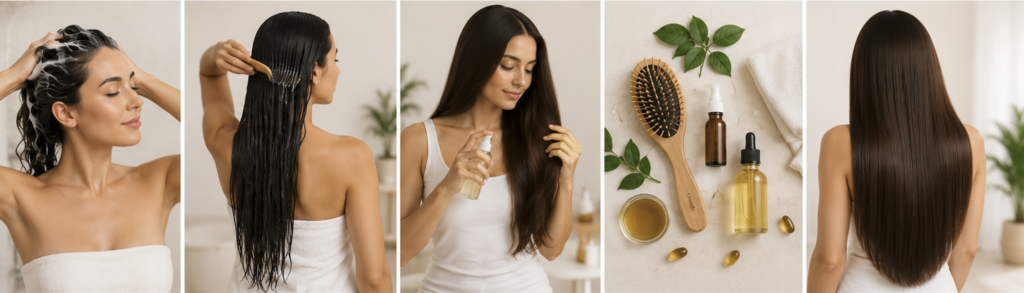
Then: scalp massage with a rosemary and peppermint oil blend in a jojoba base, working for about eight minutes, followed by a gentle sulfate-free shampoo focused at the roots. Conditioner applied from mid-shaft to ends, left for five minutes. Rinse with cool water to close the cuticle. A leave-in conditioner while the hair is still damp. Air dry or a low-heat diffuse if I need some volume. If I wash in the morning, my hair is usually dry and ready to style by mid-afternoon. If I wash at night, I use a microfiber towel to gently press out excess water and let it air dry while I sleep on my silk pillowcase — but only when I know I can manage the morning texture.
Monday through Wednesday: Protection Mode
These are my wear-it-simply days. Hair is usually either in a loose bun, a low ponytail with a silk scrunchie, a half-up style, or worn down if it’s having a particularly cooperative moment. Minimal manipulation. A little argan oil on the ends in the morning to prevent dryness. No heat. Maybe a dry shampoo at the roots on day two or three if needed.
Thursday: Mid-Week Scalp Check-In
A quick dry scalp massage on Thursday evening — five minutes, fingertips working in circular motions — keeps the circulation going between wash days. I sometimes apply a few drops of rosemary oil directly to the scalp and work it in without washing it out, letting it sit overnight. It’s a low-effort habit with consistent payoff.
Friday: Something Slightly More Intentional
Friday is when I might spend a little more time on styling — not necessarily heat, but maybe a properly done blowout with a round brush for volume if I have somewhere to be, or a more polished braid or updo situation. This is also the day I apply a cuticle-sealing hair serum if my ends are feeling particularly dry.
Saturday: Rest and Refinement
Saturday is my reading-the-ingredient-lists-of-new-products day. It’s when I track how my hair feels after the week, note anything that’s been working or not working, and maybe spend thirty minutes going down a rabbit hole of hair science articles because that is genuinely how I spend some of my Saturday mornings and I have made my peace with it. It’s also when I take my monthly progress photo.
This routine isn’t rigid — life intervenes, travel changes things, seasons shift the priorities. But the underlying principles remain constant: protect the scalp, retain moisture, avoid mechanical damage, nourish from within, and do everything with enough consistency that the habits become effortless.
The Hair of Your Dreams Is Within Reach — Really
I want to end where I began: with honesty. Growing beautiful, long, thick hair takes time, attention, and a genuine willingness to understand what your particular hair needs — not just what worked for someone else’s hair in a YouTube video or a TikTok comment section. It requires consistency more than it requires products. It requires patience more than it requires perfection.
But it is absolutely possible. I know it because I have lived it — slowly, imperfectly, through seasons of shedding and seasons of growth, through bad haircuts and good ones, through expensive products that did nothing and inexpensive habits that changed everything. My hair today is not the hair of a miracle transformation story; it is the hair of years of gradually smarter choices.
And yours can be too. It probably already is, if you’ve read this far — which means you care, you’re paying attention, and you’re willing to do the work with grace and intention. That’s the foundation. Everything else is just practice.
“You are not starting over. You are starting informed. That is the most elegant beginning of all.”
Take the practices that resonate with you, build them into your life in ways that feel natural and sustainable, and give your hair the time and the conditions it needs to do what it was designed to do. You might be surprised how far it takes you — and how beautiful you feel along the way.
— With love and well-conditioned ends,
elegantstreetwearblog.com
ELEGANT WOMEN STREETWEAR · Hair & Beauty Guide Series · 2026