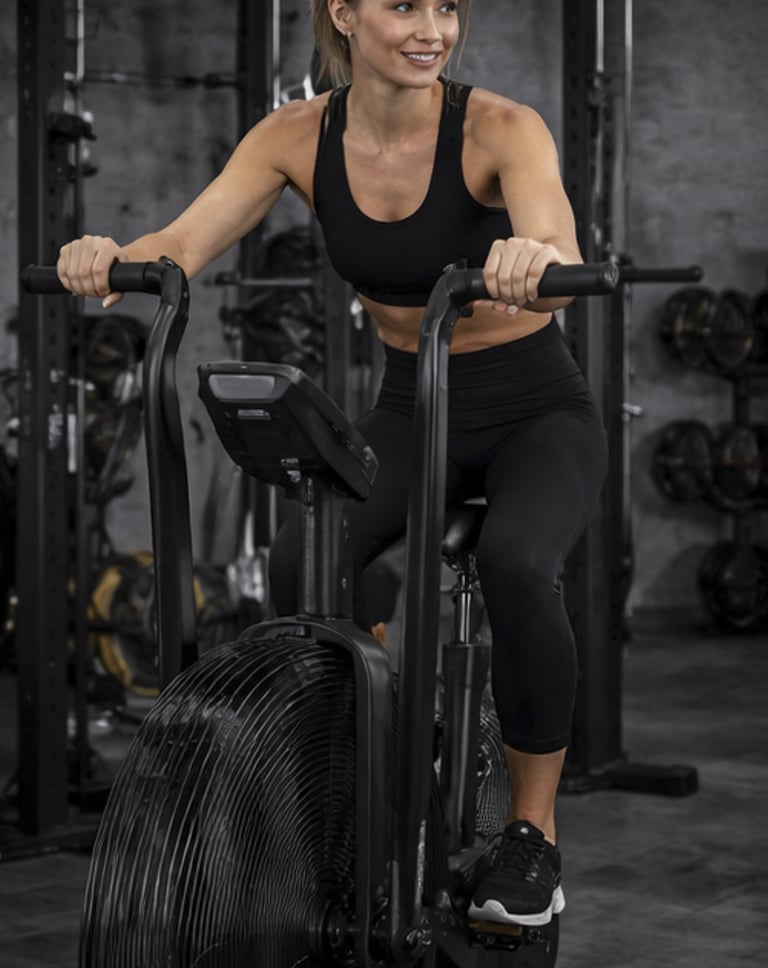
I didn’t think a cardio machine would become part of my routine in a way that actually felt… personal.
For the longest time, cardio was just something I programmed—for clients, for structure, for balance—but not something I genuinely looked forward to myself. I’m a strength girl at heart. I like the feeling of lifting, the clarity of numbers, the progression you can track week after week. Cardio always felt a bit like an obligation. Necessary, yes. Exciting? Not really.
And then this bike showed up in my space.
At first, I approached it the same way I approach anything new in the gym: curious, but a little skeptical. I’ve used air bikes before. I know what they’re about. You sit down, you start pedaling, and within seconds you’re questioning your life choices. That part didn’t change. But what I didn’t expect was how different the experience would feel.
The first ride wasn’t anything dramatic. I didn’t go all out. I just wanted to get a sense of it—how it moves, how it responds. And the first thing that stood out wasn’t the resistance or the intensity. It was how stable everything felt.
There’s something subtle but important about that. When you’re about to push hard, your body is already preparing for effort. You brace, you tighten your core, you get ready to generate force. If the machine underneath you feels even slightly unstable, you hold back without realizing it. You adjust. You compensate.
Here, I didn’t feel that at all.
It felt grounded. Solid in a way that let me stop thinking about the machine and just focus on the movement. And once that mental barrier disappears, something shifts. You stop negotiating with yourself and you just… go.
I started building my sessions slowly. A few intervals here and there, nothing too aggressive. But very quickly I noticed something I hadn’t felt on other bikes before—a sense of control over the intensity that didn’t depend entirely on how fast I was moving.
Most air bikes work the same way: the harder you push, the harder it pushes back. Simple, effective, and brutally honest. But also a bit chaotic sometimes, especially if you’re trying to follow a structured program or stay within a certain effort level.
What changed things for me here was the ability to adjust resistance in a more intentional way.
Instead of just relying on speed, I could actually set how challenging the movement felt. I remember one session in particular—I was doing longer intervals, trying to stay consistent. Normally, I’d be constantly adjusting my pace, trying to guess if I was working too hard or not enough.
This time, I set the resistance slightly higher and just stayed there.
Same rhythm, same movement—but the effort felt completely different. My legs had to work harder with every push, my arms had to stay engaged, and my breathing found a deeper, more controlled pattern.
It wasn’t just harder. It was more focused.
And that’s something I didn’t realize I was missing.
Because when you can control intensity like that, your training becomes more intentional. You’re not just surviving the workout—you’re shaping it.
I’ve started using it a lot with clients as well, especially those who struggle with pacing. It removes that guesswork. Instead of telling someone to “push a bit harder,” I can guide them into a resistance level that challenges them appropriately, and they can feel the difference immediately.
There’s something really empowering about that, especially for women who are still building confidence in the gym. When the feedback is clear and consistent, you trust yourself more.
And trust is everything in training.
Another thing I’ve come to appreciate—more than I expected—is how smooth the movement feels. It’s hard to explain until you experience it, but there’s a kind of rhythm you fall into when nothing is interrupting you. No jerking, no lag, no mechanical noise pulling you out of the moment.
Just you, your breathing, and the steady repetition of effort.
It almost becomes meditative, in a strange way. Even when it’s intense.
There have been days where I’ve gotten on the bike not because I had a structured workout planned, but because I needed to clear my head. And instead of feeling like I’m forcing myself through something, it becomes this steady, grounding experience.
You move, you breathe, you focus. And everything else fades into the background for a while.
Of course, there are also days when it’s anything but calm.
Days when I’m pushing intervals that leave me completely breathless, questioning why I thought this was a good idea. And that’s where the bike really shows what it’s capable of.
It doesn’t hold you back. It doesn’t soften the effort. If you want to push, it meets you there fully.
But it never feels out of control.
And that balance—between challenge and control—is what keeps me coming back.
I’ve also become more aware of how important fit and alignment are, especially over time. It’s one of those things you don’t notice immediately, but your body does.
If something feels slightly off—if your hips aren’t aligned properly, if your knees track awkwardly—you start to feel it during longer sessions. Discomfort builds, and eventually it affects how you move.
What I noticed here is that everything feels more natural. The position encourages better alignment without forcing it. You don’t have to think about it constantly—it just happens.
And that matters, especially for women.
We adapt a lot in the gym. We adjust to equipment, to setups, to environments that weren’t always designed with us in mind. So when something actually fits well, you feel the difference immediately.
You move more freely. You push more confidently.
And over time, that adds up.
Durability is another one of those things that quietly shapes your experience. It’s not exciting, it’s not flashy, but it’s essential.
There’s a certain peace of mind that comes from knowing your equipment can handle whatever you throw at it. No second-guessing, no hesitation.
You show up, you train, and it responds exactly the way you expect it to.
That consistency builds trust. And trust builds consistency in your own routine.
Looking back, I think what surprised me most is how this bike changed my relationship with cardio.
It stopped being something I “have to do” and became something I actually choose to include.
Not every day. Not perfectly. But regularly, and without that internal resistance I used to feel.
And I think that’s the real value of good equipment.
It doesn’t just perform well—it changes how you experience your training.
It makes it easier to show up. Easier to stay consistent. Easier to push yourself when it matters.
And maybe even, sometimes, to enjoy the process a little more than you expected.
Which, if you’ve ever struggled to love cardio, you’ll know… is saying a lot.