There was a time in my life when I genuinely believed I was “too busy” for yoga. Between work, responsibilities, constantly being online, and trying to keep up with everyone else’s expectations, I felt like slowing down was a luxury I couldn’t afford. Ironically, that was exactly when my body started whispering — and then shouting — that something had to change. My hips were tight from sitting all day, my lower back ached more often than I admitted, and my mind felt like a browser with 47 tabs open at once.
That’s how I found Vinyasa yoga.
At first, I didn’t fully understand what “Vinyasa” meant. I just knew it looked fluid and beautiful — almost like dancing on a mat. Later, I learned that Vinyasa comes from the Sanskrit word meaning “to place in a special way,” and in modern classes it refers to linking breath with movement. In practical terms, it’s that steady rhythm you hear your instructor cue over and over: inhale, lift; exhale, fold; inhale, lengthen; exhale, step back. Movement followed by breath. Breath guiding movement. Over and over again.
The first class I attended surprised me. I expected long, static stretches where we’d hold poses forever. Instead, we flowed. We moved through sequences, staying in each posture for maybe 10 to 30 seconds before transitioning. At first, I worried I wasn’t “getting enough” from each stretch. I had been conditioned to believe that flexibility only improves if you hold a stretch for a full minute or more.
But here’s what I didn’t realize at the time: repetition adds up. Even though you don’t hold a single pose for 60 seconds straight, the repeated cycles of similar movements accumulate the total stretch time recommended by organizations like the American College of Sports Medicine (ACSM). By the end of class, my hamstrings, shoulders, and hips had absolutely felt the work.
And it wasn’t just flexibility.
One of the first things I noticed after a few weeks of consistent Vinyasa practice was how different my body felt during the day. I sit a lot — most of us do. Research has shown that the average adult spends an alarming number of hours sitting daily. I could feel that reality in my own body: shortened hip flexors, rounded shoulders, stiffness when I stood up too quickly. There are studies, including reports published in the Annals of Internal Medicine, linking prolonged sitting with increased risk of chronic disease, weight gain, and joint stiffness. I didn’t need a scientific paper to tell me sitting wasn’t ideal — my lower back had already been delivering that message.
Vinyasa became my antidote to that stagnation.
The flowing lunges opened the front of my hips. Downward Dog lengthened my calves and hamstrings. Backbends counteracted my slouched posture. Over time, I felt more elastic — less like a creaky door hinge and more like a body that could move freely. The tightness that once felt permanent slowly softened. I wasn’t just stretching; I was restoring balance.
Another thing that genuinely surprised me was how physically demanding Vinyasa can be. Before I started, I didn’t associate yoga with calorie burn or cardiovascular conditioning. I thought of it as gentle and restorative. While some styles absolutely are, Vinyasa can be wonderfully intense.
A 45-minute Vinyasa session can burn a significant number of calories — for example, a woman weighing around 150 pounds may burn roughly 400+ calories during a strong, continuous flow. Of course, that depends on how actively you move and the pace of the class. But make no mistake: when you’re transitioning through Sun Salutations, stepping back into Plank, lowering through Chaturanga (that push-up-like movement that humbles everyone), lifting into Upward Dog, and pressing back to Downward Dog repeatedly, your heart rate climbs.
There were classes where I left drenched in sweat, my ponytail soaked, my arms shaking from repeated Chaturangas. And yet, I felt powerful — not depleted.
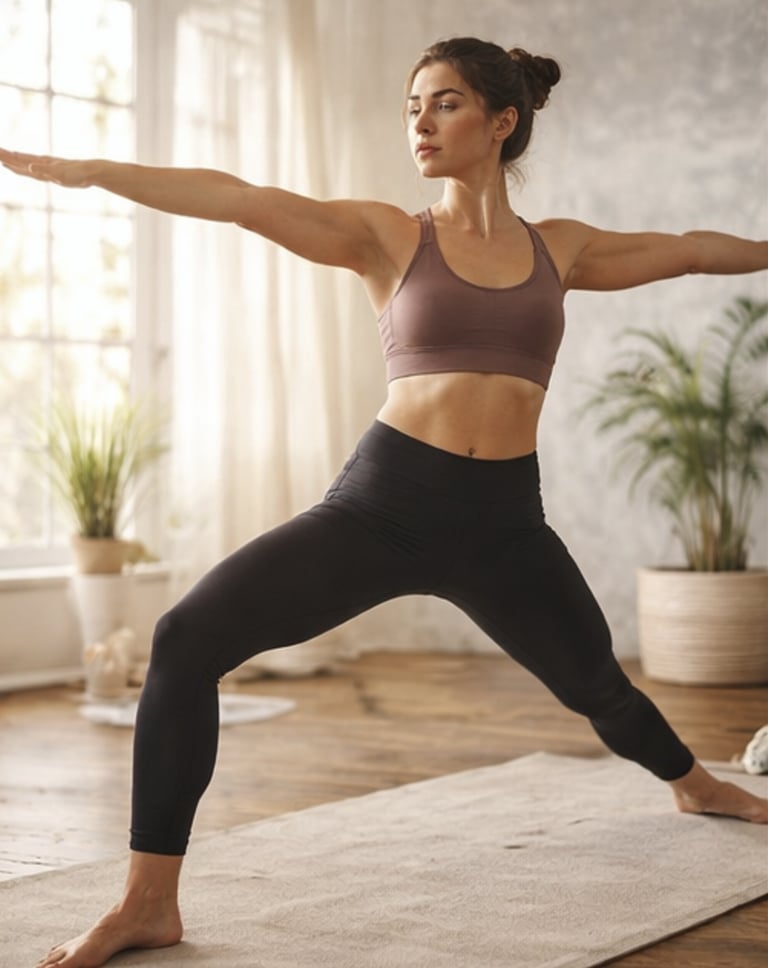
Sun Salutations alone are deceptively comprehensive. They lengthen, strengthen, flex, and extend nearly every major muscle group. Add in sequences like Warrior I and Warrior II, Crescent Lunge, Boat Pose, and Horse Pose, and suddenly you’re working your legs, glutes, core, shoulders, and back in a balanced way. I started noticing muscle definition in my arms and legs — not in a bodybuilder way, but in a “my body feels capable” way. Carrying groceries became easier. My posture improved. Even my balance felt steadier when I wore heels.
Vinyasa builds functional strength. It’s not about lifting the heaviest weight; it’s about moving your own body through space with control. The repeated transitions between poses train stability and coordination. And because everything is guided by breath, you’re not just muscling through movements — you’re syncing effort with awareness.
There’s also evidence supporting the broader fitness benefits of yoga. A study published in the Indian Journal of Physiology and Pharmacology found that participants improved their overall fitness and exercise tolerance after just two months of yoga practice. In real-life terms, that means you can handle physical stress better. I noticed this personally. Other workouts felt easier. I recovered faster. I didn’t feel as winded climbing stairs or during interval training.
But if I’m being honest, the physical changes — while wonderful — are only half of why I keep coming back.
The mental shift is what truly hooked me.
Before yoga, my stress lived in my chest and jaw. I clenched without realizing it. My thoughts raced constantly: deadlines, grocery lists, conversations replaying in my head. Even during downtime, my mind rarely rested. When I stepped onto my mat, that noise didn’t magically disappear. In the beginning, it was loud. I’d think about emails while holding Warrior II.
But Vinyasa has a way of gently demanding your attention.
When you’re balancing in Crescent Lunge and your back heel is lifted, if your mind wanders too far, you wobble. When you’re lowering slowly through Chaturanga, if you’re distracted, you collapse. The breath becomes your anchor. Inhale to lengthen. Exhale to fold. Inhale to rise. Exhale to twist. Over and over.
There’s research backing up the psychological benefits too. Reviews published in journals such as the International Journal of Yoga have concluded that regular yoga practice reduces stress, improves sleep quality, eases anxiety, and can even support addiction treatment. But beyond statistics, I felt the change in subtle, deeply personal ways.
For 60 minutes, my world narrowed to the size of my mat.
I wasn’t thinking about what someone had said that hurt my feelings. I wasn’t planning tomorrow’s to-do list. I was simply breathing and moving. That’s why Vinyasa is often described as moving meditation. It’s not about sitting cross-legged in silence (although that has its place); it’s about finding stillness inside motion.
As a woman, especially, I find this form of practice empowering. So much of our daily life involves multitasking, caregiving, meeting expectations, shrinking ourselves, or constantly being “on.” Vinyasa gives me a space where I’m allowed to take up space. Where my strength is celebrated. Where sweating and shaking aren’t signs of weakness but evidence of effort.
There were days I came to class emotionally exhausted. Days I wanted to cry in Child’s Pose. And sometimes I did. The mat has this incredible way of holding whatever you bring to it — frustration, joy, grief, ambition — and helping you move through it physically. A deep hip opener can release tension I didn’t know I was storing. A heart-opening backbend can feel vulnerable and freeing at the same time.
And sleep — oh, the sleep. On evenings when I practice Vinyasa, I fall asleep faster and more deeply. My body feels pleasantly tired, not overstimulated. My mind feels quieter.
What I also appreciate about Vinyasa is its adaptability. Classes can be fast-paced and challenging, or slower and beginner-friendly. The creativity of the instructor shapes the sequence. Some days the focus is strength; other days it’s mobility or balance. You can modify almost every pose. You can skip a Chaturanga. You can rest in Child’s Pose. There’s no single “right” way to flow.
If you’re considering trying Vinyasa, here’s my honest advice: go in without expectations. Don’t compare yourself to the woman in the front row effortlessly floating into handstand. Focus on your breath. Let it be messy at first. Let yourself feel awkward. Strength and grace come with repetition.
And remember — you don’t have to transform overnight. You won’t suddenly become hyper-flexible or serene. But you might notice, slowly, that your back hurts less. That your shoulders sit lower. That you respond to stress instead of reacting. That you feel a little more at home in your own skin.
Vinyasa taught me that movement can be medicine. That breath can be a bridge between chaos and calm. That strength and softness can coexist in the same body.
I started yoga because I wanted to feel better physically. I stayed because it changed how I experience my life.
Now, when I see a Vinyasa class on the studio schedule, I don’t think of it as “just another workout.” I see it as an appointment with myself. An hour to move, sweat, breathe, and return to center.
And in a world that constantly asks us to rush, achieving that rhythm — inhale, exhale, move — feels like the most radical, beautiful act of self-care.