Organize Your Life, Shape Your Body
1/25/20269 min read


Organize Your Life, Shape Your Body: Smarter Habits for Lasting Change
True change rarely comes from extreme promises, crash diets, or endless to-do lists that only create guilt. Whether we talk about productivity, health, or body transformation, the real breakthroughs always come from better systems, conscious energy management, and realistic consistency. This long-form guide connects practical time organization with honest fitness and lifestyle principles, so you can build results that actually last.
Why the Way You Organize Your Tasks Shapes Your Entire Life
One of the most underrated lifestyle upgrades is learning how to manage your time and mental energy. Many people feel constantly overwhelmed, not because they have too much to do, but because everything is floating around in their head at the same time.
When your tasks are unstructured, your nervous system stays in stress mode. Stress then affects sleep, eating habits, motivation, hormones, and ultimately your body composition. Productivity and health are far more connected than most people realize.
Smarter To-Do Lists: Less Pressure, More Progress
1. Assign Every Task to a Specific Day
Instead of keeping one never-ending to-do list, connect each task to a specific calendar day. This small change creates a huge mental relief. You no longer carry the emotional weight of everything at once, because you know exactly when something will be handled.
Your brain can finally relax, focus on the present task, and work more efficiently.
2. Batch Similar Tasks Together
Constantly switching between activities drains energy. Instead, group similar tasks into blocks:
phone calls
emails and messages
admin tasks and payments
content creation
This method reduces decision fatigue and helps you move through your day with intention rather than chaos.
3. End Procrastination With One Bold Rule
For tasks you have been postponing for weeks or months, apply this rule:
either do it today, or
delete it from your list
If it truly matters, it will come back naturally. If it doesn’t, releasing it frees mental space and reduces background stress.
4. Use Thematic Days for Complex Lives
If your life includes multiple roles—parent, professional, partner, creator—everything can feel scattered. Thematic days help bring clarity. One day can focus on work, another on home, another on personal development.
You are not limiting yourself—you are creating structure that supports freedom.
5. Delegate Without Guilt
Delegation is not weakness. It is leadership.
Delegate tasks to:
your partner
coworkers
service providers
even children, in age-appropriate ways
Paid outsourcing is often worth it if it allows you to move forward in higher-impact areas of your life.
A Body Truth Most Diets Ignore
There are two life stages when the number of fat cells in the body can increase:
infancy
adolescence
If excess weight is present during these periods, more fat cells are created. Later in life, these cells do not disappear—they only shrink or expand. This means that in adulthood, fat cells can grow theoretically without limit in size.
This biological fact explains why some people gain weight more easily than others. It is not a lack of willpower. Genetics, epigenetics, hormones, and psychological patterns all play a role.
Understanding this removes shame and allows for smarter, compassionate strategies.
Honest Weight Loss: No Lies, No Miracles
I will never promise:
losing 10 kilograms in one week
dramatic transformations in a few days
Those claims are misleading and harmful.
What is realistic: visible, measurable progress within a few weeks—if the approach is correct. For example, starting in early June, you can realistically reach a noticeably leaner, firmer body by late July.
The difference is not intensity. It is precision.
What Actually Works (And Why Guessing Fails)
Lasting results require:
personalized training programs
personalized nutrition plans
sufficient and regular sleep
professional guidance and accountability
conscious lifestyle habits
Random workouts, influencer diets, and drugstore supplements rarely deliver sustainable change.
A free initial consultation helps identify what truly fits your body, schedule, and goals—before time and energy are wasted.
And yes, you are allowed to buy that bikini now. Motivation matters 😉
June Momentum: Double Your Progress
For a limited period, every selected program or service includes:
one additional self-guided program or e-book as a bonus
You can use it in parallel or save it for later—either way, your growth accelerates.
If you feel overwhelmed by choices, simply share your goal and what caught your interest. Guidance ensures that programs complement each other instead of competing for your energy.
Example Combinations
Fast but sustainable fat loss with small children → Fitness Mom Program + Nutrition Basics
Confidence boost with gentle movement → Level Up Coaching + Busy Women Program
Visible body shaping with inner work → Hourglass Shape Program + Form & Flow
Postpartum Weight Loss: Why It’s Hard—and What Helps
Losing weight after childbirth comes with unique challenges. Understanding them removes frustration and replaces it with solutions.
Common Challenges and Practical Strategies
Fatigue increases carbohydrate cravings
Keep healthier snacks available, track carbohydrate intake gently.Low energy for workouts
Short 15-minute sessions and daily walks are enough to restart momentum.Slower metabolism due to stress
Increase fiber intake and hydration.Breastfeeding hunger
Only 200–300 extra calories are usually needed—not unrestricted eating.Stress eating from anxiety
Seek supportive conversations with other mothers and professionals.Boredom eating in repetitive days
Create small daily goals: new walking routes, social calls, tiny self-care rituals.Motherhood guilt
Your wellbeing directly supports your child’s wellbeing. Self-care is not selfish.Lack of time
Ask for help and rely on very simple, nourishing recipes.Interrupted workouts
Use compound exercises and baby-friendly movement variations.Overload and emotional burnout
Share responsibilities, delegate tasks, and avoid the habit of doing everything alone.
A supported mother is a stronger mother.
The Inner Side of Transformation
Anyone who has gone through significant weight loss knows this truth: there is no big external change without internal change.
Mindset work, emotional awareness, and self-trust are not optional extras—they accelerate and stabilize physical results. That is why coaching tools and self-reflection exercises are integrated alongside training and nutrition.
Final Thoughts
Lasting change is not about punishment or perfection. It is about building systems that support your energy, your body, and your life.
This summer can mark the beginning of a new chapter—physically, mentally, or both.
You are allowed to feel organized.
You are allowed to feel strong.
You are allowed to feel good in your own skin.
And this time, the change can last.
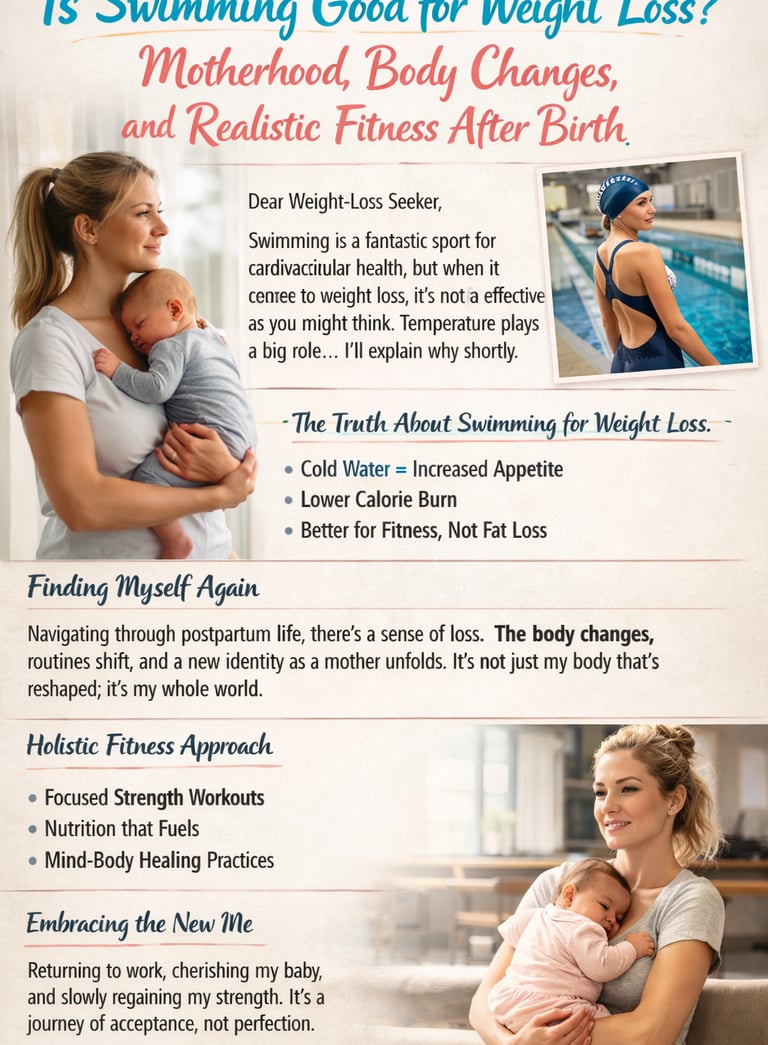
Is Swimming Good for Weight Loss? Motherhood, Body Changes, and Realistic Fitness After Birth
When you want to lose weight, one of the most common questions that comes up is surprisingly simple:
Is swimming a good sport for weight loss?
The short answer is: it depends. And the long answer is far more interesting—and honest—than most fitness advice you’ll find online.
In this article, I’ll talk about swimming from a holistic fitness perspective, share why temperature actually matters more than you’d think, and connect this topic to postpartum recovery, motherhood, work, energy management, and long-term body acceptance.
Is Swimming a Good Choice If You Want to Lose Weight?
Swimming is often recommended for weight loss because it is low-impact, joint-friendly, and works almost the entire body. From a health perspective, it’s an excellent form of movement:
it strengthens the cardiovascular system
improves lung capacity
supports spinal health
protects the joints
enhances overall mobility
So far, so good.
However, when the primary goal is fat loss, swimming has a hidden limitation that most people never talk about: water temperature.
Why Temperature Matters More Than You Think
In cooler water, your body focuses on maintaining its core temperature. This shifts energy usage toward survival rather than fat-burning efficiency. In many cases, swimming can even increase appetite significantly afterward, leading to compensation eating that cancels out the calorie deficit.
This doesn’t make swimming “bad.” It simply means that for many people, swimming alone is not the most efficient tool for weight loss, especially when time, recovery, and hormonal balance matter—such as after childbirth.
In my upcoming Holistic Fitness program, I explain this mechanism in detail and show how to combine movement types for better results.
Six Weeks After Birth: A Quiet but Powerful Milestone
Six weeks postpartum is a symbolic and practical turning point. The medical check-up is done. Officially, the postpartum period ends. You are told that you can “return to life.”
But life doesn’t simply resume where it left off.
There are more tasks, less sleep, new emotional layers, and a body that no longer feels—or functions—the same way.
I sometimes think back with longing to the hospital room: the silence, the gentle rhythm of newborn care, the smiling nurses, the feeling of being held in a quiet capsule outside of normal time.
That phase ends quickly. Everyday life returns.
With a first baby, many of us believe it will soon get easier—after six weeks, after one year, after three years. With more experience, you realize something different:
It doesn’t necessarily get easier. You get stronger, wiser, and more flexible.
The Grief That Comes With Motherhood
Pregnancy already involves a subtle grief process: you lose control over your body, your routines, your eating patterns. But postpartum grief can be even more layered.
No matter what anyone says:
your body will not be exactly the same
your relationship will not be exactly the same
your habits will not be exactly the same
You also say goodbye to a certain kind of attention—the special status of pregnancy, the gentle looks, the kindness from strangers. Even the small perks disappear (yes, including free restroom access in shopping malls
Suddenly, you’re just a woman again—with a baby.
This realization can be painful, but it can also be grounding.
I return to my life with acceptance: to my training, my meetings, my work, my routines—hoping for more sleep, a firmer body, and sharper mental focus. I don’t chase these aggressively. I know things will evolve.
What feels like a perfect routine today may not work tomorrow.
So we keep adjusting.
Slowly.
Calmly.
Motherhood and Work: Energy as a Resource
I like to work ahead—whether it’s storing expressed breast milk for later or preparing professional materials months in advance. During pregnancy, I already had promotional materials created for a February tourism expo.
This connects deeply to my understanding of energy as a resource.
My work is not a burden—it is one of my greatest energy sources. Fitness and tourism are not just jobs for me; they are my calling, my hobby, and my creative playground.
Because of this, I never imagined fully giving up work for months or years after giving birth. In fact, I’m genuinely excited to return to professional conversations and in-person events.
The extra effort—planning, organizing, pumping—is worth it if it allows me to collect energy drops later in a professional space that feeds me emotionally and intellectually.
How about you?
Do you work out of obligation—or is your work a form of self-expression?
Family Patterns and Conscious Motherhood
As women, we don’t only carry our own stories. We also carry inherited patterns—our mothers’, grandmothers’, and generations before them.
At twenty, we often roll our eyes at our parents’ mistakes, convinced we’ll do everything differently.
Then life happens.
Some things we repeat consciously, because now we understand why they mattered.
Some things we repeat unconsciously—and only then understand their origin.
Some things we change, but aren’t fully sure if the new path is actually better.
And sometimes—if we’re brave—we step off the inherited tracks entirely.
This, to me, is one of the most meaningful forms of growth: healing family patterns upward and downward at the same time.
Four Weeks Postpartum: How My Body Feels
Physically, I’m currently four weeks postpartum.
I’ve been training again for about a week, already close to my pre-pregnancy weights and intensity—which surprises even me, considering I didn’t train heavily during pregnancy.
Movement feels good. My body asked for it.
There are still extra kilograms compared to before pregnancy, and I’ll share before–after photos later. Right now, this doesn’t frustrate me. My focus is comfort, wellbeing, and fitting back into my wardrobe gradually.
I eat intuitively. I deeply miss strong coffee—this might be the hardest part of breastfeeding.
I stretch a lot. Long feeding and soothing sessions stiffen the body, and stretching brings relief.
More details will come soon.
Three Weeks After Birth: Real Life, Not Instagram
There aren’t many “Instagram moments” right now—and that’s okay.
Life moves in waves: slow and intense at the same time. One child receives school reports and teenage humor. The baby grows, and we adjust.
And us?
We actively search for energy sources in between tasks.
One of the most recharging moments recently was walking in the sunshine with childhood friends—one of them had given birth just 22 hours before me. It was our first walk with the babies together.
We are well—because we share energy, responsibility, and emotional presence.
My Energy Sources With a Newborn
Sleep deprivation is the hardest part. I sleep whenever I can, but when that’s not possible, I consciously turn to my personal energy list:
meaningful work
gentle training
meditation, breathing, visualization
one good coffee (mostly decaf for now)
music, journaling, series, phone calls with loved ones
This also means letting go of certain things. Not everything fits into 24 hours—and that’s okay. (And yes, I have immense support from my partner.
A New Definition of Progress
Whether we talk about swimming, weight loss, postpartum recovery, or motherhood itself, one thing remains true:
There is no real change without inner adjustment.
The body follows the nervous system.
The routine follows the energy.
The results follow patience.
Swimming can be part of your journey.
So can strength training, walking, rest, and self-reflection.
The key is not doing everything—but doing what fits your current life phase.
And that is where real, lasting transformation begins.