

The overtired spiral is one of the most exhausting places a new parent can find themselves. Here’s how to gently break the cycle — and build the kind of sleep foundations that actually last.
It’s 7pm. Your baby has been awake for what feels like forever. Their eyes are red-rimmed, their bottom lip is doing that heartbreaking quiver, and every attempt you’ve made to settle them has been met with an escalating chorus of protest that could probably be heard three doors down. You’re exhausted. They’re exhausted. And somehow, impossibly, they are fighting sleep with the full force of their tiny being.
If you’ve found yourself in this particular circle of parenting chaos, you already know: an overtired baby is a whole different challenge to a simply tired one. It seems deeply counterintuitive — surely the more tired a baby is, the more easily they’ll drift off? — but the biology of it tells a completely different story. When a baby pushes past their natural sleep window, the body floods with cortisol (the stress hormone) in an attempt to keep them going. And cortisol, as any sleep-deprived parent will confirm from personal experience, is not a hormone that lends itself to peaceful rest.
The good news — and there genuinely is good news here — is that the overtired spiral is something you can interrupt. Not always instantly, not always without a fair amount of patience, but with the right combination of environment, connection, and routine, you can help your baby settle and, over time, build the kind of sleep foundations that prevent the overtired cycle from taking hold in the first place.
This is everything I know about getting an overtired baby to sleep — and keeping them that way.
The First Step
When They’re Wired and Won’t Wind Down: Start with Connection
I know it’s tempting, when a baby is overtired and overstimulated, to try to solve it quickly. To want a technique, a trick, a fix. And we’ll absolutely get to those. But the single most powerful thing you can do for an overtired baby — the thing that sits beneath every other strategy — is to close the distance between you both.
Lots of close contact and skin-on-skin connection is not a soft, fluffy suggestion. It’s rooted in genuine physiology. Skin-to-skin contact triggers the release of oxytocin — the bonding hormone — in both parent and baby. It regulates heart rate, body temperature, and breathing. It tells the nervous system, at a cellular level, that this is safe. That rest is possible.
Hold your baby close. Let them hear your heartbeat — a sound they know from before they were born. If you have a partner who can help, this is a genuinely beautiful moment to bring them in: dad taking his top off and letting the baby rest chest-to-chest builds that same oxytocin connection, deepens the bond between them, and often works remarkably well precisely because it’s a slightly unfamiliar set of arms and a different heartbeat to settle against.
There’s no rushing this bit. Some babies need five minutes of being held before they begin to soften. Others need twenty. When an overtired baby finally stops fighting and lets their body go heavy and loose in your arms, it is one of the most quietly triumphant moments in parenting. Don’t cut it short.
- 01
- Close Contact & Cuddles
- Skin-on-skin triggers oxytocin and signals safety to an overtired nervous system. Hold your baby close and let them hear your heartbeat.
- 02
- A Warm Bath
- A regular bathtime routine teaches babies to associate warm water with the approach of sleep, making it one of the most powerful settling tools available.
- 03
- Swaddling
- The contained, secure feeling of a swaddle mimics the womb and prevents the startle reflex from jolting a drowsy baby awake.
- 04
- White Noise
- A continuous white noise track can replicate the ambient sound of the womb — and dramatically reduce the time it takes an overtired baby to settle.
Building the Ritual
Why Bathtime is One of the Best Sleep Tools You Have
Let’s talk about baths, because I think they are criminally underestimated in most baby sleep conversations. A warm bath before bed isn’t just a hygiene exercise — it is, when used consistently, one of the most effective sleep cues you can build into your baby’s evening.
The science behind it is elegant: a warm bath raises the body’s core temperature slightly, and then as the baby is lifted out and dried, their temperature drops. That drop in core temperature is one of the body’s primary signals that it’s time to sleep. It’s the same mechanism that makes a warm shower before bed feel so effective for adults. You’re not just cleaning your baby — you’re literally preparing their nervous system for rest.
Beyond the biology, there’s the ritual aspect. Babies are creatures of pattern. They find deep comfort in predictability, in the reliable sequence of events that tells them what’s coming next. When bathtime consistently precedes sleep — when bath always means bedtime is close — the act of getting into the water begins to carry a kind of pre-sleep signal all by itself. You’re building a Pavlovian response, except it’s beautiful rather than clinical.
As your baby grows older and more interactive, bathtime becomes something else as well: a genuinely joyful space for learning and bonding. The splashing, the bath toys, the bubbles, the back-and-forth babbling that starts to emerge somewhere around four to six months — all of it is developmental gold. Your baby is building language, cause and effect understanding, and fine motor skills, all while warm and happy and safely enclosed. And then you scoop them out, wrap them in a towel, and lead them gently towards sleep.
It’s a beautiful thing, when it works. And with consistency, it works more often than not.
“A warm bath doesn’t just clean a baby. It prepares the nervous system, builds trust, and tells the body — quietly, reliably — that rest is coming.”
— MotherFit
The Evening Routine That Actually Works
Here’s a sample bedtime sequence that combines all the elements we know to be effective — bath, feed, pyjamas, sleep cues — into a rhythm your baby can begin to anticipate and relax into:
6:00 pm
The Final Feed Before Bath
A good feed before the bath means your baby goes into the water content and calm — not hungry and frustrated. This sets the emotional tone for the whole sequence that follows.
6:20 pm
Warm Bathtime
Keep the water pleasantly warm, the room calm, and the lighting soft if possible. Sing gently, chat softly. Let this be a quiet, connected experience rather than an energetic one.
6:40 pm
Into Pyjamas
The moment pyjamas go on, something shifts. This is one of the most powerful sleep cues available to you — a physical change that signals “night is here.” Do this in the same order, in the same room, every night.
6:50 pm
Final Feed & Settle
A slightly larger feed at this stage — sometimes called a “top-up” feed — can help extend sleep. Hold your baby close, keep voices low, and let them feed in dim, calm light.
7:00 pm
Same Songs, Every Night
Five minutes of the same lullabies or songs — yes, even when you’ve sung them so many times the melody haunts your dreams — builds one of the strongest sleep associations you can create. Consistency is everything here.
7:10 pm
Into the Cot
Dark room, white noise on, swaddle if appropriate for age. Leave the room calm and uncluttered. This environment should feel the same every single night.
The power of this sequence isn’t in any single element — it’s in the accumulation of familiar cues, one leading naturally to the next, until sleep becomes the obvious and expected conclusion. Babies who have a consistent bedtime routine fall asleep faster, stay asleep longer, and are significantly less prone to the overtired spiral in the first place.
The Body Clock
Helping Your Baby Find Their Natural Rhythm
One of the things that surprises new parents most is that babies aren’t born knowing the difference between day and night. This might seem obvious when stated plainly, but in the blur of the early weeks it can be easy to miss how much of the work of parenting involves actively teaching the body clock.
The circadian rhythm — the natural 24-hour cycle that governs sleep, wakefulness, hunger, and hormone release — is established through light exposure. During the day, blue-spectrum daylight signals to the brain that it’s time to be awake and alert. As evening comes and light levels drop, melatonin (the sleep hormone) begins to rise, and the body starts preparing for rest. In newborns, this system is essentially undeveloped. Your job, over the first few months, is to help it find its footing.
This means being intentional about light. Long walks outdoors during the day — even on overcast days, when diffuse daylight still carries more blue light than indoor artificial lighting — are genuinely one of the best things you can do for your baby’s circadian rhythm development. And at home, the opposite: dim lights in the hours before bedtime, blackout blinds in the sleeping space, and a clear, consistent signal that when the light changes, night is coming.
Something else that matters here, and that I find genuinely lovely: your face. Eye contact, smiling, and mirroring your baby’s expressions during the day is not just bonding and play — it’s circadian education. Your animated, bright presence signals “this is daytime, this is when we’re awake and engaged.” Your softer, quieter evening self says “this is when things slow down.” Babies learn the emotional texture of the day from you.
By around three to six months, most babies will have developed a more established circadian rhythm, supported by melatonin production that genuinely helps them sleep longer stretches at night. Until then, patience and consistency with light cues will do more than almost anything else.
Feeding, Fullness, and the Sleep Connection
There’s a reason a well-fed baby sleeps more peacefully — and it’s not just the satisfying physical heaviness of a full tummy (though that is, genuinely, part of it). Whether you’re breastfeeding or formula-feeding, establishing a feeding routine gives your baby a framework for understanding the shape of their day. Hunger cues, feeding, satisfaction, play, sleep — when these follow each other in a recognisable pattern, everything feels more predictable to a baby who is still making sense of an entirely new world.
A small practical note that makes a real difference: a slightly larger feed in the evening — sometimes called a “cluster feed” for breastfeeding mothers — can significantly extend the stretch of sleep that follows. The idea isn’t to stuff a baby, but simply to ensure they go into their night sleep as full as they comfortably can be, which reduces the likelihood of a hunger wake-up just as you’ve gratefully fallen asleep yourself.
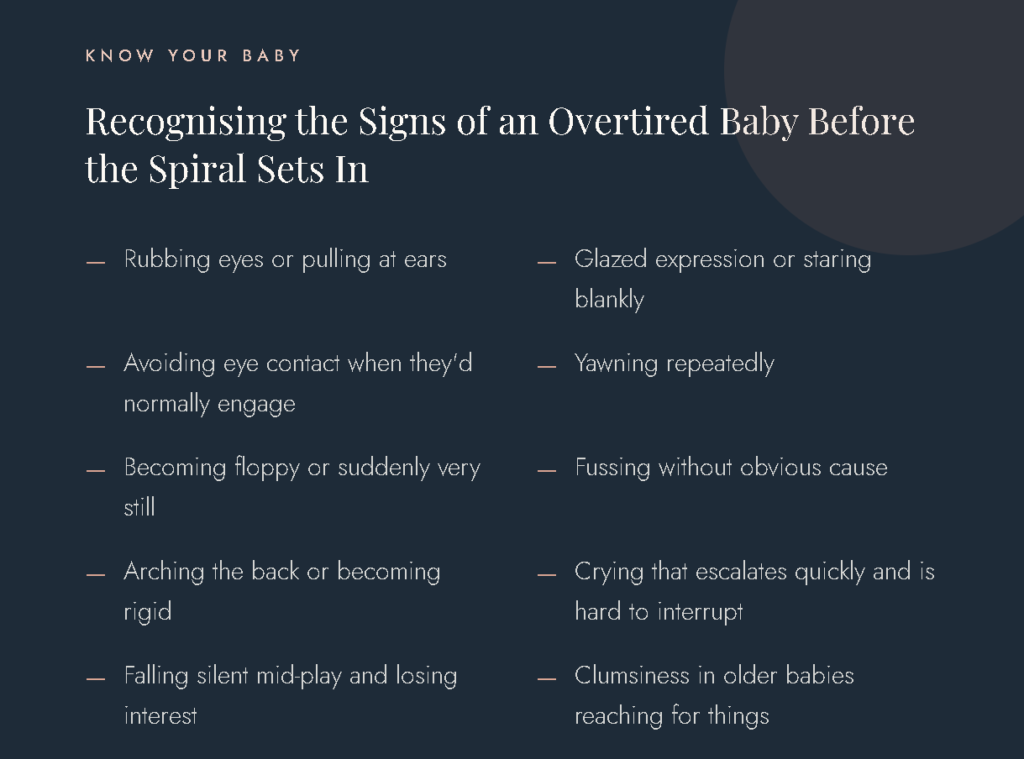
Learning your own baby’s tired signs is one of the most powerful sleep skills you can develop — and it genuinely is a skill, one that takes a little time and observation to refine. Every baby has their own signature sequence: my little one, for instance, would always go very still and stop making eye contact about five minutes before she was ready for a nap. Once I noticed that pattern, everything changed.
Keep a mental note — or a written one if that helps — of your baby’s nap times, their durations, and how long they stay happily awake between sleep periods. At three to six months, most babies manage roughly one and a half to two hours of awake time before they need to sleep again. That window varies by baby, and it changes as they grow. But tracking it gives you an invaluable early-warning system for when a nap is needed — before the overtired cortisol flood makes settling so much harder.
The Environment
White Noise, Swaddling, and Building a Sleep Sanctuary
Let’s talk about white noise, because it is one of my most enthusiastic recommendations to every new parent I speak to — and it consistently surprises people with how effective it is. White noise is not just background sound. For a baby who has spent nine months in an environment filled with constant ambient noise (the whooshing of blood flow, the muffled sounds of the outside world, the rhythmic pulse of a heartbeat), silence can actually be more startling than sound.
A steady white noise track — whether it’s a proper white noise machine, a fan, a dedicated app, or even a detuned radio — creates a sonic blanket that serves two purposes. First, it masks the unpredictable sounds of the household: a door closing, a television in the next room, a car outside. These sudden sounds are among the most common causes of a baby jolting awake from light sleep. Second, it recreates something that feels instinctively familiar to a baby’s nervous system — a continuous, surrounding sound that echoes the environment they came from.
Swaddling works on a similar principle. The sensation of being snugly wrapped — arms contained, movement gently restricted — reduces the Moro reflex (the involuntary startle that wakes babies when they feel like they’re falling) and creates the sense of secure containment that newborns find deeply soothing. It won’t be right for every baby, and there are important safety guidelines around swaddling to follow carefully, but for many newborns it is transformative.
The physical sleeping environment matters too — perhaps more than we often acknowledge. A dark room (blackout blinds are worth every penny), a comfortable temperature, a clean and uncluttered sleep space: all of these are non-verbal messages to a baby’s nervous system that this place is for rest. Keeping it consistent — the same white noise, the same darkness, the same smell of the room — builds a powerful environmental sleep association over time.
The Sling: Underrated, Brilliant, Worth Knowing About
For babies who develop reflux or colic — both of which can make the standard laid-flat-in-cot approach genuinely difficult — a sling is worth its weight in gold. Keeping your baby upright and close to your body after feeds reduces the discomfort of reflux, and the gentle movement and warmth of being carried soothes in a way that is almost impossible to replicate from the outside.
There’s a reason babywearing has been practised across almost every culture in recorded human history. It works with the biology of both parent and baby: the carrier’s movement, heartbeat, warmth, and breathing pattern all work together to regulate the baby’s nervous system. Many parents who’ve struggled for weeks to settle a colicky baby find that consistent babywearing in the evenings changes everything.
In the Small Hours
When Your Baby Wakes at 3am — and What to Do
Here’s something worth knowing, and genuinely reassuring: it is entirely normal for babies to wake briefly in the night, chat to themselves, make small sounds, and then drift back off without any intervention at all. In fact, the ability to self-settle — to transition between sleep cycles without needing external help — is one of the key sleep skills you want your baby to develop. And they can only practice it if they’re given the opportunity.
The instinct when you hear your baby stirring at 3am is immediate and powerful: go to them. Fix it. It comes from love, from protectiveness, from the deep biological drive to respond to your child. And there are absolutely times when going to them is exactly right — when the cry escalates, when it sounds distressed rather than conversational, when something clearly needs attending to.
But a little whinge, a bit of self-talk, the soft sounds of a baby resettling between sleep cycles — give those a moment. Wait, and listen. You may find that within two or three minutes, the sounds settle back into silence. Your baby has found their way back to sleep without needing you. That is a beautiful thing, for both of you.
It’s worth thinking about what your baby has learned to associate with falling asleep. If they always fall asleep on the breast, or in your arms, or with a dummy that then falls out, they may genuinely not know how to fall asleep any other way — and when they surface between sleep cycles in the night, they’ll need that same condition recreated before they can return to sleep. Gradually building the ability to fall asleep in their cot, with a bit of awareness and consistency, is one of the most valuable gifts you can give both of you.
Questions We Hear Often
Honest Answers to the Questions Every Parent Asks
Do baths actually help babies sleep better?
Yes — and the science behind it is genuinely interesting. A warm bath raises body temperature slightly, and the drop in temperature that follows as the baby is lifted out mimics one of the body’s natural pre-sleep signals. Used consistently as part of a bedtime routine, bathtime becomes a powerful sleep cue in its own right. The ritual aspect matters just as much as the physiology: when bath reliably precedes sleep, the association between the two deepens over time until the bath itself begins to signal rest.
Does white noise help overtired babies sleep?
It can be enormously effective, yes. White noise creates a continuous auditory backdrop that masks sudden household sounds (a common cause of babies jolting awake from light sleep) and also recreates the ambient sound environment of the womb. For overtired babies, white noise gives the nervous system a steady, predictable input to focus on rather than cycling through heightened alertness. Many parents who introduce white noise find the change in settling time dramatic.
When should I start a bedtime routine?
Earlier than most people think — from around six to eight weeks, you can begin introducing the elements of a bedtime sequence. It won’t produce instant results at that age, but you’re planting seeds. By three to four months, when the circadian rhythm is more established and melatonin production is kicking in, a consistent routine starts to show real, tangible results in settling time and sleep duration.
How do I know if my baby is overtired versus just tired?
A tired baby gives clear cues — yawning, eye rubbing, decreasing activity — and usually settles with relative ease once those cues are caught. An overtired baby has pushed past that window, and the stress hormones that kicked in to compensate make settling significantly harder. They may seem “wired” rather than calm, fuss and cry more intensely, resist settling despite obvious exhaustion, and take longer to transition into sleep. The key is catching tired cues early, before the overtired cortisol flood makes everything more difficult.
Is it okay to leave a baby to self-settle at night?
The brief, conversational night sounds of a baby cycling between sleep stages — a little whinge, some soft noises — are generally something worth waiting out before responding. Many babies will settle themselves back down within a few minutes. Responding immediately to every sound can inadvertently prevent a baby from developing the self-settling skill. That said, distressed crying — the kind that escalates and doesn’t resolve — warrants a response. Learning to distinguish between your baby’s sounds takes time and practice, but most parents find they develop an instinct for it fairly quickly.
Does extra milk before bed help babies sleep longer?
A top-up feed before bed can extend the first stretch of sleep in many babies, simply by ensuring they go into the night well-fed. It’s not a guaranteed fix, and hunger is only one of many potential reasons for night waking, but it’s a simple and gentle thing to try. Breastfeeding mothers may find cluster feeding in the early evening achieves a similar effect.
✦ A Final Word
You Are Doing Beautifully
Sleep deprivation is a particular kind of hard — the kind that makes everything else harder, that strips away patience and perspective and makes 3am feel like the loneliest place on earth. I want to say this clearly: whatever you’re managing right now, you are doing beautifully. The fact that you’re here, reading this, thinking about how to help your baby — that is the whole thing. That is what good parenting looks like.
None of these tips will work overnight (no pun intended). Building sleep associations and circadian rhythms and the quiet confidence of a bedtime routine — this is weeks-and-months work, not days. Be patient with yourself and with your baby. There will be nights that go sideways for no discernible reason. There will be weeks when a developmental leap or a cold dismantles everything you thought you’d established, and you’ll need to start again.
But underneath all of it — underneath the white noise and the swaddle and the dim lights and the carefully timed bath — is the most important thing: the relationship between you and your baby. The trust that’s building every time you respond to them, hold them, sing to them, and show up again and again in the dark. That is what sleep is built on, ultimately. Everything else is just the scaffolding.
Take good care of yourself too, whenever you possibly can. Reach out for support — to a partner, to family, to your health visitor or GP if you’re struggling. And know that this season, as relentless as it feels right now, is a season. It passes. And in its place comes something almost unbearably sweet.