
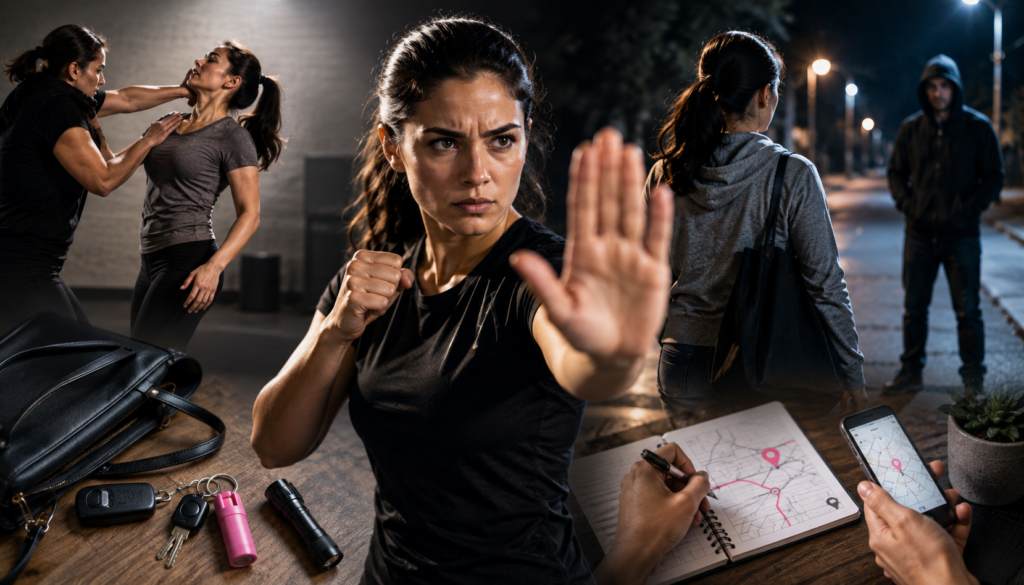
A hands-on companion guide covering the tools, plans, and habits that turn awareness into action — built around one principle: the goal is always to stay safe, escape danger, and get help, never to “win” a confrontation.
Introduction: From Awareness to Action
Knowing that awareness and boundaries matter is one thing. Building the actual systems — the contacts, the apps, the checklists, the plans — that make safety automatic when you’re stressed, distracted, or afraid is another. This guide is the practical, action-oriented companion to a broader self-defense mindset: it focuses on safety planning, tools, travel habits, digital protection, and how to respond if you’re being stalked, threatened, or harassed.
As with everything in this space, the point is never to create a life ruled by fear or an exhausting list of rules to follow perfectly. It’s to build a handful of durable systems — most of which take only minutes to set up — so that if something ever does go wrong, you’re not improvising from zero. Preparation reduces panic, and reduced panic leads to clearer decisions.
And as always: if you ever need any of this, what happens to you is never your fault, regardless of what you did or didn’t have in place beforehand. These are tools for you to use, not a standard to be judged against.

Idrotherapy *GET PAID ON REBILLS EACH MONTH*
Deliverable
Unlock Your Skin’s Potential With A Single Product Designed For Mature Skin
Acting without any toxicological dangers, Idrotherapy is alternative to retinol
1. The Foundations of a Personal Safety Plan
A safety plan is simply a set of decisions made in advance, so you don’t have to make them under pressure. Emergency responders, domestic violence advocates, and travel-safety experts all use versions of the same basic structure.
The Core Elements of Any Safety Plan
-
Who you’d contact in different types of emergencies (a trusted person, a hotline, 911).
-
Where you’d go if you needed to leave a location quickly (a specific, named place — not just “somewhere safe”).
-
What you’d bring if you had only a few minutes (documents, medication, a charged phone, cash).
-
How you’d communicate if your phone were lost, dead, or taken (a memorized number, a code word, a backup method).
-
What you’d say to explain leaving quickly, if you needed a cover story in the moment.
Writing these down — even just in a private notes app — turns a vague intention (“I’d just leave if something happened”) into an actual, executable plan.
Safety Planning Looks Different Depending on the Risk
A safety plan for a general sense of public safety (walking home, traveling, meeting new people) looks different from a safety plan for an identified, specific threat (a stalker, an abusive partner, a threatening ex). This guide covers both, but if you are currently in an abusive relationship or being actively stalked, please also connect directly with an advocate through the National Domestic Violence Hotline (1-800-799-7233) or the Stalking Prevention, Awareness, and Resource Center (SPARC, stalkingawareness.org) — trained advocates can help build a plan tailored to your specific situation, which is far more effective than a general guide alone.
2. Emergency Contacts: Building Your Safety Network
Who Belongs on the List
-
At least two trusted people who know your general routines and would notice if something seemed off — this redundancy matters, since one person may be unreachable when you need them.
-
A local contact who could physically come to you, distinct from a contact who lives far away but could still make calls or coordinate on your behalf.
-
Relevant hotlines, saved in your phone under clear names rather than generic numbers you’d have to look up under stress:
-
National Domestic Violence Hotline: 1-800-799-7233
-
RAINN National Sexual Assault Hotline: 1-800-656-4673
-
988 Suicide & Crisis Lifeline (also equipped to help in a range of crisis situations)
-
Local non-emergency police line (for situations that need police awareness but not an immediate 911 dispatch)
-
Set Up a Check-In System
A check-in system is a simple agreement with one or two trusted people: you tell them where you’re going, roughly when you expect to be done, and you check in by a set time. If they don’t hear from you, they know to call or come find you.
-
For a date, a rideshare trip, or a solo outing: text a friend the details beforehand (who, where, expected time) and check in when it’s done.
-
Consider a code word or phrase that means “I need you to call me with an excuse to leave” or “I need you to come get me, don’t ask questions.” Something ordinary-sounding works best — “Did you feed the cat?” is easy to say to anyone without raising suspicion from someone standing nearby.
-
If you don’t check in by an agreed time, decide in advance what your contact should do: call you, call the venue, or call the police — rather than leaving that decision for them to guess under pressure.
Emergency Contacts on Your Phone’s Lock Screen
Most smartphones allow you to set up medical ID or emergency contact information that’s accessible directly from the lock screen, without needing to unlock the phone — useful for first responders or bystanders if you’re incapacitated.
-
On iPhone: set up through the Health app’s Medical ID, which appears on the lock screen under “Emergency.”
-
On Android: set up through the Emergency Information section in Settings, or through the “Personal Safety” app on many Android devices.
3. What to Carry: Practical Safety Tools
There is no single “correct” self-defense item — the right choice depends on your comfort level, local laws, and lifestyle. Below is an overview of commonly used options, along with honest notes on their strengths and limitations.
Personal Alarms
A personal safety alarm emits a very loud sound (often 120–140 decibels) when triggered, typically by pulling a pin or pressing a button.
-
Advantages: No proximity to a threat required, no legal restrictions in most places, easy to use under stress, and effective at both startling an attacker and drawing outside attention.
-
Limitations: Only useful if it’s accessible (clipped to a bag strap or keychain, not buried inside a bag) and if you’re in a place where the noise can actually reach potential help.
Pepper Spray / OC Spray
-
Advantages: Can incapacitate an attacker at a short distance, allowing you to create space and run.
-
Limitations: Requires accurate aim under stress, can be affected by wind, has a limited range (typically several feet), and legal restrictions vary significantly by location — some places restrict concentration, size, or require a permit. Always check your local laws before purchasing or carrying.
-
Practice matters. If you carry it, practice accessing and aiming an inert (non-active) practice canister so the motion is familiar, since fine motor skills degrade significantly under adrenaline.
Personal Safety Apps
Many free or low-cost apps combine several safety features — an SOS button, live location sharing, and fake-call features. (See the “Phone Preparation” section below for specifics.)
A Whistle or Loud Deterrent
A low-tech, low-cost option that requires no charge, no batteries, and works in virtually any condition — a reasonable backup even if you carry other tools.
Tactical Flashlights
A bright flashlight serves a dual purpose: practical illumination in a dark area, and a genuinely disorienting tool if shone directly into an attacker’s eyes at close range, buying a second or two to create distance.
What Not to Rely On
-
Anything you haven’t practiced using. An item you fumble with under stress can waste precious seconds, or in some cases, be turned against you.
-
A single tool as your entire plan. Tools support a broader safety strategy; they don’t replace awareness, boundaries, or an escape plan.
-
Items that violate local law, which vary widely — some self-defense tools that are legal in one state, province, or country are restricted or illegal elsewhere, including certain types of sprays, stun devices, and blades. Research your specific location before purchasing or traveling with any safety tool, especially across state or national borders.
4. Phone Preparation: Your Most Powerful Everyday Tool
Your phone is likely already the single most useful safety device you own — if it’s set up correctly in advance.
Emergency Features to Set Up Now
-
Emergency SOS: Most smartphones have a built-in feature (typically triggered by rapidly pressing the side or power button several times) that can call emergency services, alert your emergency contacts with your location, and in some cases sound an alarm — all without needing to unlock the phone. Learn the exact gesture for your specific device and practice it once so it’s not unfamiliar in a real emergency.
-
Emergency contacts within the SOS feature, so alerts and your location are automatically sent to trusted people the moment SOS is triggered.
-
Battery health and charge habits. Keep your phone reasonably charged, and consider carrying a small portable battery pack, particularly when traveling or attending events where outlets aren’t accessible.
-
A passcode you can enter quickly without needing to look at the screen, useful if you need to unlock your phone discreetly or in low light.
-
Volume and silent switches you know by feel, so you can silence a ringtone quickly if you need to make a discreet call in a situation where being overheard is risky.
Personal Safety Apps Worth Knowing About
Several dedicated apps combine multiple safety features. (Availability and specific features change over time, so check current app store listings and reviews before choosing one.) Commonly offered features include:
-
One-touch SOS alerts that notify chosen contacts with your live location.
-
Fake incoming call features, which simulate a phone call to give you a natural reason to leave a situation.
-
Timer-based check-ins, similar to a manual check-in system but automated — if you don’t cancel the timer, contacts are alerted automatically.
-
Walk-with-me / stay-on-the-line features, which let a friend track your location in real time as you walk somewhere, similar to staying on a call but without needing to talk the whole way.
Discreetly Calling for Help
-
In the United States, dialing 911 and staying silent, or saying very little, does not mean the call is disregarded — many dispatch centers are trained to recognize a silent or distressed call and may still send help, particularly if background sounds indicate danger. If you can safely say anything, even simple words like “I need police” or answering yes/no to the dispatcher’s questions, that helps enormously.
-
Text-to-911 is available in many (though not all) areas in the U.S. as an alternative when a voice call isn’t safe or possible — check whether it’s available in your area in advance, since coverage isn’t universal.
-
Some regions have specific fake-emergency code phrases recognized by pharmacies, bars, or specific safety initiatives (for instance, asking for a nonexistent drink or code word at a bar to signal a bartender for help) — it’s worth knowing whether any such program exists in your area or the areas you frequent.
5. Location Sharing
Sharing your location with trusted people is one of the simplest, most effective modern safety tools — and it costs nothing and takes seconds to set up.
How to Use Location Sharing Well
-
Share continuously with a small, trusted circle rather than broadly or publicly — most phones (through Find My on iPhone, or Google Maps/Family Link on Android) allow ongoing sharing with specific people you choose.
-
Share temporarily for specific situations — a date, a solo hike, a late-night drive — using a time-limited share if you don’t want to keep it on permanently.
-
Tell the person you’re sharing with what to do if your location suddenly stops updating, stays static for an unusually long time in an unexpected place, or shows you somewhere far outside your expected route.
-
Combine with a verbal or text plan. Location data alone doesn’t tell someone why you’re somewhere unusual — pairing it with a quick check-in message adds context that raw location data can’t provide.
A Note on Privacy and Control
Location sharing should always be something you control and can revoke — it’s a tool for your safety, not a mechanism for anyone else’s control over you. If a partner, family member, or anyone else pressures you into constant location sharing as a condition of the relationship, or refuses to let you turn it off, that is a significant warning sign in itself, covered further in the stalking section below.
6. Travel Safety
Walking
-
Choose well-lit, busier routes over shorter, isolated ones, especially after dark.
-
Walk facing traffic where there’s no sidewalk, both for visibility and safety from vehicles.
-
Keep headphones at low volume or in only one ear so you can hear your surroundings.
-
Vary your routine routes occasionally if you’re concerned about being watched or predictable to someone specific.
Rideshares and Taxis
-
Confirm the driver’s name, photo, and license plate match the app before entering the vehicle — a simple habit (“What’s my name?” asked to the driver, rather than you volunteering it first) can help confirm you’re getting into the correct car.
-
Sit in the back seat rather than the front, which gives you more room to exit from either side and keeps a slightly greater distance from the driver.
-
Share your trip status with a trusted contact through the app’s built-in trip-sharing feature, available on most major rideshare platforms.
-
If a route feels wrong — the driver deviates significantly from the app’s suggested path without explanation — it’s reasonable to ask about it directly, or, if you feel unsafe, to ask to be let out in a public, well-lit area immediately.
Public Transit
-
Wait for buses or trains in well-lit, populated areas of the platform or stop rather than isolated ends.
-
Sit near the driver, conductor, or other passengers rather than in an empty section.
-
Have your ticket, card, or fare ready in advance so you’re not distracted or fumbling at the point of boarding.
Driving Alone
-
Keep your car maintained, with enough fuel to avoid unplanned stops in unfamiliar areas.
-
Keep doors locked while driving, particularly in stop-and-go traffic or unfamiliar areas.
-
Glance into the back seat before getting in, and check around and under your car if it’s been parked somewhere unattended for a while, particularly at night.
-
Keep a basic emergency kit in your car (phone charger, flashlight, water, first-aid supplies) so a breakdown doesn’t force you into a more vulnerable position.
Solo Travel (Overnight Trips, Vacations, Business Travel)
-
Share your full itinerary with someone at home — flights, accommodation, and rough daily plans — updated if plans change significantly.
-
Choose accommodations with interior hallway access, working locks, and preferably some form of front-desk or staff presence overnight, rather than isolated exterior-entry units with no oversight.
-
Use a door stop or portable door lock as an extra layer of security in unfamiliar lodging, especially in places where you can’t verify the quality of existing locks.
-
Research the specific neighborhood and any location-specific safety considerations before arriving, rather than relying only on general country-level assumptions — safety can vary significantly between different areas of the same city.
-
Keep a physical, offline copy of key documents (passport photo page, ID, emergency contacts, hotel address) in case your phone is lost, stolen, or dies.
7. Home Security
Physical Security Basics
-
Use secondary locks (deadbolts, chain locks, or door reinforcement bars) in addition to the standard lock, particularly for exterior doors.
-
Ensure window locks function properly, especially on ground-floor and easily accessible windows.
-
Install motion-sensor exterior lighting near entrances, which deters opportunistic intrusion and improves your own visibility when arriving home after dark.
-
Consider a video doorbell or camera system, which allows you to see who’s at the door without opening it, and provides useful documentation if needed later.
-
Don’t rely on visible indicators of an empty home — hold mail and packages, use timers on interior lights when traveling, and avoid broadcasting travel plans in real time on social media.
Access Control
-
Rekey locks after moving into a new home, after a breakup where an ex-partner had a key, or any time you’re unsure who might still have access.
-
Be selective about who has spare keys, and keep track of how many exist and who holds them.
-
If you use a keypad or smart lock, change the code periodically and after ending any relationship in which the other person knew it.
Answering the Door
-
Verify identity before opening the door to unexpected visitors, including service or delivery personnel — a legitimate worker will not object to waiting while you confirm through a window, video doorbell, or by calling the company directly.
-
It’s reasonable to speak through a closed and locked door rather than opening it fully for anyone you’re unsure about.
8. Digital Safety
Digital safety has become an essential extension of physical safety, particularly given how much personal information — location, routine, relationships, appearance — is generated and stored online, often without much thought.
Social Media Hygiene
-
Post real-time location tags after you’ve left a location, not while you’re still there.
-
Review privacy settings on all platforms periodically, since default settings often change with app updates and can quietly become more public than intended.
-
Be cautious about geotagged photos, which can reveal a home address or workplace through background details even without an explicit location tag.
-
Limit who can see your friends/connections list, which can otherwise be used to identify and approach people close to you.
Account and Device Security
-
Use unique, strong passwords for accounts, ideally managed through a password manager rather than reused across sites.
-
Enable two-factor authentication wherever available, particularly on email, banking, and social media accounts.
-
Review connected/logged-in devices periodically on major accounts (email, social media, cloud storage) and remove anything unfamiliar.
-
Be alert to signs your accounts may be monitored by someone else — password reset emails you didn’t request, being logged out unexpectedly, or someone knowing details of private conversations they shouldn’t have access to.
Stalkerware and Device Monitoring
“Stalkerware” refers to apps installed (often covertly, sometimes disguised as parental control or “find my phone” software) on a device to monitor someone else’s location, messages, calls, and activity without their knowledge or consent.
-
Signs that may indicate stalkerware include: unusually fast battery drain, the device running warm even when idle, unfamiliar apps or unusually high data usage, and someone knowing information about you that they shouldn’t have access to.
-
If you suspect stalkerware and are not in immediate danger, consult a domestic violence tech-safety organization (such as the Safety Net project run by the National Network to End Domestic Violence) before simply deleting the suspected app — removing it abruptly can alert the person monitoring you and, in some situations involving abuse, escalate risk. A specialist can help you weigh the safest sequence of steps for your specific situation.
-
If you are in immediate danger, prioritize physical safety first and address the device concerns afterward, ideally with professional guidance.
Sharing Information With New Contacts
-
Avoid sharing your home address, workplace, or daily routine with someone you’ve only met online or recently, until trust has been clearly established over time.
-
Reverse image search photos of new online contacts if something feels inconsistent with their stated identity — a well-known and simple verification step.
-
Video call before meeting in person when possible, as an added layer of identity verification beyond photos and text conversation.
9. Recognizing and Responding to Stalking
Stalking is a pattern of repeated, unwanted attention or contact that causes fear or safety concerns — and it is far more common, and far more serious, than it’s often treated as. According to the CDC’s National Intimate Partner and Sexual Violence Survey, about 1 in 5 women in the United States will experience stalking at some point in their lifetime, and the majority of stalking victims know their stalker, most often a current or former intimate partner.
Recognizing Stalking Behavior
Stalking can include any combination of:
-
Repeated unwanted contact — calls, texts, messages, emails, or showing up in person — after being told to stop.
-
Following or showing up at your home, workplace, or regular locations without a legitimate reason.
-
Monitoring your location, social media, or communications, including through shared accounts, devices, or stalkerware.
-
Sending unwanted gifts, messages, or communications through third parties when direct contact has been blocked.
-
Threats — direct or implied — toward you, your family, friends, pets, or property.
-
Damage to property, or behavior clearly designed to demonstrate access and control (“I know where you were last night”) without an overt threat.
Stalking often escalates gradually, and behaviors that seem individually minor — an unexpected “coincidental” run-in, a persistent string of messages — can form a pattern that’s more serious viewed together than any single incident on its own.
What to Do If You’re Being Stalked
-
Trust the fear. If a pattern of behavior is making you afraid, that fear is meaningful information, regardless of whether any single incident would “count” as a crime on its own.
-
Document everything, covered in detail in the next section — this is often the single most important thing you can do, both for your own clarity and for any future legal action.
-
Limit direct contact and do not engage. Responding to a stalker — even to tell them to stop — can sometimes reinforce the behavior by providing the attention they’re seeking. A single, clear, documented statement that contact is unwanted (ideally with a witness or in writing) is generally recommended, followed by no further engagement.
-
Inform people around you. Let coworkers, security staff, neighbors, and close contacts know about the situation (with as much or as little detail as you’re comfortable sharing) so they can help watch for the person and support you.
-
Involve law enforcement. Many jurisdictions have specific stalking statutes, separate from general harassment law, and can pursue a case even without a single “big” incident if the pattern is documented. A restraining or protective order may also be an option, though it’s worth discussing the practical protections and limitations of one with an advocate or attorney familiar with your local laws.
-
Connect with a specialized advocate. SPARC (stalkingawareness.org) and the National Domestic Violence Hotline (1-800-799-7233) both offer guidance specifically tailored to stalking situations, including safety planning that accounts for a stalker’s specific patterns and access to you.
10. Threatening Messages and Harassment
Whether by text, email, social media, or a third party, threatening or harassing messages should be treated seriously and handled methodically.
Immediate Steps
-
Do not delete anything, even messages that are upsetting to look at — they are potential evidence and often the clearest record of a pattern over time.
-
Do not engage or respond in most cases, particularly with angry or defensive replies, which can escalate the situation or provide the attention the sender may be seeking.
-
Screenshot everything, including the sender’s username/number, timestamps, and full message content — not just the most alarming portion, since context can matter later.
-
Note the platform and any account details (username, handle, associated phone number or email) in case the account is later deleted or blocked.
If Threats Reference Specific Harm
Any message that includes a specific, credible threat of violence — to you, your family, your home, your workplace — should be reported to law enforcement immediately, rather than handled only through documentation. Trust your assessment of what feels credible; you don’t need to wait for a threat to become more explicit before taking it seriously.
Blocking vs. Documenting
There’s a common tension between wanting to block someone immediately for peace of mind and needing to preserve evidence first. Where possible:
-
Document (screenshot, save, note details) first.
-
Then block, mute, or restrict contact.
If the emotional toll of seeing the messages is too high to wait, it’s entirely reasonable to ask a trusted friend or advocate to review and document the messages on your behalf, so you don’t have to keep re-reading them yourself.
11. Emergency Escape Planning
An escape plan is a specific, rehearsed set of steps for leaving quickly and safely — from a home, a relationship, or a dangerous in-the-moment situation.
Escape Planning for Immediate, In-the-Moment Danger
-
Identify, in every space you regularly occupy, at least one primary and one backup exit.
-
Keep a phone charged and within reach, and know exactly what a quick, discreet call for help would sound like in that space.
-
If you live with a threat (an abusive partner, a housemate you no longer trust), identify a room with a lock and a phone as a fallback safe point, and keep essential items (a spare phone, cash, a copy of important documents) accessible from that room specifically.
Escape Planning for Leaving an Abusive Situation
Leaving an abusive relationship is widely recognized by advocates as one of the most dangerous periods for a victim, because it often represents a loss of control for the abuser — which is precisely why a deliberate, supported plan matters so much, rather than an unplanned, spur-of-the-moment departure whenever possible.
-
Work with a domestic violence advocate to build a plan specific to your situation — the National Domestic Violence Hotline can connect you with local resources and help think through timing, safety, and logistics confidentially.
-
Prepare a “go bag” in advance (see the 24-hour checklist below) kept somewhere accessible but not obviously visible — with a trusted friend or family member, in a locked drawer at work, or in your car.
-
Identify a safe destination in advance — a friend, family member, or a domestic violence shelter (many operate with confidential locations specifically for this reason) — rather than deciding in the moment.
-
Consider timing carefully. Advocates often recommend leaving when the other person is not present, if at all possible, rather than announcing an intention to leave in advance, which can sometimes increase immediate risk.
-
Legal protections such as a protective order can be part of a broader safety plan, but should be discussed with an advocate or attorney who can walk through what protection they realistically offer given your specific circumstances, since their effectiveness varies by situation and jurisdiction.
Escape Planning at Work
If a threat (a stalker, an abusive ex-partner, a threatening client) could plausibly reach you at your workplace:
-
Inform HR, security, or a trusted supervisor, with as much detail as you’re comfortable sharing, so they can watch for the person and adjust access if needed.
-
Provide a photo or description of the person of concern to front-desk or security staff, if your workplace has them.
-
Identify an alternate exit from your building and a plan for getting to your car or transportation safely, particularly if your normal route could be anticipated.
12. Working With Employers, Landlords, and Institutions
Safety planning sometimes requires enlisting the cooperation of institutions around you — employers, landlords, schools — who may have policies or resources you’re not aware of.
Employers
-
Many companies have protocols for workplace violence concerns, including the ability to adjust building access, provide a security escort to your car, or flag a specific individual to front-desk and security staff.
-
Some employers offer paid leave specifically for safety-related needs — for court dates, moving, or recovery — sometimes under a specific policy separate from standard sick leave; it’s worth asking HR directly rather than assuming none exists.
-
If a threat could plausibly involve your workplace becoming aware regardless (a stalker calling your office, for instance), proactively looping in a trusted supervisor or HR contact is generally better than being caught off guard.
Landlords and Housing
-
Some jurisdictions have specific legal protections allowing survivors of domestic violence, stalking, or sexual assault to break a lease early without the usual financial penalty — a landlord-tenant law resource or legal aid organization in your area can confirm whether this applies to you.
-
Lock changes, once you’ve moved in or after a relationship ends, are generally the tenant’s right to request, though the specific process (who pays, who’s authorized) varies by lease and location.
Schools (For Yourself or a Dependent)
-
Title IX coordinators at U.S. educational institutions are specifically tasked with responding to sex-based harassment, violence, and stalking concerns, and can coordinate accommodations (schedule changes, housing changes, no-contact orders) even before or without a formal investigation concluding.
-
K-12 schools typically have their own designated safety or counseling staff who can be looped in if a concern involves a minor.
13. Documenting Incidents and Seeking Help
Why Documentation Matters
Clear documentation serves several purposes: it supports your own memory and clarity over time (memory of trauma is often fragmented, and events can blur together, particularly in an ongoing pattern), it strengthens any future legal action, and it helps advocates and law enforcement understand the full scope of a situation rather than a single isolated incident.
What to Document
-
Dates, times, and locations of every relevant incident, as close to the time of occurrence as possible.
-
Direct quotes where possible, rather than paraphrased summaries.
-
Physical evidence — photos of injuries, damaged property, or relevant physical scenes, with timestamps when possible.
-
Witnesses, including their names and contact information if they’re willing to be identified.
-
Your own reactions and impact — this is often overlooked, but documenting how an incident affected you (missed work, fear, changed routines) can matter for both legal and personal-clarity purposes.
How to Store Documentation Safely
-
Keep a copy somewhere the person you’re documenting cannot access — a personal email account they don’t know about, a password-protected note, or with a trusted friend or advocate.
-
Back up digital evidence (screenshots, photos, messages) in more than one location, since a lost or damaged phone shouldn’t mean lost evidence.
-
If safety is a concern, avoid keeping documentation only on a shared device or account.
Seeking Medical Care
-
Seek medical attention for any injury, regardless of severity, both for your health and because medical records can serve as documentation.
-
For sexual assault specifically, many hospitals offer forensic exams (sometimes called a “rape kit”) performed by a trained Sexual Assault Nurse Examiner (SANE), which can preserve evidence even if you’re undecided about reporting to police — in many areas, evidence can be collected and stored confidentially while you take time to decide whether to move forward with a report.
-
You are not required to report to police to receive medical care or to have an exam performed, and receiving care doesn’t obligate you to any further legal action.
Reporting to Law Enforcement
-
Reporting is always your choice, and there is no “right” timeline — some people report immediately, some after time has passed, and some not at all, and all of these are valid.
-
If you do report, bringing an advocate (many hotlines can connect you with one, sometimes able to accompany you in person) can make the process significantly less isolating and overwhelming.
-
Keep a record of any report you do file — the report number, the responding officer’s name, and the date — for your own records.
Seeking Legal Support
-
Many areas have free or low-cost legal aid organizations specializing in domestic violence, stalking, or sexual assault cases, which can help with protective orders, custody considerations, or other legal steps.
-
The National Domestic Violence Hotline and local Sexual Assault Response Teams (SARTs) can typically provide referrals specific to your area.
Seeking Emotional Support
-
Trauma-informed counselors, support groups, and hotlines all serve different but complementary roles — professional counseling isn’t a replacement for hotline support in an acute crisis, and vice versa.
-
Recovery is not linear, and there is no required timeline for how you should feel or process an experience.
14. Preparing a “Go Bag”
A go bag is a small, pre-packed set of essentials that lets you leave quickly — whether the trigger is an escalating domestic situation, a natural disaster, or simply the peace of mind of knowing you could leave on short notice if you ever needed to. Advocates who work with domestic violence survivors consistently recommend this as one of the highest-value, lowest-effort safety measures available.
What to Include
-
Identification documents (or copies): ID, passport, birth certificate, Social Security card, immigration documents if applicable.
-
Financial essentials: a small amount of cash, a spare debit or credit card if you have one not tied to a joint account someone else can monitor, and any important account information.
-
A spare phone or phone charger, ideally a basic prepaid phone if you’re concerned about a current device being monitored.
-
Medication (a few days’ supply) and copies of prescriptions.
-
Copies of key legal documents: lease or mortgage papers, any existing protective orders, custody documents if relevant, insurance information.
-
A change of clothes and any essential items for children or dependents, if applicable.
-
A list of emergency contacts and important numbers, written down in case your phone is unavailable.
-
Sentimental or irreplaceable small items, if there’s room and time — this is optional, but many advocates note it can matter for a survivor’s sense of continuity during a difficult transition.
Where to Keep It
-
With a trusted friend or family member, rather than in a location the person you may need to escape can access.
-
In a locked drawer at work, if that’s more discreet than storing it at home.
-
In your car, if the vehicle is one only you have regular access to.
A go bag is not an admission that something bad is imminent — it’s the same category of preparation as a fire extinguisher or a spare tire: something most people never need to use, but are glad to have if the moment arrives.
15. Safety Planning for Specific Life Situations
New Relationships
The early stages of a relationship are a valuable window for noticing patterns before emotional investment makes it harder to act on concerns.
-
Take note of how a new partner responds to a boundary early on — with respect, or with pressure, guilt, or dismissiveness.
-
Maintain your existing friendships, routines, and independence rather than merging your entire life quickly, which preserves your support network regardless of how the relationship develops.
-
Trust a friend or family member’s outside perspective if they express concern, even if it’s hard to hear — people outside a relationship sometimes see patterns more clearly than the person inside it.
Co-Parenting or Shared Custody With a Difficult Ex-Partner
-
Use a neutral, documented communication method (a co-parenting app that logs all messages) rather than personal texts or calls, which can be harder to reference later if a pattern of harassment emerges.
-
Arrange custody exchanges in public, well-monitored locations (a police station parking lot, in some areas, is specifically designated for this purpose) if there’s any history of conflict or concern.
-
Keep your own documentation of exchanges, communications, and any concerning incidents, separate from any shared or court-ordered records.
College and University Life
-
Familiarize yourself with your campus’s specific safety resources — many have dedicated safety escort services, blue-light emergency phones, and Title IX offices with trained staff for exactly these situations.
-
Establish a buddy system for parties, late-night study sessions, and unfamiliar social situations, especially early in a semester before routines and trusted circles are established.
-
Know your campus and local off-campus reporting options, since they sometimes differ in scope and process.
Nightlife and Bars
-
Establish a “drink watching” habit as a baseline — this isn’t about assuming a specific person will interfere with a drink, but about a low-effort precaution that removes an entire category of risk.
-
Identify staff (bartenders, security, hosts) as a resource the moment you arrive, not only if something goes wrong — knowing who’s who makes it much faster to get help if needed.
-
Arrange transportation before you need it, rather than making that decision at the end of the night when you may be tired, impaired, or in an inconvenient location.
24-Hour Safety Prep Checklist
A quick-start list you can realistically complete in a single day, aimed at building a baseline of preparedness immediately.
-
Save the National Domestic Violence Hotline (1-800-799-7233), RAINN’s hotline (1-800-656-4673), and 988 in your phone under clear names.
-
Set up your phone’s Emergency SOS feature and learn the exact gesture to trigger it.
-
Add emergency contact/medical ID information accessible from your phone’s lock screen.
-
Share your live location with at least one trusted person, even temporarily.
-
Identify and rehearse an “exit line” you can use to leave any uncomfortable situation.
-
Agree on a code word or phrase with one trusted person for “come get me” or “call me with an excuse.”
-
Check that your home’s doors and windows lock properly, and address anything that doesn’t.
-
Review your social media privacy settings for the first time (or the first time in a while).
-
If you carry pepper spray, an alarm, or similar tool, confirm it’s accessible (not buried in a bag) and check that it’s not expired.
-
Identify one specific person you could call right now, in the middle of the night, if you needed help.
7-Day Self-Defense Improvement Plan
A realistic, low-pressure week to build durable habits, one manageable step at a time.
Day 1 — Awareness Baseline: Practice the habit of scanning entrances/exits every time you enter a new space today. Notice, without judgment, how often your attention is fully absorbed by your phone in public.
Day 2 — Boundaries: Practice stating one small boundary out loud today, even a low-stakes one (declining a sample, saying no to an unwanted suggestion). Notice how it feels versus how you expected it to feel.
Day 3 — Digital Safety: Review privacy settings on your two most-used social media accounts. Set up two-factor authentication on your email if it isn’t already active.
Day 4 — Physical Tools: Research your local laws on personal safety tools (pepper spray, alarms) if you don’t already carry one, or check the expiration date and accessibility of any you currently own.
Day 5 — Travel Habits: Review your regular commute or common routes with fresh eyes — identify well-lit alternatives, note where the nearest police/fire stations or 24-hour businesses are along your path.
Day 6 — Communication Plan: Set up (or update) a check-in system with a trusted friend, including a code word. Practice saying the code word once so it doesn’t feel unfamiliar.
Day 7 — Reflection and Class Research: Reflect on which habits from this week felt most useful. If you’re interested in physical self-defense training, research reputable scenario-based classes (such as IMPACT/Prepare-model programs) in your area.
Frequently Asked Questions
Q: How much should I actually spend on safety tools? Very little is required for meaningful protection — a personal alarm, a saved hotline number, and a location-sharing habit cost nothing beyond a few minutes of setup. More expensive tools (pepper spray, subscription safety apps) can add value but are supplements, not substitutes, for the free habits covered throughout this guide.
Q: Is it overkill to have a “go bag” if I’m not in an obviously dangerous situation right now? No — a basic emergency kit (documents, cash, a phone charger, a few days of essentials) is a reasonable general preparedness measure, similar to a first-aid kit or a fire extinguisher: something you hope never to need, kept ready in case you do.
Q: What if I suspect someone has installed monitoring software on my phone, but I’m not ready to confront the situation yet? This is a common and important concern. Rather than deleting anything immediately (which can alert the person monitoring you), reach out to a specialized organization like the National Network to End Domestic Violence’s Safety Net project, which can advise on the safest sequence of steps for your specific circumstances before you take action.
Q: Do restraining orders actually work? They can be an important part of a broader safety plan and do carry legal consequences for violation, but they are not a guarantee of physical safety on their own. Most advocates recommend treating a protective order as one layer among several — alongside documentation, a safety plan, and support from law enforcement and advocates — rather than a stand-alone solution.
Q: I feel guilty setting up all this “just in case” planning, like I’m assuming the worst about people. Is that healthy? Safety planning is closer to wearing a seatbelt than to distrusting everyone you meet — it’s a background precaution, not a daily judgment about the people around you. Most people you interact with will never require any of this. The plans exist for the exceptions, not as a verdict on everyone else.
Q: Where can I find a reputable self-defense class near me? Look for programs that include full-force, padded-attacker scenario training (not only static technique drills), transparent instructor credentials, and a curriculum that explicitly covers awareness and de-escalation, not just physical technique. Community centers, YWCAs, university campuses, and programs affiliated with IMPACT/Prepare Inc. are good starting points for research.
Key Takeaways
-
A safety plan turns vague good intentions into specific, executable steps — decided in advance, so you’re not improvising under stress.
-
Emergency contacts, hotline numbers, and a check-in system with a trusted person cost nothing and take only minutes to set up.
-
Your phone, properly configured, is one of the most powerful safety tools you own.
-
Digital safety — social media habits, account security, and awareness of stalkerware — is now inseparable from physical safety.
-
Stalking is common, frequently perpetrated by someone known to the victim, and should be documented and addressed early rather than dismissed as a series of unconnected minor incidents.
-
Documentation supports both your own clarity and any future legal action, and can be started even before you decide whether to report.
-
None of this preparation is about assuming danger everywhere — it’s a background layer of readiness that lets you move through daily life with less anxiety, not more.
Sources and Further Reading
-
National Domestic Violence Hotline: thehotline.org | 1-800-799-7233
-
RAINN (Rape, Abuse & Incest National Network): rainn.org | 1-800-656-4673
-
Stalking Prevention, Awareness, and Resource Center (SPARC): stalkingawareness.org
-
Centers for Disease Control and Prevention, National Intimate Partner and Sexual Violence Survey (NISVS): cdc.gov/nisvs and cdc.gov/intimate-partner-violence
-
National Network to End Domestic Violence, Safety Net Project (technology safety): techsafety.org
-
National Center for Victims of Crime: victimsofcrime.org
-
988 Suicide & Crisis Lifeline: 988lifeline.org | Call or text 988
-
IMPACT Personal Safety / Prepare Inc.: impactpersonalsafety.org | prepareinc.com
-
U.S. Department of Justice, Office on Violence Against Women: justice.gov/ovw
If you are in immediate danger, call 911 (or your local emergency number) now. The organizations above offer confidential, free support around the clock — reaching out does not obligate you to any particular next step.