
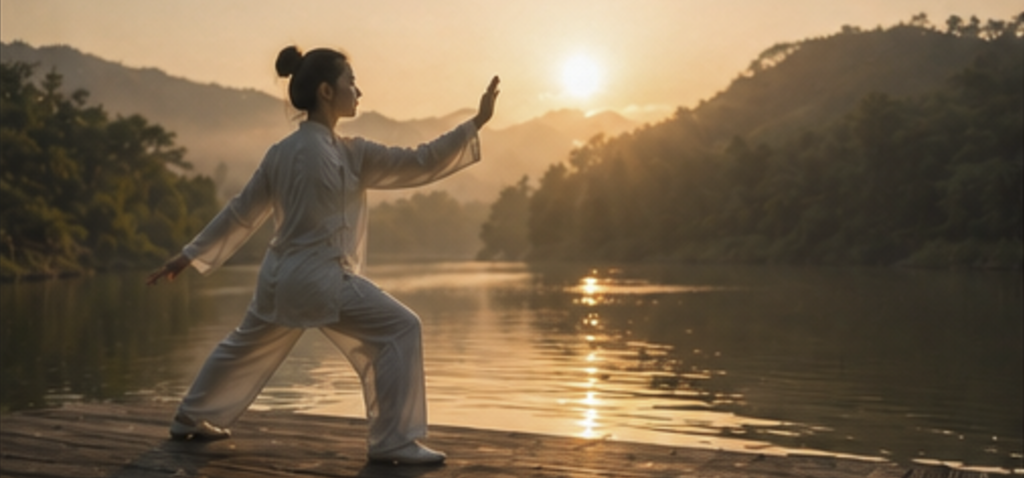
There was a time when I believed that taking care of my body meant fixing it. Fixing the stiffness, fixing the fatigue, fixing the quiet tension that seemed to sit somewhere between my shoulders and my thoughts. I approached movement like a problem-solving exercise, something mechanical, almost transactional: if I do this, then I will feel better. But Tai Chi slowly, almost imperceptibly, shifted that mindset. It didn’t arrive in my life as a solution. It arrived as an invitation.
I didn’t begin practicing Tai Chi because something was broken. I started because something in me was curious. There was this subtle pull toward slowing down, toward experiencing movement in a way that didn’t demand performance or perfection. And if I’m honest, that was uncomfortable at first. We’re so used to measuring progress, to chasing visible results, to pushing ourselves toward some external goal. Tai Chi doesn’t work like that. It doesn’t rush to meet your expectations. Instead, it gently asks you to meet yourself.
What am I thinking and feeling when I practice Tai Chi? The answer isn’t fixed, and that’s exactly the point.
Sometimes, I begin a session with a restless mind. Thoughts circling around unfinished tasks, conversations replaying in loops, small worries magnified by repetition. At the beginning, my body moves, but my attention lags behind. I notice it immediately now—the way my mind tries to escape the present moment, drifting toward the familiar territory of past regrets or future concerns. It’s almost automatic, like an old program running in the background.
And that’s when Tai Chi begins to work on me—not through force, but through awareness.
There’s a moment, usually subtle, when I shift from thinking about the movement to feeling it. My weight transfers from one leg to the other, and instead of just performing the action, I start sensing it. The pressure under my foot, the alignment of my hips, the quiet coordination between breath and motion. My arms aren’t just lifting; they’re floating, guided by something softer than intention. It’s as if the body already knows what to do, and my role is simply to listen.
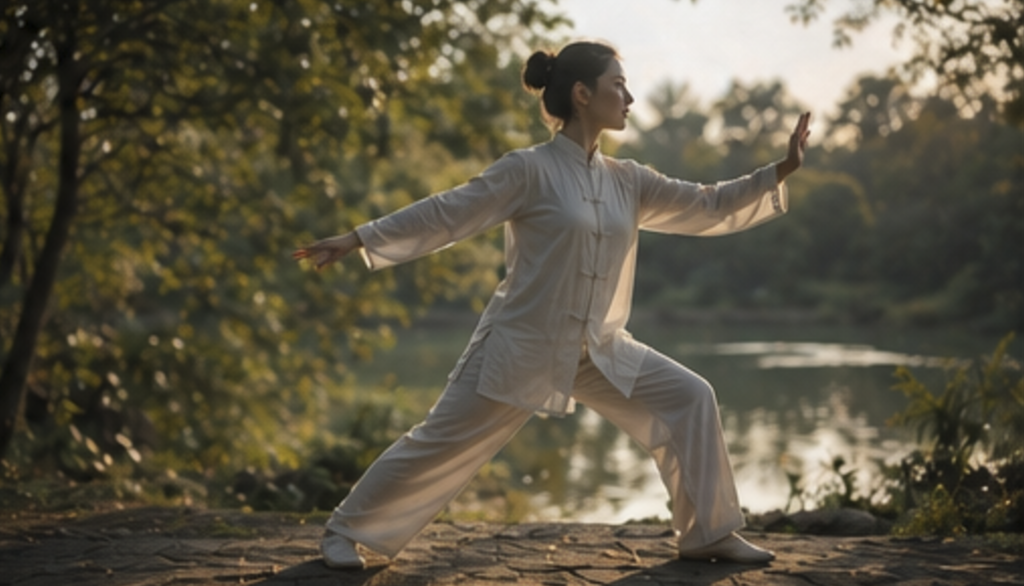
That’s when my thoughts begin to quiet—not because I’m trying to silence them, but because they become less interesting than what I’m experiencing right now.
There’s a kind of honesty in Tai Chi that’s hard to avoid. You can’t fake presence. You can’t rush through it without losing something essential. If my mind wanders too far, my movements become disconnected. I feel it immediately—like a break in continuity, a subtle tension creeping back into my shoulders or my breath becoming shallow. It’s not a failure; it’s feedback. Tai Chi doesn’t judge you. It just reflects where you are.
As a woman, I think there’s something deeply nurturing about this practice. Not in a soft, passive way, but in a grounded, attentive way. It encourages a relationship with the body that isn’t based on criticism or correction. I’m not here to fix myself. I’m here to experience myself.
There are days when I feel strong, fluid, almost effortless in my movements. My body feels open, my breath deep and steady. In those moments, Tai Chi feels like a quiet kind of freedom. Not the loud, dramatic kind, but something more intimate. A sense that I am not confined to a rigid structure, that I can move and adapt, that there’s space within me.
And then there are other days.
Days when my body feels heavy, when my thoughts are louder, when my patience is thin. On those days, Tai Chi becomes something else entirely. It becomes a practice of staying. Staying with the discomfort, staying with the resistance, staying with the part of me that would rather be anywhere else. And strangely, those sessions often feel the most meaningful.
Because that’s where I begin to understand something deeper: I am not fixed.
We often carry an image of ourselves—who we are, how we feel, what we’re capable of. These images are built over time, shaped by past experiences, habits, and repeated patterns of thinking. They can feel very real, very permanent. But when I practice Tai Chi, that sense of solidity begins to soften.
I start to notice that everything is in motion. My breath is moving, my weight is shifting, my attention is flowing from one sensation to another. Even my emotions, which can feel so intense and consuming, are not static. They change, they evolve, they pass.
In those moments, I don’t feel like a fixed body performing a sequence of movements. I feel like movement itself. A process, not a thing.
There’s something incredibly freeing about that.
It changes how I relate to discomfort, especially physical pain. Instead of seeing it as something to fight against or eliminate, I begin to explore it. Not in a reckless way, but with curiosity. Where exactly is it? Does it stay in one place, or does it shift? Does it intensify with tension and soften with relaxation?
Often, I discover that what I thought was a solid, unchanging pain is actually dynamic. It responds to attention. It changes with breath. It softens when I stop resisting it. This doesn’t mean pain disappears instantly, but it loses some of its power over me.
The same applies to mental patterns.
We all have them—those loops of worry, frustration, self-doubt. They feel familiar because we’ve repeated them so many times. It’s easy to believe that they’re just part of who we are. But Tai Chi offers a different perspective.
When my mind drifts into those patterns during practice, I don’t try to suppress them. I notice them. And then, gently, I return to sensation. To the feeling of my feet on the ground, to the rhythm of my breath, to the slow unfolding of movement.
That act of returning is simple, but it’s powerful.
Each time I bring my attention back, I’m interrupting the old program. I’m choosing something different. Not through force, but through awareness. Over time, that creates space—space between me and the patterns that used to define my experience.
And in that space, something new can emerge.
Sometimes, it feels like a quiet sense of openness. Other times, it’s a subtle shift in perspective, a realization that I don’t have to react in the same way I always have. It’s not dramatic. It’s not instant. But it’s real.
One of the most unexpected aspects of Tai Chi for me has been the way it changes my sense of time.
We live in a world that constantly pulls us forward—toward the next task, the next goal, the next moment. Even when we try to relax, our minds often stay busy, planning, analyzing, anticipating. Being fully present can feel almost unnatural.
But Tai Chi creates a different rhythm.
The movements are slow, deliberate, continuous. There’s no rush, no urgency. Each transition matters. Each shift of weight, each turn of the wrist, each breath is part of a larger flow. And when I allow myself to fully enter that flow, something shifts.
Time doesn’t disappear, but it feels different. Less fragmented. Less pressured.
I’m not thinking about what comes next. I’m not replaying what already happened. I’m here, in this movement, in this breath. And that’s enough.
This presence isn’t something I achieve once and keep forever. It’s something I practice, again and again. Some days it comes easily. Other days it doesn’t. But even on the days when my mind feels scattered, the act of showing up matters.
Because every time I practice, I’m reinforcing a different way of being.
A way that isn’t driven by urgency or tension. A way that values awareness over control. A way that allows for change.
And that, more than anything, is what Tai Chi has given me.
Not a perfect body, not a perfectly calm mind, but a deeper relationship with both.
I’ve learned to listen more closely—to the subtle signals in my body, to the shifts in my energy, to the patterns in my thoughts. I’ve learned that tension often comes from holding on too tightly, whether it’s in my muscles or in my expectations. And I’ve learned that letting go doesn’t mean losing control; it means allowing movement.
If I had to describe the feeling of practicing Tai Chi in one word, it wouldn’t be “relaxing,” even though it often is. It would be “alive.”
There’s a quiet aliveness that comes from moving with awareness. From feeling the body not as an object, but as a living, responsive system. From recognizing that change is not something to fear, but something to participate in.
And maybe that’s the real answer to those questions we all carry.
How do you get past pain? Not by fighting it, but by understanding it.
How do you let go of old patterns? Not by forcing them away, but by creating space for something new.
How do you stay present? Not by trying to control your thoughts, but by returning, again and again, to what you can feel right now.
Tai Chi doesn’t promise quick results. It doesn’t offer shortcuts. What it offers is something more subtle, but far more lasting.
A way to come back to yourself.
So if you’re waiting for the “right time” to start, maybe this is it. Not because you need to fix anything, but because you’re ready to experience something different. Something quieter, deeper, more connected.
Start where you are. Move slowly. Pay attention.
And see what begins to change.