Some cities reveal themselves slowly. Hong Kong doesn’t. It hits you immediately with movement, noise, density, humidity, and color. It’s a city that never really whispers – it hums, vibrates, flashes, and breathes all at once. And yet, once you step outside the obvious center, once you give yourself permission to move a little slower and wander further than the postcard version, Hong Kong shows a surprisingly soft, human side. This trip wasn’t about ticking landmarks off a list. It was about drifting between extremes: hyper-urban chaos and almost village-like calm, neon nights and quiet mountain paths, perfectly framed Instagram spots and messy everyday life.
One of the most memorable places we visited was Tai O, a small fishing village about an hour away by bus from the Big Buddha. The bus ride alone feels like a transition between worlds. You leave behind the polished surfaces of the city and slowly move into greenery, curves, hills, and a pace that already hints that life works differently here. Tai O feels like stepping back in time. There are almost no cars. Instead, bikes pass you quietly, people sit in front of their houses cleaning vegetables, cooking, chatting with neighbors. Fruit and vegetables are sold from simple stalls. Boats float lazily in the canals that cut through the village. Houses stand on stilts above the water. The air smells different here – more salty, more humid, more alive in a raw way.
What I loved most about Tai O is that nothing feels staged. It doesn’t try to impress you. It just exists. You can wander around without a plan, walk over tiny bridges, watch fishermen prepare their boats, sit down for a tea or coffee in a small local place, and simply observe life unfolding. It’s incredibly photogenic, but not in a glossy, perfect way. It’s photogenic because it’s honest. The textures, the colors, the reflections in the water, the contrast between the weathered houses and the soft light – it all comes together naturally. Is it worth the time and distance? Absolutely. Especially if you’ve never visited smaller towns in China or Hong Kong before. Tai O offers a kind of visual and emotional reset. It reminds you that Hong Kong isn’t only glass towers and shopping malls. There’s a quieter rhythm beating underneath the city’s fast heart.
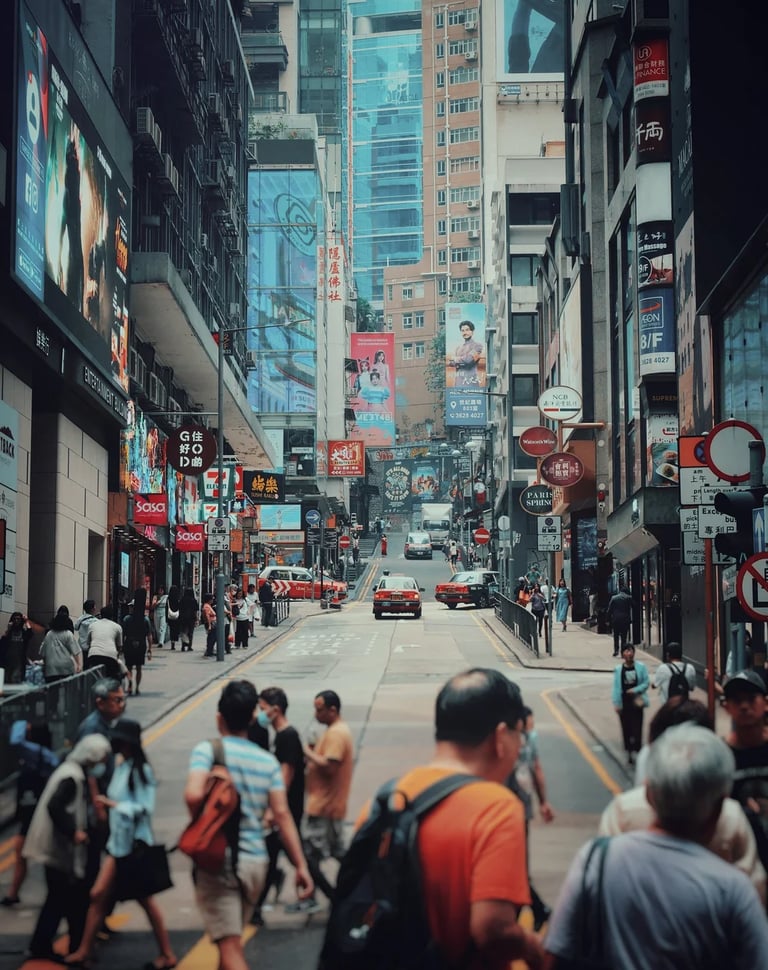
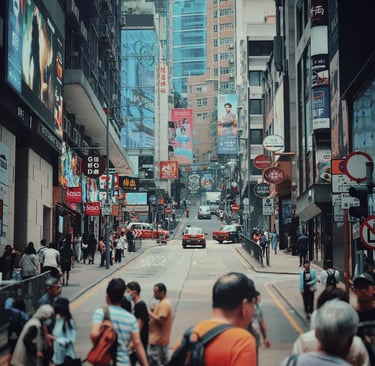
Then there’s Mong Kok, which feels like the complete opposite. If Tai O is a deep breath, Mong Kok is a sprint through a crowd. It’s busy, loud, alive in a way that almost feels overwhelming at first. Streets are packed with people, signs hang everywhere, shops spill their goods onto the sidewalks, and there’s always something happening in your peripheral vision. And yet, I loved the vibe of this neighborhood. After sunset, Mong Kok feels like an Asian version of New York – not because of skyscrapers, but because of energy. The way people move, the way light reflects on wet pavement, the way the city seems to glow from the inside out.
Mong Kok is a dream if you love street photography. Every corner offers a new scene: steam rising from food stalls, neon signs flickering, small local shops next to global brands, people bargaining, laughing, rushing, waiting. It’s also endless when it comes to shopping and dining. You can find everything from cheap souvenirs to trendy fashion, from simple local eats to surprisingly fancy dining spots hidden above street level. It’s chaotic, yes, but there’s a rhythm to the chaos. Once you tune into it, you stop feeling overwhelmed and start feeling part of the flow.
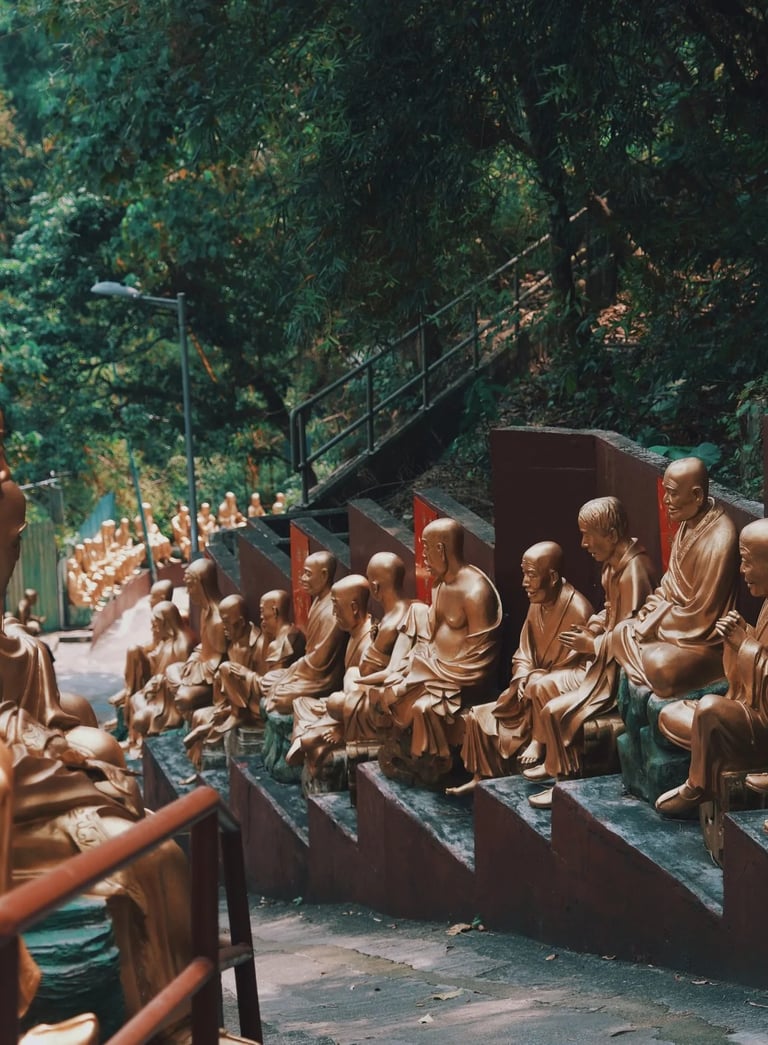
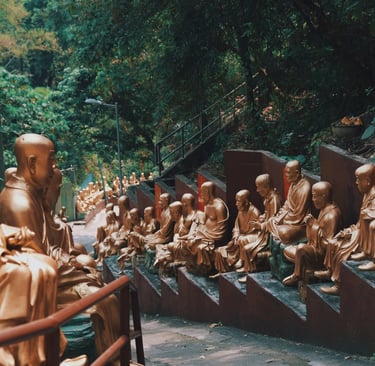
One place that completely shifts the atmosphere again is the Ten Thousand Buddhas Monastery. It was my second time visiting, and I remembered it being beautiful, but I had forgotten how physical the experience is. The monastery is located uphill in the mountains, and the way leading up is lined with golden statues of monks. Each statue is different. Some smile, some look serious, some seem playful, some almost stern. Walking past them feels like walking through a silent crowd of guardians. The actual “ten thousand buddhas,” which give the monastery its name, are inside the temple. Tiny golden figures, repeated over and over again, creating an almost hypnotic visual effect.
The climb itself is all stairs and concrete, and depending on the temperature and humidity, it can feel surprisingly exhausting. It’s not a long hike, but it’s relentless. Step after step after step. You sweat. Your legs complain. You question why you’re doing this. And then you reach the top, and suddenly the effort makes sense. The view opens up, the noise of the city fades into the distance, and there’s a quietness in the air that feels earned. The golden statues glow differently in natural light. The monastery feels like a small island of stillness above the chaos.
A small practical tip: at the bottom, when you get out of the station, there’s a big shopping mall with lots of Japanese food options. It’s honestly a great place to refuel before heading up. Getting some proper protein in before climbing those stairs makes a noticeable difference, especially if the weather is heavy and humid.
Another place that surprised me was Quarry Bay’s so-called “Monster Building.” This cluster of residential buildings became famous after appearing in a Transformers movie, and now it’s one of those places that seems to exist half as real housing and half as tourist attraction. Architecturally, it’s nothing pretty in the traditional sense. It’s dense. Concrete. Repetitive. Buildings are packed extremely close to each other, creating this overwhelming visual wall of windows, balconies, and air-conditioning units. And yet, the effect is striking. Standing in the courtyard and looking up, you feel tiny. The scale of human life stacked vertically becomes very real.
It’s definitely a cool photospot, but it’s also often crowded with tourists trying to get the perfect symmetrical shot. There’s a strange tension in photographing a place where people actually live. It’s important to be respectful, not block entrances, not treat the space like a movie set. What I enjoyed just as much as the famous courtyard were the surrounding streets. The everyday life around the Monster Building – small shops, local eateries, people coming home with groceries – feels far more intimate and, in a way, more photogenic than the iconic spot itself.
And then there’s Choi Hung Estate, home to the famous colorful basketball court. It’s another tourist magnet, and yes, it’s very Instagrammable. But seeing it in real life still made me smile. The colors are bold. The lines are clean. The symmetry is oddly satisfying. Palm trees rise behind the court, adding this almost surreal tropical touch to a very urban setting. We took a taxi from the Ten Thousand Buddhas Monastery because we were tired of long subway rides and wanted to save some energy. When we got out of the taxi, we weren’t even sure if we were at the right place. It doesn’t feel like a tourist attraction at all when you arrive. You have to walk a bit, find the right building, and then take an elevator up to the rooftop of a parking lot.
Once we reached the top, the scene was almost surreal: at least fifty people taking photos, posing, changing outfits, adjusting angles, waiting for others to move out of their frame. It’s fascinating how a simple neighborhood basketball court became a global photo destination. I guess it’s the colors, the alignment, the symmetry, the palm trees, and the contrast between playful design and concrete surroundings that make it so visually appealing. If the court were gray, nobody would care. Color changes everything.
What these places taught me is that Hong Kong isn’t one story. It’s a collection of moods. A fishing village that feels like time slowed down. A hyper-dense neighborhood buzzing with life. A quiet monastery above the noise. A residential complex turned cinematic icon. A colorful basketball court turned global backdrop. None of these places alone define the city. But together, they form a mosaic that feels incredibly rich and layered.
Traveling through these contrasts made me appreciate how flexible Hong Kong is as a destination. You can chase iconic photo spots all day, or you can wander into everyday neighborhoods and find beauty in ordinary scenes. You can escape the city without really leaving it. You can climb into silence and descend back into noise within the same afternoon. And somewhere in between, you find your own rhythm. Not the city’s rhythm. Yours.