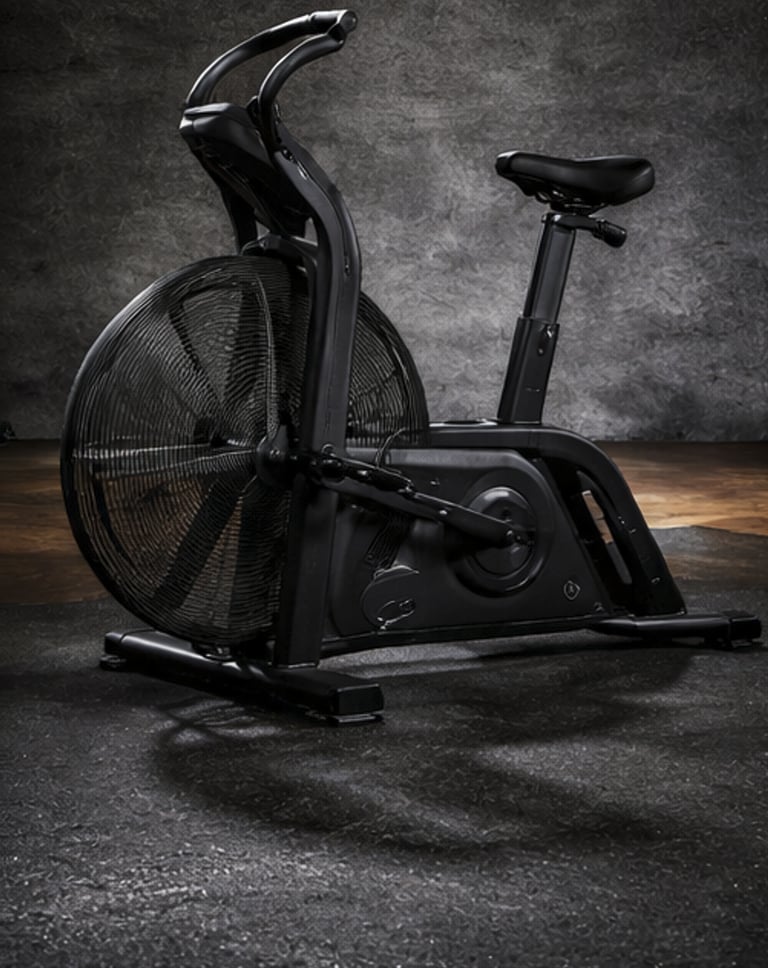
If you’ve ever worked with a good personal trainer, you know the difference immediately. It’s not just about telling you what to do—it’s about understanding how your body responds, how your energy fluctuates, and how to push you without breaking you. That’s exactly the mindset I’m bringing into this, because when I look at something like the Strive™ Air Bike, I don’t see a machine—I see a tool that either supports real progress, or wastes your time.
And most people? They’ve spent enough time already on equipment that looks impressive but delivers very little.
So let’s talk honestly, the way I would with a client standing in front of me.
The first thing I care about is whether something holds up under real effort. Not casual pedaling, not a five-minute warm-up—I mean the kind of sessions where your breathing gets heavy, your legs start to fatigue, and your form is the only thing holding everything together. That’s where most equipment starts to show its weaknesses. Movement becomes unstable, resistance feels inconsistent, and instead of focusing on your output, you start adjusting to the machine.
That’s a problem.
With this bike, that issue is removed right away. The frame feels planted, and that matters more than people realize. When your base is stable, your nervous system relaxes just enough to let you push harder. You’re not compensating, you’re not holding back—you’re actually training.
Now, let’s talk about resistance, because this is where most air bikes fall short in terms of programming flexibility.
Traditional air bikes tie everything to speed. You go faster, it gets harder. Simple, yes—but from a coaching perspective, it’s limiting. Because not every session should be dictated by how fast you can move. Sometimes I want controlled output. Sometimes I want sustained effort at a fixed intensity. Sometimes I want you working hard without turning the session into a sprint.
That’s where this system changes the game.
Being able to adjust resistance independently of cadence gives you structure. It allows me—as a coach—to prescribe specific effort levels without relying on guesswork. I can tell you to hold a pace, maintain power, and actually expect consistency. That’s how you build conditioning properly—not randomly, but with intention.
And intention is everything in training.
Let me give you a real-world example.
If I’m programming a beginner session, I’m not throwing you into high-intensity chaos. I want you to learn rhythm, breathing, control. So we start light. The movement needs to feel natural, almost effortless. That’s how confidence builds. From there, we gradually increase resistance—not by forcing speed, but by increasing demand. Your body adapts progressively, not abruptly.
Now compare that to a more advanced athlete.
Here, I might lock in a higher resistance and ask for intervals—short bursts of aggressive output followed by controlled recovery. The key difference is that the resistance stays consistent. You’re not just spinning faster and hoping for intensity—you’re working against a defined load. That’s how we measure progress accurately.
And that brings me to something most people overlook: feedback.
If you can’t measure what you’re doing, you’re guessing. And guessing doesn’t get results.
Having clear metrics—time, output, cadence—changes how you approach every session. You stop thinking in terms of “that felt hard” and start thinking in terms of “this is what I produced.” That shift is subtle, but it’s powerful. It turns training into something objective, something you can build on.
As a trainer, that’s exactly what I want.
Now let’s address comfort—but not in the way people usually talk about it.
I’m not interested in comfort for the sake of making things easy. I’m interested in efficiency. If your positioning is off, if your joints aren’t aligned, if your setup forces compensation—you’re losing power, and over time, you’re increasing risk.
The adjustability here solves that.
Seat height, forward-back positioning—it allows me to dial in your setup properly. When your hips, knees, and feet are aligned, movement becomes efficient. You produce more force with less strain. That’s not just better performance—that’s smarter training.
And yes, the details matter. Grip positioning, handle variation, even the ability to isolate upper or lower body work—it all adds options. From a programming standpoint, that’s valuable. It means I can use the same piece of equipment across different training goals without it becoming repetitive or limited.
Let’s talk about those goals for a second.
If your focus is fat loss, this bike fits perfectly into interval-based conditioning. Short, intense efforts that elevate heart rate quickly and efficiently. You’re not wasting time—you’re creating a metabolic demand that actually drives change.
If your goal is endurance, we shift gears. Longer sessions, controlled pacing, steady output. This is where discipline builds. It’s not flashy, but it’s effective.
If you’re an athlete, now we’re looking at power. Output. Repeatability. Can you produce high effort consistently, and can you recover fast enough to do it again? That’s where this kind of equipment becomes extremely useful.
And if you’re coming back from fatigue, stress, or even injury, it becomes something else entirely—a low-impact way to stay in motion. No joint stress, no unnecessary load, just controlled movement to keep your system active.
That’s versatility done right.
But here’s the part I always come back to with clients, and I’m going to be direct with you too.
No machine will change your results if your approach doesn’t change.
This bike gives you the structure, the consistency, the ability to train properly—but you still have to show up. You still have to put in the effort. You still have to be honest about where you are and where you want to go.
What it does do is remove excuses.
You can’t blame instability. You can’t blame poor resistance. You can’t say the setup doesn’t work. Everything is there, ready to support real training. The only variable left is you.
And from a coaching standpoint, that’s exactly what I want.
Because progress isn’t built on perfect conditions—it’s built on repeatable ones.
When you have equipment that responds the same way every time, you create a reliable environment. That’s where habits form. That’s where consistency takes over. And consistency is what drives results, not motivation.
I’ve seen too many people jump from one method to another, one machine to another, always looking for something “better,” when in reality what they need is something stable. Something they can trust. Something they can return to, day after day, without second-guessing.
That’s what this is.
It’s not flashy. It’s not trying to entertain you. It’s built for work.
And if you’re serious about improving your conditioning—whether that’s for performance, health, or simply feeling stronger in your own body—that’s exactly what you need.
So if you were standing in front of me right now and asking, “Is this worth it?” my answer wouldn’t be emotional, and it wouldn’t be based on hype.
I’d tell you this:
If you’re ready to train with structure, if you’re willing to be consistent, and if you want a tool that supports real progression instead of limiting it—then yes, this is a solid choice.
But if you’re still looking for shortcuts, for something to do the work for you, or for a quick burst of motivation that fades in a week—this won’t fix that.
Nothing will.
The difference is, this won’t hold you back either.
And in training, that’s exactly where progress starts.