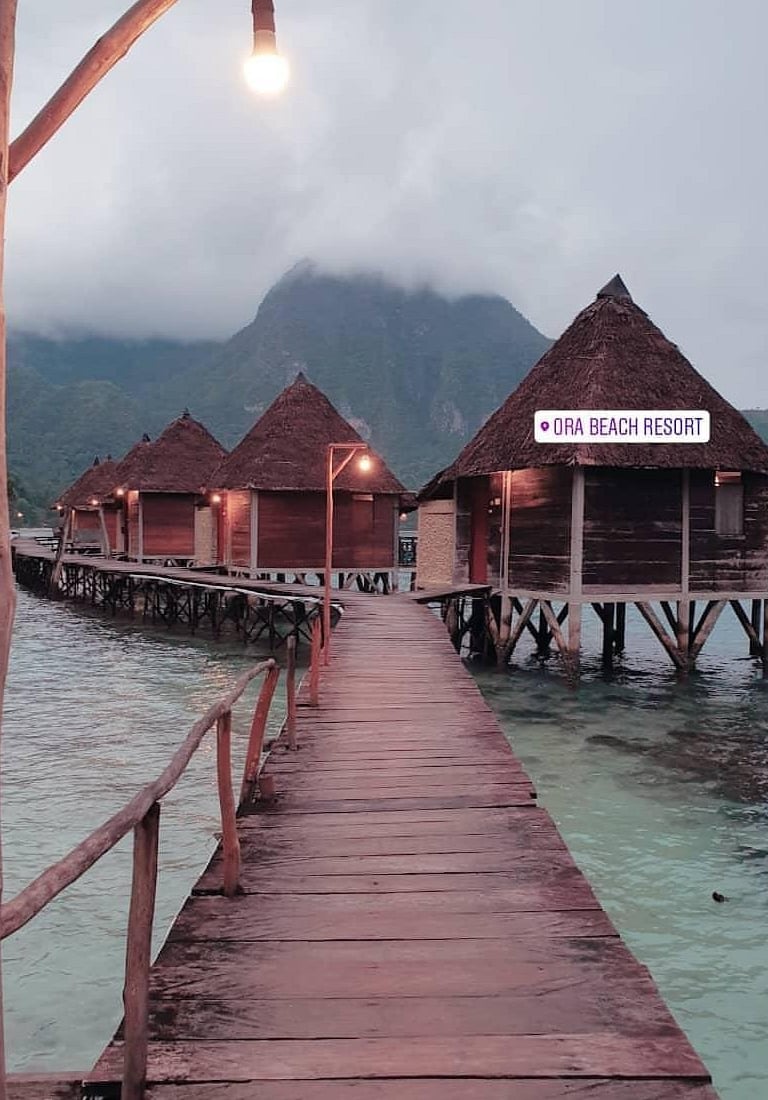
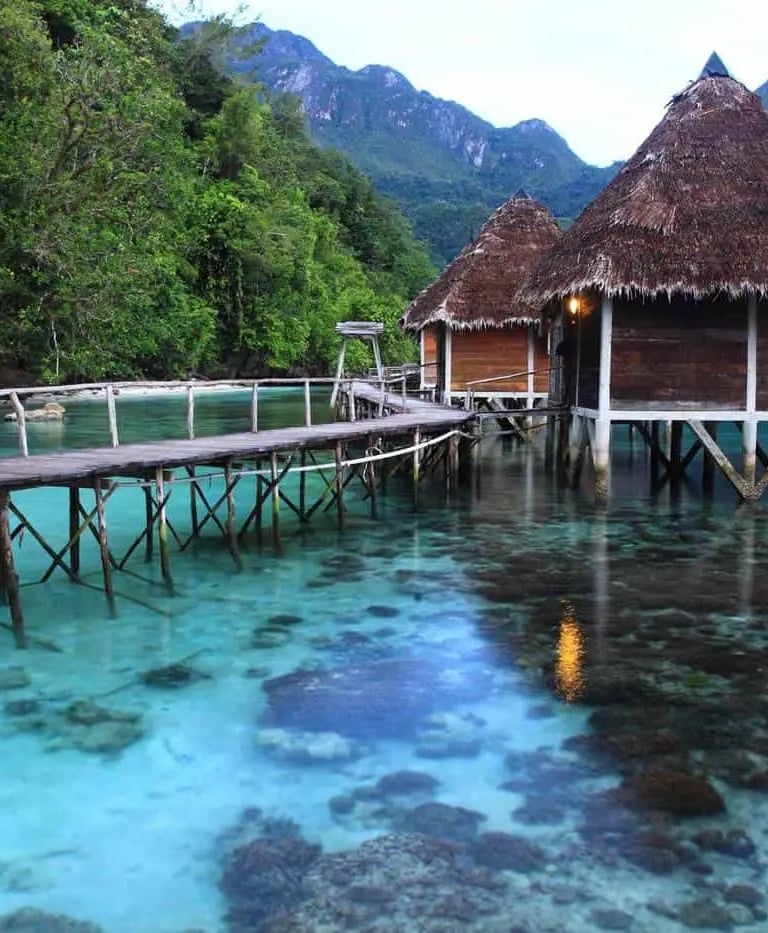
Ora Beach had been living in my imagination long before my feet ever touched its sand. During this pregnancy I’ve found myself craving places that feel quiet, safe, and almost dreamlike—destinations where the air itself seems to slow your heartbeat. When I first saw a photo of that row of wooden cottages stretching over translucent turquoise water, backed by towering green cliffs, I remember thinking: this doesn’t look real. And yet, it is very real, carefully hidden on the north coast of Seram Island in Indonesia’s Maluku Province, like something nature decided to keep secret for as long as possible.
Traveling while pregnant changes the way you see the world. I’m no longer chasing adrenaline or ticking off “must-see” attractions. Instead, I’m drawn to places that feel nurturing, calm, and deeply connected to nature. Ora Beach, often described as a paradise for eco-travelers and honeymooners, turned out to be exactly that kind of sanctuary—a place where you wake up to nothing but the sound of gentle water beneath your cottage and distant bird calls echoing from the rainforest.
Indonesia itself is almost overwhelming in its beauty. As a country with one of the longest coastlines in the world, it holds more beaches than most of us could explore in a lifetime. Yet Ora Beach feels different from the famous, busy shores people usually picture. It is remote—truly remote—and that distance from crowds is part of what makes it so magical. Reaching it is not effortless, but perhaps that’s why it has remained so untouched.
The journey began with a flight into Ambon’s Pattimura Airport, which is the main gateway to the region. Ambon is a domestic airport, connected to larger Indonesian cities like Jakarta, Surabaya, and Makassar. Even before leaving the airport, I was already reminded to slow down. Everything moved at a gentler pace than the cities I’m used to, and traveling while pregnant made me even more mindful of rest, hydration, and patience.
From the airport, we hired a car for the short drive—about thirty minutes—to Tulehu Port. The road wound through small villages, lush greenery, and glimpses of the sea. There’s something grounding about these transitions between transport modes. Each step of the journey feels intentional, like you’re gradually being welcomed into a quieter world.
At Tulehu, we boarded a ferry to Masohi on Seram Island. The ticket prices were surprisingly affordable, usually between 50,000 and 150,000 Rupiah depending on the vessel. The crossing took roughly one and a half to two hours. Sitting on that ferry, I remember resting my hands over my growing belly, feeling both excitement and a strange sense of calm. The sea stretched endlessly around us, and for once, travel didn’t feel rushed—it felt like a gentle passage.
Seram Island itself is fascinating. It is the largest island in the Maluku Province, covering around 16,000 square kilometers, yet it has a population of only about 170,000 people. Compared to crowded destinations elsewhere in Indonesia, Seram feels wild and spacious. It lies just north of Ambon, surrounded by tectonic complexity that has shaped its dramatic terrain. A central mountain range runs across the island, crowned by Gunung Binaya, which rises just over 3,000 meters. Dense tropical rainforest covers much of the land, with towering cliffs on one side and white sand beaches on the other, all wrapped in clear blue sea.
After arriving in Masohi, the journey continued by car—another two hours along steep, winding roads cutting through thick forest. Normally I might have found this exhausting, but there was something mesmerizing about the endless green. Occasionally we passed small settlements or glimpsed birds darting between trees. Seram is famous for its bird life—out of 117 species found there, fourteen are endemic, found nowhere else in the world. Even without being an avid birdwatcher, I could feel the richness of the ecosystem around us.
Eventually we reached Saleman, a tiny fishing village that felt like the edge of the known world. Life there moved slowly, shaped by tides and sunlight rather than schedules. The final stretch to Ora Beach Resort was just a ten-minute boat ride across calm water. And then suddenly, there it was.
I’ll never forget that first sight. A line of cozy wooden cottages stood over white sand and crystal clear water, perfectly reflected like a painting. Behind them rose limestone cliffs and lush mountains layered in tropical green. It looked untouched, almost unreal, like stepping into a storybook illustration of paradise.
Our cottage sat directly above the water. Standing on the small wooden balcony, I could see straight through to the coral below. The sea was so clear it felt as if the boats were floating on glass. Even with the midday sun overhead, the colors were soft and inviting rather than harsh. As someone traveling while pregnant, I appreciated how peaceful everything felt—no loud music, no crowds, no pressure to “do” anything.
Days at Ora Beach unfold naturally. Mornings begin with the soft light rising over Sawai Bay, turning the water pale blue and silver. The air is warm but not oppressive, and there’s often a light breeze coming from the mountains. I found myself waking earlier than usual, simply to sit quietly and listen.
Snorkeling is one of the main attractions here. Although I personally stayed cautious—pregnancy changes your balance and energy levels—it was still incredible just to watch others explore the reefs. The coral in the area is abundant and vibrant. Visitors are advised to snorkel in deeper waters rather than the shallow areas where coral is easily damaged. It’s a reminder that places this beautiful survive only if we treat them gently.
One practical thing I quickly learned is how important preparation is. There are no ATMs or banks on the island, so bringing enough cash from Ambon is essential. The resort itself has only one restaurant, and while the food is good, having your own snacks can be very helpful—especially with pregnancy cravings that arrive without warning. If you plan to dive or snorkel extensively, equipment is best rented in Ambon before arriving, since options on site are limited.
Despite its simplicity, the resort has a comforting warmth. Meals are shared in a relaxed setting, often featuring fresh fish and local ingredients. Evenings are quiet, with the sky darkening into a deep canopy of stars. Without city lights, the Milky Way feels almost close enough to touch. I spent more than one night simply sitting outside, breathing in the humid tropical air and feeling the baby shift gently—a strange but beautiful connection between new life and an ancient landscape.
What struck me most about Ora Beach was how restorative it felt. Pregnancy can bring waves of fatigue, emotion, and constant awareness of your body’s changes. Here, surrounded by rainforest and sea, that awareness softened. There was no pressure to keep up with a busy itinerary. Walking slowly along the beach, feeling the sand warm beneath my feet, was enough.
Seram’s wilderness adds another layer to the experience. Knowing that dense rainforest stretches across much of the island, hiding rare birds and untouched ecosystems, creates a sense of humility. You realize how small you are in the larger rhythm of nature. And perhaps that’s exactly why places like Ora Beach resonate so deeply—they remind you that beauty doesn’t need to be constructed or curated.
Eco-travel here isn’t just a label; it’s a necessity. Visitors are encouraged not to litter and to actively protect the fragile environment. Seeing how pristine the water and shoreline remain makes you understand why these reminders matter. Even small actions—carrying your trash, respecting coral reefs—feel significant.
For honeymooners, I can easily imagine this being one of the most romantic destinations imaginable. For me, traveling here while pregnant created a different kind of intimacy—not between partners, but between myself, my changing body, and the world I’ll soon introduce my child to. Standing on that balcony, watching the endless gradient of blue water, I kept thinking: this is the kind of beauty I want my baby to grow up knowing still exists.
The remoteness that makes Ora Beach challenging to reach is also its greatest strength. There are no crowds competing for the perfect photo, no rows of commercial resorts. Just a handful of cottages, the sound of waves, and a horizon that seems to stretch forever.
Leaving was surprisingly emotional. The same sequence—boat, car, ferry, car, flight—felt different in reverse. I carried with me not just photos, but a sense of calm that lingered long after the journey ended. Ora Beach isn’t a destination you “conquer” or check off a list. It’s a place you absorb slowly, like sunlight warming your skin.
If someone asked me whether the long journey is worth it—especially while pregnant—I would say yes, with thoughtful preparation. Travel here requires patience, planning, and respect for your body’s limits. But in return, you receive something increasingly rare: silence, authenticity, and a landscape that still feels untouched by mass tourism.
Ora Beach is often described as a hidden paradise, and for once, that phrase doesn’t feel exaggerated. It truly does resemble a piece of fairyland tucked between mountains and sea. And perhaps the most beautiful part is knowing that, with care and respect, it can remain that way—for future travelers, and maybe one day, for the child who quietly shared that journey with me before ever seeing the world.