
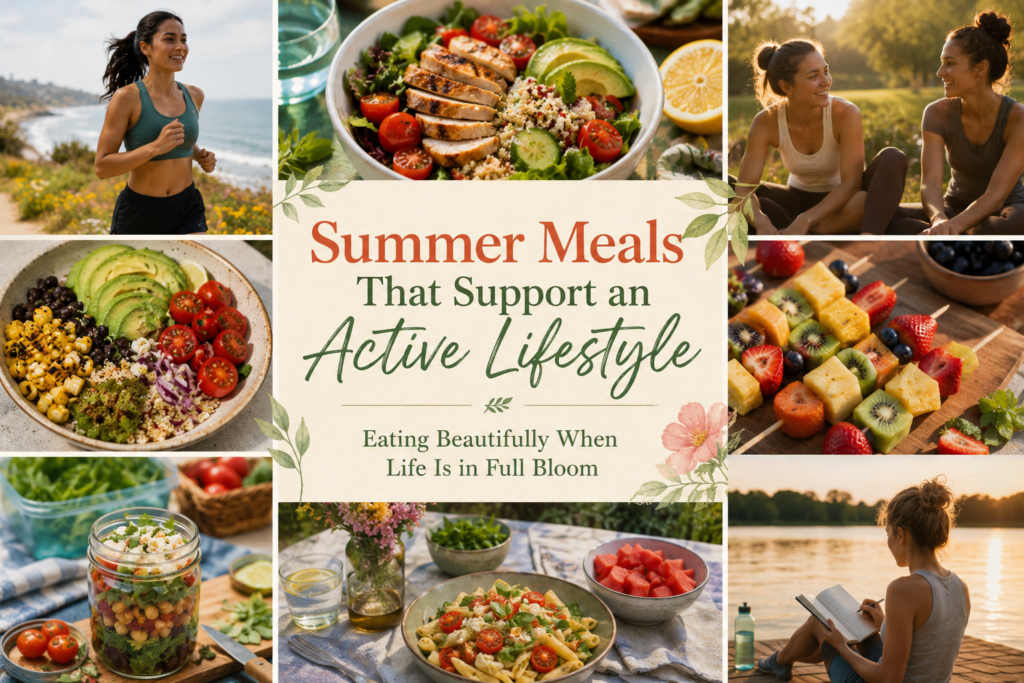
Summer Meals That Support an Active Lifestyle — Eating Beautifully When Life Is in Full Bloom
For the woman who moves through summer with intention — and wants every meal to match the energy she’s building.
There is something about summer food that exists nowhere else in the calendar year. It’s the way a tomato tastes in August when it’s been growing in actual heat and sunlight rather than a controlled greenhouse somewhere. It’s the cold of a watermelon slice against your palm on a day when the air feels thick with warmth. It’s the particular satisfaction of a lunch that was assembled rather than cooked — things pulled from the refrigerator, arranged on a beautiful plate, eaten in the garden or at a window with light coming through it — that manages to feel both effortless and genuinely luxurious.
Summer food is alive in a way winter food isn’t. And if you’re also living an active life in summer — if you’re moving your body regularly, building strength, walking more, spending more time in physical contact with the world — then what you eat takes on an even more specific kind of importance. Your food becomes the fuel behind the feeling. The difference between a body that moves through the day with ease and one that drags is often, genuinely, on the plate.
I’ve spent the last few summers paying closer attention to this relationship — between what I eat and how I feel, specifically in the context of an active lifestyle — and what I’ve found has less to do with any particular nutritional protocol and everything to do with a handful of principles about quality, timing, pleasure, and the kind of cooking that fits into a real summer life rather than requiring you to become a different person. These are the principles I want to share here, alongside the actual meals — the recipes, the ideas, the combinations — that have become my most consistent, most loved, most body-supporting summer staples.
This is not a diet plan. It is not a calorie guide. It is a love letter to eating well in summer, written by a woman who moves her body and wants her food to match the life she’s building.
The Philosophy First: Why Summer Eating Deserves Its Own Approach
Before we get into specific meals, I want to spend some time on the underlying principles, because the why behind summer eating for active women is different enough from generic nutrition advice that it’s worth articulating clearly.
Summer changes your body’s needs in specific, practical ways. Heat affects appetite — many women find their desire for large, heavy meals diminishes significantly when temperatures rise, which can actually make summer a natural opportunity for the kind of lighter, more produce-forward eating that supports an active lifestyle beautifully. The body is also working harder in heat — thermoregulation is an energy-intensive process — which means hydration and electrolyte balance become even more important than in cooler months. And if you’re more physically active in summer (more outdoor movement, more swimming, more generally energetic living), your protein and carbohydrate needs shift accordingly.
The clean girl approach to summer eating — which in its best, most honest expression is not about restriction but about real food — fits this context beautifully. Real vegetables at their seasonal peak. Quality protein that tastes like something. Grains and legumes prepared simply and well. Good fats from olive oil and avocado and nuts that make everything taste better and support hormonal health. Food that is genuinely beautiful to look at, which matters more than most nutritional science acknowledges, because eating food that looks appealing is part of what signals satisfaction to your brain and prevents the endless nibbling that comes from meals that feel somehow unsatisfying despite being technically sufficient.
The aesthetic dimension of summer eating is also genuinely relevant here — and I want to be unabashed about this, because I think the intersection of beauty and nourishment is one of the most underexplored areas in the wellness conversation. A meal that is beautiful — that has been assembled with some attention to color, texture, and presentation — is eaten differently than a meal shoveled into a container and consumed standing at the counter. It is eaten slowly, with more presence, which is actually how you absorb nutrients better and feel satisfied on less. The mindful eating that wellness culture has been advocating for years is, at its core, the practice of eating beautiful food with attention. And beautiful food is, in summer, almost embarrassingly easy to produce.
This is the philosophy. Now let’s talk about the actual meals.
Morning Fuel: Breakfast That Powers Your Active Summer Days
The morning meal has a particular relationship with active living that’s worth understanding before you design it. When you work out in the morning — or even just move significantly, walking a substantial distance or doing a physical practice — your body’s glycogen stores and overnight fast create a specific nutritional context. What you eat in the hours around morning movement affects your energy, your performance, and your recovery in measurable ways.
For women who work out early and then eat breakfast, the post-workout window is when protein absorption is particularly efficient — your muscles are primed to use amino acids for repair and growth, which means a protein-rich breakfast in the hour or so after exercise is genuinely valuable rather than just nice to have.
For women who eat before morning exercise, something light and digestible that provides quick energy without sitting heavily — a banana with a small amount of nut butter, or a small bowl of yogurt with berries and honey — is usually the approach that feels best physically and performs best during movement.
The Overnight Oat Formula That Works in Every Summer Configuration
I want to talk about overnight oats first because I have complicated feelings about them, which I think is actually useful to share. For years I found them slightly virtuous-but-sad — a meal that looked good in a glass jar on a wellness account but tasted, to me, like effort rather than pleasure. Then I started treating them less like a health food and more like an actual breakfast I wanted to eat, and everything changed.
The formula that has worked for me, and that I’ve seen work for everyone I’ve recommended it to: the ratio is one part oats to one part liquid, where the liquid is a combination of something creamy (full-fat coconut milk, or a good oat milk, or whole milk if that’s your preference) and something tart (plain full-fat yogurt makes up about a third of the liquid volume). A small amount of chia seeds — a tablespoon per serving — adds thickness and omega-3 fatty acids and the kind of sustained energy release that keeps you from being hungry again by ten in the morning. A tiny amount of honey, stirred in before refrigerating. And then toppings added in the morning, because adding them the night before turns berries to mush and granola to something soft and disappointing.
Summer toppings that are genuinely beautiful and genuinely nourishing: fresh raspberries and a spoonful of almond butter, with a scattering of hemp seeds for additional protein. Sliced peaches with a handful of chopped pistachios and a small drizzle of good honey. Mango pieces with toasted coconut flakes and a few macadamia nuts. Figs with a crumble of good dark chocolate (and yes, this is a breakfast) and a small scattering of flaxseed.
The visual result of overnight oats done this way — layered in a beautiful wide bowl or a clear glass, the colors of the fruit against the creamy oats — is exactly the kind of clean girl morning aesthetic that looks like a Pinterest save and tastes like you meant it.
The Protein-Forward Egg Situation
Eggs are, without apology, one of the most perfectly designed foods for an active woman’s summer breakfast. They provide complete protein — all nine essential amino acids — along with healthy fats, choline (which supports brain function and is chronically underconsumed by women), and a satiety that most alternative breakfast proteins don’t match. They’re also versatile in a way that means eating them daily doesn’t require eating the same thing daily.
The egg preparations I come back to most in summer:
A simple soft scramble — low and slow, with good butter, the eggs barely set and incredibly creamy, served on a piece of toasted sourdough that’s been rubbed with a cut garlic clove and drizzled with olive oil. Add a handful of whatever herbs look best at the market — fresh basil or chives or tarragon — and a scattering of flaky sea salt. This takes seven minutes and tastes like something from a beautiful café.
Baked eggs in a summer tomato sauce — a shakshuka-adjacent preparation that works brilliantly in July when good tomatoes are everywhere and cheap. Slow-cooked tomatoes with olive oil, garlic, a little smoked paprika and cumin, a handful of wilted spinach or kale if you want the greens. Eggs cracked into wells in the sauce, covered, cooked until the whites are just set and the yolks are still soft. Eaten directly from the pan with good bread and preferably with someone you like.
A soft-boiled egg served alongside a grain bowl — one of the most satisfying and complete summer breakfasts, particularly after a substantial morning workout. The egg provides the protein and richness, the grain provides sustained carbohydrate energy, and the whole thing comes together quickly if you’ve prepped the grains in advance (which we’ll discuss at length in a moment).
The Smoothie Philosophy: When It’s Worth It and When It Isn’t
I have strong opinions about smoothies — specifically about the gap between the smoothie aesthetic (beautiful, colorful, photographed artfully with a bamboo straw) and the smoothie reality (often a rapidly absorbed sugar bomb that produces a blood sugar spike followed by a crash, which is not ideal for anyone and particularly not for active women managing energy throughout a day).
This doesn’t mean smoothies are bad. It means the composition matters enormously and it’s worth thinking about it rather than just blending whatever sounds nice.
The smoothie formula that actually supports an active lifestyle: a source of protein (a scoop of quality protein powder, or a large amount of Greek yogurt — two hundred grams rather than a spoonful — or silken tofu if you prefer plant-based), a source of fat that slows absorption (half an avocado, a tablespoon of almond butter, a tablespoon of coconut butter), fiber from the fruit and any vegetables you add (and frozen spinach, I promise, you cannot taste it), and moderate fruit — enough for flavor and natural sweetness, not so much that the sugar content defeats the purpose. Frozen mango or berries are the most reliably beautiful and flavorful choices; banana adds creaminess and is particularly useful in post-workout smoothies when your muscles need quick-access carbohydrates.
The smoothie I return to most consistently in summer: frozen mango, frozen spinach, half an avocado, Greek yogurt, a scoop of vanilla protein powder, coconut water, a small piece of fresh ginger, and a squeeze of lime. It is brilliant yellow-green, it tastes like a tropical holiday, and it provides the kind of macro balance that fuels a two-hour morning without a mid-morning crash.
The Midday Meal: Lunches That Are Light, Beautiful, and Actually Filling
Summer lunch is where the pleasure principle of seasonal eating is most fully expressed. The heat tends to eliminate desire for heavy, cooked meals, and the produce available in July and August is so extraordinarily good that the least processed approach to it is usually the most delicious. This is the season for assembling rather than cooking — for letting beautiful ingredients speak for themselves with minimal intervention.
The Bowl Formula
The grain bowl has become such a cultural fixture in 2026 wellness and food aesthetics that it risks feeling clichéd, but its persistence in beautiful kitchens and food photography alike is genuinely justified. When built well — with real attention to protein, texture, flavor, and color — a grain bowl is one of the most perfect summer meals available. It is nutritionally complete, deeply satisfying, beautiful to look at, and almost infinitely variable, which means you can eat it several times a week without eating the same meal twice.
The architecture of a bowl that works: a grain base that has been cooked properly and seasoned while still warm (this makes an enormous difference to flavor — grain that is seasoned while it absorbs the water or stock tastes completely different from grain that has been seasoned afterward). The best grains for summer bowls are farro (nutty, chewy, slightly toothsome in a satisfying way), quinoa (lighter, quicker to cook, complete protein — genuinely useful for active women), brown rice or a wild rice blend (earthier and more robust), and freekeh, which is underused and has a beautiful smoky quality that pairs surprisingly well with summer vegetables.
On top of the grain: a generous amount of cooked or raw vegetables. In summer, the options are overwhelming in the best way — roasted cherry tomatoes (roasting concentrates their sweetness in a way that raw tomatoes don’t provide), grilled zucchini or corn, raw cucumber and thinly sliced radish for crunch, massaged kale or arugula that adds a peppery bitterness against the sweetness of the grain. Pickled onion, which you can make in fifteen minutes by soaking thinly sliced red onion in apple cider vinegar with a pinch of sugar and salt, adds brightness and acidity that ties everything together.
Protein: grilled chicken thighs marinated in lemon and herbs, or seared salmon, or a poached egg (still my favorite bowl protein — the yolk breaks and becomes a sauce), or chickpeas roasted with good olive oil and cumin until they’re crispy and slightly addictive, or slices of good quality feta crumbled generously over the top.
The dressing is where so many bowls fail, and it’s the element most worth getting right. A dressing with good fat (olive oil or tahini or good quality sesame oil), acid (lemon juice or a good apple cider vinegar), and flavor (garlic, herbs, a small amount of honey or miso) transforms adequate ingredients into something genuinely delicious. My current most-reached-for summer dressing: lemon juice, good olive oil, a small spoonful of tahini, a minced garlic clove, a little honey, salt, and enough water to make it pourable. It works on everything.
The Large Salad That Means It
Summer salads have a reputation problem created almost entirely by bad salads — the wet iceberg and pale tomato situation that masquerades as a meal at every mediocre restaurant, the side salad that is literally a garnish presented as food. I want to talk about the other kind: the salad that is a genuinely satisfying, nutrient-dense, beautiful meal that leaves you feeling nourished rather than virtuous-but-hungry.
The large salad that works begins with a base that has texture and flavor of its own — not iceberg, but a mix of something peppery (arugula), something tender (butter lettuce or Little Gem), and something more substantial (thinly sliced radicchio, or a handful of shaved fennel). The base matters because it’s the backdrop for everything else, and a flavorful base means the salad tastes like something even before the dressing is added.
Then: protein that is present in a quantity that constitutes a meal. Not a garnish of chickpeas or a few shreds of chicken — a genuinely adequate serving. Grilled salmon or tuna (good quality canned tuna in olive oil is genuinely excellent in a salad and requires no cooking), a chicken breast that has been properly seasoned and cooked, a hard-boiled egg or two, a generous amount of legumes. The protein is what makes this a meal rather than a side dish.
Then: at least one component with warmth or richness that grounds the salad and prevents it from feeling merely virtuous. Warm roasted vegetables add both sweetness and weight. A good cheese — a creamy burrata, or crumbled feta that’s been marinated in olive oil and herbs, or shaved pecorino — adds richness. Avocado adds creaminess and the good fats that support sustained energy. Toasted nuts or seeds add crunch and depth.
The summer salad combination I come back to most: arugula and butter lettuce, warm roasted sweet potato, shaved red onion, cucumber, avocado, sunflower seeds toasted in tamari, and grilled chicken — dressed with the lemon-tahini dressing above and finished with torn fresh mint and a scattering of pomegranate seeds if I’m feeling extra. It is beautiful on the plate in a way that makes you want to eat it, which is relevant, and it is satisfying in the way that a real meal is satisfying.
The Cold Noodle Situation
I want to make a case for cold noodles as a summer lunch that doesn’t get nearly enough attention in the wellness eating conversation, possibly because noodles have been unfairly treated as indulgent rather than recognized as the genuinely excellent source of complex carbohydrates and meal satisfaction that they are.
Soba noodles — made from buckwheat, with an earthy, slightly nutty flavor — are particularly well suited to an active lifestyle: they have a lower glycemic index than most pasta, they’re satisfying and substantial, and they eat beautifully cold with the kind of Asian-inspired dressings that work so well in summer. Cook them, rinse them immediately under cold water to stop the cooking and prevent sticking, toss them with a small amount of sesame oil, and then dress them with whatever combination of tamari, rice wine vinegar, sesame oil, ginger, and garlic sounds good to you.
The toppings that make cold noodles genuinely beautiful and nutritionally complete for an active woman: sliced cucumber, shredded purple cabbage (for color as much as nutrition), edamame (excellent protein, also beautiful green against the buckwheat noodles), thinly sliced spring onions, a soft-boiled egg halved and placed on top with the yolk running slightly, and either a handful of grilled chicken or some good tofu for protein. A scattering of sesame seeds and some torn coriander to finish.
The visual result is one of the most beautiful summer lunches you can produce. The colors are extraordinary — deep purple, bright green, pale gold of the egg yolk, dark brown of the soba, all against a white or matte bowl. This is a meal that looks like something from a beautiful food magazine and is eaten on a Tuesday when you need to get back to work in forty-five minutes.
Dinner: The Evening Meal as a Summer Ritual
Summer dinners hold a particular place in the emotional calendar of warm months. There is something about eating at a time of day when the light is still golden and the air is beginning to soften from the day’s heat, with windows open or outdoors entirely, that makes dinner in summer a genuinely different experience from dinner in November. It is slower, more social, more connected to the pleasure principle.
For active women, dinner also plays a specific nutritional role: it’s when the body is in recovery mode from the day’s movement, when carbohydrates and protein together support overnight muscle repair, and when the parasympathetic nervous system (the rest-and-digest mode) is most active and most receptive to full absorption of nutrients.
This means dinner is the meal where I’m least interested in restriction and most interested in pleasure and completeness. A good summer dinner is satisfying and nourishing simultaneously — not in the way of therapeutic eating, but in the way of genuinely good food that happens to be good for you.
The One-Pan Summer Dinner
The one-pan or one-tray dinner is the most practical and often the most delicious approach to summer cooking — the high heat of the oven concentrates and caramelizes flavors in a way that nothing else replicates, and the cleanup is minimal enough that cooking it doesn’t feel like a commitment.
My most reliable summer oven dinner: a full sheet pan covered with a parchment and loaded with a protein (chicken thighs, bone-in and skin-on, which become crispy in the oven in a way that boneless skinless never does; or a whole side of salmon; or a tray of large prawns) alongside the best summer vegetables the market has — halved cherry tomatoes, zucchini cut into thick half-moons, whole cloves of garlic, red onion cut into wedges, a handful of olives if you love them. Everything is dressed generously with good olive oil, salt, pepper, and whatever herbs are growing or available — thyme, rosemary, and basil are the summer trinity. The oven does the rest.
What comes out is not just a complete, protein-and-vegetable dinner but something with concentrated, caramelized, entirely natural sweetness from the roasted tomatoes and onion that makes the whole thing taste far more effortful than it was. Add some good bread to absorb the pan juices. Add a handful of fresh herbs torn over the top when it comes out of the oven. Pour a glass of whatever you like and eat it at a table, ideally with another person, with the windows open.
The Grilled Dinner
Summer and grilling have an ancient relationship that I have no interest in interrogating. The particular quality of flavor that comes from cooking over direct heat — the char, the smoke, the slight caramelization of the exterior — is worth the setup even if you’re working with a small balcony grill or a ridged cast iron pan in the kitchen.
The grilled dinner that is both most beautiful and most supportive of an active lifestyle: a protein that benefits from grilling (chicken thighs marinated in lemon zest, garlic, olive oil, and oregano for at least an hour before cooking; a thick fillet of sea bass or sea bream; lamb chops with a rosemary and garlic marinade), served alongside grilled corn (the sweetness that develops when corn is grilled directly in the husk or directly on the grate is extraordinary), grilled asparagus or broccolini that has been tossed in olive oil and salt, and a simple cold salad or grain side that provides textural contrast to the warmth of the grilled elements.
The combination of warm, slightly charred protein and vegetables alongside a cold element — a cucumber and herb salad, a simple tabbouleh, some good tzatziki — is one of the most satisfying and beautiful summer dinners available. It looks incredible on a table. It photographs well. It tastes like summer at its most concentrated.
The Pasta That Belongs in August
I want to make a specific and passionate case for pasta as summer dinner, because I think it has been unfairly sidelined in the active-eating conversation by people who have decided that carbohydrates are the enemy and pasta is their general. Pasta — good pasta, served with a sauce that earns it — is an excellent dinner for an active woman. It provides sustained complex carbohydrates that replenish glycogen stores used during the day’s movement. It is deeply satisfying in a way that prevents the evening snacking that disrupts so many nutritional intentions. And when made with summer’s best ingredients, it is one of the most beautiful meals in existence.
The pasta dinner I want to describe is not a heavy, cream-laden situation. It is this: good-quality pasta (the shape matters — rigatoni or paccheri for a chunky sauce, spaghetti or linguine for a lighter one) cooked properly in aggressively salted water until just al dente, drained, and tossed in a pan with a sauce built on olive oil, garlic, and the best tomatoes you can find. In August, those tomatoes barely need cooking — a fast sauce made by halving cherry tomatoes and cooking them in good olive oil with garlic and a pinch of red pepper flakes for eight minutes produces something that is both deeply flavorful and not heavy in the slightest.
Add good protein if you want more substance: prawns sautéed and added to the sauce, or chicken thighs torn and folded in, or a generous amount of ricotta stirred through at the end for creaminess and protein. Finish with fresh basil — an entire handful, torn, not chiffonaded, because the bruising from tearing releases more flavor — and good quality parmesan grated over the top. Eat it immediately.
This dinner is complete. It is satisfying in the deep, lasting way that only carbohydrates combined with protein and fat achieve. It tastes like a summer evening in southern Europe, which is either literally where you are or the best version of where you are.
Snacks and Small Things: The Between-Meal Moments That Matter
An active lifestyle creates a different relationship with snacking than a sedentary one — the body genuinely needs more fuel, and there are specific windows (particularly post-workout) when snacking isn’t a guilty pleasure but a legitimate nutritional necessity.
The snacks that serve an active woman best in summer are ones that provide either protein, or protein and carbohydrate together, or substantial healthy fat with fiber — the combinations that provide genuine fuel rather than a brief blood sugar moment followed by a crash that makes you hungrier than before.
The Post-Workout Snack Window
In the thirty to sixty minutes after exercise, your muscles are in a state of heightened insulin sensitivity and are primed to absorb glucose and amino acids for repair and glycogen replenishment. This is not the time for a small piece of fruit. It is the time for a proper combination of protein and carbohydrate.
What this looks like in practice: Greek yogurt with honey and a handful of granola. A smoothie built on protein powder and fruit. A slice of good bread with almond butter and banana. Cottage cheese (which has had a remarkable cultural rehabilitation in the past few years and deserves every bit of it) with berries. A quality protein bar if you need something portable — and I’d rather you eat a good protein bar than skip the window entirely.
The Beautiful Grazing Plate
The grazing plate — a composition of several small things arranged beautifully — is one of the summer snacking concepts I love most because it bridges the gap between nourishment and pleasure in a way that a single snack item rarely achieves. It also photographs in a way that makes you want to eat it before you’ve even assembled it.
A summer grazing plate built for an active lifestyle: a small amount of hummus (homemade if you have twenty minutes and a food processor, bought if you don’t — quality varies enormously so it’s worth finding a brand you love), alongside sliced cucumber and radish and halved cherry tomatoes, a handful of good olives, a small amount of nut mix (almonds and cashews, maybe a few dried apricots for sweetness), a few slices of good quality cheese if cheese is your thing — manchego or a quality pecorino or a young goat cheese that is soft and mild. Add some good crackers or a few slices of sourdough if you need more carbohydrate for an active day.
The plate costs almost no effort to assemble and looks beautiful on a ceramic board. It is also genuinely satisfying — the combination of protein from the hummus and nuts and cheese, fiber from the vegetables, healthy fat from the olive oil and olives, creates a snack that holds you until the next proper meal without leaving you feeling like you’ve eaten nothing.
The Fruit That Is Actually Dessert
Summer fruit — I mean genuinely seasonal summer fruit, ripe and warm and purchased from somewhere that cares about how it was grown — needs almost no help to become dessert. A bowl of halved figs with a thin drizzle of good honey and a scattering of crushed pistachios. Sliced peaches with a spoonful of mascarpone and a torn mint leaf. Strawberries macerated briefly in balsamic and sugar, served over a small amount of Greek yogurt. Watermelon cubed and tossed with fresh basil and a squeeze of lime and a pinch of flaky salt.
These are not deprivation desserts. They are not what you eat because you can’t have the other thing. They are genuinely, completely beautiful, and they taste better in summer than anything cooked in an oven, because the raw fruit in its season is already perfect.
Hydration: The Active Woman’s Summer Non-Negotiable
I want to give hydration its own section rather than tucking it into the nutrition overview, because I think it is the single most impactful and most overlooked aspect of an active woman’s summer diet.
You lose more fluid in summer heat, and you lose even more when you’re active in that heat. The thirst mechanism, as I’ve mentioned previously, is a delayed signal — by the time you feel thirsty, mild dehydration is already underway. Mild dehydration produces measurable declines in cognitive performance, physical endurance, mood, and energy — effects that are often attributed to other causes (tiredness, stress, poor sleep) and treated accordingly, with caffeine or rest, when the actual solution is simpler.
The goal for an active woman in summer is consistent, throughout-the-day hydration rather than catching up with large amounts of water infrequently. The best way to achieve this: a beautiful water bottle that you actually want to use, kept visible and within reach at all times, refilled before it’s empty rather than when it’s empty. The bottle matters more than it seems — the right vessel is the one you pick up habitually, and that is partly about aesthetics as much as functionality. A wide-mouth glass bottle, or a quality stainless steel bottle in a muted tone that fits your aesthetic, is more likely to be used consistently than a cheap plastic one that creates a faint taste you’ve been ignoring.
Beyond plain water, there are several hydration approaches that work beautifully in summer for active women.
Electrolyte Water
When you sweat significantly — during workouts, during time in direct heat, during sustained outdoor activity — you lose not just water but electrolytes: sodium, potassium, magnesium, and others that regulate fluid balance, muscle function, and nerve signaling. Replacing just the water without replacing the electrolytes can actually worsen certain symptoms of dehydration, particularly muscle cramping and fatigue.
Electrolyte supplementation for summer doesn’t need to be clinical or complicated. A pinch of good sea salt in your water bottle provides sodium. Coconut water, which is naturally high in potassium and has a pleasant sweetness, is one of the most delicious and functional electrolyte drinks available. There are also excellent electrolyte powders and tablets that dissolve in water and provide a complete profile without the sugar of commercial sports drinks — worth having in your summer toolkit, particularly for longer or more demanding workouts.
The Infused Water Aesthetic
Infused water — water that has been left with fruit, herbs, cucumber, or citrus for a period of hours and absorbs their flavors — is both genuinely useful (it makes drinking water more pleasurable, which means you drink more of it) and aesthetically beautiful in a way that aligns perfectly with the clean girl summer aesthetic. A large glass jar of water with sliced cucumber, mint, and lime in the refrigerator is the kind of small visual detail that makes your kitchen feel considered and makes your hydration feel intentional rather than functional.
My current summer infusion obsessions: cucumber, mint, and lime, which is the most classically refreshing combination; watermelon and basil, which is unexpected and beautiful in both flavor and appearance; strawberry, black pepper, and lemon, which is a little spiced and unusual in the best way; and a simple slice of peach with a few sprigs of thyme, which is the most summer thing I can imagine tasting.
The Herbal Tea Moment
Cold herbal teas — brewed strongly and cooled, served over ice — deserve a proper place in the summer hydration conversation because they provide not just fluid but genuine functional benefits that plain water doesn’t. Hibiscus tea is deeply hydrating and contains flavonoids with anti-inflammatory properties; it is also a brilliant, extraordinary deep crimson color that is one of the most beautiful things you can put in a glass. Peppermint tea, cold, has a cooling effect that is especially appreciated in heat. Chamomile and lemon balm cold brew, made by steeping overnight in cold water rather than hot, is gentle and calming and particularly good in the evening.
Meal Prep for the Active Woman: How to Eat Well Without Living in Your Kitchen
I want to talk about meal preparation specifically in the context of summer and active living, because I think the relationship between prep and consistency is one of the most practical and underexplored aspects of eating well when you’re genuinely busy.
The premise is simple: if good food is readily available, you eat good food. If good food requires forty-five minutes of preparation every time you want it, you frequently eat something else — something faster and more convenient and less supportive of the active lifestyle you’re building. Meal prep is the structural answer to this problem, and in summer it looks different from the year-round version.
Summer meal prep doesn’t need to be elaborate. It doesn’t require a full Sunday of cooking. It requires about an hour, once a week, of preparing the components that make the rest of the week’s eating effortless.
The components worth preparing in advance: a large batch of cooked grain — two cups of uncooked farro or quinoa produces enough for four or five bowls and takes about thirty minutes to cook — seasoned while warm and stored in the refrigerator for up to five days. A roasted vegetable situation — a full sheet pan of whatever is seasonal and beautiful, dressed in olive oil and herbs, that can be pulled from the refrigerator and added to bowls, salads, wraps, and eggs throughout the week. A batch of hard-boiled eggs, which keep refrigerated for a week and are the fastest protein addition to any meal. A jar of dressing — the tahini lemon one I described earlier, or a good vinaigrette — so that the grain bowl or salad requires no additional prep.
With these components ready, a complete lunch takes five minutes of assembly rather than twenty minutes of cooking. A post-workout dinner comes together in the time it takes the pan to heat on the stove. The barrier between intention and execution effectively disappears.
Eating for Skin and Hair: The Summer Beauty Connection
One of the most genuinely exciting areas of nutritional science in the past few years has been the increasingly clear evidence connecting what you eat to how your skin and hair look — not as a distant, theoretical connection but as a direct, measurable, relatively fast-acting one. For women who care about their appearance as well as their physical performance, this double dividend of good summer eating is worth understanding.
The foods most consistently associated with skin quality and the particular dewy, glowing skin that defines the clean girl aesthetic summer beauty look are broadly the foods that support an active lifestyle anyway. Good fats — olive oil, avocado, fatty fish like salmon — support the lipid barrier of the skin, which is what determines whether your skin holds moisture or loses it. When that barrier is intact and nourished, skin looks full, supple, and luminous in a way that no topical moisturizer can fully replicate. Antioxidant-rich vegetables and fruit — particularly the deeply colored summer produce like tomatoes, watermelon, bell peppers, and berries — protect the skin from the oxidative stress of UV exposure, which is particularly relevant in summer. Adequate protein supports collagen synthesis, which is what gives skin its structure and firmness.
Hydration, which we’ve discussed at length, is the most visible connection of all — dehydrated skin looks dull and slightly flat in a way that well-hydrated skin doesn’t, and the effect is immediate enough to be apparent after a single day of inadequate water intake.
The hair connection is similarly direct: the shine and strength of your hair reflects, quite literally, the quality of fat and protein in your diet. A diet rich in omega-3 fatty acids (salmon, sardines, walnuts, flaxseeds), good protein, and zinc (found in pumpkin seeds, chickpeas, and meat) produces hair that is noticeably more lustrous and less prone to breakage. This is not a months-long project in the way that structural hair health changes are — the response to improved nutrition in terms of shine and texture is visible within weeks.
There is something genuinely satisfying about understanding that the meal you’re eating for your workout recovery is simultaneously feeding your skin barrier and your hair shaft — that the salmon in your grain bowl is doing multiple layers of work, all of them pointing toward the same destination of a woman who feels and looks her best.
The Social Summer Meal: Eating for Active Living Without Being Weird About It
I want to spend some time on this because I think it’s one of the most practical and least addressed aspects of eating well when you’re committed to an active lifestyle: how to maintain your nutritional intentions in social eating contexts without becoming the person whose dietary requirements are the main topic of conversation at every dinner table.
Summer is inherently social. There are barbecues and picnics and outdoor restaurants and long lunches and dinners that go until the garden is dark and the wine is finished and nobody wanted to be the first to leave. This is one of the best things about summer, and it should not be the casualty of an eating philosophy.
The approach that has worked best for me, and that I think is worth articulating explicitly: I eat everything, with pleasure, in contexts where eating everything is the right social response. A beautiful summer barbecue is not the place to interrogate ingredient lists or request accommodations that require the host to rethink the menu. It is the place to eat good food with people you like, to take pleasure in the abundance of summer eating, and to trust that one meal — however different from your weekday default — does not undermine a good overall pattern.
The nutritional integrity of a week is not determined by a single Saturday barbecue. It is determined by the overall pattern of how you eat when you’re making your own choices. Maintaining that pattern on the days you control it means that the days you’re eating socially are genuinely just pleasure rather than a disruption to manage.
Within this, there are also ways to navigate social summer eating that feel natural rather than performative. At a barbecue, the protein choices (grilled chicken, fish, a good burger) are usually excellent for an active lifestyle. The salad and vegetable sides at summer gatherings are often the most beautiful things on the table. The fresh fruit that appears at summer parties is genuinely the best dessert available in those months. You are not depriving yourself by building a plate that serves you well — you are taking advantage of the fact that the best summer food is also the most nourishing summer food.
A Week of Summer Eating: The Full Picture in Practice
I want to give you the week in a concrete, visual way — not as a rigid meal plan to follow exactly, but as a demonstration of how the principles and meals I’ve described actually look across seven days of real summer life.
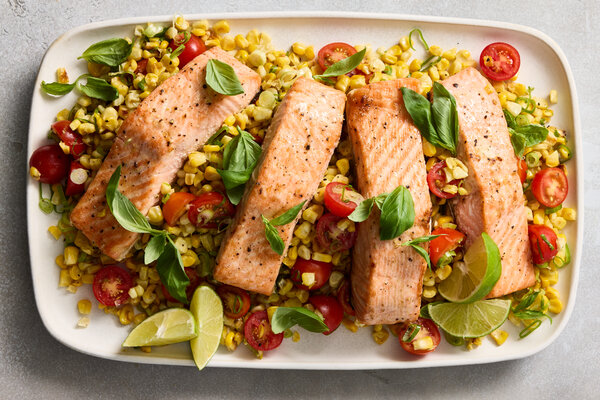
Monday starts with overnight oats prepared Sunday evening — mango and coconut version, topped in the morning and eaten at the kitchen table before the day begins. A mid-morning walk produces a light hunger that’s addressed with Greek yogurt, honey, and a handful of walnuts. Lunch is a grain bowl — farro from the Sunday prep batch, with roasted cherry tomatoes, shredded grilled chicken, cucumber, and the tahini lemon dressing. Afternoon has the grazing plate while working. Dinner is the sheet pan salmon situation, roasted with cherry tomatoes and zucchini, served over the remaining farro with a handful of rocket and a squeeze of lemon.
Wednesday is a more active day with a morning Pilates session followed by a longer walk. Breakfast is the soft scramble on sourdough with fresh herbs, eaten post-workout when hunger has arrived properly. Lunch is the soba noodle bowl, which was assembled in fifteen minutes using components partly prepared earlier in the week. Dinner is pasta with the fast summer tomato sauce, with prawns, and an entire portion of joy.
Saturday is social — a long lunch at a friend’s house that extends into the afternoon. The eating is whatever is served and it is eaten with full pleasure. Dinner is light — a large salad with leftover grilled chicken from the fridge and a piece of good bread, eaten on the balcony as the evening cools.
This is summer eating as a practice rather than a protocol. It is nourishing and intentional and also genuinely pleasurable, which is the only version of eating well that I’ve ever seen sustain itself over any meaningful length of time.
The Last Word: Food as a Love Language — to Yourself
I want to end with something I believe deeply and return to whenever I find myself getting too strategic about eating: food is one of the most fundamental ways we take care of ourselves and the people we love.
The summer meals I’ve described in this article are not primarily prescriptions for an active lifestyle, though they support one. They are an argument for eating beautifully — for using the extraordinary produce of summer, for taking the time to make things that look as good as they taste, for sitting down to meals that feel like occasions rather than fuel stops, for sharing food with people you care about in the long golden evenings that summer provides.
The woman who eats this way — who cooks the salmon with the cherry tomatoes and herbs, who makes the cold soba bowl with the colors arranged carefully, who keeps a jar of infused water in the refrigerator not because she read somewhere she should but because it gives her pleasure every time she opens the door — she is not following a diet. She is expressing a relationship with herself and her body that is rooted in care and pleasure simultaneously.
That is, I think, the most elegant approach to nutrition that exists. Not restriction, not optimization, not the management of macros and metrics — but the simple, daily practice of feeding yourself beautifully, with the best available ingredients, in ways that support everything you’re building in your body and your life.
Summer gives you the ingredients. The rest is yours.
This article is part of the Elegant Women Streetwear lifestyle series, where wellness, style, and the art of living well are explored as one continuous conversation. Save it for the morning you’re standing in a market surrounded by summer produce and you want to know what to do with it. Share it with the friend who wants to eat better but doesn’t want to stop enjoying food. And then — go make something beautiful.
ELEGANT WOMEN STREETWEAR · LIFESTYLE SERIES · ARTICLE 5 OF 5