
By the editors of Elegant Women Streetwear | Fashion & Style | May 2026
There is a particular kind of summer dressing that I have been chasing for most of my adult life — the kind that looks like you thought about it for exactly the right amount of time. Not too little, which reads as careless. Not too much, which reads as trying. Just… exactly right. The kind of outfit that makes someone across a restaurant glance twice and think, without being able to articulate why, that you have something figured out.
I used to think this was a talent you either had or didn’t. A genetic inheritance, like good bone structure or the ability to parallel park. Some women just knew — the French woman in the linen dress, the New York woman in the white blazer, the woman at every outdoor dinner you’ve ever attended who seemed to be doing nothing special and somehow looked more put-together than everyone else combined.
What I eventually understood — and what I want to share with you over the next however long it takes you to read this — is that effortless summer dressing is not a talent. It’s a philosophy. It’s a small number of well-understood principles applied with consistency, and once you have those principles, you stop shopping frantically every June and start building something that actually works.
This is what I know about summer 2026, about what’s working, what’s evolved, what the most elegant women are actually wearing right now, and how to do all of it in a way that feels like yours.
Why Summer Dressing Feels So Hard (And Why It Doesn’t Have To)
Let me acknowledge the particular difficulty of summer fashion first, because I think it’s real and it’s underacknowledged.
Summer presents a genuine sartorial challenge that the other seasons don’t quite replicate. In winter, layering is your friend — you can build almost any outfit into something interesting with the right coat, and a coat covers a multitude of choices made in haste. In autumn, the palette practically dresses you: rust and camel and burgundy and forest green are so inherently beautiful together that coordination is almost inevitable. Spring has that lightness that makes getting dressed feel like optimism made wearable.
Summer asks you to show up with very little. The heat eliminates most of your structural options. Layering becomes a logistical problem rather than an aesthetic tool. And yet summer is also the season of the most social moments — the dinners outside, the weekend trips, the occasions where you’ll absolutely be photographed and where how you look will be documented more than at any other point in the year.
The pressure, in other words, is highest precisely when the options feel most limited.
Add to this the particular chaos of summer fashion marketing — the relentless June bombardment of vacation edits and beach capsules and “hottest trends of summer” listicles, which seem designed specifically to make you feel that what you already own is inadequate and what you’re about to buy is essential — and you have a recipe for the kind of frantic, expensive, ultimately unsatisfying summer shopping that most of us have experienced at least once and that leaves you, come September, with a closet full of things you barely wore.
I’ve done that. Several summers of it. And the antidote, I discovered, is not more options. It’s clarity.
The Summer 2026 Fashion Landscape: What’s Actually Happening
Before I get into the specific outfits and the philosophy behind them, let me orient you in the actual moment, because summer 2026 has a particular character that’s worth understanding.
We are in the second or third year of a significant cultural pivot in fashion — away from the relentless trend cycle and toward something slower, more personal, more enduring. The aesthetic vocabulary of this moment draws on quiet luxury, clean girl, soft dressing, and what I’d call intelligent casual — the understanding that ease and elegance are not opposites but collaborators. The most stylish women right now are not those who are most up-to-date on what’s trending; they’re the ones who have developed such a clear relationship with their own taste that everything they wear reads as deliberate.
Specifically for summer 2026: the silhouettes that matter are relaxed but structured. Volume at the top or volume at the bottom, rarely both simultaneously. Length has become genuinely interesting — not the micro-mini that comes back every few years and works for almost no one, but a midi that hits somewhere between the knee and mid-calf, the exact length that photographs beautifully and actually flatters the widest range of bodies. The linen moment that began a few summers ago has matured and refined — it’s no longer about wrinkled-on-purpose bohemia but about linen that’s actually well-cut, in neutrals and unexpected dusty shades that feel modern rather than folkloric.
Color is quieter than it’s been in previous summers. The maximalist color energy of a couple of years ago has given way to something more considered: a palette that anchors in warm neutrals — ivory, sand, warm white, camel — with individual moments of depth. Terracotta has had its turn and is settling into the permanent repertoire. A particular shade of dusty sage keeps appearing in the collections and on the streets in a way that suggests it’s not going anywhere. Chocolate brown, which felt daring in summer five years ago, now reads as a natural choice. And white, always, in the fullest, most committed versions — not cream, not off-white, but the kind of white that requires conviction and effort to wear and rewards you handsomely for both.
Fabric is having a serious moment, which I find extremely gratifying. The quality of what something is made from has become as much of a fashion statement as its design. Women who are investing in their wardrobes now are asking about thread counts and fabric composition and whether a linen is a loose weave or tight, in the same way that a previous generation might have asked about brand names. This is a genuinely lovely evolution, and it tracks with the broader move toward fewer, better things.
The elegant streetwear that has become the dominant aesthetic for the kind of fashion-aware woman this piece is written for — and by this I mean the intersection of street credibility and elevated taste, the blazer worn with straight-leg denim, the silk slip dress worn with minimal sneakers, the beautiful trouser worn with a simple white tee — this is having its fullest summer yet. It has never looked more confident. It has never looked more effortless.
The Foundational Summer Outfit: White and Why It’s Everything
I want to begin with white because it’s where I always begin mentally when summer comes, and because I think it’s the most honest possible starting point for a piece about effortless summer dressing.
White in summer is not a cliché. It’s a philosophy.
The right white outfit — and I’ll spend some time on what “right” means, because not all whites are created equal — has the extraordinary quality of making you look as if you’re exactly where you’re supposed to be, doing exactly what you’re supposed to be doing, feeling exactly how you’d want to feel. A well-cut white linen wide-leg trouser with a simple white cotton tee, tucked just enough to suggest intention but not so precisely that it looks effortful — this is, I would argue, one of the most effective outfits in the entire summer arsenal, and it costs less thought than almost anything else.
The details matter here in ways that distinguish a transcendent white outfit from a merely white outfit. The fabric quality is everything — cheap white fabric reads immediately, both in how it falls and how it photographs. Look for a weight that has presence: linen that’s dense enough to drape without going see-through, cotton that has a slight thickness, poplin that holds its shape. The cut needs to be deliberately generous in a way that suggests consideration rather than approximation — there’s a specific kind of oversized that works and a specific kind that simply looks wrong, and the difference is in whether the proportions are intentional. And the state of the white matters: brilliant, pure white that’s been kept that way through care and attention is one of the most impactful things a woman can wear. Slightly greying white, or white with the faintest trace of yellow, is unfortunately the opposite.
A white linen blazer over a white or ivory tank with white or linen-colored wide-leg trousers is the kind of tonal white outfit that has been spreading across Instagram and Pinterest this summer in a way that suggests it has genuinely entered the canon. It’s architectural without being stiff. It’s minimal without being cold. It requires exactly two things: fabric quality and correct fit. With those two elements in place, you will look extraordinary.
And then there is the white dress, which is its own enormous topic and one I love enormously. The white summer dress, this summer specifically, is doing its best work in a midi silhouette — something that falls to mid-calf, in a fabric that moves with you rather than against you. A smocked top with a full skirt gives you a feminine ease that works at the beach and at dinner. A straight-cut slip in a heavier satin or silk does something entirely different — quieter, more intentional, more evening. A wrap style in lightweight linen offers the everyday version, the one you grab without thinking and that looks as if you gave it significant thought.
White is not safe. I want to push back on that perception, because I hear it often and I think it’s categorically wrong. White is bold. White is the choice that says you’ve edited, that you’ve committed, that you’re not hedging with print or color or distraction. White, worn with confidence, is one of the most powerful fashion statements available. And in summer, it is also simply the most beautiful thing you can put on your body.
Linen: The Most Elegant Summer Fabric, Done Right
Let’s spend some real time on linen, because it deserves it, and because the relationship between a woman and linen is one that requires some refinement before it becomes genuinely flattering.
Linen has been through a journey in fashion consciousness. It went from purely utilitarian (the fabric of tablecloths and grandmother’s trousers) to briefly bohemian (the wrinkled, artisanal, beachy version that dominated coastal grandmother aesthetics) to where it is now: genuinely elegant. Sophisticated. A fabric of choice rather than compromise. The evolution happened in parallel with the quiet luxury movement’s insistence on natural materials and understated quality, and linen was perfectly positioned to benefit.
What makes linen exceptional as a summer fabric is simple physics: it is one of the most breathable textiles in existence. The weave allows air circulation in a way that cotton, for all its virtues, doesn’t quite achieve at the same level. It gets better with washing. It has a particular drape when it’s well-made that looks expensive in a way that’s very difficult to fake with synthetic alternatives. And it has a texture — visible, present, slightly imperfect — that gives it a quality no other fabric can replicate.
The key to wearing linen elegantly, which is something I had to learn through several summers of doing it less elegantly, is understanding the relationship between weight and silhouette. Lighter-weight linen — the kind that’s almost sheer in a certain light — works best in wider, more generous silhouettes, where the floatiness is the point. Heavier-weight linen — the kind that holds a structure, that could almost hold a crease — is the one that translates into more tailored pieces: the blazer, the trouser, the button-down shirt.
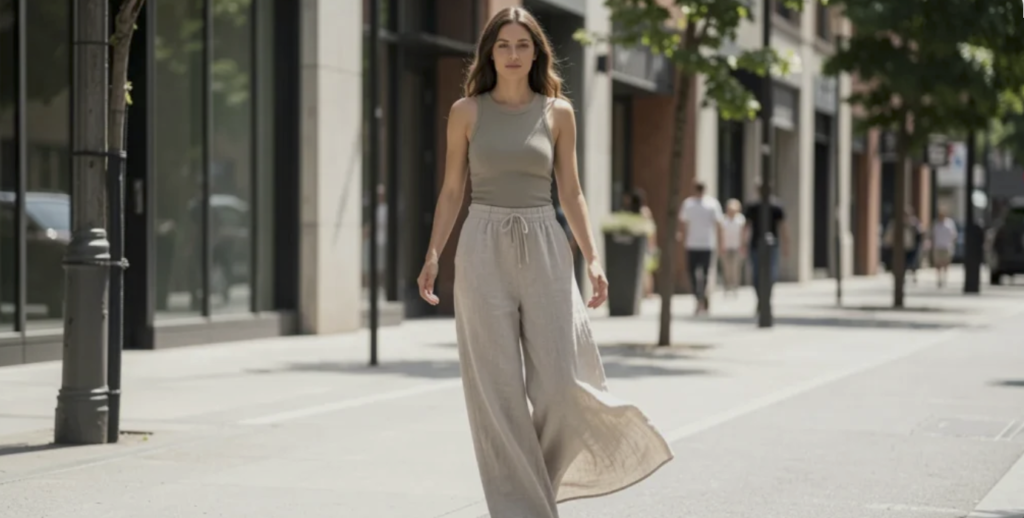
The linen trouser is perhaps my single most-worn summer piece, and has been for two years now. I have several — in ivory, in a warm oat, in a shade that’s almost the color of a paper bag and somehow deeply flattering on a range of skin tones — and they work with almost everything: a simple tank, a tucked-in shirt, a silk blouse that creates a beautiful contrast in texture. The key is fit: linen trousers need to be cut with a relaxed leg that allows for natural movement without bunching, and they need to be long enough that they don’t read as cropped unless the cropping is clearly intentional.
A linen shirt, particularly in a slightly oversized style that can be worn open over a camisole or fully buttoned as a dress — I have been reaching for this so consistently that it’s become what I’d call a summer uniform piece. It transitions from morning coffee to beach to dinner in a way that almost nothing else manages. The crucial detail: cuffs that can be rolled and kept rolled without falling down. A small thing. Changes everything.
The linen dress — and in 2026, specifically, the linen midi dress — is the piece that has genuinely completed my summer wardrobe in a way I hadn’t anticipated. There’s something about the length combined with the fabric that creates a proportion impossible to achieve with any other combination. It moves beautifully. It photographs beautifully. It feels, when worn, like exactly the right thing — unhurried and considered and entirely of this summer.
The Silk Moment: Quiet Luxury’s Summer Statement
If linen is the democratic summer fabric — accessible, practical, universally flattering when chosen well — silk is the aspirational one. The one that elevates an outfit from nice to quietly extraordinary. And silk, in summer 2026, is having a proper moment.
The silk slip dress is the piece I want to talk about first, because it’s the most direct expression of what silk does for summer dressing. At its simplest — and simplicity is the point — it’s a bias-cut or straight-cut dress in a satin or crepe silk that falls against the body with a particular kind of grace that no other fabric replicates. It clings slightly without being tight. It moves with you without being shapeless. It catches light in a way that makes the most ordinary dinner feel like an occasion.
The current iteration of the slip dress in 2026 has evolved past the bare, barely-there version of a few years ago. The silhouettes are slightly more substantial — longer, sometimes with a subtle gathering or ruching, occasionally layered with a coordinating robe or longline cardigan for daytime wearability. The color palette is staying close to skin: champagne, rose gold, warm ivory, the palest possible sage. These shades photograph as almost nude from a distance and reveal their depth up close, which gives the wearer a quality that I find genuinely magnetic.
Silk beyond the slip dress: the silk top, in particular the silk camisole or the silk button-down, is doing significant work this summer in the elegant streetwear context. A silk camisole tucked into a really well-cut linen trouser is an outfit of almost absurd elegance for how little thought it appears to require. The contrast in texture between the silk’s liquidity and the linen’s grain creates a visual interest that printing or embellishment would do clumsily. It’s the kind of combination that the French have been perfecting for decades and that the fashion world keeps rediscovering.
Silk also works in the form of the wrap skirt — a category I’d underestimated until this summer, when I acquired one in a dusty old-rose and discovered that it might be the most versatile single garment I own. Tied loosely, worn with a simple white tee and flat sandals, it’s an afternoon outfit of complete ease. Tied more deliberately, with a silk camisole tucked in and a small heel, it’s the perfect dinner look. It packs to almost nothing. It requires no ironing. It makes you look, always, like you just arrived from somewhere beautiful.
A note on real versus faux silk, because I know it’s a conversation: the difference in how a garment falls, moves, and feels against the skin is significant enough that I’d always encourage choosing real silk when it’s within reach. That said, the technology behind silk alternatives has improved dramatically in recent years, and there are now faux silk fabrics — particularly those made from Tencel or BEMBERG — that drape with convincing grace and are completely appropriate for the elegant summer look. The key test remains the eye test: does it look like a fabric that has weight and character, or does it look like it’s trying?
The Outfit Equation: Summer Combinations That Never Fail
I want to give you a set of outfit frameworks — not rules, but reliable starting points — because I find the concept of frameworks more useful than outfit prescriptions. A framework is flexible; it accommodates what you actually own and what your life actually requires. A prescription becomes irrelevant the moment your body, your wardrobe, or your plans don’t match the scenario exactly.
The Tonal Look. Choose one color family and dress entirely within it, varying the depth and texture rather than the hue. An ivory linen blazer over an ivory silk camisole over ivory wide-leg trousers. A camel silk camisole with warm white linen trousers. A dusty sage dress with sage-toned slides. The tonal look reads as highly intentional and requires zero effort in coordination — all of the mental work happens in choosing a single color you love and committing to it. It photographs extraordinarily. It elongates the silhouette. It is, in my view, the most reliably elegant summer option for any occasion.
The Textural Contrast. Choose two pieces in the same or near color family but in opposing textures. The example I keep returning to: a heavy cotton oversized tee with a silk midi skirt in a similar neutral. Or a linen blazer with a silk slip dress underneath. Or a cotton canvas tote with a silk blouse — the accessories count. The contrast between matte and sheen, between rough and liquid, between structured and draped creates visual complexity that makes an outfit look as if you’ve thought about it more than you have. This is perhaps the most reliable shortcut in elegant summer dressing.
The One Bold Piece. Build your entire outfit from neutrals — white, ivory, sand, camel, light grey — and introduce a single piece that carries all the personality. This could be a color: a pair of terracotta linen trousers in a sea of white and ivory. A deep burgundy silk camisole against white everything else. It could be a print: one beautifully printed silk scarf tied at the neck or in the hair. It could be an accessory with strong presence: a sculptural bag in a color, a pair of gold earrings substantial enough to be noticed. The formula requires discipline — the rest of the outfit must stay completely neutral, or the bold piece loses its power — but when executed correctly, it gives you an outfit that reads as both considered and individual.
The Elevated Basic. This is the formula that comes closest to real effortlessness: take the most basic possible outfit and upgrade every individual element to the best possible version of itself. Not a white tee — the white tee. The one in a fabric so perfect, a cut so flattering, that it looks like a garment with intentions. Not jeans — the exact pair of high-rise straight-leg jeans in a fade so considered it’s almost architectural. Not sneakers — white leather sneakers so clean and minimal they feel like a fashion statement. The elevated basic works because it harnesses the power of simplicity while refusing to compromise on quality. The investment is almost entirely in choosing the individual pieces carefully; the combination takes care of itself.
The Dress as Outfit. The most effortless option of all: one piece, no coordination required. This only works when the dress itself is remarkable — when the fabric or the cut or both are doing enough work that no amount of styling could add to it. The white linen midi dress. The silk slip in champagne. The oversized shirtdress in olive or stone. These are outfits in themselves, complete, and they require the smallest possible number of decisions from you: a shoe, a bag, whether or not to add a small piece of jewelry. Done.
Summer Shoes: The Decision That Changes Everything
The shoe is where the summer outfit either completes or collapses, and I want to talk about it with the seriousness it deserves, because this is consistently where I see beautiful summer outfits go wrong.
The flat sandal is the foundational summer shoe, the one that works with almost everything in an elegant wardrobe. But not all flat sandals are equally useful, and the distinction matters. The sandals that work with elegant summer dressing — the linen trousers, the silk dresses, the elevated basics — are those with clean, simple lines. A thin leather strap, or two, or three — but positioned with intention, not haphazardly strappy. A sole that has quality to it. A toe that has not been corrected into the pointed excess of a trend that will pass, but a natural, slightly tapered shape that works.
The specific sandal styles worth owning, for summer 2026: a simple leather slide in tan or cognac that goes with absolutely everything warm in your wardrobe. A white or ivory sandal — slightly more expensive to keep looking good, infinitely more effective at making an outfit look deliberate. A sandal with a very slight platform, just enough to create length without the commitment of a heel — this is the secret middle option that manages to be both comfortable and flattering in a way that neither pure flat nor full heel achieves.
The mule has become the summer heel I keep reaching for: that backless slip-on with a small block heel or a kitten heel that’s comfortable enough for actual use while adding the elevation that changes the proportions of an outfit dramatically. A linen trouser with a flat sandal is elegant. The same linen trouser with a small-heeled mule in the same color family is extraordinary. The difference is perhaps two centimeters of height and a disproportionate shift in how the whole look lands.
The minimal sneaker deserves its own paragraph, because I think it’s one of the great summer shoe revelations and one that the elegant streetwear aesthetic is built on. A clean, well-maintained white leather sneaker with essentially any elegant outfit creates the exact combination of dressed-up and dressed-down that is the hallmark of good fashion instinct. A silk slip dress with white sneakers. A white linen set with white sneakers. A beautiful midi skirt with white sneakers. This combination says: I care about how I look, and I also know that comfort is not the enemy of elegance.
What summer 2026 is not: platform foam sandals, ultra-chunky everything, the maximalist shoe that competes with rather than complements the outfit. The direction of elegant summer footwear is quieter, more intentional, more aligned with the principle that the shoe should make the outfit better without demanding its own attention.
The Summer Bag: Functionality as Aesthetic
There’s a very particular satisfaction in a summer bag that is genuinely beautiful and genuinely functional — the satisfaction of something that doesn’t require compromise.
The summer bag landscape in 2026 reflects the same values as everything else I’ve been describing: quality materials, considered design, an aesthetic that is about substance rather than logomania. The bags I keep seeing on the women whose style I most admire are either very structured or very relaxed, with almost nothing in between: the clean, small, top-handle bag in leather that could work from morning to evening, or the generously sized woven tote that holds everything you actually need for a day and looks better for being full.
Woven bags have been building in relevance for a few summers now, and in 2026 they have solidified into something essential. Not the obvious raffia-on-the-beach version, though that has its place, but a more sophisticated iteration: bags woven from leather or high-quality straw in a pattern intentional enough to read as design rather than decoration. The size tends toward generous, the palette tends toward natural — sand, camel, warm white, occasional touches of tan — and the construction is precise enough that the bag holds its shape even when full.
The small leather shoulder bag or crossbody has become the evening option of choice for a summer that’s been returning to slightly more intentional dressing. Something that holds a phone, a card, a lip balm — nothing more than what the evening actually requires. In a cognac or warm brown leather, or in cream, or in a deep burgundy for something more evening, this bag has the quality of a piece that will outlast every trend currently operating, and knows it.
On the topic of bags and logos: the quiet luxury moment has not killed the status bag, but it has changed the conditions under which it works. The very recognizable, very logo-heavy bag reads differently now than it did even three years ago — not necessarily wrong, but less straightforwardly right. The bags that work in the current aesthetic, even at the luxury level, tend toward those where the design carries the quality signal rather than the branding doing the work. This is a shift worth noting if you’re considering a bag investment: what does this bag look like when you cover the hardware?
Jewelry for Summer: Less, Louder, and the Art of the Single Statement
The jewelry philosophy that works best with elegant summer dressing is perhaps the most personal of all the elements — because jewelry is the most direct expression of individual taste, the piece of an outfit that’s least about trend and most about character. But there are still principles worth discussing.
The summer 2026 jewelry moment is doing something interesting: it’s moved away from both the maximalist layering of a couple of seasons ago and the clinical minimalism that preceded it, into a middle space that I’d call purposeful presence. One or two pieces, chosen with intention, worn with conviction. Not nothing, but not everything. The statement earring that is the only jewelry on the face and neck. The substantial cuff worn alone on one wrist. The layered necklace — two or three fine chains — that creates its own subtle texture without becoming ornate.
Gold has solidified as the dominant metal of this moment, as it has been for a few years now. The specific gold that’s working: not flashy, not yellow-gold-as-status-signal, but a warm, slightly muted gold — antique gold, brushed gold, 18-karat gold that shows its actual quality in its restraint. Silver is returning gently, particularly in the context of summer whites and pale linens where it creates a cooler, slightly crispier counterpoint. Mixed metals, which were considered sartorial heresy not long ago, have earned their place when the mixing is done with intention rather than accident.
The earring is where most of the summer jewelry action is, and where I spend most of my attention. A sculptural hoop — not the thin, fine hoop but the kind with actual presence, either in its size or its shape — has become my near-daily choice with summer looks. It adds structure to the face in a way that’s particularly welcome in summer, when the generally softer, more minimal approach to makeup benefits from something architectural nearby. The statement earring for evening — something that moves slightly, or catches light, or has a quality of craft about it — is doing the work that a layered jewelry moment would do in winter, but in a more concentrated, considered way.
Worth mentioning: the increasingly beautiful world of artisanal and vintage jewelry that has been growing in relevance through social media and specifically through Pinterest, where the finds from markets and small jewelers get circulated far beyond their physical location. A beautiful piece of vintage gold jewelry — a brooch worn at the collar, a pair of clip earrings inherited or found, a substantial link bracelet from another decade — has a character that no amount of new-jewelry spending can replicate. These pieces are conversation starters. They have stories. And in an aesthetic moment that values genuineness and individuality over conspicuous newness, they are genuinely powerful style choices.
The Summer Hair-and-Skin Equation with What You’re Wearing
I can’t write a 7000-word piece about summer outfits without acknowledging that what you’re wearing works in partnership with how you look, and that summer specifically creates a set of conditions where that partnership requires attention.
The heat of summer changes the relationship between skin and clothing. The clothes that work best — the linens and silks and lightweight cottons — are those that allow the skin to do what it needs to do without fighting the garment. But this also means that skin is more visible in summer than any other season, which has implications for how you prepare and care for it.
The current beauty aesthetic that pairs most naturally with elegant summer dressing is what gets called skin-first beauty — the philosophy that the goal is luminous, healthy, clearly cared-for skin, with makeup used to enhance rather than to cover. A cream blush in a warm peach or coral, blended high on the cheekbone. A mascara that defines without dramatizing. A lip in a sheer gloss or a soft tinted balm. A sunscreen that finishes well enough to wear alone, and which you’re reapplying throughout the day because SPF is non-negotiable in summer.
This approach — and I know I’m simplifying a more complex beauty routine — creates a face that partners effortlessly with the kind of summer outfits we’ve been talking about. A silk slip dress with a heavy, full-coverage makeup look is a visual non sequitur. The same dress with flushed, glossy, clearly alive skin is an aesthetic statement. The simplicity of the clothes asks for simplicity of the face, and the two together create a coherence that registers as genuine elegance.
Hair in summer has a practical dimension that has to be incorporated into the aesthetic. The humidity, the heat, the salt water, the general increased activity of the season — these are realities that style has to accommodate. The hair approaches that work with elegant summer dressing tend to be those that have a quality of deliberate undone-ness: the low bun that’s slightly loose at the temples, the half-up style that keeps the hair off the face without the severity of a full updo, the slicked bun of clean girl aesthetics that requires only a comb and a gel and creates an immediate impression of polish.
The relationship between hair and jewelry in summer is particularly interesting: when you pull your hair back — which the heat will eventually demand — your earrings become significantly more visible and therefore more important. A pulled-back style with beautiful earrings is one of the simplest, most effective summer beauty-and-style combinations available. The earrings do more work when there’s no competing detail. The hair being off the face shows your skin. The overall effect is one of a woman who is entirely comfortable in her own presentation.
What to Wear to Every Summer Situation (Actually, All of Them)
Rather than giving you outfit formulas for every conceivable scenario, I want to talk about the three or four summer situations that most of us actually encounter, because I think specificity is more useful than comprehensiveness.
The Weekend Day with No Specific Plans. This is actually the hardest category, because the absence of requirement creates a vacuum that can lead to either inspired dressing or getting dressed in the most proximate thing available and regretting it by 11 a.m. My current answer to the weekend day: linen trousers in a neutral, the white tee or tank that fits perfectly, flat sandals or clean sneakers, sunglasses with some presence, a woven bag. This is done in under five minutes of decision-making, looks completely deliberate, and works for coffee, for a market, for lunch, for an afternoon gallery visit, for most things that Saturday and Sunday actually contain.
The Dinner Outside. Summer dinner — outdoors, warm evening, the particular social occasion that defines the season — is where I see women struggle most with dressing. The instinct is often to try harder, to reach for something more obviously occasion-appropriate, and the result is frequently a mismatch between the relaxed warmth of an outdoor dinner and the formality of the outfit. My approach: the silk element is key here. A silk slip dress in a beautiful shade. A silk camisole with a beautifully cut trouser. A silk skirt with a simple blouse. The fabric does the occasion-elevation without the outfit becoming stiff. Add a heel of some kind, gold earrings, and something that smells extraordinary, and you’re entirely right for the occasion.
The Travel Day. The airport and the transit day are a particular challenge in summer because the temperature shifts from the freezing of aircraft to the heat of the arrival can be dramatic and because a day of travel requires both comfort and, ideally, some dignity of appearance. My current summer travel outfit: a linen oversized blazer (which can be removed, used as a blanket, and reapplied without wrinkling in any significant way), wide-leg jersey or linen trousers in a neutral, a simple tee, clean sneakers, and a bag that holds everything without losing its structural integrity. This works on a six-hour flight and at the destination immediately after landing.
The Working-From-A-Terrace-Somewhere Day. Which is to say: the day when you’re working but doing so from a beautiful place, and you want to look like a woman who works from beautiful places on purpose rather than someone who happened to open her laptop at an outdoor café. This is the occasion for the linen shirtdress, worn open over a simple bikini top if you’re at a beach location, or buttoned as a dress if you’re at a city café. It reads as dressed while allowing for the flexibility of a day that might go in multiple directions. With good sunglasses and a quality bag, it’s a complete look.
The Beach-to-Dinner Transition. The holiday scenario that requires the most logistical thinking: you’ve been at the beach or the pool, and you need to be at dinner in two hours, and the transition requires minimal effort and maximal impact. The solution I’ve landed on: a beautiful cover-up that is actually a real garment — not a see-through mesh thing designed to be removed immediately, but a proper dress or tunic in a linen or cotton gauze that can go over a swimsuit and then, with the bikini top removed and the right sandals and jewelry added, work for dinner. The line between beachwear and eveningwear in elegant summer dressing is more permeable than it used to be, and that permeability is a gift to anyone trying to navigate a holiday with minimal luggage.
Building Your Summer Capsule: What You Actually Need
I’ve been building toward this section throughout the piece, because I think it’s where the philosophy of effortless summer dressing gets most practical.
A summer capsule wardrobe — not in the prescriptive, here-are-the-exact-ten-items-you-need sense, but as a concept — is a small, coherent collection of pieces that work together, that you genuinely love, and that cover the actual variety of your summer life without excess.
The key word is coherent. Coherent means that the pieces share a color story, so that everything goes with everything without requiring matching decisions. Coherent means that the fabrics are related — mostly natural, mostly breathable, mostly in the weight range appropriate for your specific climate. Coherent means that the silhouettes complement each other rather than fight each other — that the proportions of your wider pieces work against the proportions of your narrower ones.
Building toward that coherence starts with color. Before you buy anything for summer, identify three or four colors that you genuinely love and that work on your specific skin tone in summer light. For most women, the answer is some version of white or ivory, some version of sand or camel, and one or two more specific shades — a dusty rose, a sage, a terracotta, a warm chocolate. These become your palette. Everything you buy that doesn’t fit the palette requires a specific and compelling reason.
Within that palette, what you need is simple: enough tops to create variety without feeling overwhelming (for most women, three to four is correct — two tanks or camisoles, one or two blouses), enough bottoms for the actual number of days in your week (again, three to four: a trouser, a skirt, a pair of shorts if they work for your life), two or three dresses of varying formality, and enough shoes and bags to create distinct looks without duplicating function.
That’s genuinely it. Everything else — the impulse summer purchase, the trend-specific piece that calls from the sale rack — should be tested against this question: does it go with at least three other things I already own? Does it fit my color story? Does it make me feel the way I want to feel this summer?
The answers, when you ask them consistently, are clarifying in a way that nothing else about shopping is.
The Quiet Luxury Summer Woman: Who She Is and How She Dresses
I want to paint a picture, because I find that having a character in mind — a woman whose style you can inhabit, even briefly, as a kind of north star — is more useful than any number of specific outfit suggestions.
She is not following trends this summer, exactly, though she’s aware of them and occasionally they overlap with what she already knows she loves. She has a wardrobe that’s small enough to know intimately — every piece, where she got it, why it’s still there — and large enough to dress for the full variety of her summer. She shops occasionally, carefully, for the specific piece that addresses a specific gap, and she resists everything else.
She wears linen and silk and good cotton in warm neutrals and quiet shades. She has one color that she keeps returning to — a dusty sage, a warm terracotta, a deep ivory — that has become almost a signature without her intentionally making it so. She wears flat sandals most days and switches to a small heel when the evening calls for it, and her shoes are always clean.
Her jewelry is minimal but present — a pair of earrings that she reaches for more days than not, a bracelet or ring that she’s worn long enough to feel like part of herself. Her bag is real leather, or a very good woven piece, and it’s neither too small to be useful nor so large that it becomes luggage. Her sunglasses have presence — they’re a considered choice, not an afterthought.
She has good skin — not because she has a complicated routine, but because she sleeps enough and drinks water and wears SPF every day and has a simple evening ritual that she’s been consistent about long enough to see results. Her makeup in summer is almost nothing: a tinted sunscreen, maybe a cream blush, a gloss on the lips when she feels like it. The skin is the point. She knows this.
She moves through the world with the ease of someone who has made her decisions and is living inside them rather than continuing to make them. She’s dressed before the day has demanded anything of her, and dressed well, which gives her a quality of presence that has nothing to do with trend or expense and everything to do with knowing yourself well enough to express it.
This woman is available to all of us. She’s not a type you’re born as. She’s a practice you build.
The One Piece I’d Tell You to Buy Right Now
If I had to collapse everything in this piece into a single recommendation — the one summer 2026 purchase that I’d make from any budget — it would be this: a really excellent white linen piece.
Not a whole outfit. One piece. The piece in white or ivory linen that makes the most sense for your life and your existing wardrobe. A blazer if you’re someone who layers. A trouser if you live in trousers. A dress if you’re a dress woman. A shirt that can be a shirt or, open and loose, a layer.
White linen, in its best form, is the single piece that can make almost anything else you own look better, more deliberate, more summer-appropriate. It’s the connective tissue of the elegant summer wardrobe. It’s what turns an outfit you’ve worn fifty times into something that looks freshly considered. It photographs beautifully. It wears beautifully. It communicates, without saying a word, exactly the kind of effortlessness that takes, as I said at the very beginning, exactly the right amount of thought.
Buy the white linen piece. Wear it all summer. Let it become one of those garments you remember in future years as belonging to a particular summer when you had your dressing figured out, when you walked into rooms and felt completely right, when the world was warm and the light was long and you wore what you needed to wear with exactly the ease you’d always been reaching for.
That summer is this summer. And it starts with what you put on in the morning.
In the End: The Most Effortless Thing You Can Do
Everything I’ve written here comes back to a single principle, and I want to end with it because I think it’s the truest thing I know about fashion and the most useful for building a summer wardrobe that actually works.
The most effortless thing you can do is know yourself.
Not in a vague aspirational way. In a practical, wardrobe-applicable way. Know what colors do something specific to your face. Know which silhouettes move right on your body and which fight it. Know what kind of woman you are: the one who needs ease and mobility, or the one who feels best with a little structure. The one for whom a heel is a pleasure or the one for whom it’s a negotiation. Know your actual life — the things you do, the places you go, the occasions that actually recur — rather than the life of the woman you’re imagining yourself as when you’re in a store.
With that self-knowledge in place, summer dressing becomes remarkably simple. You’re not shopping against yourself or for a fantasy version of your life. You’re choosing deliberately, for who you actually are, in the summer you’re actually having.
And that clarity, more than any specific piece or trend or formula, is what effortless looks like. Not the absence of thought, but the application of the right amount of it — exactly as much as needed, in exactly the right direction.
Here’s to your most beautiful summer yet.