
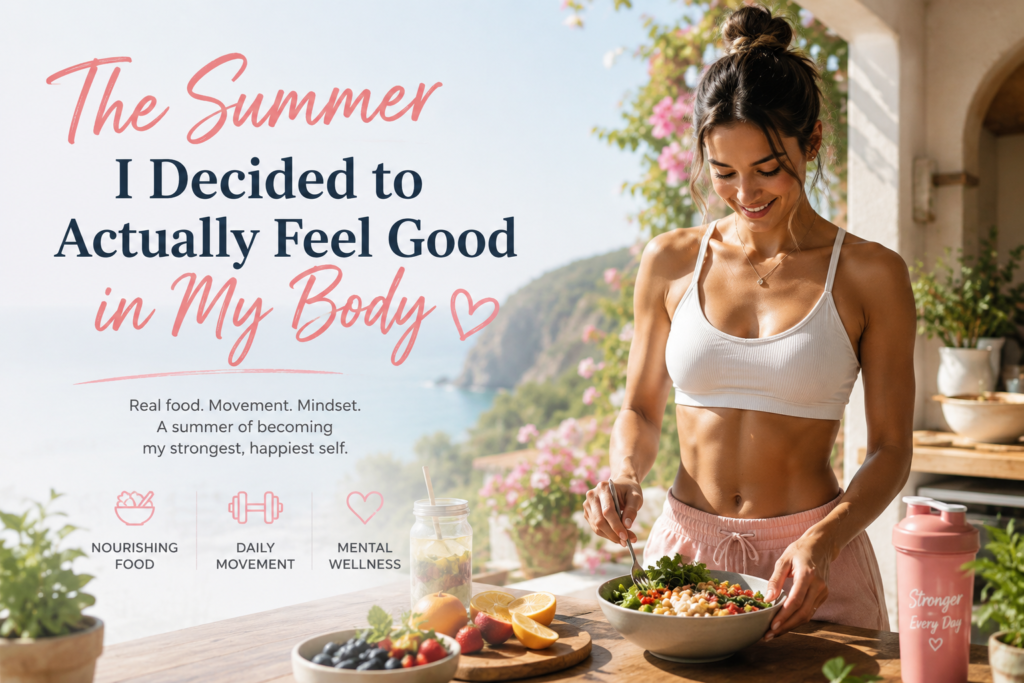
I want to be honest with you before we dive into anything — this is not one of those posts that’s going to tell you to eat less, exercise more, and magically become a different person by August. I have zero interest in that kind of advice, and honestly, neither do you. What I want to talk about is something far more interesting: the version of summer that actually feels good. The kind where you wake up with energy, where your skin has that inexplicable dewy glow, where you feel strong and at home in your own body. That version is entirely achievable, and it has nothing to do with deprivation.
I started this clean eating journey about three summers ago now, almost by accident. I had a week in early June where I genuinely just felt terrible. Bloated, sluggish, not sleeping well, and absolutely running on coffee and anxiety. My workouts felt like a punishment instead of something I actually enjoyed. My skin was dull. I looked in the mirror one morning after a particularly grim Tuesday and thought — okay, something has to shift. Not my weight. Not my dress size. My entire relationship with how I was fuelling myself.
That shift was one of the most quietly revolutionary things I ever did. And I want to share it with you, all of it — the recipes, the fitness habits, the mindset adjustments, and yes, some of the aesthetic elements too, because the truth is, how something looks matters when it comes to motivation. A beautiful meal, an outfit that makes you feel powerful walking into the gym, a kitchen counter arranged in a way that makes healthy choices feel natural and easy — all of it adds up.
“Eating well isn’t about willpower. It’s about building a life where the healthy choice is also the beautiful choice.”
So consider this your summer companion. Bookmark it, send it to a friend, pull it up when you’re standing in the grocery store aisle wondering what on earth to do with a bunch of rainbow chard. We’re going to cover everything: what clean eating actually means in 2026 (hint: it’s not austere), the summer recipes I genuinely eat every week, the fitness habits that have completely changed how I feel, and the lifestyle rituals that tie it all together. Let’s get into it.
✦ ✦ ✦
What ‘Clean Eating’ Actually Means in 2026 (And What It Doesn’t)
The phrase ‘clean eating’ has had a rough decade. It got hijacked somewhere around 2014 by a certain kind of wellness culture that made the whole thing feel simultaneously virtuous and exhausting — all restrictive food rules, photogenic smoothie bowls that took forty-five minutes to arrange, and a subtle undercurrent of judgment toward anyone who ate pasta. I’m not here for any of that.
Clean eating, the way I practice it and the way I’m going to talk about it throughout this guide, is genuinely simple. It means eating food that’s as close to its natural state as reasonably possible, most of the time. It means prioritising things that grew somewhere, that have colour and texture and nutrients your body actually recognises. It means reducing the ultra-processed stuff — the things with seventeen ingredients, most of which you can’t pronounce — not because they’re morally wrong, but because your body genuinely feels different when they’re not taking up the majority of your plate.
It does not mean perfection. It does not mean never having the pasta, or the glass of wine, or the dessert at that restaurant you’ve been wanting to try for months. The ‘clean girl aesthetic’ that’s been circulating everywhere from TikTok to Pinterest — that effortless dewy skin, the green juice on the kitchen counter, the linen outfits that somehow always look put-together — is actually built on sustainability, not restriction. The real clean girl secret isn’t that she never eats a croissant. It’s that the majority of her days are genuinely nourishing, so when she does indulge, it’s joyful rather than guilt-ridden.
The Principles I Actually Live By
Over the years, I’ve distilled clean eating down to a handful of principles that I actually follow in real life, as a person with a job and social obligations and days when the fridge is mysteriously empty at 7pm:
01. Eat as many different colours as possible throughout the day. Not obsessively, just noticing. A purple cabbage here, some golden turmeric there, a handful of blueberries in the morning. Colour means phytonutrients, and phytonutrients are one of the most powerful things you can give your body.
02. Prioritise protein at every meal. This is the single change that made the biggest difference to how I feel. When every meal has a solid protein component, energy is stable, cravings reduce, and you feel genuinely satisfied rather than hungry again ninety minutes later.
03. Whole grains over refined ones, most of the time. Not always. Not as a rule that causes anxiety. Just as a natural preference that has become habitual.
04. Fat is your friend. Avocado, olive oil, nuts, fatty fish — these are the foods that make your skin look like you’ve had eight hours of sleep and a facial, and they keep you full and your brain running beautifully.
05. Hydration is non-negotiable. This is the most boring piece of advice and also the most true. Everything looks and feels better when you drink enough water.
The other thing I want to say about clean eating in 2026 is that it’s become genuinely beautiful. The food world has caught up with what health-conscious eaters have wanted for years — ingredients that are nutritious and also visually stunning, recipes that feel elevated and restaurant-worthy rather than sad and utilitarian. We’re going to lean fully into that in this guide.
✦ ✦ ✦
Summer Recipes That Are Genuinely Beautiful to Eat
Summer is the best possible time to eat cleanly, and I say that with complete sincerity. The produce is extraordinary. Farmers’ markets overflow with things that need almost nothing done to them — a handful of cherry tomatoes still warm from the sun, herbs that are vibrant and fragrant, peaches that taste like a better version of every peach you’ve ever had. The work, if you can call it that, is almost effortless.
What follows are the recipes I genuinely rotate through every single summer. Some of them I’ve been making for years; others are newer additions that I’ve fallen in love with. All of them are the kind of thing that feels special enough to serve at a dinner party but easy enough for a Tuesday night. That combination is everything.
Morning: Starting the Day with Intention
Golden Hour Smoothie Bowl
I know smoothie bowls have been around for a while, but the version I’m going to share with you is not the sugar-loaded fruit explosion of early Instagram. This one is built around a genuinely protein-forward base and topped with things that are both beautiful and nourishing.
The base is frozen mango (about a cup), half a frozen banana, a scoop of vanilla plant-based protein powder, a generous tablespoon of almond butter, and just enough coconut milk to get your blender moving. Blend until it’s thick — resist the urge to add more liquid; you want it dense enough to eat with a spoon. Pour into your most beautiful bowl (because presentation genuinely makes food taste better, I stand by this), and then the toppings are where the magic is: sliced fresh mango and kiwi, a tablespoon of hemp seeds, a small handful of granola, a drizzle of raw honey, and if you can find them, a few dried hibiscus flowers for colour that is honestly stunning.
The nutritional profile here is everything your body wants in the morning — natural sugars that give you energy without the crash, protein to stabilize your blood sugar, healthy fats from the nut butter, and a spectrum of vitamins from the fruit. And it looks like something from a hotel brunch in Santorini.
The Savoury Breakfast Situation
On mornings when I want something more savoury — and this is probably three or four days a week — I come back to what I call my ‘green goddess eggs.’ This is embarrassingly simple: two or three eggs, scrambled softly in a little olive oil, served on top of a slice of good sourdough that’s been spread with ripe avocado and a pinch of flaky sea salt. On top of the eggs goes a handful of whatever fresh herbs I have — usually basil, dill, or chives — and a scattering of microgreens or baby arugula.
The secret addition that makes people ask what on earth is in this is a tiny drizzle of good quality extra-virgin olive oil over everything right at the end, and a few drops of lemon juice. It brightens the whole thing. It takes about eight minutes start to finish and it keeps me genuinely full until well past noon.
Midday: The Art of the Properly Satisfying Lunch
The Watermelon & Feta Summer Salad
This combination has been around forever and I refuse to pretend otherwise — but the version I make has a few additions that elevate it from a simple side to a legitimately satisfying main. You need a quarter of a small watermelon, cut into cubes or triangles, about 150 grams of good quality sheep’s milk feta, a handful of fresh mint leaves, half a thinly sliced red onion, and about a cup of arugula.
For the dressing: two tablespoons of good olive oil, one tablespoon of pomegranate molasses (this is the game changer — it adds a tangy sweetness that works with everything), a teaspoon of lemon zest, a little black pepper, and a pinch of chilli flakes if you like heat. Scatter the arugula on a large plate, arrange the watermelon and feta on top, add the red onion and mint, drizzle everything generously with the dressing, and finish with a handful of toasted pine nuts.
For protein: I often add some thinly sliced prosciutto draped over the top, or a few slices of grilled halloumi if I want to keep it vegetarian. Either way, this salad is visually stunning — the deep red and white and green against a beautiful ceramic plate is Pinterest-perfect without trying — and it tastes like summer distilled into a dish.
Cold Sesame Noodles with Edamame and Cucumber
This is the lunch that changed my entire summer meal prep strategy, because it is magnificent cold, it travels beautifully, and it takes about fifteen minutes to make. Cook about 200 grams of soba noodles according to package directions, then rinse them under very cold water until they’re completely cool — this is important for the texture. While they’re draining, whisk together the dressing: three tablespoons of tahini, two tablespoons of soy sauce or tamari, one tablespoon of rice vinegar, one tablespoon of sesame oil, a teaspoon of honey, a teaspoon of freshly grated ginger, and enough cold water to thin it to a pourable consistency.
Toss the noodles with the dressing, then add a cup of shelled edamame, one cucumber cut into thin half-moons, four spring onions sliced diagonally, and a large handful of shredded purple cabbage for colour and crunch. Finish with toasted sesame seeds and, if you like, a scatter of fresh coriander. This serves two generously, or one person for lunch and the next day’s too, because it keeps remarkably well in the fridge.
The protein content from the edamame combined with the whole grain soba makes this nutritionally excellent — you will not be hungry two hours later, I promise.
The Golden Hours: Afternoon Rituals and Snacks
I used to skip snacks entirely, thinking it was the disciplined thing to do, and I was wrong. The 3pm energy crash is real, and ignoring it doesn’t make you virtuous — it just makes you tired and irritable and far more likely to eat something you didn’t plan on at dinner. A properly constructed afternoon snack that has both protein and fat is one of the most genuinely useful habits I’ve built.
My current favourites: a small bowl of full-fat Greek yogurt with a drizzle of honey and a few crushed walnuts; half an avocado with a squeeze of lemon and flaky salt eaten with a spoon directly from the skin (unbothered, no shame); a small plate of sliced vegetables — cucumber, radishes, capsicum — with hummus that I make in large batches on Sundays; or a couple of medjool dates stuffed with almond butter, which sounds almost too indulgent for the middle of the afternoon but is actually nutritionally excellent and tastes like a dessert.
The key with all of these is the combination of fat and protein. Either one alone isn’t quite enough to hold you through to dinner; together, they are.
“The 3pm snack isn’t a weakness. It’s a strategy. The women who eat well at 3pm make better decisions at 7pm.”
Evening: Dinner as Ceremony
Lemon Herb Baked Salmon with Summer Vegetables
If I could choose one dinner to eat for the rest of the summer, it would be this one. The salmon almost cooks itself — you barely have to do anything — and the result is something that looks and tastes like it required real effort. Preheat your oven to 200°C. On a large baking tray, arrange a medley of summer vegetables: sliced courgette, halved cherry tomatoes, thin asparagus spears, and a few artichoke hearts if you can find them. Drizzle generously with olive oil, season with salt and pepper, scatter over some fresh thyme, and tuck in a few smashed garlic cloves.
Nestle two salmon fillets among the vegetables. Lay a few thin slices of lemon over the top of the fish, add a handful of fresh herbs — dill and parsley are perfect — and drizzle with a little more olive oil and a squeeze of additional lemon juice. Roast for 18 to 22 minutes depending on the thickness of your fillets. The fish should be just barely cooked through; if it flakes easily but still looks slightly glossy in the centre, it’s perfect.
Serve this on a large platter, family-style, with some crusty bread to soak up the juices, and maybe a simple green salad on the side. It is genuinely one of the most beautiful things to put on a table — all those bright colours against the golden salmon — and the omega-3 content alone makes your skin grateful for the next 48 hours.
The Grain Bowl That Actually Tastes Good
Grain bowls get a reputation for being boring, and that reputation is earned because most of them are. The secret to a grain bowl that you actually want to eat — that you would choose over the takeaway option without any feeling of sacrifice — is threefold: the grain needs to be well-seasoned and warm, the toppings need to have textural contrast, and the sauce has to be genuinely excellent.
For the base, I use a mixture of farro and quinoa cooked together in vegetable stock with a bay leaf and a little saffron if I’m feeling fancy, which gives it a beautiful golden colour. For toppings: roasted sweet potato that’s been seasoned with cumin and smoked paprika, a handful of chickpeas roasted until crispy, thinly sliced raw red cabbage, some quick-pickled cucumber (just cucumber slices in rice vinegar, salt, and a little sugar for twenty minutes), avocado, and a generous scatter of fresh herbs.
The sauce is the most important part: half a cup of tahini, juice of one lemon, a clove of garlic, a teaspoon of ground cumin, and enough cold water to make it pourable, with salt to taste. Drizzle this over everything and you have a bowl that is genuinely complex and satisfying and looks like it came from one of those very aesthetically considered health restaurants that charges twenty-five dollars a bowl. Yours cost about six dollars to make.
Hydration as a Beauty Ritual (Not a Chore)
I have a theory about hydration that I want to share with you, which is that most people don’t drink enough water not because they’re lazy but because plain water is not compelling. I am not going to stand here and tell you to just drink more water and leave it at that, because I know from my own experience that advice is about as helpful as telling someone to ‘just sleep more.’ Instead, let me tell you what has actually worked.
The thing that transformed my water intake was making it sensory and beautiful. It sounds ridiculous, but it’s genuinely true. When I started keeping a large glass carafe on my counter filled with water that was visually pretty — sliced cucumber and fresh mint, or strawberry and basil, or lemon and rosemary — I drank it because it was there and it was appealing. When I invested in a water bottle that I actually liked — one that felt good in my hand and kept things cold properly — I carried it everywhere.
Summer Hydration Combinations Worth Making
These are the combinations I come back to most often: cucumber and fresh mint, which is the most refreshing thing possible on a hot day; watermelon and lime, which looks extraordinary and tastes like a non-alcoholic cocktail; fresh peach and ginger, which is unexpectedly complex; and blueberry and lemon, which turns a gorgeous soft purple colour after about an hour. Make a large batch on Sunday and keep it in the fridge through the week.
Beyond infused water, I’ve become genuinely passionate about herbal teas drunk cold. Hibiscus cold brew — just steep dried hibiscus flowers in cold water overnight in the fridge — is the most beautiful deep ruby colour and is packed with antioxidants and naturally very slightly tart. I drink it over ice with a slice of orange and it feels like something from a rooftop bar. Green tea cold brew is another one I make constantly; it’s lighter and more delicate, and the L-theanine in green tea has a genuinely calming effect that I notice.
The baseline I try to hit is about two and a half litres of fluid on a regular day, more when I’ve exercised or the heat is significant. But I don’t count obsessively — I’ve found that when you’re eating whole foods that contain a lot of water (cucumber, watermelon, leafy greens, tomatoes) and drinking beverages you actually enjoy, the target becomes natural rather than effortful.
✦ ✦ ✦
Fitness Habits That Have Actually Changed My Body (And My Mind)
I want to be very transparent about something: I spent a long time approaching fitness as punishment for what I’d eaten, or as the price of admission for the body I thought I was supposed to want. That relationship with exercise is exhausting and ultimately unsustainable, and if it sounds familiar, I want you to know that it’s possible to completely rewrite it.
The fitness habits I’m going to share with you are the ones that I have maintained consistently for over two years now, not because I’m particularly disciplined but because they are genuinely enjoyable. That is the only test I apply to any habit at this point — is this something I look forward to, or at minimum don’t dread? If the answer is consistent dread, the habit will not stick, no matter how objectively good for you it is.
Strength Training: The Non-Negotiable
If you are not strength training and you want to make one change to your fitness routine this summer, please make it this one. I say this with genuine passion because strength training changed my body in a way that no amount of cardio ever did — and not in the way you might fear if you’re someone who has historically avoided it because of worries about ‘bulking up.’ What strength training actually does is build lean muscle mass that sits beautifully on the body, increase your resting metabolism so you burn more calories even at rest, improve bone density, and create a feeling of physical capability and strength that is honestly one of the best things I’ve ever given myself.
I train four times a week, following a split that works well for me: two lower body sessions and two upper body sessions. I train at a gym I actually like — this matters more than people admit — and I wear activewear that I feel good in, because vanity is not a dirty word when it comes to motivation. The current aesthetic in fitness fashion has moved beautifully toward what I’d describe as quiet luxury activewear: neutral tones, excellent fabrics, clean lines. Think bone, chocolate brown, warm grey, soft olive. The kind of set that looks as appropriate at a brunch as it does at the gym, which I appreciate immensely.
A Simple Starter Strength Routine
For anyone beginning with strength training, here is the routine I’d recommend starting with. Three days a week, with a rest day between each session, and you don’t need much equipment beyond a set of dumbbells:
Day one focuses on the lower body: squats, lunges, Romanian deadlifts, and glute bridges. Day two focuses on the upper body: dumbbell chest press, bent-over rows, shoulder press, and bicep curls. Day three is a full-body session: deadlifts, push-ups, a pulling movement, and core work.
Three sets of each exercise, eight to twelve repetitions. Rest for sixty to ninety seconds between sets. The weight should be challenging enough that the last two or three reps of each set feel genuinely difficult. This is the zone where adaptation happens; staying comfortably within your capability forever does not build strength or change your body.
Progress by increasing the weight slightly every one to two weeks when you can complete all sets and reps with good form. Keep a simple log — even just the notes app on your phone — of the weights you used. Watching those numbers increase over the summer is genuinely one of the most satisfying things you can do.
Walking: The Underrated Game Changer
I want to spend a moment on walking because it has become one of my absolute non-negotiables and yet it is constantly underrated in wellness conversation that tends to glamorise more intense forms of exercise. Here is what I know about walking: it reduces cortisol, it improves mood immediately and measurably, it supports metabolism and cardiovascular health, it is accessible and free and can be done almost anywhere, and it is sustainable for decades in a way that high-intensity training is not always.
I aim for around eight to ten thousand steps a day, which sounds like a lot but is achievable when you approach it with intention. Morning walks before I check my phone have become something I genuinely look forward to — there is something about movement and daylight in the first hour of the day that sets an entirely different tone. I listen to podcasts or music or sometimes just the sounds of wherever I am. In summer, when the mornings are already warm and golden by 7am, these walks feel like a genuine gift.
The evening walk has also become a ritual. Thirty minutes after dinner, which serves the dual purpose of getting movement and of genuinely aiding digestion and blood sugar regulation. It’s also when I process the day, think through anything that needs thinking, or have phone calls with friends. It doesn’t feel like exercise at all; it feels like a natural transition from day to evening.
Pilates and the Quiet Revolution in Women’s Fitness
I started Pilates about eighteen months ago and I want to be very clear: it is significantly harder than it looks. If you have ever seen someone doing reformer Pilates and thought it seemed gentle, I invite you to try a single session and report back. That said, the nature of the challenge is different from lifting heavy weights or high-intensity interval training — it is precise, controlled, deeply connected to breath and core engagement, and it creates a kind of body awareness that I had genuinely never experienced before.
The physical results of consistent Pilates practice are well-documented at this point: improved posture (perhaps the most visible change and one that affects how every single item of clothing fits), stronger deep core muscles that actually protect your spine and support your lower back, improved flexibility and joint mobility, and a lengthened, toned appearance to the muscles. But the mental benefits are what have made it indispensable for me. An hour of Pilates requires enough concentration that you genuinely cannot be elsewhere mentally — you cannot be planning dinner or worrying about the work email you didn’t send or scrolling through anything. It is present in a way that is almost meditative.
I do two reformer classes a week, and I consider this non-negotiable in the same way my strength sessions are. The combination of the two — heavy compound movements for strength and metabolic benefit, Pilates for mobility, posture, and core stability — is, in my honest opinion, the gold standard for a complete female fitness practice.
The Morning Movement Practice That Takes Fifteen Minutes
Not every day is a full workout day, nor should it be. Rest and recovery are when adaptation actually happens, and the body genuinely needs them. But I have found that even on rest days, some kind of intentional movement in the morning makes an enormous difference to how I feel. My minimum viable practice on rest days is fifteen minutes, and it looks like this:
Five minutes of gentle stretching — nothing structured, just moving into whatever stretches my body is asking for, which in summer often means hip flexors and hamstrings. Five minutes of what I’d describe as intuitive movement, which is a fancy way of saying I put on something I love and move in whatever way feels good. And five minutes of conscious breathing, usually a simple box breathing technique — four counts in, hold for four, out for four, hold for four — which has a genuinely calming effect on the nervous system that I find carries through the day.
It takes fifteen minutes. It doesn’t require changing into gym clothes. And it bridges the gap between a rest day and a training day in a way that keeps the habit of movement alive even when you’re not formally working out.
✦ ✦ ✦
The Clean Girl Aesthetic: Where Health and Style Intersect
I want to take a moment to talk about something that I think is genuinely relevant to how we approach health and wellness, which is the aesthetic dimension of the clean living lifestyle. The ‘clean girl aesthetic’ that has dominated social media for the past couple of years — the minimal makeup, the slicked-back bun, the glass of green juice, the white linen everything — is not just a visual trend. It represents a deeper shift in how women are choosing to present themselves: effortfully effortless, genuinely healthy-looking rather than made-up, strong and capable rather than decorative.
What I love about this direction is that it aligns health with beauty in a way that feels true. The dewy skin that’s all over Pinterest right now is not achievable with skincare alone — it is the result of hydration and sleep and good food and reduced chronic stress. The strong, defined physique that characterises the wellness aesthetic of 2026 comes from the gym and the kitchen together. The confidence and ease that radiates from women who embody this look is the direct result of actually feeling good, not just looking like you feel good.
Dressing for Your Active Life This Summer
The intersection of activewear and elegant casual wear has never been more sophisticated than it is right now, and as someone who genuinely cares about both fitness and style, I find it genuinely thrilling. The current direction — which I would describe as ‘quiet luxury activewear’ — has moved completely away from the hyper-coloured, logo-heavy aesthetic that dominated the early 2010s and toward something far more considered: premium fabrics in neutral tones, clean silhouettes that flatter the body rather than merely covering it, and pieces that transition seamlessly from workout to coffee to errands without requiring a full outfit change.
My current wardrobe rotation for summer active life: a good high-waisted legging in a deep chocolate brown or soft stone colour, paired with a cropped ribbed tank in ivory or cream. A matching set in a warm camel colour that photographs beautifully in natural light and feels like wearing nothing. For outdoor workouts or walks, a pair of elegant wide-leg training trousers — the kind that move like linen but perform like technical fabric — with a fitted long-sleeve top in a complementary neutral.
Footwear has become its own category of style statement in the wellness world. The current aesthetic leans toward clean, minimal trainers in neutral colourways — bone white, off-white, soft taupe — that work as much with the rest of the outfit as they do with the actual activity. Brands have responded to this with releases that are genuinely beautiful objects that happen to also perform excellently, and I’m here for it entirely.
The Jewellery of the Active Life
One of the small pleasures I’ve developed around my workout routine is the question of jewellery — specifically what to wear and when. For gym sessions where I’m lifting, I go completely bare except for my watch, because I’ve learned the hard way that rings and heavy bracelets are both uncomfortable and potentially risky with barbells. But for Pilates, for walks, for yoga, I have curated a small collection of pieces that I consider my ‘movement jewellery’: a very fine gold chain that sits close to the collarbone, small gold hoops that are too small to catch on anything, and a barely-there gold cuff that sits flat enough to not interfere with anything.
The soft glam aesthetic — which has been one of the defining beauty and style directions of the past eighteen months — translates beautifully to active life when approached with restraint. A little highlighter on the cheekbones before a morning walk, a tinted lip balm that gives the illusion of lip colour without needing to be reapplied, a simple slicked-back ponytail or bun that is simultaneously practical and elegant. You are not required to look like you just woke up when you go to the gym. You are also not required to do a full face of makeup. The middle ground — effortful in its effortlessness — is exactly where the current moment lives.
✦ ✦ ✦
Building the Lifestyle: Habits, Rituals, and the Week That Actually Works
Eating well and exercising are not things that happen in isolation — they happen within a life, and the success of those habits is entirely determined by how thoughtfully the life is structured around them. This is the section I wish someone had given me when I first started, because the recipes and the workout plans are the easy part. What makes them sustainable over months and years and eventually just becomes who you are is the structural stuff.
The Sunday Reset Ritual
Sunday afternoon is the foundation of my entire week, and I protect it with enormous care. This is the time, usually about ninety minutes to two hours, when I do the things that make the rest of the week exponentially easier. It begins with a slow walk to the farmers’ market or a visit to a grocery store I actually enjoy — not the most convenient one, but the one where the produce is beautiful and the experience of shopping feels like a pleasure rather than a chore.
From there, I come home and do a loose version of meal prep that I’ve refined over time. I don’t prepare complete meals for every day of the week — that feels too rigid and the food loses its appeal by Thursday — but I prepare the components that make good decisions easy: a large batch of grains (farro, quinoa, or brown rice) that can form the base of bowls or be stirred into soups; a tray of roasted vegetables that can go into everything; a jar of tahini dressing; a big batch of hummus; washed and dried salad greens stored in a container with a paper towel to absorb moisture.
This takes about an hour of actual work with some things in the oven simultaneously, and it means that on Tuesday night when I’m tired and have nothing planned, there is a good meal available that takes ten minutes to assemble rather than thirty minutes to make from scratch. That ten-minute gap between a healthy meal and reaching for the delivery app is everything.
The Workout Week Structure I’ve Found Works
After two years of experimentation, the weekly structure that works best for me is: Monday, Wednesday, and Friday for strength training; Tuesday and Thursday for Pilates or yoga; Saturday for a longer outdoor activity (usually a longer walk, a hike, or an outdoor swim if I can access one); Sunday as a rest day with just the light movement practice I described earlier.
The thing I had to learn, and this took longer than I’d like to admit, is that rest is not laziness. The days off from structured exercise are when your muscles repair and grow stronger, when your nervous system recovers, when your motivation and enjoyment of movement replenish. Treating rest as a reward rather than a concession changed everything about my relationship with training.
I also had to learn not to let perfect be the enemy of consistent. Weeks when the schedule falls apart — when there’s travel, or illness, or just a period of life when other things take priority — are not failures. A week of shorter workouts is better than no workout. A single Pilates session when I’d planned three still counts. The habit of showing up, even in reduced form, is worth far more than the perfect version of the routine.
Sleep: The Most Underrated Element of Any Health Practice
I’m going to spend some time on sleep because it is genuinely the most dramatic lever I’ve pulled in my own health and aesthetic journey, and it consistently gets less attention than nutrition and exercise because there’s nothing to sell around it. You cannot buy better sleep. You can create the conditions for it, and those conditions are worth taking seriously.
The changes that made the biggest difference to my sleep quality: a consistent bedtime and wake time, including weekends, which sounds terrible and actually becomes completely natural within about three weeks; a cool, dark, quiet room (I use blackout curtains and I cannot overstate the difference they make); no screens for at least forty-five minutes before bed, which I initially resisted enormously and now can’t imagine abandoning; and a very simple wind-down routine that signals to my nervous system that we are done for the day — usually a few minutes of stretching, a cup of chamomile tea, and some reading of an actual physical book.
Seven to eight hours of quality sleep visibly affects my skin within about forty-eight hours. The dark circles recede, the dullness lifts, there’s a quality to the skin that skincare products can support but cannot replicate. It affects my appetite regulation too — I am dramatically less likely to reach for high-sugar things in the afternoon when I’ve slept well the night before. And it affects my mood and my energy and my motivation to train. Everything connects.
“Good sleep is not a luxury. It is the infrastructure everything else is built on. Protect it accordingly.”
✦ ✦ ✦
The Mental Side: Mindset, Body Image, and the Real Goal
I’ve been thinking about how to write this section for a while because it feels like the most important one and also the hardest to get right without veering into territory that is either preachy or reductive. So I’m going to be direct and personal about it, in the way I would be with a friend.
When I first started paying attention to my nutrition and fitness, my motivation was almost entirely appearance-based. I want to be honest about that because I think it’s more honest than the ‘I just want to feel healthy’ line that people often give, and which is sometimes true and sometimes not entirely the whole story. I wanted to look a certain way. I had a very specific image in my mind, drawn from social media and fashion magazines and comparison to people around me, and I was pursuing it with a determination that, looking back, was not entirely healthy.
The shift that happened over time — and it was gradual, not a single revelation — was that I started to notice how I felt more than how I looked. I noticed that after six weeks of consistent strength training, I could carry my groceries up four flights of stairs without stopping. I noticed that after cutting out most of the ultra-processed food I’d been eating, my anxiety was measurably lower and my sleep improved dramatically. I noticed that on mornings when I’d been for a walk and eaten a good breakfast, I was kinder and more present with the people I love.
These things, the functional things, the how-I-actually-experience-my-life things, became the motivation. The appearance changes came anyway — they are a natural consequence of genuine health — but they stopped being the point. And when they stopped being the point, the whole endeavour became sustainable and even joyful in a way it had never quite managed to be before.
Social Media and the Clean Aesthetic
I want to say something about social media and the clean girl aesthetic because I think it’s worth naming honestly. The images we see — the perfect smoothie bowls, the impeccably organised pantries, the women who appear to glow at 6am in their neutral activewear — are curated, usually significantly. They represent the best moment of a day that probably also contained stress and ordinary tiredness and meals that didn’t look like art.
I find inspiration in the aesthetic — I genuinely do, and I don’t apologise for that. A beautiful image of a vibrant meal or an elegant workout outfit genuinely does motivate me in the way that beautiful things tend to. But I try to hold it lightly, to let it be inspiring rather than prescriptive, to remember that the goal is to feel good in my actual life, not to replicate someone else’s curated presentation of theirs.
The Pinterest boards and the Instagram accounts and the TikTok ‘what I eat in a day’ videos are useful when they expand your recipe repertoire or introduce you to a training style you hadn’t considered. They become less useful when they make you feel inadequate about your own version of the same efforts. The distinction is worth paying attention to.
The Body Neutrality Framework That Actually Helped
Body neutrality — the idea that you don’t have to love your body to treat it well, that respect rather than devotion is a perfectly valid framework — has been genuinely transformative for me. On days when I don’t feel particularly beautiful, on days when the mirror is not offering what I’d like it to offer, the body neutrality perspective allows me to say: okay, this is the body I have today, and I am going to nourish it and move it and give it what it needs, not because I’ve earned the right to eat well by looking a certain way, but because this body deserves good care simply by virtue of being mine.
It’s a quieter relationship with your physical self than the intense love or the intense frustration that tends to dominate the cultural conversation about women’s bodies. It is, I think, a more sustainable one. And interestingly, it tends to produce better outcomes — both in terms of physical health and in terms of genuine wellbeing — than either of the extremes.
✦ ✦ ✦
A Complete Summer Week: Bringing It All Together
I want to close this guide with something practical and specific, which is what a week of this life actually looks like in execution. Not ideally — actually. With the messiness and imperfection and adaptation that real life requires.
Monday
Monday begins with the golden hour smoothie bowl and a twenty-minute walk with my morning podcast. Strength training in the late morning, which I’ve found is my best time biologically — I’m alert but not yet exhausted by the day. Lunch is something from Sunday’s prep: a grain bowl assembled in about seven minutes with the batch-cooked farro, roasted vegetables, a soft boiled egg, and tahini dressing. Afternoon involves the Greek yogurt and honey snack. Dinner is the baked salmon with summer vegetables, made for two and eaten slowly with a glass of sparkling water and some conversation.
Wednesday
Wednesday is a Pilates day, which happens in the early morning, and I have noticed over time that Pilates in the morning is particularly good for my mental state throughout the rest of the day — something about the focus and the physical presence required carries over. Breakfast is the green goddess eggs. Lunch is the cold sesame noodles that I made in a large batch on Monday. Dinner is a pasta night, because it’s Wednesday and pasta is one of life’s genuine pleasures: spaghetti with cherry tomatoes, basil, very good olive oil, and a generous amount of parmesan. Clean eating does not mean no pasta. Wednesday is pasta.
Friday
Friday is another strength training day, usually my favourite of the week because it ends the training block and there is a particular satisfaction in completing it. I treat myself to a café breakfast on Friday mornings — usually an oat flat white and a really good piece of sourdough toast with something excellent on top. Lunch is often out, and I choose with genuine freedom rather than anxiety: something that looks appealing, usually something salad-based or grain-based because that’s what my body tends to want by midday, but occasionally a proper restaurant lunch with a friend. Friday dinner is social, usually — cooking for people or being cooked for or a restaurant, and no mental commentary about what’s on the table.
Saturday
Saturday morning is the longer outdoor activity — in summer, this is often an early morning swim or a longer hike with a friend, the kind that ends with coffee and conversation and that particular satisfaction that only comes from being physically outside and active for a couple of hours. Saturday afternoons in the summer are for the farmers’ market, which is one of my favourite places in the world, and for cooking something unhurried and genuinely joyful for dinner: maybe a whole roast chicken with every herb I could find, or a slow-cooked summer stew, or an elaborate grazing board if I can’t be bothered to cook properly and want to turn the act of assembling food into its own pleasure.
“This is what a healthy summer life actually looks like: imperfect, flexible, deeply enjoyable, and built on a foundation that genuinely nourishes you.”
✦ ✦ ✦
A Final Note: This Is Yours to Shape
Everything I’ve shared in this guide works for me, and it’s been developed over years of experimentation and adjustment and paying honest attention to what my body and mind actually respond well to. Some of it will resonate completely with your own life; some of it won’t fit at all. Both of those outcomes are fine and actually expected.
What I hope you take from this is not a rigid template to follow but a perspective — that eating well and moving your body can and should feel like genuine care rather than punishment, that beauty and health are not in opposition but are actually deeply aligned, that the aesthetics of how you live (the beautiful food, the clothes you feel good in, the rituals that make ordinary days feel special) are not superficial but are in fact the texture of a life that is being consciously and joyfully inhabited.
You deserve to feel extraordinary in your body this summer. Not because you’ve earned it or because you’ve been perfect, but because feeling well is your birthright and eating and moving are the tools through which you get there. Make the smoothie bowl. Do the Sunday prep. Take the evening walk. Put on the activewear that makes you feel good. Sleep the hours you need. Be as kind to yourself in the process as you would be to someone you love.
That’s the whole secret, really. It was always this simple and this profound.
With so much love and a very large glass of cucumber water,
✦ ✦ ✦
SAVE THIS ARTICLE TO PINTEREST
Share it with a friend who deserves a beautiful summer ✦