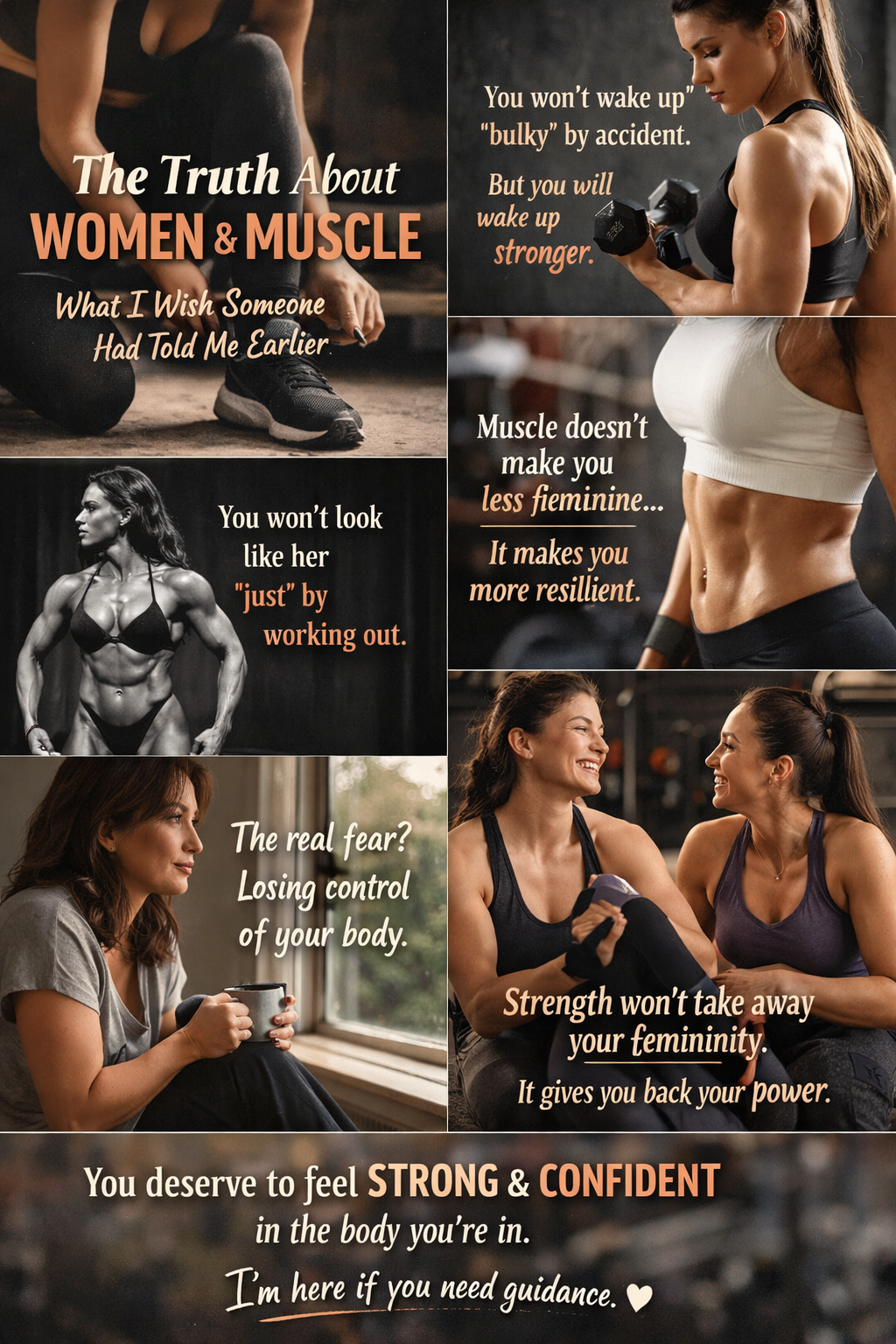
For most of my adult life, I carried a quiet fear around strength training. It wasn’t loud or dramatic. It didn’t stop me from moving my body entirely. It just lingered in the background, shaping my choices in subtle ways. I would avoid heavier weights. I would choose “toning” classes over strength work. I would tell myself that I wanted to stay feminine, lean, soft in the right places.
And I wasn’t alone. Almost every woman I knew had some version of the same concern. “I don’t want to get bulky.” Sometimes it was said jokingly, sometimes defensively, sometimes like an unquestionable truth. It became a shared belief, passed around so often that no one stopped to ask where it actually came from.
What surprises me now is how little that fear had to do with reality, and how much it shaped women’s relationship with their bodies anyway.
The idea that women should avoid muscle didn’t come from biology. It came from aesthetics, marketing, and misunderstanding. It came from decades of messaging that framed strength as masculine and softness as feminine. It came from images that reduced women’s bodies to shapes rather than systems. And it came from a fitness industry that learned it could sell fear more easily than understanding.
What no one explained clearly was that muscle itself is not extreme. Muscle is normal tissue. It is part of how the human body functions. Without it, nothing works particularly well. We don’t walk, carry, stabilize, or recover without muscle. Yet somewhere along the way, women were taught to see muscle not as support, but as a threat.
I wish someone had told me earlier that building noticeable muscle is not easy. Not for women. Not for men. Not for anyone.
Muscle growth is a slow biological process. It requires repeated mechanical stimulus, sufficient nutrition, adequate recovery, and time. From an evolutionary perspective, muscle is costly. It demands energy every single day, even at rest. The human body is far more inclined to conserve energy than to invest it. That’s why fat storage is efficient and muscle gain is not.
This matters, because the idea of “accidentally” becoming muscular ignores how resistant the body actually is to change.
Women, in particular, are biologically less primed for muscle hypertrophy. Testosterone plays a central role in muscle growth, and women produce only a fraction of it compared to men. That doesn’t mean women can’t become strong. It means that strength develops differently. More gradually. More subtly. Often in ways that enhance shape, posture, and firmness rather than size.
When women do gain muscle, it rarely appears overnight. It shows up slowly, often as improved tone, better alignment, and a sense of physical confidence that feels unfamiliar at first. The dramatic physiques often used as cautionary examples are not the product of casual training. They represent years of specialized programming, extreme nutritional strategies, and in many cases, external hormonal manipulation. They are not an inevitable outcome of lifting weights twice a week.
Yet this distinction is rarely made clear.
Instead, women are left with a vague warning: be careful, or you might lose control of your body.
That fear of losing control runs deeper than muscle itself. When I listen closely to women’s concerns, what I hear is not really about size. It’s about identity. About recognition. About the worry that if the body changes, it might stop feeling like home.
That fear deserves to be taken seriously. Bodies are personal. Change can feel threatening, especially in a culture that constantly judges women’s appearance. But fear should not be confused with fact.
What strength training actually does for most women is far less dramatic and far more supportive than we’re led to believe. It improves bone density, which becomes increasingly important with age. It stabilizes joints, reducing the risk of injury. It enhances insulin sensitivity, supporting metabolic health. It helps regulate appetite and energy levels. And perhaps most importantly, it allows women to maintain muscle mass as they age, instead of gradually losing it.
That last point matters more than most people realize.
Muscle loss does not announce itself loudly. It happens slowly, quietly, often unnoticed until its effects accumulate. Lower energy. Reduced strength. Slower metabolism. Increased fat storage despite eating less. A sense that the body is becoming less responsive, less capable.
Many women interpret these changes as personal failure or inevitable aging. In reality, they are often the result of under-stimulated muscle tissue.
When muscle mass declines, the body becomes less efficient. It burns fewer calories at rest. It handles blood sugar less effectively. It tires more easily. And the irony is that avoiding muscle to stay “soft” often leads to a body that feels heavier, less defined, and more difficult to manage.
Muscle doesn’t harden the body in a masculine way. It gives the body structure. It creates contrast. It supports posture, which alone can dramatically change how a body appears.
This is why so many women are confused when they lose weight but don’t like how they look. Without sufficient muscle, weight loss often results in a smaller version of the same softness, rather than the defined shape they expected. The problem is not fat itself. It’s the absence of underlying muscle.
From a fat-loss perspective, muscle is not optional. It is foundational.
Muscle tissue is metabolically active. It increases the body’s baseline energy expenditure and improves how the body uses nutrients. This doesn’t mean muscle magically burns fat. It means it creates an environment where fat loss is more sustainable and less punishing.
Many women attempt to lose weight by eating less and doing more cardio, often while avoiding resistance training. Initially, the scale may move. But over time, this approach tends to backfire. Muscle mass decreases, metabolism slows, hunger increases, and the body becomes more efficient at conserving energy. Weight regain becomes likely, not because of lack of discipline, but because the body adapts to scarcity.
Strength training interrupts this cycle. It signals to the body that muscle tissue is needed. When paired with adequate nutrition, it helps preserve lean mass even during fat loss. This is why women who include resistance training often find it easier to maintain results over time.
Another misconception I wish someone had corrected earlier is the idea that muscle growth happens independently of nutrition. It doesn’t. Muscle cannot grow without sufficient energy and protein. If a woman is eating at maintenance or in a calorie deficit, significant muscle gain is unlikely. At best, she will maintain what she has, which is already beneficial.
This means that the fear of becoming bulky while trying to lose fat is largely unfounded. The physiological conditions required for noticeable muscle growth are simply not present in most women’s routines.
Understanding this removes so much unnecessary anxiety.
It also restores agency. Strength training is not something that happens to you. It is something you guide. Load can be adjusted. Volume can be adjusted. Frequency can be adjusted. The body responds gradually, providing constant feedback. Nothing changes overnight.
What changed for me once I truly understood this was not just my training, but my relationship with my body. Strength stopped feeling like a risk and started feeling like support. I felt more stable, more capable, more at home in my physical self. Not bigger. Not harder. Just more grounded.
There is something deeply empowering about feeling physically competent. About trusting your body to carry you, protect you, and respond when challenged. That confidence does not come from appearance alone. It comes from function.
And function is what muscle provides.
This doesn’t mean every woman needs to love lifting weights or chase visible muscle definition. It means women deserve accurate information. They deserve to know that muscle is not the enemy of femininity, youth, or softness. It is the foundation of resilience.
If someone had explained this to me earlier — without exaggeration, without fear-based messaging — I would have saved myself years of confusion and self-doubt.
Strength is not something that takes away from a woman’s body. It gives back.
And the truth is, muscle has been quietly supporting women all along. It’s time we stop being afraid of it.