
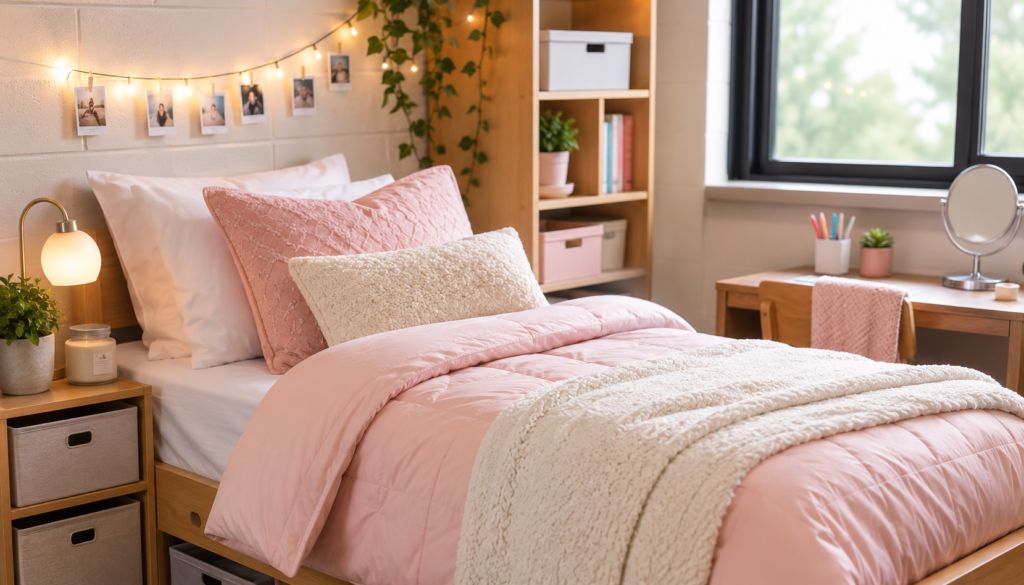
Everything you need to know before you swipe “add to cart” on your college bed setup

Why Your Dorm Bedding Matters More Than You Think
Your dorm bed is going to be the single most-used piece of furniture in your entire college life. It’s where you sleep, study, scroll, cry over a bad exam, FaceTime your family, eat late-night snacks, and occasionally host your entire friend group for a movie night because your room is the cozy one. When people search for dorm bedding ideas, dorm bed inspo, or college bedroom ideas, what they’re really looking for is a way to make an eight-by-twelve-foot cinderblock box feel like somewhere they actually want to exist. And it almost always starts with the bed.
Here’s the thing nobody tells you before move-in day: dorm bedding is not the same as home bedding. The mattress is thinner. The frame is often metal and slightly too narrow. The room might be freezing or a sauna depending on your school’s HVAC system. And you are very likely sharing a small space with a stranger who has their own opinions about aesthetics, noise, and how many decorative pillows is “too many.” This guide walks through every decision that goes into building a dorm bed setup that actually works — practically and aesthetically — from the sheets touching your skin to the comforter people will screenshot off your Pinterest board.
We’re going to cover sizing, material science (yes, really), warmth ratings, pillow anatomy, color theory for tiny rooms, budget strategy, roommate diplomacy, and the exact checklist to bring on move-in day. By the end, you won’t just have a cute bed — you’ll understand *why* it works, which means you’ll be able to adapt it season to season, year to year, without starting from scratch every August.
It’s also worth saying upfront: there is no single “correct” dorm bed. The most common mistake students make is trying to recreate one specific photo pixel-for-pixel, only to end up frustrated when their mattress, lighting, or roommate situation doesn’t match the reference image. The goal of this guide isn’t to hand you a formula to copy — it’s to give you enough understanding of how sizing, fabric, fill, and layering actually work so you can build something that fits your actual room, your actual budget, and your actual sleep preferences. Think of the aesthetic inspiration as a starting point, not a strict blueprint.
The Twin XL Reality Check
Before you fall in love with any bedding set on Pinterest, you need to understand the one detail that trips up more freshmen than anything else: dorm beds are almost universally Twin XL, not standard Twin. A Twin XL mattress measures 39 inches by 80 inches — five inches longer than a regular twin. That extra length matters enormously once you actually try to fit a standard twin fitted sheet onto a Twin XL mattress. It will not work. It will ride up, pop off the corners at 3am, and bunch under you all semester.
This is the number one reason so many students end up re-buying their entire bedding set during syllabus week. When you’re browsing dorm room bed ideas, always double check the product listing says “Twin XL” or “Twin Long” specifically. Standard twin sheets are cheaper and more widely available, which is exactly why they end up in so many carts by mistake — they look identical in a thumbnail image but simply won’t stretch those extra five inches.
If you’re not sure whether your school uses Twin XL frames, check your housing portal or orientation packet — nearly every four-year university in the U.S. uses Twin XL as the standard dorm bed size, but it’s always worth confirming, especially for community colleges, international programs, or older residence halls that occasionally still use standard twin frames. It takes thirty seconds and saves you an entire round of returns.
Choosing Sheets: A Material-by-Material Breakdown
Sheets are the part of your bedding that touches your skin for roughly a third of every day, so this is not the place to cut corners just because a set looks good in a photo. The material determines how warm or cool you sleep, how the sheets wear over a nine-month school year, and how much upkeep they require with dorm laundry machines that are, let’s be honest, not always gentle.
Cotton Percale
Percale is a tightly woven cotton fabric with a crisp, matte finish — think hotel sheets. It’s breathable, durable, and gets softer with every wash, which makes it a favorite for students who run warm or attend school somewhere humid. Percale sheets tend to hold color well over repeated dorm laundry cycles, so if you’re building a specific color palette for your room, percale is one of the safest long-term investments. The main tradeoff is that it can feel a little stiff for the first few washes before it breaks in.
Sateen Cotton
Sateen is also cotton, but it’s woven differently, which gives it a silkier, slightly glossy surface and a heavier drape. It photographs beautifully — this is why so many of the “dorm bed ideas” you see on Pinterest with that soft, luxe sheen are sateen. It’s warmer than percale, which is great for students in colder climates but can feel a bit much in a dorm room without air conditioning. Sateen is also more prone to snagging, so it’s worth being mindful of long nails, jewelry, and Velcro-backed items nearby.
Jersey Knit
If you love the feel of a soft t-shirt, jersey sheets are essentially that same knit fabric applied to bedding. They’re stretchy, forgiving on a Twin XL mattress (easier to wrestle onto the corners), and genuinely cozy, which makes them a popular pick for students who prioritize comfort over crisp hotel aesthetics. The downside is that jersey traps more heat than woven cotton, so it’s a better fit for cold dorms or students who run cold than for a room with unreliable air conditioning in late August.
Microfiber
Microfiber is a budget-friendly synthetic option, and it’s genuinely a smart choice for a first dorm bedding set if you’re not sure yet what you’ll want long-term. It’s wrinkle-resistant, dries quickly (a real plus with limited dorm dryer access), and comes in an enormous range of colors and patterns at low price points. The tradeoff is breathability — microfiber can trap heat and doesn’t feel as premium against the skin as natural fibers. It’s a solid “starter set” while you figure out your preferences before investing in something nicer sophomore year.
Bamboo and Tencel (Lyocell)
These plant-based fibers have surged in dorm bedding searches over the last few years, and for good reason. Bamboo and Tencel sheets are naturally moisture-wicking, temperature-regulating, and hypoallergenic, which makes them an excellent pick for students who sweat at night, live somewhere humid, or deal with sensitive skin. They’re also silky-soft right out of the package, no break-in period required. The main consideration is price — these tend to sit at the higher end of the dorm bedding market — and care, since they typically need a gentler wash cycle than cotton or microfiber.
Linen
Linen has become the unofficial fabric of the “effortlessly aesthetic” dorm room. It’s breathable, gets softer and more textured with every wash, and has that relaxed, lived-in look that photographs beautifully for room tours. It’s genuinely one of the best options for hot dorms without air conditioning. The catch: linen wrinkles by nature — that’s part of its look, not a flaw — and it can feel a little rough for students who prefer smooth, silky bedding. If a slightly textured, matte, sun-bleached aesthetic is your vibe, linen delivers it better than any other fabric on this list.
Bedding Considerations for Lofted and Bunked Dorm Beds
A huge percentage of dorm beds aren’t sitting flat on the floor — they’re lofted, bunked, or raised on risers, and this changes a few practical things about how you should shop for bedding. First, always confirm your mattress dimensions after your bed is actually lofted or bunked, not before, since some schools use a slightly different or older mattress in bunked configurations than in standard single-bed rooms. It’s a quick check that prevents an entire bedding set from being the wrong size.
Second, think about access. If your bed is lofted several feet in the air, wrestling a fitted sheet onto all four corners becomes a genuine workout, and you’ll want to prioritize sheets with generous corner elastic and a bit of stretch — jersey knit and good-quality percale with deep pockets both perform well here. A step stool, or simply doing the fitted sheet corners from your desk chair, makes the process significantly less annoying once you’ve done it once or twice.
Third, safety matters more with a lofted setup. Avoid bedding with long ties, ribbons, or drawstring closures on comforters or bed skirts near the ladder or edge of a lofted bed, and be mindful of how far pillows and blankets hang over the side — a beautiful cascading blanket look is a lot less charming when it’s a nightly tripping hazard for whoever’s climbing the ladder in the dark. A bed rail or guard, even a simple foam one, is worth considering for any lofted setup, and most fit discreetly under a fitted sheet without disrupting the aesthetic at all.
Seasonal Bedding Rotation: Fall, Winter, and Spring
One of the most underrated dorm bedding ideas is planning for rotation from the start, rather than buying one set and trying to make it work for nine straight months of wildly different temperatures. A dorm room in September and that same room in January can feel like two completely different climates, especially in buildings with older or inconsistent HVAC systems.
Move-In Through Early Fall
August and September dorm rooms tend to run warm, especially in un-air-conditioned buildings baking in late-summer heat. This is the season to lean on breathable materials — linen, percale, bamboo — and a lighter comforter or just a duvet cover without the heavier winter insert. If you’re using a duvet system, this is exactly the scenario where it pays off: swap to a lightweight insert or skip it entirely in favor of a light quilt or coverlet until temperatures actually drop.
Deep Winter
By November and December, most dorms have flipped from too-warm to genuinely cold, particularly overnight when heating systems in older buildings often cycle down. This is when a heavier down or down-alternative comforter earns its keep, along with flannel or brushed cotton sheets, which trap noticeably more warmth than crisp percale. A knit throw blanket layered at the foot of the bed isn’t just decorative in winter — it’s an easy way to add warmth on especially cold nights without overheating under a comforter that’s too heavy for the rest of the night.
Spring Refresh
As the semester winds toward finals and warmer weather, swapping back to lighter sheets and a spring color palette is a small but genuinely effective way to reset your motivation during the hardest academic stretch of the year. Many students use this seasonal swap as an easy styling refresh — a new duvet cover or a different set of throw pillows — without buying an entirely new bedding set, since the base layer (sheets, pillows, mattress topper) can usually stay the same year-round while only the top layer changes.
Sustainable and Eco-Friendly Bedding Options
Sustainability has become a real factor in how students shop for dorm bedding, not just an afterthought. Organic cotton, produced without the synthetic pesticides used in conventional cotton farming, is now widely available at price points close to standard cotton sheets, making it one of the easiest sustainable swaps to make without a big budget shift. Bamboo and Tencel, discussed earlier for their moisture-wicking properties, also tend to require significantly less water to produce than conventional cotton, which is part of why they’ve become a favorite in more sustainability-minded dorm bedding ideas.
Recycled polyester, made from post-consumer plastic bottles, has also become a common fill material in down-alternative comforters and pillows, offering a way to divert plastic waste while still getting a soft, hypoallergenic product. When shopping with sustainability in mind, look for certifications like OEKO-TEX (which verifies textiles are free from harmful substances), GOTS (Global Organic Textile Standard), or Fair Trade Certified, which indicate real third-party verification rather than vague “eco-friendly” marketing language on a product page.
Buying less, but better, is itself a sustainability strategy that works especially well for dorm bedding specifically. Because dorm rooms are small and storage is limited, there’s a natural ceiling on how much bedding you can reasonably own anyway — which makes it easier to justify spending a bit more on two or three genuinely well-made, long-lasting pieces rather than cycling through cheap sets every semester.
Styling Your Bed for That Pinterest-Worthy Photo
If part of your motivation is genuinely wanting your dorm bed to look as good in photos as the inspiration images you’ve been saving, a few styling tricks make a bigger visual difference than people expect. Natural light is the single biggest factor — shoot bed photos near a window during daytime hours whenever possible, since overhead fluorescent dorm lighting tends to wash out color and flatten texture in a way that makes even a beautifully styled bed look flat and dull.
Texture variation matters more than color coordination for a photogenic bed. A bed made entirely of smooth, matching fabric photographs as flat and one-dimensional, while mixing in one knit or waffle-weave throw, one smoother sateen or silk-look pillow, and one matte linen or cotton piece creates visual depth that reads beautifully on camera even in a small space. This is the actual secret behind most of the dorm bed ideas that look effortlessly elevated — it’s rarely about expensive pieces, it’s about deliberate texture mixing.
Pillow arrangement follows a simple rule that professional stylists use constantly: largest and darkest pieces go in back, smallest and lightest go in front, arranged slightly off-center rather than perfectly symmetrical, which reads as more natural and less staged. Fluff and “karate chop” pillows (a light press down the center to create a soft dent) right before photographing — it’s a small five-second step that makes a noticeable difference in how full and intentional the bed looks in a final shot.
When to Buy: Before Move-In or After You See Your Room?
There’s a real debate among students about whether to buy dorm bedding before arriving on campus or to wait until you’ve physically seen your assigned room. Both approaches have genuine tradeoffs worth considering before you commit either way.
Buying before move-in guarantees you’re not scrambling on day one without sheets on a bed you’re expected to sleep in that same night, and it lets you take advantage of back-to-school sales, which tend to offer the best pricing of the entire year on dorm essentials. The risk is committing to a color palette or aesthetic before knowing your room’s actual lighting, wall color, and layout, which occasionally leads to a mismatch once you’re actually standing in the space.
Waiting until you’ve seen your room lets you shop with full information — you’ll know exactly how much natural light you’re working with, what your roommate’s style leans toward, and the actual dimensions you’re decorating around. The tradeoff is time pressure, since most students don’t want to sleep on a bare mattress for the first several nights of the semester while waiting for bedding to arrive.
A practical middle ground that a lot of students land on: buy your functional essentials before move-in (sheets, mattress topper, one comforter, pillows) in a fairly neutral, flexible palette, then add the more decorative, aesthetic-driven pieces (accent pillows, a patterned duvet cover, a statement throw blanket) after you’ve actually seen the room and have a feel for the space. This way you’re never sleeping on a bare mattress, but you’re also not locked into a full aesthetic before you’ve seen the room it needs to live in.
The Thread Count Myth, Debunked
If there’s one number that gets thrown around dorm bedding marketing more than any other, it’s thread count — and it is, frankly, one of the most misunderstood specs in the entire bedding industry. Thread count simply measures how many threads are woven into one square inch of fabric. It is not, on its own, a reliable measure of quality, softness, or durability, despite what a lot of product listings imply.
Here’s why: some manufacturers inflate thread count by twisting multiple thin threads together and counting each strand separately, which produces a high number on paper but a fabric that’s actually thinner and less durable than a well-made 300-count percale. In general, for cotton sheets, anything in the 200–400 range using single-ply, long-staple cotton will outperform an inflated 800-count set made from lower-quality fibers. The material and weave type matter far more than the number on the tag — which is genuinely good news, because it means you don’t need to spend a fortune to get sheets that feel great and hold up through a full academic year.
Choosing a Comforter or Duvet: Warmth, Weight, and Fill
Once your sheets are sorted, the comforter or duvet is usually the visual centerpiece of the whole dorm bed — it’s the layer that sets the color palette, the texture, and honestly, most of the “look” people are chasing when they search dorm bed inspo. But before aesthetics, it’s worth understanding fill type and warmth rating, because a comforter that’s wrong for your climate is one of the most common (and expensive) dorm bedding regrets.
Down Comforters
Down (the soft under-feathers of ducks or geese) is the gold standard for warmth-to-weight ratio — it traps heat incredibly efficiently while staying light and fluffy. A quality down comforter will last for years, even through repeated dorm laundering, as long as you follow care instructions. The downsides are cost and allergies: real down is one of the pricier fill options, and it’s not suitable for students with feather or dust allergies.
Down-Alternative
Down-alternative comforters use synthetic microfiber clusters engineered to mimic the loft and softness of real down, without the allergy risk or the price tag. This is genuinely the most popular category among current dorm bedding searches, and for good reason — it’s machine washable, budget-friendly, and cruelty-free, checking a lot of boxes for college students juggling limited laundry access and limited funds. Quality varies a lot by brand, so look for reviews specifically mentioning how the comforter holds up after multiple washes, since cheaper down-alternative can flatten and clump over a semester.
Duvet Inserts vs. All-in-One Comforters
This is a genuinely underrated decision. An all-in-one comforter is the fill and the outer fabric in one piece — you wash the whole thing whenever it needs cleaning. A duvet setup separates the fill (the insert) from the decorative cover, which you can swap seasonally or wash far more frequently without hauling the bulky insert to the communal laundry room every time. For students who want to change up their dorm bedroom ideas mid-year — say, swapping a cream cover for a plaid one once it gets cold — a duvet system offers way more flexibility. The tradeoff is more pieces to manage and slightly more setup effort on move-in day.
Matching Weight to Your Climate
If you’re heading somewhere with brutal winters and drafty older dorms, look for a comforter rated for cold climates — heavier fill weight, often labeled “winter weight” or with a higher GSM (grams per square meter) rating for down-alternative fills. If your school is somewhere warm most of the year, a lightweight or “all-season” comforter paired with an extra throw blanket for the occasional cold snap will serve you far better than sweating through September in a heavy set. When in doubt, the layering approach — a lighter comforter plus a blanket you can add or remove — beats betting everything on one single-weight piece.
The Pillow Guide Nobody Gives You
Pillows get treated as an afterthought in most dorm bedding hauls, which is a mistake, because pillow choice affects sleep quality more directly than almost anything else on this list — and bad sleep in your first semester is genuinely rough. There are two separate categories to think about here: sleep pillows (the ones you actually rest your head on) and decorative pillows (the ones doing the heavy lifting for your dorm bed ideas aesthetic).
Sleep Pillows by Position
Side sleepers generally need a firmer, higher-loft pillow to keep the neck aligned with the spine — memory foam or a firm down-alternative works well here. Back sleepers do best with a medium-loft pillow that supports the natural curve of the neck without pushing the head too far forward. Stomach sleepers need the flattest, softest pillow of the three, since anything too thick strains the neck at an unnatural angle all night. If you’re not sure which category you fall into, a medium-firm, medium-loft pillow is the safest all-purpose choice for a dorm bed.
Fill Types
Memory foam contours closely to the head and neck and tends to hold its shape longest, but it can sleep warm and has a distinct sink-in feel that not everyone loves. Down and down-alternative pillows are soft, fluffy, and easy to shape, but they compress faster and often need replacing sooner than foam. Gel-infused options aim to combine foam support with a cooler sleep temperature, which is worth considering for dorms without air conditioning. Buckwheat hull pillows are a newer favorite among students who want a firm, adjustable, naturally cooling option — you can add or remove hulls to change the loft, which is a nice bit of customization most other pillow types don’t offer.
Decorative and Accent Pillows
This is where dorm bed ideas really come to life visually. A good rule of thumb for a Twin XL bed: one or two standard sleep pillows up front, then one to three decorative pillows behind them in varying sizes — a large lumbar or square pillow in back, a smaller accent pillow layered in front, maybe a textured throw pillow for contrast. Going much beyond three or four total pillows on a Twin XL starts to eat into usable bed space fast, which matters when you’re also using that bed as a couch, desk chair alternative, and study nook.
A Quick Word on Layering
Layering is really its own topic (we’ve got an entire guide dedicated to it), but the short version: the magic of a Pinterest-worthy dorm bed almost never comes from one single “perfect” comforter. It comes from combining a fitted sheet, a flat sheet or duvet, a folded throw blanket at the foot of the bed, and a mix of pillow sizes, so the bed has visual depth and texture instead of looking flat. Even the simplest, most budget-friendly bedding set can look elevated once it’s layered with intention rather than just tossed on.
Choosing Colors and Patterns for a Tiny Room
Color choice does a lot of heavy lifting in a small dorm room, because your bed usually takes up a huge percentage of the visible floor plan. A few principles come up again and again in the most popular room bed ideas: lighter, warmer neutrals (cream, sand, soft terracotta) tend to make small rooms feel bigger and calmer, while very dark or saturated bedding can make an already small space feel more cramped, even if it looks stunning in isolation.
That doesn’t mean you have to go all-neutral — a bold color or pattern works beautifully as an accent (a patterned throw pillow, a colorful duvet cover, a printed throw blanket) layered over a more neutral base. This gives you the flexibility to swap out the bold piece seasonally or when you get bored, without re-buying your entire bedding set. If your dorm room has a lot of visual noise already — cinderblock walls, an ugly built-in desk, fluorescent overhead lighting — a more restrained, tonal color palette on the bed often reads as more intentional and put-together than a maximalist mix.
It’s also worth considering your existing decor before you buy anything. If you already know you want a specific dorm bedroom ideas theme — cottagecore, dark academia, coastal grandmother, Y2K, boho — pick your bedding palette to match that direction from the start, rather than buying bedding first and trying to force the rest of the room to match it later. Bedding is the most expensive, hardest-to-return piece of a dorm room aesthetic, so it should usually anchor your color decisions, not follow them.
Budget Breakdown: Where to Splurge and Where to Save
A full dorm bedding set can run anywhere from $60 to $400+ depending on materials and brand, and most students don’t need to spend at the top of that range to get something that looks and feels great. Here’s a general splurge-or-save framework that comes up again and again among students who’ve actually lived with their setup for a full year, not just unboxed it for a room tour video.
- Splurge on your mattress topper — this affects sleep quality more than almost anything else on this list, and dorm mattresses are notoriously thin.
- Splurge on your primary sleep pillow — you use it every single night, and a bad one affects your neck and sleep quality all year.
- Save on decorative throw pillows — these get swapped often and don’t need premium materials since they’re rarely slept on directly.
- Save on your first set of sheets if you’re not sure of your preferences yet — microfiber is a smart, cheap starting point.
- Splurge on your comforter or duvet if it’s the visual centerpiece of your room — this is the piece that shows up in every photo and gets the most wear.
- Save by buying a duvet insert plus an affordable cover rather than a single premium all-in-one comforter, so you can change the look without repurchasing the fill.
Allergy-Friendly Bedding: What to Look For
Dorm rooms are small, shared, often carpeted spaces that recirculate air with dozens of other rooms — which makes allergies and sensitivities a genuinely bigger deal than they might be at home. If you deal with allergies, a few specific choices in your bedding setup can make a real difference in how you sleep and feel throughout the semester.
Dust mites are the most common bedding-related allergen, and they thrive in warm, humid environments — exactly the conditions in an un-air-conditioned dorm room in September. Hypoallergenic mattress and pillow protectors with a tight weave create a physical barrier that dust mites can’t penetrate, and they’re a worthwhile investment even for students without diagnosed allergies, since they also extend the life of your mattress and pillows significantly.
For fill materials, down-alternative, bamboo, and Tencel are generally the safest choices for allergy-prone students, since real down and feather fills are among the most common bedding allergens. Washing sheets and pillowcases weekly (rather than every two weeks) during high-pollen seasons or if you’re prone to skin sensitivities also makes a measurable difference, as does choosing looser, more breathable weaves over dense synthetic blends that trap moisture and allergens closer to the skin overnight.
Storing Bedding Over Winter and Summer Break
Most students don’t think about bedding storage until they’re standing in an empty dorm room at the end of the semester trying to figure out what to do with a comforter, three pillows, and two sets of sheets before a flight home. A little planning here saves a lot of last-minute stress, especially for students flying rather than driving home.
Vacuum storage bags are genuinely one of the best investments for dorm bedding specifically — they compress bulky comforters and pillows down to a fraction of their normal size, which matters enormously if you’re packing for a flight or trying to fit everything into a small storage unit or your family’s car alongside everything else from your room. Always make sure bedding is completely dry before vacuum-sealing it for long-term storage, since sealing in any residual moisture can lead to mildew over a multi-week break.
If your school offers on-campus or nearby storage for returning students, cedar blocks or lavender sachets tucked into storage bins are a simple way to keep bedding smelling fresh and deter moths and other fabric pests over an extended break. Labeling bins by season (“winter bedding,” “summer bedding”) also makes move-in day dramatically faster the following year, since you’ll know exactly which bag to grab first instead of digging through everything you own.
Where to Shop: Budget, Mid-Range, and Premium
The dorm bedding market spans an enormous price range, and it’s genuinely possible to build a great-looking, comfortable bed setup at almost any budget level — the key is knowing where each price tier tends to deliver the most value.
Budget retailers (think mass-market department and discount stores) are strongest for basics: microfiber sheet sets, decorative pillow covers, and simple throw blankets, where the price-to-quality ratio is genuinely good and the risk of a bad purchase is low. This tier is ideal for pieces you expect to replace or swap seasonally anyway.
Mid-range specialty bedding brands (often sold online or through dedicated home goods retailers) tend to offer the best value for the pieces that matter most for comfort and longevity — quality cotton sheet sets, down-alternative comforters, and supportive pillows, usually with better return policies and more size-specific options tailored to Twin XL dorm mattresses specifically.
Premium and boutique bedding brands deliver the best raw material quality — organic cotton, real down, genuine linen — but at a meaningfully higher price point that’s worth it mainly for pieces you’ll keep and use well beyond your dorm years, like a duvet insert or a high-quality mattress topper that can move with you into your first apartment. A hybrid approach — budget or mid-range for decorative, easily swapped pieces, and mid-range to premium for the functional pieces you’ll use every single night — tends to give students the best overall outcome without overspending on any single category.
Coordinating (Without Clashing) With a Roommate
If you’re sharing a room, bedding is one of the easiest ways to create a cohesive look without either person losing their individual style. You don’t need matching bedding — in fact, fully identical setups can sometimes feel a little sterile — but agreeing on a shared color family or palette before move-in day makes the whole room feel designed rather than like two separate dorm rooms accidentally pushed together.
A simple approach that works well: pick two or three colors both of you are comfortable with, then let each person express their own taste within that palette. One person might lean into patterns while the other stays solid, or one might go for a warmer shade and the other a cooler one within the same family. This keeps both beds feeling personal while the room reads as intentional when someone walks in.
It’s also worth having a quick conversation about practical logistics before buying anything: who’s bringing the mini fridge, who’s handling the shared rug, whether you’re splitting a command-hook gallery wall down the middle or coordinating it across both sides. Bedding decisions tend to go much more smoothly once those bigger shared-space questions are settled first.
If you and your roommate genuinely have opposite taste — one of you wants dark academia moodiness and the other wants bright, sunny minimalism — it’s completely fine to let both beds look distinct rather than forcing a compromise neither of you loves. A shared neutral like the wall decor, rug, or curtains can visually tie the room together even when the two beds look quite different, which often ends up looking more like an intentional, curated shared space than two people who fought over paint swatches until they landed on beige.
Your Move-In Day Bedding Checklist
Here’s the exact list to work from so you’re not scrambling to find a Target at 9pm on move-in night because you forgot mattress protector or extra pillowcases.
- Mattress topper (memory foam or featherbed style — dorm mattresses are thin and firm)
- Waterproof mattress protector (protects your topper and the mattress itself, and it’s often required by housing agreements)
- 2 sets of Twin XL fitted and flat sheets, so you always have a clean set ready during laundry gaps
- 1 comforter or duvet + insert appropriate for your climate
- 1–2 sleep pillows plus pillowcases
- 2–3 decorative pillows for layering
- 1 folded throw blanket for the foot of the bed and for those movie-night hangouts
- Bed risers if you want under-bed storage space
- Command hooks or a clip-on reading light if your dorm doesn’t have great bedside lighting
- A mesh laundry bag sized for sheets and comforter, since dorm washers vary widely in capacity
Caring for Dorm Bedding With Communal Laundry
Dorm laundry rooms are a different beast than a home washer and dryer — machines vary in size, detergent access isn’t always guaranteed, and you’re often paying per load, which changes how you should think about wash frequency. As a general rule, sheets should be washed roughly every one to two weeks, more often if you sweat a lot at night, have allergies, or share your bed with a pet during breaks. Comforters and duvet covers can go longer between washes — every four to six weeks is typical — especially if you’re using a top sheet as a barrier layer, which also extends the life of the comforter itself.
Always check the care label before your first wash, especially for down, bamboo, or Tencel bedding, since these often require cold water and a gentle cycle to avoid damaging the fibers or clumping the fill. If your dorm’s washers only offer hot water settings or you’re unsure about machine size, a large mesh laundry bag is worth the small investment — it prevents delicates from getting tangled with other items and keeps your comforter from overloading a smaller machine.
For quick refreshes between full washes — genuinely useful during exam weeks when laundry is the last thing on your mind — a fabric refresher spray and regularly airing out your comforter near an open window can buy you extra days without a full wash cycle. It’s a small habit that keeps your bed feeling and smelling fresh even when your schedule doesn’t allow for laundry as often as you’d like.
Common Dorm Bedding Mistakes to Avoid
- Buying standard Twin sheets instead of Twin XL — always double-check the label before purchasing.
- Skipping the mattress topper entirely — dorm mattresses are notoriously thin and firm, and this is the single upgrade most students wish they’d made sooner.
- Choosing an all-dark palette in a room with poor natural light, which can make an already small space feel smaller and dimmer.
- Overloading the bed with too many decorative pillows, leaving no usable space for actually sitting or studying on the bed.
- Buying premium bedding before knowing your dorm’s temperature control — a gorgeous heavy comforter is miserable in a room with no AC in September.
- Forgetting a second sheet set, which turns laundry day into an actual crisis when your only sheets are in the wash.
- Not checking your housing agreement for any bedding-related requirements, like mandatory mattress protectors in some dorms.
Frequently Asked Questions
Do I really need Twin XL sheets, or will regular Twin work in a pinch? Regular Twin sheets will physically fit onto a Twin XL mattress, but they’ll be uncomfortably short, riding up and popping off the corners throughout the night. It’s worth the extra few dollars to get the correct size from the start.
How many sheet sets should I actually bring? Two full sets is the sweet spot for most students — enough to always have a clean set ready without hauling an excessive amount of bedding to a small dorm room with limited storage.
Is a mattress topper really necessary, or is that just marketing? For most students, yes — dorm mattresses are consistently rated among the firmest, thinnest mattresses people sleep on, and a quality topper is one of the highest-impact, lowest-cost upgrades you can make to your entire dorm bed setup.
What’s the best fabric if my dorm doesn’t have air conditioning? Linen and bamboo/Tencel are the top performers for breathability and moisture-wicking, making them the most comfortable options for hot, humid dorm rooms without climate control.
Should my roommate and I match our bedding exactly? Not necessarily — coordinating within a shared color palette usually looks more intentional and personal than fully identical bedding, while still creating a cohesive room.
Can I use my regular home bedding for my first year and upgrade later? Absolutely — plenty of students start with a Twin XL-adapted version of what they already own (or a cheap starter set) and reserve bigger bedding purchases for sophomore year once they know their preferences and have seen how their first dorm room actually functions.
How do I stop my sheets from sliding off a Twin XL mattress? Look for sheets with deep pockets (rated for mattresses 14–16 inches thick, ideally with extra corner elastic) and consider inexpensive sheet suspenders or grippers, which clip the fitted sheet to the mattress corners and box spring to stop slipping — especially useful on lofted or bunked beds that get jostled more than a standard frame.
Is it worth buying a weighted blanket for a dorm bed? For students who find weighted blankets genuinely helpful for sleep or anxiety, yes — just size down appropriately for a Twin XL (usually 12–15% of body weight is the standard recommendation) and check your dorm’s laundry facilities can handle the weight, since many communal machines have load limits that a heavy weighted blanket can exceed.
What if my roommate and I have completely different temperature preferences? This is common, and the easiest fix is separate, individually appropriate bedding rather than trying to compromise on one shared room temperature — one person can layer a heavier comforter while the other sticks with a lighter one, since you’re each only responsible for regulating your own bed’s warmth.
How much should I expect to spend on a full dorm bedding setup? A complete, comfortable setup — topper, protector, two sheet sets, comforter, pillows, and a couple of decorative pieces — typically lands somewhere between $150 and $350 for most students, though it’s entirely possible to go lower with careful budget-tier shopping or higher if you’re investing in premium, multi-year pieces.
Will my dorm bedding still look good by the time finals roll around? It will if you’ve chosen durable materials and stuck to a reasonable wash schedule — this is exactly why the material section at the start of this guide matters so much. A cheap, low-quality set can look tired by October, while a well-chosen mid-range set styled with intention will still look great through move-out day in May.
Building Your Dorm Bed by Aesthetic
If you’re still narrowing down your direction, here’s a quick-reference guide to how the four most-searched dorm bedroom ideas aesthetics translate into actual material and color choices, so you can shop with a clear target instead of getting overwhelmed by options.
Minimalist / Scandinavian
Neutral, tonal color palette (white, oatmeal, soft gray, sage), matte natural fabrics like percale or linen, minimal pattern, one or two decorative pillows maximum. The look relies on quality of material and clean lines rather than layering lots of pieces — a single well-chosen waffle-knit throw does more here than five mismatched pillows.
Boho / Eclectic
Warm, earthy tones (terracotta, mustard, rust, cream), mixed textures and patterns — think a woven throw, a tasseled pillow, a patterned duvet cover, layered without perfect coordination. This aesthetic embraces visual busyness in a way minimalism doesn’t, so don’t be afraid to mix two or three patterns as long as they share a color family.
Preppy / Coastal Grandmother
Crisp white or cream base layer, classic patterns like gingham, stripe, or scalloped edges, soft blues and greens as accent colors. Percale or quilted cotton fabrics fit this aesthetic best — the crisp, structured texture is a defining feature, so overly soft or slouchy jersey sheets can undercut the look.
Dark Academia / Moody
Deep jewel tones, plaid patterns, heavier fabrics like flannel or velvet-look throws, brass or vintage-style accents nearby. This is one of the few aesthetics where a darker overall palette works well in a small room, as long as it’s balanced with a warm lamp and enough surrounding light to avoid the space feeling cave-like.
A Note on Trends vs. Timelessness
Pinterest and social media move fast, and dorm bedding trends cycle through phases just like everything else — one year it’s all about a specific shade of sage green, the next it’s checkerboard patterns or a particular brand’s viral waffle-knit blanket. It’s genuinely fine to chase a trend if it excites you, but it’s worth knowing which of your purchases are trend-driven and which are foundational, so you can budget accordingly.
A useful mental split: your sheets, mattress topper, pillow, and comforter fill are foundational purchases — they should be chosen for comfort, durability, and your actual climate, and they’ll serve you well regardless of what’s trending. Your duvet cover, decorative pillows, and throw blanket are the trend layer — the pieces you can afford to buy a little cheaper, swap more often, and update as your taste evolves without much financial regret.
This split also protects you from the most common dorm bedding regret: spending a large chunk of your budget on a very trend-specific comforter that feels dated within a year, while skimping on the topper and pillow that actually determine how well you sleep every single night. Trends are fun and worth participating in — just make sure they’re layered on top of a foundation that would still serve you well even if the trend disappeared tomorrow.
Final Thoughts
Building the right dorm bedding setup isn’t about chasing a single trending aesthetic — it’s about understanding sizing, material, warmth, and layering well enough that you can actually create *your* version of whatever look you’re drawn to, whether that’s minimalist neutrals, maximalist boho, or something in between. Get the fundamentals right — correct sizing, a good topper, sheets suited to your climate, a comforter weighted for your dorm’s temperature — and the aesthetic part becomes the fun, flexible layer on top, one you can keep evolving all four years without starting over from scratch.