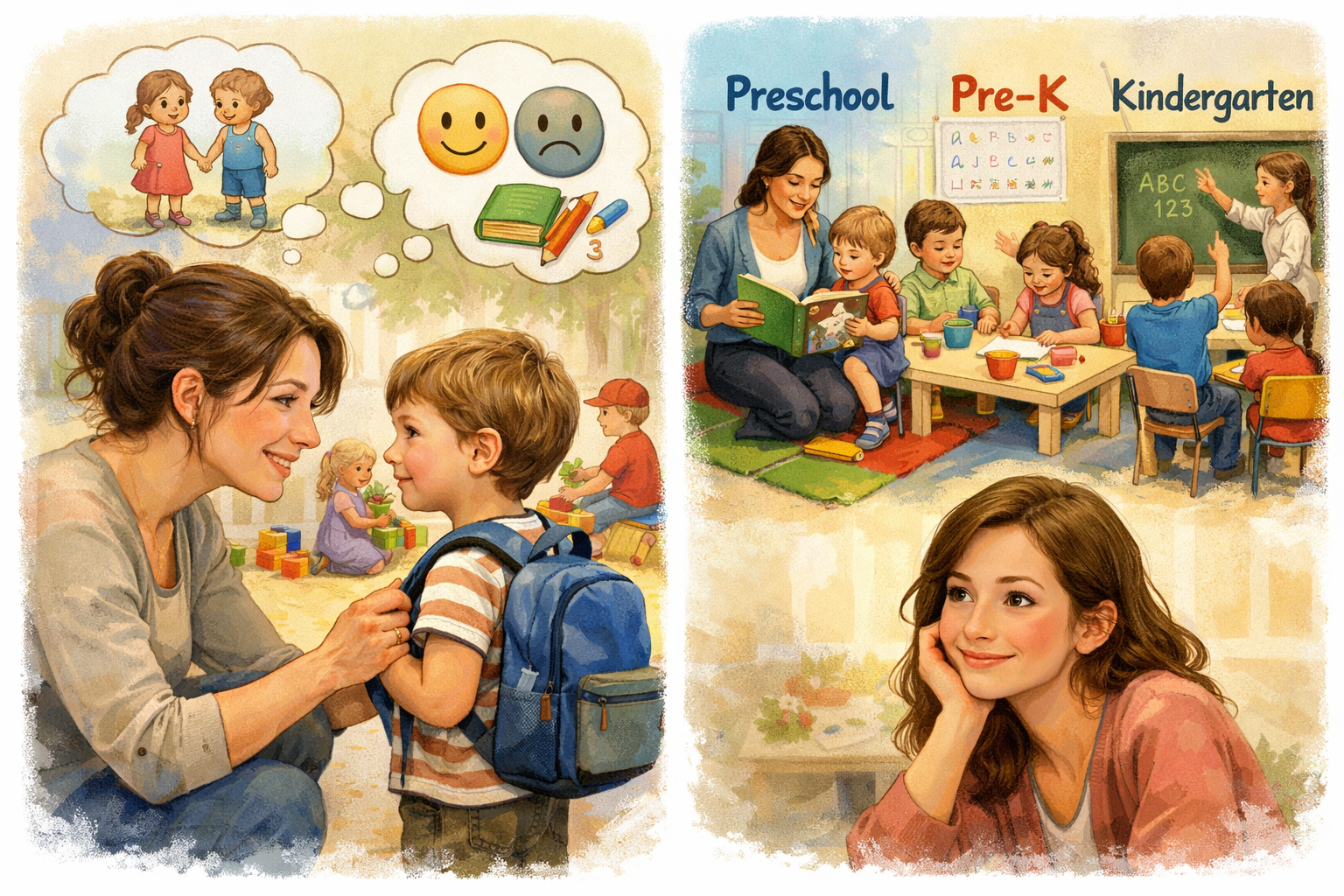
The morning my oldest asked where the school bus was, I realized something quietly profound: she was more ready for the world than I was ready to let her go.
She was three. Three felt impossibly small and surprisingly big at the same time. Big enough to hold conversations, to insist on choosing her own socks, to memorize the theme song of The Magic School Bus and sing it loudly and proudly every single day. Small enough to still crawl into my lap when she was tired and press her warm cheek against my chest.
In our tiny town, there was only one preschool program. It had a firm requirement: children had to be fully potty trained. My daughter was close, but not quite there. She could identify when she needed to go, she understood the routine, but she wasn’t consistently independent yet. And while I refused to rush her body into something it wasn’t ready for, I also couldn’t ignore how socially and intellectually ready she seemed. She craved interaction. She lit up around other children. She asked questions that surprised me.
So I enrolled her in a preschool about thirty minutes away — the one where a few of my friends sent their children. It wasn’t the most convenient choice, but it felt like the right one. It also gave me a few quiet hours with my one-year-old and space to breathe between laundry, errands, and the constant hum of motherhood.
On that first day, she stood on the porch, backpack slightly too big for her tiny frame, scanning the street. “Where’s the school bus?” she asked with genuine expectation. Every day she had watched the big yellow buses roll past our house, carrying older kids to the local elementary school. In her mind, school meant bus. It meant adventure.
Thinking quickly — and perhaps drawing on years of imaginative survival as a mom — I told her our van turned into a magic school bus when we drove to preschool. Her eyes widened. She grinned. She climbed into the minivan like she was stepping into something extraordinary.
I had prepared myself for tears at drop-off. I had rehearsed the calm voice, the reassuring hug, the quick exit strategy. Instead, she walked in confidently, turned around, waved, and said, “Bye, Mommy!” like she’d been doing it her whole life.
I cried in the car anyway.
Deciding when to start preschool is not just a logistical choice. It’s an emotional threshold. It’s the first time many of us hand our child over to a structured environment with other adults guiding their day. It’s the first time we admit that our role is slowly shifting from being their entire world to being their safe place at the end of the day.
What I learned through her — and later through her three siblings — is that readiness is not defined by a birthday alone.
Yes, most preschool programs serve children roughly between two-and-a-half and four years old. And pre-kindergarten, often called pre-K, typically focuses on four- and five-year-olds preparing for kindergarten. But development doesn’t follow a calendar with clean lines and checkboxes. It unfolds unevenly, beautifully, and sometimes inconveniently.
With my oldest, the tension was potty training. Some programs require full independence in the bathroom. Others are more flexible. That six-month gap between social readiness and physical readiness felt enormous at the time. I worried about holding her back. I worried about pushing too hard. I questioned myself constantly.
But readiness is layered.
There’s physical readiness — like using the toilet independently, washing hands, managing basic self-care like putting on shoes or opening a lunchbox.
There’s social readiness — can your child tolerate sharing? Do they show interest in peers? Are they curious about other children’s activities? Do they engage, even shyly?
There’s emotional readiness — can they separate from you for a few hours with manageable anxiety? Not zero tears necessarily, but recoverable tears.
And then there’s cognitive readiness — do they show curiosity about letters, numbers, shapes, stories? Not mastery, but interest.
My daughter had the social and cognitive pieces early. She wanted group experiences. She asked to “go to school like the big kids.” The potty part just needed time.
With each of my other children, the equation shifted.
One was fiercely independent but deeply sensitive emotionally. Another was physically advanced but socially cautious. One thrived in busy environments; another needed gentler transitions. Each decision about preschool timing became less about what “most people do” and more about who that particular child was.
Research consistently shows that high-quality early childhood programs can support social, emotional, and cognitive growth. Children exposed to structured play, peer interaction, and guided learning often build foundational skills that serve them long-term — from language development to self-regulation.
But here’s the nuance that rarely gets enough attention: the quality and fit of the program matter more than simply starting early.
A nurturing preschool with experienced educators who understand child development can help children practice turn-taking, problem-solving, emotional expression, and early literacy in developmentally appropriate ways. Play-based learning is not “less academic.” It is the architecture of early learning. Through play, children develop executive functioning, motor coordination, and social negotiation skills.
Pre-K programs, generally aimed at children closer to five, often introduce more structured academic elements — early phonemic awareness, basic numeracy, pattern recognition, name writing. The goal is to ease the transition into kindergarten’s more formal routines.
The distinction between preschool and pre-K varies by district and program model, but typically preschool focuses more on socialization and play-based development, while pre-K intentionally bridges toward academic readiness.
Still, none of that replaces parental observation.
As mothers, we know when our child melts down at the idea of separation versus when they bounce into a room without looking back. We know if they are exhausted after two hours with peers or energized by it. We know if they can follow simple two-step instructions or if that still feels overwhelming.
When people ask me now, “What’s the right age to start preschool?” I answer differently than I would have ten years ago.
It depends.
It depends on the child. It depends on family needs. It depends on work schedules, financial realities, sibling dynamics, transportation logistics. It depends on whether your child has access to other rich social experiences — playgroups, extended family, community activities.
For me, preschool was not only about education. It was about rhythm. It gave structure to our week. It gave my older child a sense of identity beyond our home. It gave me space to focus on the baby without dividing my attention constantly.
There’s also the transition to kindergarten — another emotional mountain.
Kindergarten requirements vary depending on location. In many places, children must turn five by a specific date to enroll that year. Some regions have compulsory school attendance starting at five, others at six or even later. Families sometimes choose to “redshirt” — delaying kindergarten by a year — especially if a child is developmentally young for their age.
Again, readiness is broader than academics.
A child ready for kindergarten can typically separate without prolonged distress. They can follow classroom routines. They can cooperate with peers. They can manage basic self-care independently — bathroom use, handwashing, opening food containers, putting on a coat.
Academically, many children entering kindergarten can recognize letters and numbers, identify shapes and colors, and sometimes write their name. But perfection is not required. Kindergarten is designed to teach.
One of my children could read simple words before kindergarten. Another struggled with letter recognition but had strong social skills. Both succeeded — in different ways.
The deeper question beneath all of this is not “Is my child ahead?” but “Is my child ready to grow in this environment?”
There is also the emotional side that we, as mothers, rarely admit out loud: sometimes we are not ready.
Letting go, even for a few hours, can stir guilt. We question whether we are outsourcing something sacred. We wonder if we’re missing moments. We worry about being judged for starting too early — or too late.
I’ve stood on both sides of that internal argument.
What grounded me was reframing preschool not as a replacement for parenting, but as an extension of it. A partnership. A space where my child could practice independence in small, supported ways, then return home to the safety of familiarity.
And something beautiful happens when they come home after their first day.
They tell you about a friend. About a song. About the way the classroom smelled like crayons. They show you artwork that makes no logical sense but carries immense pride.
You see them expanding.
Looking back, that image of my daughter asking about the school bus feels symbolic. She was ready for adventure long before I felt steady enough to release her.
Our van never did turn into a magic school bus, of course. But in many ways, those preschool mornings were magical. Not because everything was perfect — there were hard days, tired afternoons, forgotten lunchboxes — but because they marked the beginning of her stepping gently into the world.
If you’re standing at that same threshold, wondering when to begin, here is what I would tell you as a mother who has walked it multiple times:
Watch your child more than you listen to outside pressure.
Notice their curiosity. Notice their resilience. Notice how they recover from frustration. Notice how they interact with others.
Ask practical questions — about potty training policies, teacher qualifications, class size, safety procedures. Understand the difference between play-based learning and academic drilling. Speak with the school district about enrollment requirements and timelines for kindergarten.
But also, trust your intuition.
Motherhood is full of decisions that feel enormous in the moment and softer in hindsight. Preschool is one of them. It matters — but it is not the sole determinant of your child’s future success.
Children grow at their own pace. Some need six extra months. Some need a year. Some are ready early. There is no universal formula.
What there is, though, is the quiet pride of watching your child carry a backpack down a hallway, turn around, wave, and walk forward.
And even if you cry in the car afterward — you will know you made the decision with love, with care, and with the deep, instinctive understanding that only a mother has.