I didn’t plan to fall in love with a place called Green Canyon.
Honestly, when someone first mentioned it, I rolled my eyes a little. Green Canyon? In Indonesia? My brain immediately jumped to Arizona, red rocks, dramatic deserts, cowboy hats. I imagined something touristy with a disappointing reality check waiting at the end of a dusty road. But Pangandaran has a way of humbling you. It lures you in with beaches and sunsets and then quietly reveals its secrets if you’re willing to leave the comfort of your towel and coconut drink behind.
Green Canyon is one of those secrets.
The morning we went, the air felt thick and warm, the kind that clings to your skin before the sun even climbs properly into the sky. Pangandaran was just waking up. Small warungs were opening their shutters, scooters buzzed past us in lazy zigzags, and the smell of frying bananas drifted through the street. I pulled my hair into a messy bun, already accepting that by the end of the day I would look nothing like the girl in my mirror that morning. Traveling in Indonesia has a way of dissolving vanity. Sweat, river water, sunscreen, salt — everything blends into one wild version of you, and honestly, it’s kind of freeing.
The drive from Pangandaran to Green Canyon takes about 45 minutes, winding through small villages, rice fields, and stretches of jungle that look like they’re swallowing the road. Our driver barely spoke English, but he smiled a lot and pointed out things with pride — a school, a river bend, a tiny mosque hidden behind trees. I pressed my forehead to the window and watched life happen in slow motion: women washing clothes in rivers, kids riding three to a motorbike, old men sitting in the shade as if time itself had decided to nap with them.
Green Canyon’s original name is Cukang Taneuh, which in Sundanese means “Soil Bridge.” The story goes that long before tourists arrived, locals crossed a narrow natural bridge made of soil between the cliffs. The name Green Canyon came later, supposedly given by a French traveler who was struck by the unreal color of the water and the moss-covered cliffs. Whatever name you use, the place doesn’t care. It just exists in its own quiet, breathtaking way.
When we arrived at the entrance, it felt almost too ordinary for what I’d been promised. A dusty parking lot. A small ticket booth. A row of simple wooden boats lined up along the riverbank. These boats, called ketinting, are long and narrow, with small engines attached to the back. They look humble, but they are your gateway into something that feels almost mythical. The system is surprisingly organized. You pay the fee — around IDR 75,000 per person — and receive a number. Then you wait your turn like everyone else, watching boats glide away into the green water.
I remember feeling a mix of impatience and curiosity as we stood there. The river looked calm, almost sleepy, reflecting the trees above it like a soft green mirror. Nothing dramatic yet. No roaring waterfalls. No towering cliffs. Just water, boats, and people adjusting life jackets.
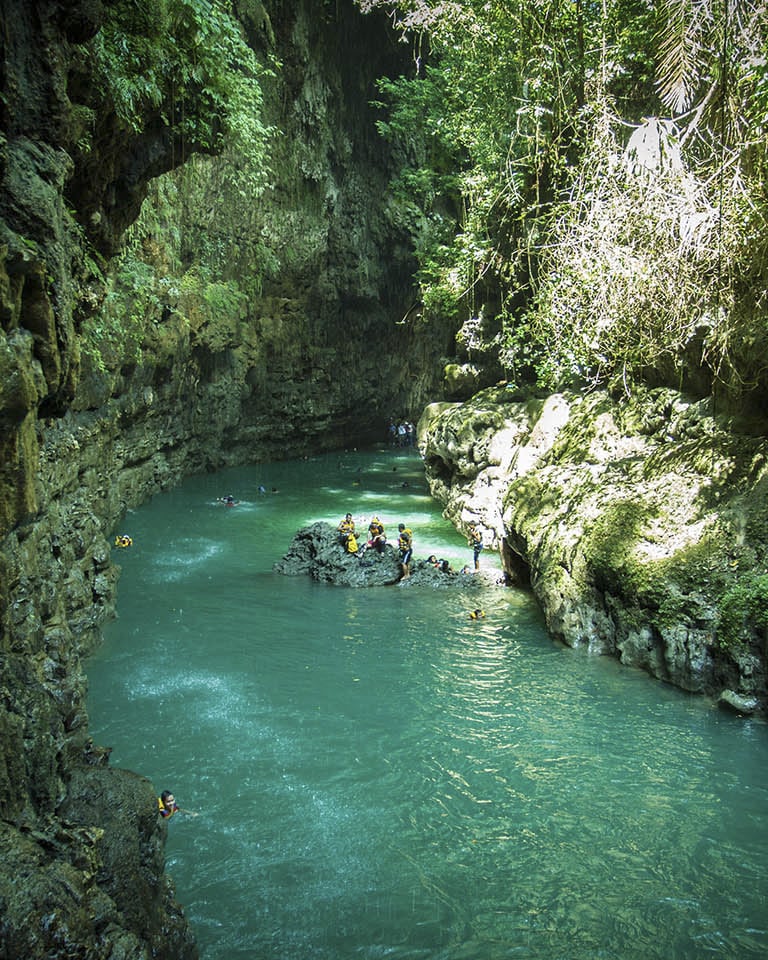
When our number was called, we climbed into the boat and settled onto the narrow wooden seats. The engine sputtered to life, and suddenly the world behind us began to slip away. The river widened, then narrowed, twisting gently through dense jungle. The water was a shade of green I’ve never seen anywhere else — not emerald, not jade, something softer and deeper, like nature had mixed its own secret color just for this place.
As we glided along, the forest leaned in close. Branches stretched over the water, vines hung like lazy ropes, and sometimes something moved in the undergrowth. Our boatman pointed to the riverbank and laughed softly. A lizard slid into the water, disappearing with barely a ripple. Further along, something long and dark slipped off a branch into the river — a snake, he said casually, as if mentioning a stray cat. My heart jumped, then settled. The animals here aren’t props in a zoo. This is their home. You’re just floating through it.
The deeper we went, the quieter everything felt. The engine’s hum softened, and the outside world — traffic, emails, schedules, expectations — dissolved into the background. I realized how rare it is to truly arrive somewhere mentally, not just physically. Green Canyon did that to me. It didn’t demand attention with noise or spectacle. It gently pulled me into stillness.
Then, almost without warning, the river bent, and the world opened up.
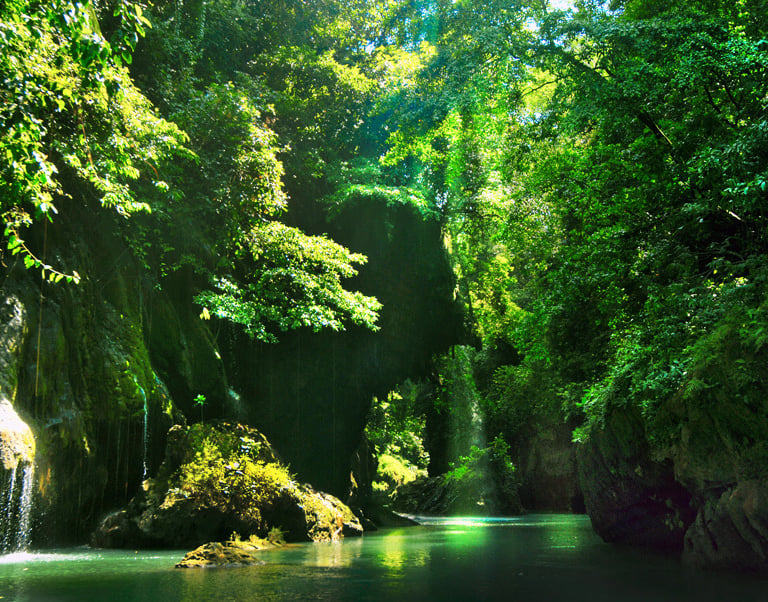
Two massive cliffs rose on either side of us, their walls streaked with green moss and dotted with tiny plants clinging to impossible ledges. Above, stalactites hung like stone teeth, dripping slowly into the water below. The light changed here. It filtered through the narrow opening above, creating soft beams that danced on the surface of the river. The air felt cooler, heavier with moisture, and the sound of water echoed between the rock walls.
It felt unreal. Not dramatic in a postcard way, but intimate and ancient, like stepping into a secret place that existed long before humans decided to name things.
Waterfalls trickled down the cliffs on both sides, their constant murmur filling the canyon with a low, soothing rhythm. At low tide, you can walk under what was once a cave, stepping between the cliffs as if the earth itself had parted for you. That day, the water was high enough that we couldn’t walk all the way through, but we could swim.
I hesitated at first. The water looked inviting, but dark in places, and I couldn’t see the bottom. Then I reminded myself why I travel in the first place. Not for perfect photos. Not for checklists. For moments that scare me just enough to feel alive.
I slid into the river, and the coolness shocked the breath out of me. The water wrapped around my skin, washing away the heat, the sweat, the city dust that still clung to me. I floated on my back for a moment, staring up at the cliffs towering above me. From down there, everything felt bigger — the rock, the sky, the silence. I felt small in the best possible way.
Swimming against the gentle current between those cliffs was strangely emotional. My arms moved slowly, deliberately. Every stroke felt like a quiet conversation with the place. The water wasn’t rushing me forward. It allowed me to move at my own pace. I realized how often in life I’m fighting currents I don’t even believe in — timelines, expectations, imaginary deadlines. Here, there was only the water, the stone, and the moment.
One of the things that struck me most about Green Canyon was how clean it was. No plastic bottles floating by. No snack wrappers stuck to the rocks. No cigarette butts tucked into corners. In a world where natural beauty is often loved to death, this place felt respected. The locals take care of it, and the visitors, for the most part, seem to follow that unspoken rule. You don’t litter in a place that feels sacred. Even if you don’t believe in sacred places, Green Canyon makes you want to.
We stayed longer than planned. Floating. Sitting on rocks. Watching light shift across the canyon walls. There was no rush to leave. Time felt soft here, stretched and gentle. Eventually, though, the boatman reminded us with a kind smile that others were waiting. The canyon doesn’t belong to anyone, but it shares itself carefully.
The ride back felt quieter. Not because the river changed, but because I had. I watched the trees slide by again, but this time I wasn’t just seeing them. I was feeling them. The layers of green. The way the forest breathed around the water. The way nature doesn’t perform; it simply exists.
Back at the parking area, life returned in small, ordinary ways. Vendors calling out. Engines starting. People laughing about how cold the water was. My clothes clung to me, heavy and damp, my hair a wild mess of curls and frizz. I looked ridiculous. I also felt more like myself than I had in weeks.
If you’re planning to visit Green Canyon, the journey matters almost as much as the destination. Most people travel to Pangandaran via Bandung, which you can reach by plane, car, or train. There are even direct international flights from places like Malaysia and Singapore to Bandung. From Bandung, you can take a bus or rent a car to Pangandaran. The roads aren’t perfect, and the trip takes time, but that slowness is part of the experience. From Pangandaran Terminal, minibuses run to Cijulang Terminal, and from there, you can hop on an ojek — one of Indonesia’s iconic motorcycle taxis — for the short ride to Green Canyon. It’s not glamorous. It’s real. And that’s exactly why it stays with you.
Green Canyon isn’t a place you conquer with a checklist and a camera. It’s a place you meet. Quietly. Honestly. Without pretending you’re untouched by beauty.
When people later asked me what Green Canyon was like, I struggled to explain it. Photos don’t capture the feeling of floating between cliffs older than memory. Words don’t quite hold the sound of water echoing through stone. You can describe the color of the river, the shape of the rocks, the cost of the boat ride — and you should, because practical details matter. But the real magic of Green Canyon is how it makes you feel when you let your guard down.
It made me feel small, but not insignificant. It made me feel present in a way I rarely am at home. It reminded me that some of the most beautiful places in the world aren’t famous because they don’t scream for attention. They wait patiently behind forests and winding roads, ready to change you quietly if you’re willing to go looking.
Green Canyon is often called “a piece of heaven on earth,” and while that might sound dramatic, standing between those cliffs, water sliding past my legs, light dripping from above, I understood exactly why people say it. It’s not heaven because it’s perfect. It’s heaven because it feels untouched by urgency. Because it invites you to slow down. Because it doesn’t care who you are outside its walls.
And maybe that’s what makes it so unforgettable.