For a long time, I absorbed that messaging without realizing it. I thought getting older meant becoming less desirable, less relevant, less exciting. I thought it meant shrinking my dreams, lowering my expectations, settling into a quieter version of myself. I thought it meant watching life from the sidelines while younger, bolder people lived it fully.
None of that turned out to be true.
Life didn’t get smaller as I got older. It got bigger. Richer. Deeper. More honest.
In my twenties, I was loud in ways that were actually insecurity. I said yes to things I didn’t want. I chased approval without even realizing that’s what I was doing. I confused attention with connection. I thought being busy meant being important. I cared deeply about what people thought of me, even people who didn’t really know me. I made decisions based on how they would look instead of how they would feel. I lived with a low-level anxiety that I might be doing life “wrong,” even when I couldn’t have explained what “right” was supposed to look like.
Getting older didn’t magically fix me. It didn’t turn me into some enlightened, unbothered woman overnight. What it did was give me perspective. Time has a way of sanding down the sharp edges of insecurity. Not because life gets easier, but because you get stronger. You survive things you once thought would break you. You learn that emotions rise and fall, that heartbreak heals, that embarrassment fades, that failure is survivable. And once you’ve lived through enough of those cycles, you stop being so afraid of them.
There’s a quiet confidence that comes from simply having lived. From having tried things and been bad at them. From having loved and lost and loved again. From having made choices you regret and choices you’re proud of. Experience doesn’t make you perfect, but it makes you real. And being real is far more powerful than being flawless.
Your thirties, forties, and fifties are often described like a downhill slope. As if your best years are behind you and now you’re just coasting toward irrelevance. That narrative is not only wrong, it’s lazy. These decades are a strange and beautiful sweet spot. You’re no longer stumbling blindly through adulthood, but you’re not done growing either. You have enough self-awareness to know what matters to you, and enough energy to go after it.
You know what you don’t want. That alone is freedom.
You know the difference between being busy and being fulfilled. You know which relationships drain you and which ones feed you. You’ve learned that boundaries aren’t cruelty; they’re clarity. You’ve probably learned the hard way that saying yes to everything is just another way of saying no to yourself. So you start choosing differently. You stop explaining your choices to people who aren’t invested in your life anyway. You let go of the need to be liked by everyone. You become more selective with your time, your energy, your attention.
That selectiveness isn’t bitterness. It’s discernment.
Your body changes as you get older. That’s true. Anyone who pretends otherwise is lying. Metabolism shifts. Recovery takes longer. You feel the effects of stress more clearly. Hormones fluctuate. Strength and flexibility require more intentional care. But here’s the part no one told me: your relationship with your body can become kinder with age.
When you’re younger, it’s easy to treat your body like a project that’s never finished. Something to constantly fix, shrink, tone, or improve. It’s easy to punish it with extreme diets, overtraining, or neglect. Over time, many women start to shift from controlling their bodies to listening to them. You begin to notice how movement makes you feel, not just how it makes you look. You start choosing food based on how it supports your energy, your mood, your health. You become aware that strength is not just aesthetic; it’s protective. Strong muscles support your joints and spine. Regular movement supports your bones. Cardiovascular health isn’t about a smaller waistline; it’s about being able to live your life with less fatigue and more freedom.
The science backs this up, even if we don’t think about it daily. Maintaining muscle mass as you age supports metabolism, stability, and independence. Weight-bearing exercise supports bone density and reduces the risk of osteoporosis. Regular physical activity lowers the risk of many chronic diseases and improves mental health by regulating stress hormones and supporting better sleep. But beyond the facts, there’s a deeper truth: taking care of your body becomes an act of self-respect instead of self-criticism.
Your mind changes too. The emotional highs and lows of youth soften into something steadier. Not flat, not boring, just more grounded. You still feel deeply, but you’re less likely to be thrown completely off balance by every emotional wave. You’ve learned that not every feeling requires immediate action. You’ve learned that discomfort doesn’t always mean something is wrong; sometimes it just means you’re growing.
One of the most underrated gifts of getting older is clarity. Clarity about what actually matters to you. Clarity about the kind of life you want to build. Clarity about the people you want to build it with. When you’re younger, everything feels urgent. Every decision feels like it will define your entire future. As you age, you realize that life is more flexible than you thought. You can change careers. You can leave relationships that no longer fit. You can start over in ways you once believed were “too late.” Time doesn’t close doors as often as fear does.
The confidence that grows in your thirties, forties, and fifties isn’t loud. It doesn’t need to be. It’s the confidence of someone who knows she can handle what comes next, even if she doesn’t know exactly what that will be. It’s the confidence of having survived disappointment and still being willing to hope. Of having failed and still being willing to try. Of having been hurt and still being willing to love.
There’s also a surprising joy in caring less about performative success. In your younger years, it’s easy to chase the version of life that looks impressive from the outside. The career title. The relationship status. The curated image of having it all together. As you get older, you start craving authenticity more than applause. You care less about how your life looks and more about how it feels when you’re alone with it at night. That shift is deeply liberating. You stop living for the audience in your head and start living for yourself.
Getting older has taught me that time isn’t the enemy. Time is the teacher. It strips away illusions. It reveals patterns. It shows you who you are when things don’t go your way. It teaches you that happiness isn’t a permanent state you achieve and then keep forever. It’s a practice. A series of choices. A way of relating to your life, even when it’s messy.
So no, I don’t miss being seventeen. I don’t miss being unsure of myself, chasing validation, feeling like I had to become someone else to be worthy. I don’t miss believing that life was happening to me instead of something I could actively shape. I don’t miss thinking that getting older meant disappearing.
Getting older has made me more present. More honest. More compassionate with myself and others. It has given me the confidence to say no without guilt and yes without fear. It has given me the wisdom to know that I don’t need to rush my life. That I can move forward with intention instead of panic. That I can grow without losing myself.
If you’re afraid of getting older, I get it. The world is loud about what you’re supposedly losing. But it’s strangely quiet about what you gain: perspective, resilience, depth, clarity, self-trust. The ability to choose your life instead of just reacting to it. The freedom to define success on your own terms. The power to live more honestly in your own skin.
Your thirties, forties, and fifties aren’t the decline years. They’re the years where you finally have the tools to build the life you want. You’ve got the confidence that comes from surviving hard things. You’ve got the clarity to know what actually matters. You’ve got the boundaries to protect your energy. And you’ve still got the drive to grow, to dream, to create, to love.
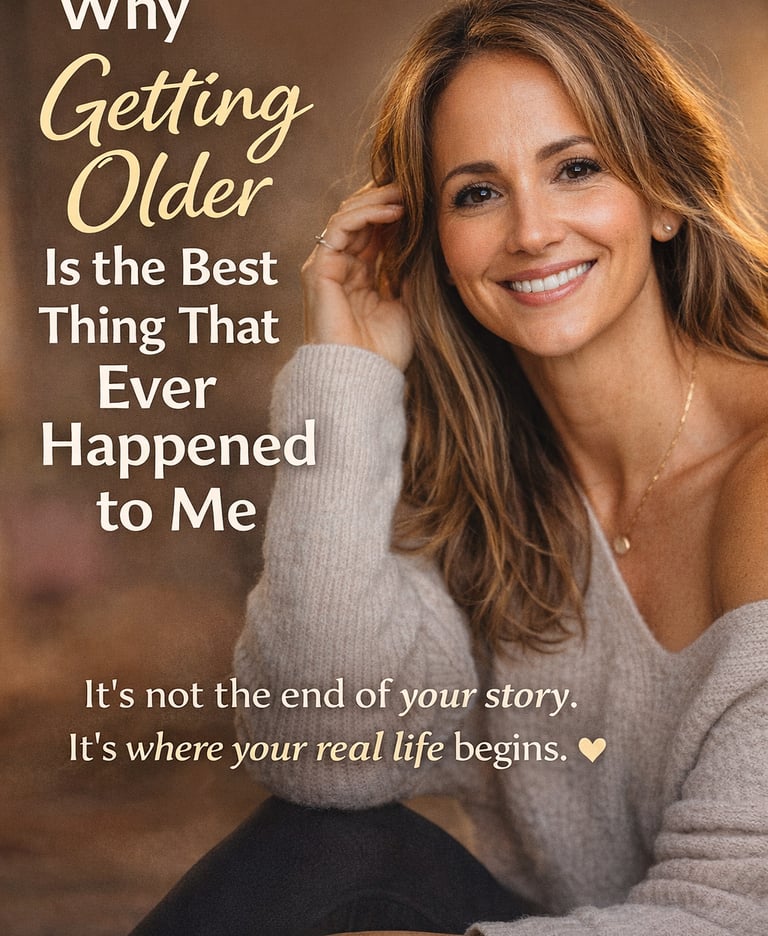
That combination is not the end of your story.
It’s where the story actually gets good.
There’s a joke I’ve heard that always makes me laugh because it hits a little too close to home: only people who peaked in high school complain about getting older. It’s funny, but it’s also painfully honest. The people who talk about aging like it’s some kind of tragedy often seem stuck in a version of themselves that belonged to another chapter of life. A chapter that’s already closed.
I used to be scared of getting older. Not in a dramatic, “I’m terrified of birthdays” way, but in that quiet, background anxiety kind of way. The kind that creeps in when you scroll through social media and notice how youth is glorified like it’s the ultimate achievement. The kind that shows up when movies frame women over thirty as either “past their prime” or only valuable if they somehow look twenty-five forever. The kind that whispers that time is stealing something from you.The world is loud about aging. Loud in its negativity. Loud in its obsession with wrinkles, with “anti-aging” products, with erasing any sign that a woman has lived. As if our faces and bodies are supposed to stay frozen in time while our lives keep moving forward. As if growth is acceptable, but visible change is not.