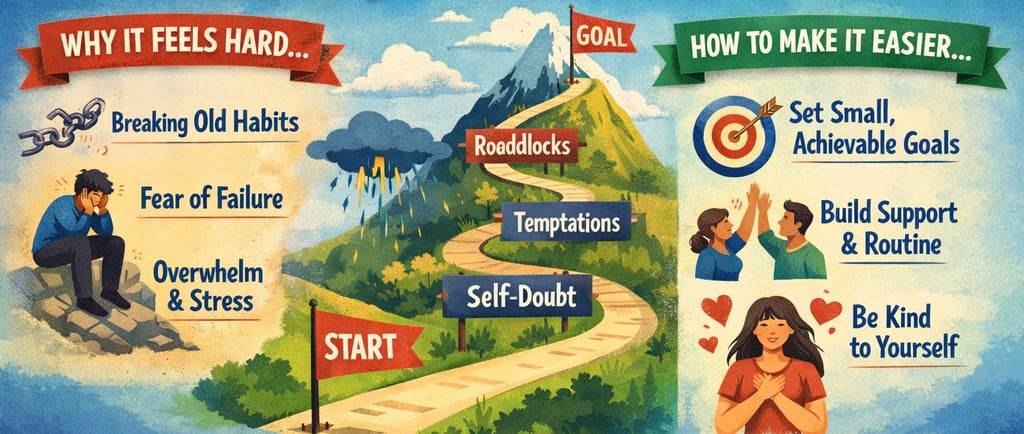
For a long time, I believed that lifestyle change was supposed to feel difficult. Not just uncomfortable, but mentally exhausting. Like something you had to prepare yourself for, brace yourself against, and survive. If it didn’t feel hard, I assumed I wasn’t doing enough.
That belief didn’t come from nowhere. It came from years of being told that real change requires sacrifice, discipline, and constant effort. That if I wanted a different body, more energy, or better health, I needed to push myself harder than I already was. And every time I failed to maintain that level of intensity, I saw it as proof that something was wrong with me.
Only later did I realize how flawed that assumption was.
Lifestyle change feels hard for many women not because they are lazy or unmotivated, but because the advice they receive is disconnected from the realities of their lives. Most recommendations are built around an idealized version of a person who has stable energy, predictable days, emotional capacity, and a body that responds linearly to effort. That version rarely exists.
Women live in bodies that are cyclical, sensitive to stress, influenced by hormones, sleep quality, emotional load, and past experiences. We carry responsibility not only in our schedules but in our nervous systems. And yet, we are often encouraged to follow rigid systems that leave no room for fluctuation or adaptation.
When lifestyle change is framed as a rigid structure, it quickly becomes another source of pressure. It asks for consistency without acknowledging that consistency does not mean sameness. It asks for discipline without recognizing fatigue. It asks for control without respecting the complexity of the human body.
I spent years approaching lifestyle change as something I needed to master. I followed plans, rules, timelines. I measured progress almost exclusively by external outcomes. And while those approaches sometimes worked temporarily, they never lasted. Eventually, life intervened. Stress increased. Energy dropped. Motivation disappeared. And the structure collapsed.
What I didn’t understand at the time was that the failure wasn’t personal. The system simply wasn’t designed to survive real life.
One of the most damaging ideas surrounding lifestyle change is the belief that if something cannot be done properly, it is not worth doing at all. This all-or-nothing mindset is particularly common among women who already hold themselves to high standards in other areas of life. When expectations are unrealistic, inconsistency feels like failure rather than a normal response to changing circumstances.
As a result, many women delay starting. They wait for the “right” time, the calmer season, the moment when everything aligns. But those conditions rarely arrive. Life continues to demand attention, energy, and flexibility.
What eventually shifted my perspective was the realization that sustainable change does not come from doing everything correctly. It comes from staying engaged, even imperfectly. From making choices that are good enough rather than ideal. From adjusting instead of quitting.
Consistency, I learned, is not repetition of the same behavior every day. It is continuity of intention across changing conditions.
This understanding transformed how I related to movement. Exercise stopped being something I completed and started being something I used. I no longer evaluated a workout by how intense it was or how many calories it burned. Instead, I paid attention to whether it supported my body, my energy, and my mental state.
There were periods when structured strength training felt appropriate and beneficial. There were other times when walking, mobility work, or rest were the most responsible choices. The value of movement became contextual rather than absolute.
From a physiological perspective, this approach makes sense. The body adapts not only to mechanical stress, but also to psychological stress. When overall stress levels are high, additional strain can impair recovery, disrupt hormones, and reduce the benefits of training. In those moments, doing less is not regression — it is regulation.
Nutrition followed a similar path. For years, I tried to follow rules that promised control and clarity. But those rules often created anxiety instead of nourishment. They encouraged restriction rather than awareness. And they ignored how appetite, digestion, and energy fluctuate based on stress, sleep, and emotional state.
Over time, I began to understand that the body does not respond to isolated choices. It responds to patterns. Regular meals, adequate protein, sufficient carbohydrates, and enough overall energy intake support hormonal balance, muscle maintenance, and cognitive function. Extreme restriction undermines all of these.
Eating well became less about following a plan and more about responding to signals. Hunger, fullness, energy levels, and emotional state all became relevant data points. This shift removed much of the guilt and rigidity that had previously made nutrition feel overwhelming.
Importantly, this approach did not lead to chaos. Structure still existed, but it was flexible rather than punitive. Meals became simpler. Decisions became easier. And consistency emerged naturally, without force.
Lifestyle change is often described as a physical process, but its foundation is psychological. Habits are shaped by identity, self-trust, and perceived capability. When women repeatedly attempt extreme changes and fail to sustain them, they internalize the idea that they are incapable of change. This belief becomes self-reinforcing.
Small, achievable actions disrupt this pattern. Each time a woman follows through on a manageable commitment, she gathers evidence that change is possible. Over time, these experiences reshape identity. Confidence grows not from dramatic results, but from reliability.
From a behavioral standpoint, this is how long-term change actually occurs. The nervous system responds to safety and predictability. When actions feel achievable, resistance decreases. When pressure is removed, engagement increases.
The most effective lifestyle changes are rarely dramatic. They are quiet adjustments repeated over time. Shorter workouts performed consistently. Simple meals eaten regularly. Adequate rest prioritized without guilt. These behaviors support metabolic health, emotional regulation, and physical resilience.
There is also an important shift in motivation that occurs when the focus moves away from appearance alone. Feeling better — having more energy, less pain, improved sleep, and greater emotional stability — becomes a more powerful and sustainable driver than external validation.
This does not mean that aesthetic goals are invalid. It means they are insufficient on their own. When lifestyle change is rooted only in dissatisfaction, it tends to be fragile. When it is rooted in self-support, it adapts.
If lifestyle change feels hard, it is worth examining not your level of discipline, but the demands of the system you are trying to follow. Difficulty is often a signal that expectations are misaligned with reality.
Real change does not require constant effort. It requires appropriate effort. Effort that considers stress, recovery, and individual context.
Lifestyle change is not a project with a finish line. It is an evolving relationship with the body. That relationship strengthens when it is based on respect rather than control.
And when that shift happens, change stops feeling like a battle — and starts feeling like something you can live with.