
Paddling Between Worlds – A Dragon Boat Training Experience on Tokyo’s Kyu-Nakagawa River
1/24/20266 min read
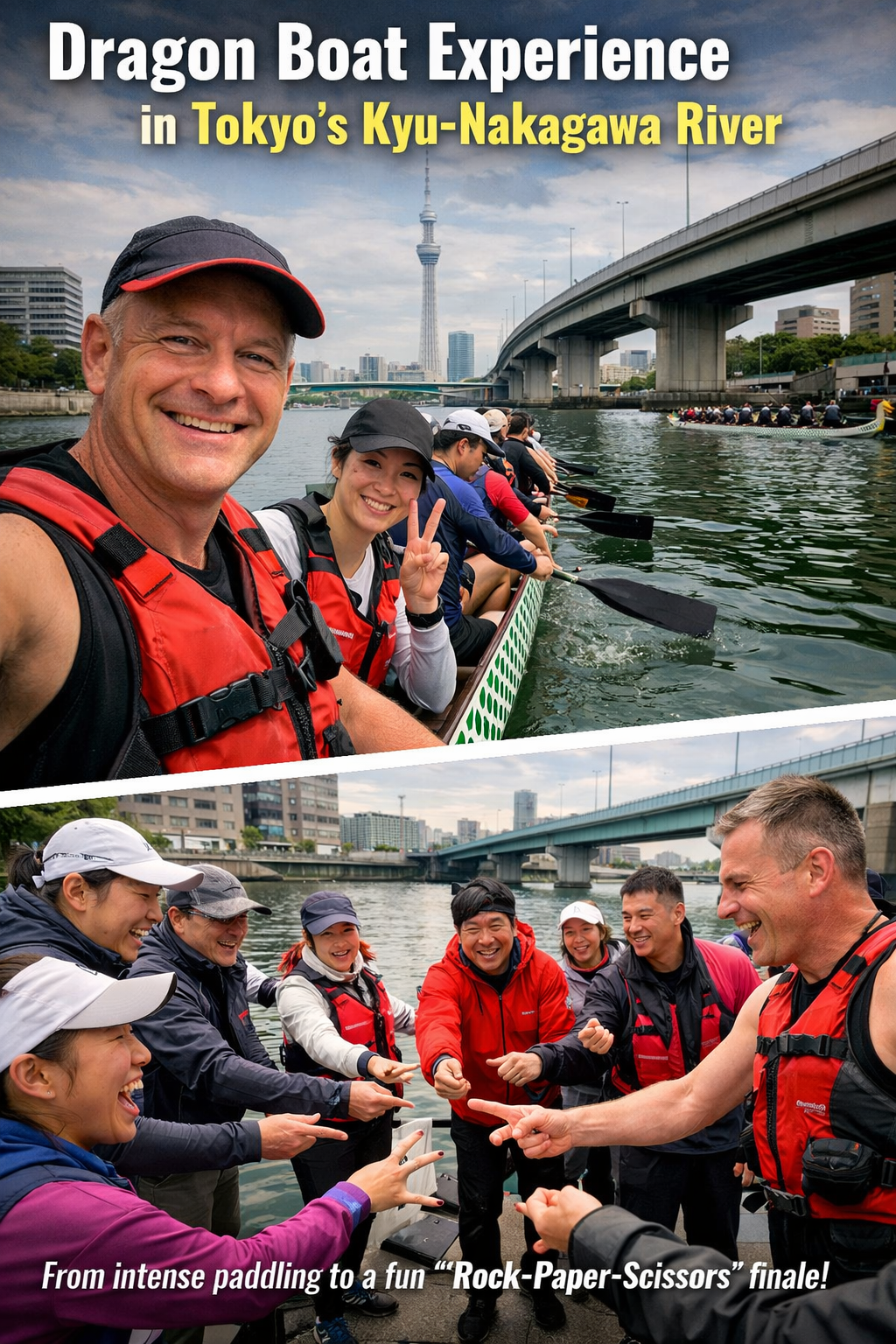
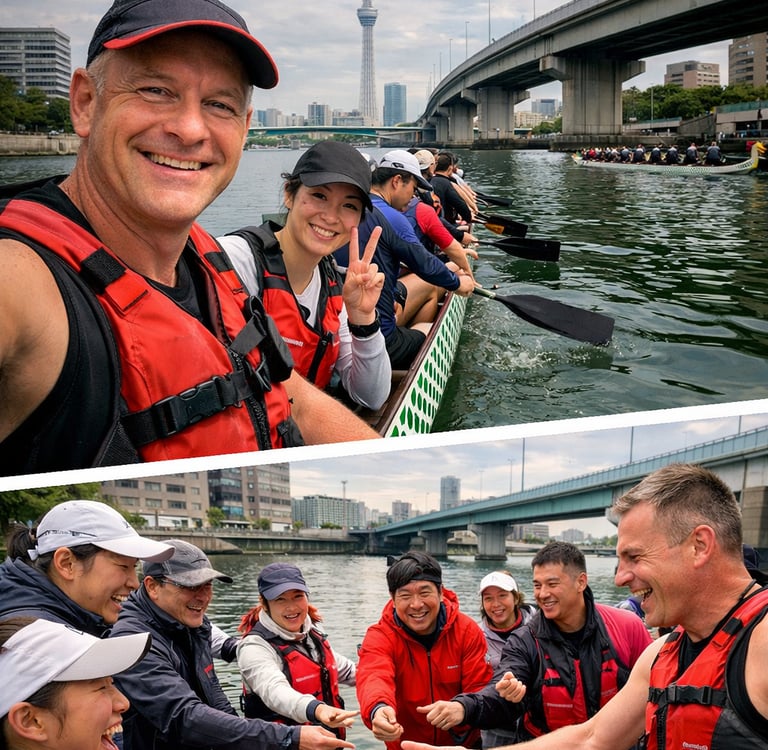
Paddling Between Worlds – A Dragon Boat Training Experience on Tokyo’s Kyu-Nakagawa River
Before our journey to Asia, my dragon boat coach, Miki Szabó, suggested that I should try to connect with a local club and see whether I could join a training session abroad. I followed his advice and reached out to the Japan Dragon Boat Association, not expecting much more than a polite acknowledgment. What happened instead was an almost immediate response that would set the tone for everything that followed.
Within days, I was put in touch with Yuki, a Tokyo-based dragon boat paddler and organizer. Her openness and warmth were remarkable from the very first email. With effortless kindness, she provided all the practical details well in advance: the exact metro station, exit number, meeting time, and training schedule. Two weeks later, while my teammates back home with the Dunai Sárkányok were almost certainly still asleep, Yuki was already waiting for me at 8:40 a.m. local time at Higashi-Ojima Station, Exit 2.
And then, as if it were the most natural thing in the world, the miracle happened.
At 10:00 a.m., I dipped a borrowed paddle—slightly too long, nearly reaching my navel, non-adjustable but carbon nonetheless—into the greenish, semi-transparent, icy water of the Kyu-Nakagawa River. Technically speaking, it is a canal, its water faintly salty from the nearby sea, but for me, it instantly became a gateway between cultures.
This is the story of that training session—and of the cultural experience that unfolded around it.
Dragon Boat Tokyo-Style
As Yuki explained, there are at least fifty amateur dragon boat clubs scattered across Tokyo. Considering the city’s staggering population of nearly 37 million, that number suddenly feels surprisingly modest. These clubs train regularly and compete internationally. Many of them attend events in Hong Kong, Thailand, and Europe. Some had raced at the IDBF World Championships in Szeged, others proudly showed photos from the Pattaya World Championships in Thailand.
To my amazement, they also shared snapshots from Budapest—mostly relaxing in the Széchenyi Thermal Bath after racing. One paddler even mentioned taking a Danube sightseeing cruise that passed Visegrád, which made me smile. The world suddenly felt incredibly small.
Their team wasn’t exclusively Japanese either. Training sessions often include expatriates living in Tokyo. That day, I noticed three European women in the boats—two with Slavic accents and one French. What was unusual, however, was that a tourist like me simply “dropped in” to train. Apparently, that doesn’t happen often.
Expectations vs. Reality
Given the popularity of dragon boat racing in Asia, I secretly expected something out of a science-fiction movie:
a high-tech training center with robot-controlled water flow, heated pools, ergometers measuring respiratory quotient, biometric screens, and maybe even a souvenir shop selling sacred dragon relics.
Reality, however, was refreshingly different.
We arrived at what was essentially a boat storage area under a bridge, enclosed by fencing. And yet, the welcome I received was anything but underwhelming. Smiles, curiosity, genuine interest. Someone handed me a plastic crate for my clothes, another passed me a mandatory life jacket—despite the fact that this canal felt about as dangerous as a calm swimming pool back home.
That contrast—between modest infrastructure and rich human connection—was my first quiet lesson of the day.
The Circle
Before anything else, we formed a circle.
Together, they discussed the goal of the day’s training. Then suddenly, all eyes turned toward me. Forty pairs of eyes. I realized that this wasn’t a casual formality—I was expected to speak.
I introduced myself.
People listened attentively. They smiled. They laughed. They gestured enthusiastically. Then my words were translated into Japanese—and they listened again, laughed again, and finally applauded.
It was disarming.
What struck me was not the applause itself, but the sincerity behind it. What I thought. What I felt. What I said—it mattered.
Preparation as a Philosophy
Boat unloading followed, carried out collectively using clever roller systems that made the heavy boats seem almost weightless. Not a single raised voice. Not one curse word. Everything flowed.
Then came the warm-up.
From a professional standpoint, it was impressive.
We spent over thirty minutes warming up together. First, a 15-minute dynamic block focusing on circulation and mobility, followed by highly specific exercises targeting the hips, lower back, and shoulders. The preparation was thorough, uncompromising, and intelligently structured.
In the final phase, paddlers were invited to demonstrate their favorite exercises, reinforcing both engagement and ownership. By the time we stepped into the boats, everyone was sweating, fully mobilized, and mentally present.
Synovial fluid was doing its quiet work, joints were ready, and the psychological shift into paddling mode had clearly taken place. It was preparation not just for performance—but for longevity.
On the Water
We spent over two hours on the water, and the experience was intense.
This was an amateur club, training for enjoyment rather than profession, yet the discipline was unmistakable. The session was meticulously structured, free of improvisation, and executed with striking speed and precision.
Due to traffic, the main training took place several kilometers away on a quieter stretch of the canal. Unfortunately, that meant no meaningful video footage—only some casual clips during warm-up paddling. I attempted to film discreetly by fishing my phone out of the life jacket pocket with wet hands, but that proved hopeless.
Later, I forgot the phone inside the vest entirely.
Cue panic.
All life jackets were soaked in fresh water to rinse off the salt. I frantically checked each one, much to everyone’s amusement, until—miraculously—I found it. The phone survived. My dignity, less so.
Cold Lessons
What I hadn’t anticipated was the wind.
While everyone else was wrapped in full cold-weather paddling gear—layers, gloves, windproof everything—I was sitting there in nothing but shorts. I suspect they now believe Hungarians are some sort of iceberg-wrestling Vikings. (To be fair, Miki does paddle around islands.)
I smiled calmly while internally freezing.
Ironically, I found myself wishing for more paddling, less waiting. This wish would later come back to haunt me.
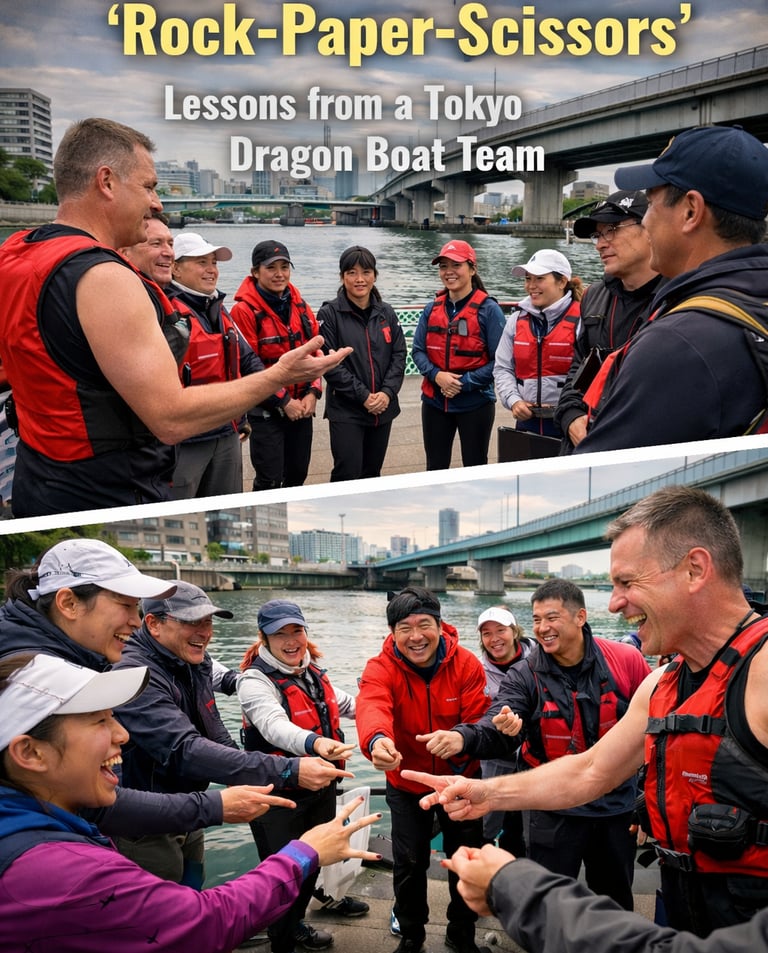
Speed, Silence, and “Rock–Paper–Scissors” – Lessons from a Tokyo Dragon Boat Team Post 2
Tokyo is a city defined by movement—by rhythm, coordination, and astonishing density. On the Kyu-Nakagawa River, that same logic applies to dragon boating.
Traffic on the canal was heavy that morning. Rowers, kayaks, mysterious floating contraptions—everything converged into a narrow aquatic bottleneck. Waiting became inevitable.
At moments like these, one truly appreciates the vastness of the Danube back home: its width, power, and natural grandeur. That said, Tokyo itself is interlaced with rivers and canals, and just a few kilometers away lies the open bay connected to the Pacific Ocean. This canal was chosen for a reason—it was calm, controlled, and predictable.
And predictability is something the Japanese value deeply.
When Speed Becomes Language
The training emphasized short, high-intensity sprint intervals, often around 500 meters. What stunned me wasn’t the distance—it was the stroke rate.
I am convinced that the paddles were moving faster than the passing power lines outside a Shinkansen train traveling at 300 km/h. Watching alone was exhausting.
Short bursts. Explosive power. Relentless rhythm.
Most paddlers sat with the water-side leg extended, driving power through the footrest. We started on the weaker side for about thirty minutes, then switched to the dominant side for the remainder of the session. Roles were rotated several times—steerer, paddler, organizer—reinforcing shared responsibility.
Everything happened efficiently, quietly, and without drama.
The Moment That Stayed With Me
And yet, the most powerful moment came after the training.
Once again, we formed a circle.
This time, someone gently nudged me and said in broken English:
“Express yourself.”
I understood.
Drawing on every polite cliché I could recall from Akira Kurosawa’s samurai films, I thanked them for the opportunity, praised the quality and intensity of the training, and expressed my admiration for their teamwork. I also told them that if they ever visited Vác, they would be welcomed with the same warmth.
They listened. Smiled. Laughed.
Then it was translated.
They listened again. Smiled again. Laughed again.
And applauded.
I was genuinely embarrassed—and deeply moved. What struck me was how seriously they took reflection. One by one, others shared their thoughts. No interruptions. No debates. Every voice mattered.
Ending with Play
Then came the final surprise.
The entire session concluded with a loud, joyful game of rock–paper–scissors.
No irony. No awkwardness. Just laughter.
Someone had to win, after all.
What I Took Home
This experience went far beyond sport.
Yes, the training was physically demanding. Yes, my muscles were thoroughly depleted. That evening, I diligently replenished my mitochondria with a local Kirin Beer, adorned—naturally—with a dragon emblem, and a generous serving of gyoza.
But what stayed with me wasn’t soreness.
It was the culture of attentive presence.
The community spirit.
The discipline aligned with shared goals.
And the uniquely Japanese blend of seriousness and playfulness—sometimes almost naively cute (kawaii), yet profoundly human.
As I typed these final lines, my fingers stiff from paddle-induced cramping, I realized that I hadn’t just trained with a foreign team.
I had been welcomed into a way of thinking.
And that, more than any sprint interval, was the real workout.