
I didn’t come to Tai Chi because I was balanced, patient, or especially in tune with myself. I came to it because something in me felt constantly tight — not just in my body, but in the way I was living. There was always this quiet pressure humming underneath everything I did, like I was slightly behind, slightly not enough, slightly needing to hurry. Even when I tried to slow down, it felt like I was pretending. My body would be still, but my mind was already somewhere else, reaching for the next step, the next result, the next version of me that I believed I had to become.
So when I first started practicing Tai Chi, I brought that same energy with me without even realizing it. On the outside, it looked calm. Slow movements, soft transitions, controlled breathing. But inside, I was rushing through every second of it. I wanted to get it right. I wanted to understand it quickly. I wanted to feel like I was progressing. And maybe the strangest part is that I thought this was a good thing. I thought that meant I was committed.
But Tai Chi has a way of revealing things you didn’t know you were carrying.
I remember one morning very clearly. The room was quiet, soft light coming through the window, everything perfectly still. I started the sequence the way I had learned — shifting my weight, stepping forward, raising my arms. And within seconds, I could feel tension creeping in. My shoulders lifted slightly. My jaw tightened. My breath became shallow without me even noticing when it changed. And my mind… it was already ahead, thinking about what came next before I had even completed the movement I was in.
That was the moment something shifted for me, not dramatically, not like a breakthrough you can point to and say “this is where everything changed,” but more like a quiet realization that settled into my body.
I wasn’t practicing. I was chasing.
Chasing the form, chasing the feeling, chasing the idea of being someone who “does Tai Chi well.” And the more I tried, the more disconnected I felt. It was like trying to hold water too tightly — the harder I gripped, the less I actually had.
There’s something deeply uncomfortable about slowing down when your entire system is used to moving fast. Not physically — that part is easy. But internally, it feels like resistance. Like you’re doing something wrong by not pushing. I didn’t expect that. I thought slowing down would feel peaceful immediately. Instead, it felt unfamiliar, almost unsettling, like stepping into silence after being surrounded by noise for too long.
But I stayed.
Not because I was disciplined, but because I was curious. There was something in that discomfort that felt honest, like I was finally seeing something real about myself.
And what I saw was this: I had been using force in almost every area of my life.
Not obvious force, not aggression, but a constant internal pressure. A subtle pushing. A belief that if I didn’t actively try to improve, fix, or move forward, I would somehow fall behind. That belief had shaped the way I worked, the way I related to people, and especially the way I related to myself.
And suddenly, in the middle of a slow Tai Chi movement, I realized I was doing the same thing here.

Trying to get somewhere.
Trying to become something.
Trying to arrive.
But Tai Chi doesn’t respond to that.
It doesn’t reward force. It reveals it.
Every time I pushed into a posture, I lost balance. Every time I tried to force my body into the “correct” shape, something felt off, stiff, unnatural. And every time I rushed, I stopped feeling what was actually happening. It was like the practice was quietly mirroring my life back to me, showing me exactly where I was creating tension without even knowing it.
So instead of trying harder, I did something that felt almost counterintuitive.
I stopped trying to improve.
Not completely, not perfectly — I’m still human — but enough to create a different kind of space. A space where I could just pay attention.
At first, it felt too simple to matter. Just noticing my weight shifting from one foot to the other. Feeling the ground under my feet. Letting my breath move naturally instead of controlling it. But the more I stayed with it, the more I realized how much I had been missing.
It’s strange to say, but I think I had been living slightly outside of my own body. Not in a dramatic way, not disconnected from reality, but just not fully there. My attention was always leaning forward into the future, into what needed to happen next.
Tai Chi brought me back.
Not through effort, but through awareness.
There’s a moment in practice — and it still surprises me every time — when everything slows down so much that time feels different. It’s not that the clock changes, but your experience of it does. It’s like each second expands, becomes fuller, richer. You start noticing details that were always there but hidden behind speed.
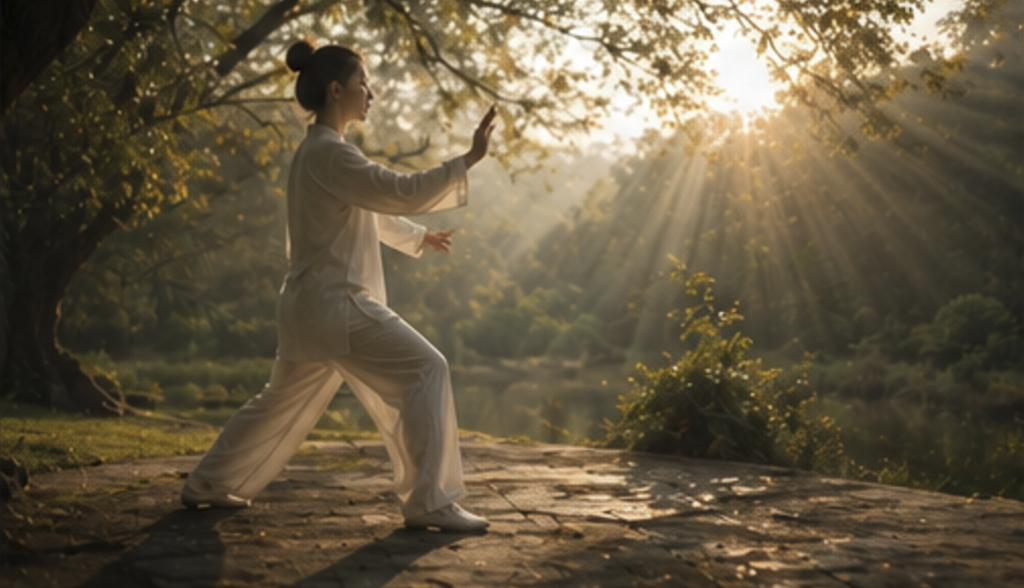
The way your heel touches the ground before your weight settles. The subtle rotation in your hips before your torso follows. The softness in your hands when you stop holding them rigid. These are small things, almost invisible from the outside, but they change everything from the inside.
And in those moments, something else begins to dissolve.
The idea that you need to fix yourself.
That belief had been so deeply rooted in me that I didn’t even question it. Of course I needed to improve. Of course I needed to become better. That’s what growth is, right?
But Tai Chi quietly challenges that.
It doesn’t ask you to become something else. It invites you to be here, exactly as you are, and to experience that fully. And when you do, when you actually allow yourself to be present without trying to change anything, something remarkable happens.
Change begins on its own.
Not forced, not controlled, not directed — just unfolding naturally.
I started to notice that my movements became smoother without me trying to make them smoother. My balance improved without me focusing on balance. My breath deepened without me practicing breathing techniques. It was as if my body knew what to do once I stopped interfering with it.
That realization changed how I understand practice completely.
Practice is not something you squeeze into the leftover time at the end of your day. It’s not something you do quickly so you can check it off a list. It’s something you give space to. Something you step into intentionally, almost like entering a different rhythm of time.
When I started treating practice this way, everything shifted.
It wasn’t about how long I practiced, but how present I was. Even a few minutes felt full, complete, meaningful. There was no rush to finish, no need to get through the sequence. Each movement became its own experience, its own moment to explore.
And maybe the most surprising part is how this began to affect the rest of my life.
I started noticing when I was rushing in other areas. When I was pushing conversations forward instead of listening. When I was trying to solve something before fully understanding it. When I was treating myself like a problem instead of a person.
And slowly, gently, I began to soften there too.
Not perfectly. I still catch myself slipping into old patterns. But now I see it. And that awareness creates a small space — just enough to choose something different.
To pause.
To breathe.
To come back.
There’s a kind of quiet kindness in this way of practicing that I didn’t expect. It’s not about being passive or lazy. It’s actually very precise, very attentive. But it’s not harsh. It doesn’t demand. It allows.
And in that allowing, something deeper grows.
A sense of being at home in your body.
That’s something I didn’t realize I was missing until I felt it. This quiet, steady feeling that I’m not trying to escape myself anymore. That I don’t need to become someone else to be okay. That I can move, breathe, exist exactly as I am, and that’s enough.
Tai Chi didn’t give me that as a concept.
It gave it to me as an experience.
And once you feel something like that, even briefly, it changes how you move through the world.
Now when I practice, there’s no urgency. No timeline. No expectation of where I should be. I begin, and that’s enough. I move, and I listen. I breathe, and I feel.
Sometimes it’s messy. Sometimes my mind is still busy. Sometimes I lose the connection and have to find it again. But even that is part of the practice.
Because this isn’t about perfection.
It’s about presence.
And presence, I’m learning, is not something you achieve.
It’s something you return to.
Again and again.
Gently.
Without force.
Without violence.
Just by beginning.