
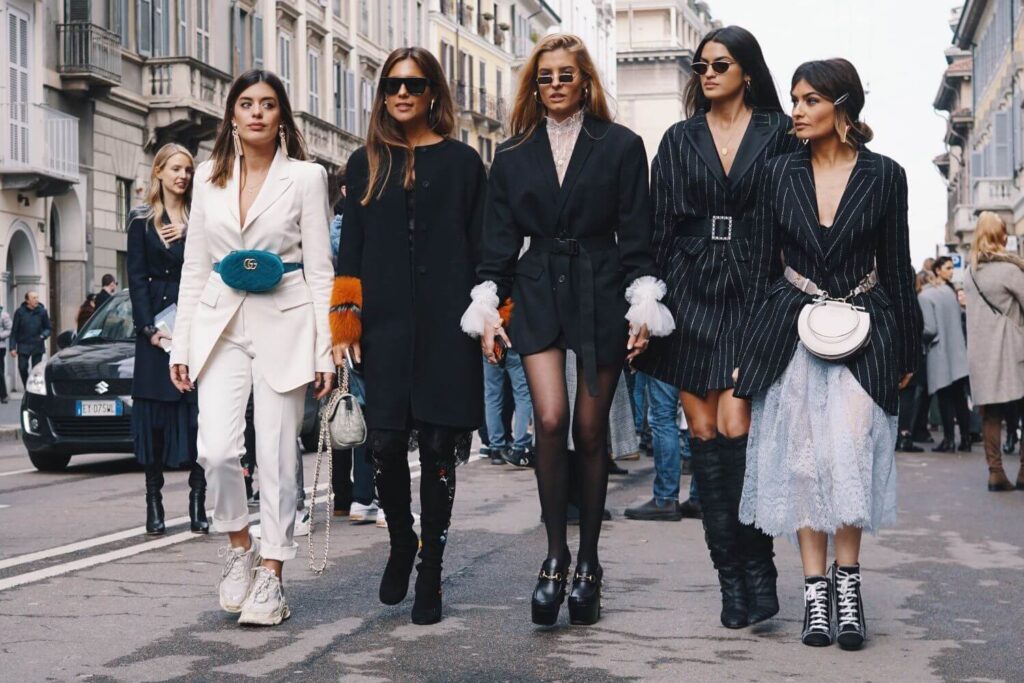
A firsthand dispatch from the streets, café terrasses, and Saturday morning markets of Paris — April 2026, all sunshine, no umbrella required.
Every spring I make a pilgrimage back to Paris and every spring Paris surprises me. Not with something wildly new — Parisians are famously resistant to the wildly new — but with something that feels inevitable once you see it. A color you hadn’t considered. A silhouette that shifts just enough. An accessory that starts making total sense the moment a real Parisian woman picks it up. April 2026 was one of the best trips I’ve taken for street style. Warm, sunny, perfectly transitional between seasons. And Paris, bathed in golden afternoon light with nowhere to be in particular, dressed up for me like it knew I was watching.
I want to be honest about how these reports come together, because the process matters and I think it shapes what I’m able to share. I don’t stand on a street corner with a professional camera waiting for people to pose. That’s not Paris, and it’s not how Parisians dress — they dress for themselves, not for an audience, which is precisely what makes observing them so instructive. My method is much more organic. I walk. A lot. I sit at café terrasses with a coffee long enough to watch a full rotation of people pass. I make voice notes on my iPhone when I see something I want to remember. I sketch in my notebook over lunch — quick impressions, not fashion illustrations, just enough to anchor the memory. And occasionally, when the light is right and someone is moving slowly enough, I get a photo.
This particular April was exceptional in one specific way: the weather. I have done this walk in a full winter coat and I have done it in drizzle with wet shoes and a damp notebook. This trip? Pure sun, every single day. Temperatures that let women actually wear what they wanted to wear, not what the weather forced on them. The result was an unusually clear window into genuine Parisian spring style — no layers obscuring the outfit, no hoods hiding the hair, no rain-ruined plans. Just people, dressed beautifully, living their lives.
These are the things I kept seeing. The things that will matter here, and then later, probably, everywhere else.
The Suede Jacket: This Is Not a Trend, This Is a Wardrobe Decision
I need to open with suede because it was simply everywhere. Not in the way that something is everywhere when a brand pushes it hard or an influencer makes it go viral — more in the way that something is everywhere when it’s the right answer to a question the season is asking. Paris in late April has a very specific dress code challenge: it’s too warm for a proper coat, too cool for nothing, and too chic to wear a basic zip-up and call it finished. The suede jacket is, it turns out, the perfect solution to all three problems simultaneously.
I saw suede jackets on Parisian women every single day. On women in their thirties striding through the Marais with a coffee in hand. On women in their sixties walking dogs in the 6th. On younger women at the weekend market, layered over silk blouses with jeans they’d clearly owned for years. The jacket wasn’t the outfit — it was the frame around the outfit, the thing that made everything else cohere.
The suede jacket wasn’t the outfit. It was the frame around the outfit — the thing that made everything else cohere. In a season of transitional dressing, it was the answer every Parisian woman already knew.
The silhouettes varied more than I expected. Some were shorter — waist-length, almost jacket-weight, worn open over a blouse. Others were longer, falling mid-thigh, almost coat-adjacent, in a tawny camel or a warm cognac that photographed beautifully in the golden spring light. But the common thread across all of them was the same quality of material: substantial without being stiff, worn-in without looking old, with that particular softness that real suede develops over time and that nothing synthetic ever quite manages to replicate.
Colors skewed warm. I saw a lot of camel, a lot of tobacco brown, some olive that edged towards khaki, and a few in a very muted taupe that looked almost stone-colored in shadow. Occasionally, a black — but the women who were clearly the most at home in the city tended toward the earth tones. They looked less like fashion and more like something that had always been in their wardrobe, waiting for exactly this weather.
How Parisians Were Styling It
The most consistent combination I saw was a suede jacket over a beautiful blouse — something with a collar, something in silk or a silk-adjacent fabric, something that peeked out at the neckline in a way that felt both effortless and considered. Not a basic white tee (though that worked too, occasionally). Something with a little personality. A printed blouse in a Liberty-style floral, worn quietly under a cognac suede, is a very Parisian kind of contradiction: the print visible but not performing. Present without showing off.
Bottoms were predominantly straight or wide-leg trousers, belted, in neutral shades. Or jeans — good jeans, dark or faded to exactly the right degree, that had clearly been around for a decade and weren’t going anywhere. Shoes were almost universally flat: ballet flats (which we’ll get to), simple loafers, or the occasional clean white sneaker that managed to look far more expensive than it probably was simply by being immaculate.
The suede jacket is not an impulse buy and I want to acknowledge that honestly. It’s an investment. But watching it worn on the streets of Paris, worn by women who had clearly owned theirs for three or five or ten years and were still reaching for it every spring, made the case for itself. This is not a trend in the here-today sense. It’s a wardrobe decision. The French would say it’s part of a fond de garde-robe — the foundational wardrobe — and they’re right.
I have the Will from Sézane — the shorter coat version — and wore it constantly in the fall. It was one of those pieces I reached for more than I anticipated. Spring in Paris made me want to wear it all over again. There’s something about seeing a piece you own on the streets of the city that created it that confirms every purchase decision. The Will confirmed.
Two Bags on Absolute Repeat
I always pay close attention to bags in Paris because Parisians are not impulsive about their bags. They don’t chase trends the way the rest of the fashion world sometimes does. They find something they love — the shape, the size, the way it feels on the shoulder — and then they carry it, over and over, until it becomes part of them. Which means when I see the same bag repeatedly on the streets of Paris, I pay attention differently than I might if I saw it on an influencer. This is real endorsement. This is women voting with their wardrobes.
This trip gave me two bags on repeat, and one of them genuinely surprised me.
The Barrel Bag
I was not expecting the barrel bag to be this moment. I’d noticed the shape emerging in the fashion press over the past few months but I’d been watching it with the mild interest you give a trend before you decide whether it’s real or editorial. Paris confirmed: it is very real.
The barrel bag — cylindrical, structured, worn on the shoulder or crossbody — was everywhere, and I mean that with the particular emphasis that comes from seeing something multiple times in one day, in multiple neighborhoods, on women with completely different personal styles. The shape that was connecting them all: round, a little compact, with a satisfying structure that kept its form even when carried. It doesn’t slouch. It stands up for itself.
Colors ran almost exclusively in a warm spectrum: the cognac browns, some camel, the occasional black, and then occasionally — thrillingly — a red. The red barrel bag is something I want to talk about for a moment because it represents a specific category of Parisian confidence. You don’t wear a red bag because it’s convenient or practical or goes with everything. You wear it because you’ve decided the outfit is done and the bag is the exclamation point. The women I saw carrying red barrel bags carried them with absolute authority. They weren’t thinking about the bag. They’d already thought about the bag, before they left home, and the thinking was over.
I recently added a barrel bag in red to my own collection after this trip, and every time I reach for it, I think of those women. Which is, I think, the best thing any purchase can do — connect you, even briefly, to something you admired.
The Polène Neuf Mini for Evenings
The second bag was the Polène Neuf mini, and this one appeared almost exclusively in the evenings — at dinner, on weekend nights out, carried by women who’d dressed up just enough for a restaurant but not into territory that required a clutch. It’s a smaller version of Polène’s signature half-moon shape, and it’s the kind of bag that looks considerably more expensive than its price point suggests.
I didn’t get a good photo of it, which is something I have to admit with some frustration — evening light is tricky, and I wasn’t about to be the woman photographing strangers at a restaurant table — but I saw it clearly enough across multiple evenings to know it was a pattern. The textured camel version was the one I saw most frequently. Something about its proportions is exactly right for an evening: small enough to be elegant, large enough to actually hold your phone and a card.
What I love about the Polène observation more broadly is what it signals about where Parisian women’s bag preferences are moving. The logo era had its moment. What’s replaced it — at least in the neighborhoods I was walking through — is a preference for interesting shapes and excellent materials over visible branding. The bag speaks, but it speaks quietly. It doesn’t announce a price tag. It just sits there, beautifully made, doing its job.
She was moving quickly — the particular speed of someone who has somewhere to be but isn’t going to rush the way she looks doing it. Brown barrel bag, tucked under her arm rather than hung on the shoulder, with the casual possessiveness of someone who’s been carrying the same bag for two years. Straight-leg dark trousers, a white collared shirt with exactly one extra button undone, suede jacket in a warm tobacco. The kind of outfit that reads as effortless only because all the effort happened somewhere else, probably the night before, probably in front of a mirror she pretends not to use. She was there and gone in thirty seconds. I wrote everything down.
The Ballet Flat Is Not Going Anywhere — And She Is My Favorite
There are trends that arrive loudly and leave quickly, and there are things that become part of the Parisian uniform so thoroughly that they stop feeling like a trend at all and start feeling like a fact. The ballet flat has reached fact status. It was the shoe on the street in Paris this April more than any other, and I say this having actively looked for exceptions.
Loafers were there. White sneakers were there, occasionally. But the ballet flat — delicate, flat, pointed or rounded toe, in leather or suede, in black or nude or a lovely soft tobacco — was the consistent choice. Worn with trousers. Worn with midi skirts. Worn with jeans. Worn with dresses for a long Saturday lunch. The ballet flat has the particular quality of making whatever it’s paired with look more Parisian, which is a genuinely remarkable thing for a shoe to achieve.
What makes the current iteration of the ballet flat interesting, fashion-technically, is the slight elevation of the silhouette around it. When you take a shoe this low and this flat and pair it with wide-leg trousers or a longer skirt, you’re playing with proportion in a way that’s actually quite sophisticated. The foot disappears slightly. The leg reads as longer. The whole outfit has a kind of ground-level grace that a heel can’t replicate because a heel changes the body’s posture, whereas a flat lets the body be itself. Paris is very interested, apparently, in bodies being themselves. I find this enormously refreshing.
The ballet flat has the particular quality of making whatever it’s paired with look more Parisian — which is a genuinely remarkable thing for a shoe to achieve. Paris is, apparently, very interested in bodies being themselves.
The Woman Who Stopped Me in My Tracks
I need to tell you about her, because she was the best-dressed person I saw on the entire trip and she was probably in her mid-seventies and she was having a tiramisu alone at lunch and I watched her from across the restaurant with what I hope was respectful admiration and not obvious staring.
She was in a matching ensemble — the kind of matching that signals real intent, not an accident — in a color I can only describe as a slightly faded dusty blue, like a piece of fabric that had been beautiful for decades and hadn’t lost anything in the process. The pieces fit her exactly. Not tightly, not loosely: exactly. Her flats were simple, dark, low-vamp with a small bow at the toe, and they looked like they’d been resoled three times and would be resoled three more. She sat down, ordered just the tiramisu, ate a few bites slowly, asked for the check, and left. The whole thing took maybe fifteen minutes. I have thought about her several times since.
There’s a version of aging in Paris that I find genuinely aspirational, and she embodied it completely. The commitment to dressing well — not for anyone else, not for an occasion, just as a baseline standard of care for herself — was absolute. She wasn’t dressed up. She was just dressed. Properly, carefully, beautifully, in things she’d clearly chosen and worn for years. The ballet flat was part of all of that. Sensible in its own way, but never resigned. Never giving up.
Paris has a way of showing you that style is not a young woman’s game. It is, if anything, the opposite — something that deepens and clarifies over decades, shedding the insecurity and the trend-chasing and the trying-too-hard until what’s left is pure personal point of view. The women I found most beautiful in Paris this April were not the youngest ones. They were the ones who had clearly spent years figuring out exactly who they were and had stopped apologizing for it. I find this genuinely aspirational in a way that no mood board has ever managed to replicate.
The Return of Braids — Not Just for Children Anymore
Hair is one of my favorite things to observe in Paris because it tells you something about a woman’s personal style that her clothes can’t always access. Clothes can be studied, planned, assembled from references. Hair tends to be more instinctual. And what I kept seeing in Paris this spring, woven through the otherwise sleek and pulled-back and bluntly cut landscape of Parisian hair, was: braids.
Not elaborate festival braids. Not anything that required three hours and a YouTube tutorial. Simple, elegant braids — a single plait worn loose, a small braid woven through a low bun, a very thin face-framing braid alongside otherwise worn-down hair. The kind of braid that reads as intentional without looking high-maintenance. The kind that says I spent an extra two minutes on this this morning and it was worth it.
I noticed braids most frequently on women in their thirties and forties, which felt meaningful. There’s something quietly subversive about a grown woman wearing a braid. It refuses the idea that hair must always be either sophisticated or effortless; a braid can be both. It also refuses the tired narrative that texture and playfulness are the exclusive territory of youth. A well-placed braid on a confident adult woman is a different thing entirely from a little girl’s hairstyle. It’s deliberate. It’s charming. It’s interesting.
Is Taylor Swift responsible? Maybe partly — the braid revival in the broader cultural conversation certainly has her fingerprints on it, and the Eras Tour’s reach into European fashion consciousness should not be underestimated. But Parisians are allergic to following anyone else’s lead too directly, so I think what happened is more nuanced: the braid trend surfaced via pop culture and then Parisian women filtered it through their own sensibility until what remained was something quieter and more personal. A braid as punctuation, not a braid as statement. That’s a very Paris thing to do with a trend.
What I found most notable was the way braids were being combined with otherwise polished outfits. A woman in a beautifully tailored blazer and good trousers, with a thin braid tucked behind one ear. It shouldn’t work, but it did — the braid added something soft to what might otherwise have been a very serious silhouette. It humanized it. It said: I am put together, and I am also a person who plays a little.
I have been wearing my hair in low braids since I got home. I’ll be honest about that. Sometimes the most useful thing Paris gives you isn’t a product recommendation or a specific piece to buy — it’s permission to try something you’d been thinking about but hadn’t quite decided to commit to. The braid is that thing for me this spring.
The Bigger Picture: What Paris Is Really Saying About Style Right Now
Specific trends are useful — they’re what you pack, what you shop for, what you test in your own wardrobe. But every time I do this walk in Paris, I come home with something bigger than a trend report. Some underlying principle that the city seems to be articulating through its people, almost unconsciously, that feels worth naming.
This spring, the principle was this: quiet intentionality. Not quiet luxury in the marketing-speak sense — that phrase has been so thoroughly colonized by social media that it barely means anything anymore. Something more personal and harder to package. A kind of dressing where the care is evident but not performed. Where the effort is real but invisible. Where everything communicates that a choice was made, deliberately, without needing to announce it.
The suede jacket is an expensive choice, but it’s not a showy one. The barrel bag is a considered choice, but it doesn’t have a logo. The ballet flat is a feminine choice, but it’s not a dainty one. The braid is a playful choice, but it’s disciplined in its playfulness. All of it adds up to a very consistent aesthetic proposition: I know who I am and I dress accordingly, and I’m not particularly interested in whether you notice. You might notice anyway. That’s not the point.
This is, of course, the fundamental lesson Paris has been trying to teach the rest of the world’s wardrobes for the better part of a century, and it’s a lesson that requires re-learning regularly because the noise of trend cycles and social media and the sheer volume of fast fashion keeps making it harder to hear. But stand on a Paris street in April sunlight and watch the women pass and it comes back clearly: care deeply, perform nothing. Dress for yourself, with the confidence of someone who has already resolved the question of who they are.
There’s a light in Paris at dusk in April that exists nowhere else. It’s golden in the specific way that French films look golden — not filtered, just real, just what happens when that particular sky meets that particular limestone and those particular café lights come on at precisely the right moment. I was sitting with a glass of wine, looking at the notes I’d accumulated over the week, when two women walked past — friends, clearly, mid-conversation, laughing at something. One in a cognac suede jacket, barrel bag over the shoulder, ballet flats. One in something else I’ve already half-forgotten. But both of them: utterly at home. Utterly, completely, unapologetically themselves. That is the whole lesson. I come back for the lesson every spring.
How to People-Watch in Paris Like You Mean It
Before I get to the shop section, I want to share the practical framework I use for this kind of observation, because I think it’s genuinely useful on your own Paris trip — or honestly, in any city where you want to understand how real people dress in real life.
First: sit, don’t stand. A stationary observation point — a café table, a bench, a spot in a market — gives you completely different data than walking. When you walk past people, you get a flash impression. When you sit and let people walk past you, you get to see how they move, how they carry their bag, how the outfit functions in motion. That’s where you learn the real things.
Second: look past the first three people. The first few things you see in any new neighborhood will be either tourists or the most obvious fashion on the street. Give yourself time. Let the scene develop. The women who are dressed in the most interesting ways are often not the most immediately attention-grabbing — they’re the ones you notice on a second pass, after your eye has calibrated.
Third: write it down immediately. I cannot stress this enough. My memory of specific outfits fades almost instantly without notes. A voice memo, a sentence in your notes app, a quick sketch in a notebook — whatever your method, use it right away. The detail that feels unforgettable while you’re watching it will be half-gone in ten minutes.
And finally: don’t photograph people without their awareness if you can avoid it. I use a long lens and I try to capture impressions rather than portraits. A woman’s overall silhouette from a distance tells you everything about how the outfit works; you don’t need a close-up of her face. Respect the people who don’t know they’re your field research. They owe you nothing; they’re just living in their city, beautifully
Shop the Trends — My Paris-Approved Picks
I’m careful about shopping recommendations from Paris because the whole point of the Parisian approach is investment over impulse. These aren’t things I’m suggesting you buy all at once. They’re things I’d think about adding, one at a time, to a wardrobe that will carry them for years. The suede jacket especially. That one you live with before you buy, but when you buy it, you buy it forever.
Everything here is something I either own, have tried, or watched real Parisian women choose in real life. That’s my only filter. I don’t include things because they’re on trend in the abstract. I include things because I watched someone in Paris pull it off so convincingly that I came home and thought about it for two weeks.
On the suede jacket specifically: I have the Will from Sézane in the shorter version and I wore it all fall and I am already wearing it this spring and it has not occurred to me to stop. If you want a longer silhouette — which is what I saw most frequently in Paris and which I think is the more elegant version of the trend — this longer version is the one I’d look at. Both feel like things you’ll have for a decade. That’s the bar I use for any piece at this price point.
On the barrel bag: I specifically want to say that this is a shape worth trying even if you’ve been a structured-top-handle person or a crossbody-forever person. The barrel bag carries differently than you expect. It sits on the shoulder or tucks under the arm in a way that’s actually very natural, and the cylindrical shape somehow manages to hold a reasonable amount without looking overstuffed. The black version is the most versatile entry point. The brown is the most Parisian. The red is for when you’re ready.
The Polène Neuf mini in textured camel is genuinely one of the better-value bags in this style category right now. Polène has carved out a very specific niche — French-designed, clean-lined, excellent materials, price point that won’t make you need to sit down — and this mini is a perfect expression of that. It’s the bag I’d take to dinner. It’s the bag I watched Parisian women take to dinner. That’s good enough for me.
Parisians are always a window into what’s coming — sometimes six months ahead, sometimes a full year. What I saw in April will arrive on the streets of your city eventually, in a slightly different form, filtered through a different culture. The suede jacket will show up in your local boutique. The barrel bag will appear in your favorite brand’s new season. The ballet flat will be everywhere, again, because it’s always everywhere in Paris and the world eventually catches up. The braid will show up in magazines. But you saw it here first, from a café table, in the April sun, from someone who was watching very carefully.
Thank you, as always, for walking these streets with me — even from where you are. If you make it to Paris, slow down. Sit. Watch. Write it down. The city will show you everything.