
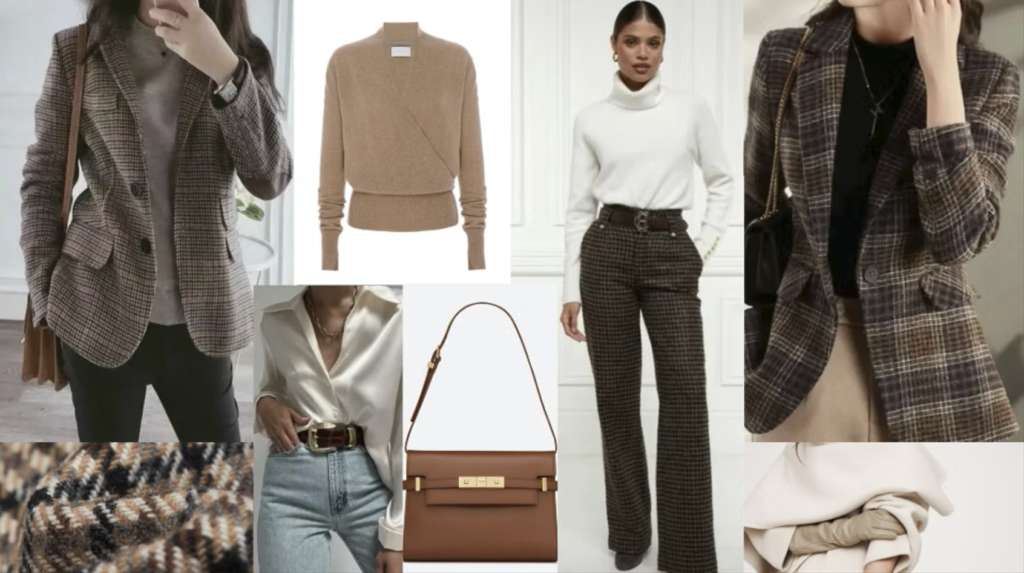
On suits, tailoring, and the quiet art of dressing like you’ve always known exactly who you are.
There’s a particular kind of woman I keep noticing lately — in coffee shops, at gallery openings, walking through cities with the specific unhurried confidence of someone who has somewhere to be and is not worried about getting there. She’s not the loudest person in the room. Her clothes don’t announce themselves. But something about the way she’s dressed makes you look twice, then keeps you looking. The fabric of her blazer moves differently. Her accessories are few but each one feels chosen. Her shoes are the right shoes.
She has, in the language of what’s become one of the most resonant style conversations of the past several years, old money energy.
I’ve been thinking about this phrase — old money aesthetic — for a while now, turning it over the way you turn over a well-made button between your fingers. It has taken hold of the cultural imagination in a serious way, spreading from Pinterest boards to entire fashion subcultures to real shifts in what people are buying and how they’re choosing to dress. And I think it’s worth examining what it actually means for real women in 2026 — not as a class statement or a performance of wealth, but as a genuine philosophy of dressing that, once you understand it, changes everything about how you approach your wardrobe.
Because here’s what I’ve come to believe: the old money aesthetic is not about money at all. It is about attention. It is about the radical, unfashionable act of caring deeply about quality over quantity, investing in things that last, and understanding that the way you dress is a form of self-knowledge. The women I most admire in this aesthetic space are not trying to look rich. They are trying to look like themselves — the most considered, most refined version of themselves — and they have found in the language of classic tailoring and understated elegance the most honest vocabulary for that project.
This is my attempt to decode that vocabulary. To talk about the clothes themselves — the suits, the blazers, the beautifully made shirts, the dresses that feel like something you inherit rather than something you buy on a trend cycle — and also about what it means to live inside this aesthetic rather than just wear it. Because old money style is not a capsule wardrobe checklist. It’s a sensibility. And sensibility takes time to develop, but once you have it, it is yours permanently.
Let’s begin.
What the Old Money Aesthetic Actually Is (And What It Isn’t)
Before we talk about specific clothes, I want to spend a moment on the philosophy, because the clothes only make sense in the context of the thinking behind them.
The old money aesthetic, as a style concept, draws from the visual vocabulary of a certain kind of inherited elegance — the English country house, the Ivy League campus in autumn, the Côte d’Azur in the 1960s, the kind of family that has owned its furniture for four generations and considers redecorating a sign of insecurity. The references are real and specific, and they matter because they point toward a consistent set of values: quality over novelty, restraint over excess, longevity over trend-chasing, confidence over attention-seeking.
What it is not, despite how it’s sometimes discussed, is elitism dressed up as aesthetics. The most interesting thing about the old money style conversation happening right now is that it’s being adopted and interpreted by women for whom inherited wealth is not remotely the point. What they’re drawn to is the attitude — the deep self-assurance of someone who doesn’t need approval from fashion cycles because her sense of style is internally sourced. The investment mentality that means buying one extraordinary coat rather than five mediocre ones. The willingness to look “boring” by fast-fashion standards in exchange for looking impeccably, permanently correct.
This is a genuinely radical position in 2026. We live in a fashion landscape dominated by micro-trends that cycle in weeks, by aesthetics that rise and fall on TikTok before most of us have noticed them, by a culture of more-more-more that treats wardrobes as disposable and style as something you perform rather than something you embody. Against all of that, the old money aesthetic is almost subversive in its insistence on slowness, quality, and permanence.
The women I know who dress this way — really dress this way, not just wear a navy blazer and call it a day — share a particular characteristic: they have done the work of knowing themselves. They know what silhouettes suit them. They know which colors make their skin look alive. They know that a perfectly cut pair of trousers worn with a crisp white shirt is more powerful than almost anything trend-driven they could put on, and they’ve stopped needing to be convinced of that.
That self-knowledge is the real foundation of the old money aesthetic. The clothes are just the beautiful, considered expression of it.
Suits and Tailoring: Why the Bespoke Mentality Changes Everything
The suit is where this aesthetic begins and, in many ways, where it reaches its highest expression. And I want to talk about tailoring specifically, because it’s the concept that unlocks everything else.
We have been trained by fast fashion and by the economics of ready-to-wear to think of clothing as something that we fit ourselves into — we find our size, we make it work, we accept that the shoulders might be slightly off or the waist not quite where we’d want it and we call that good enough. Bespoke tailoring inverts this entirely. The garment is built around your body, to your measurements, and the result is something that most women have never experienced and, once they have, can never un-experience. A suit that has been properly tailored doesn’t feel like wearing something. It feels like an extension of yourself.
Now, full bespoke tailoring — where you work with a tailor from scratch over multiple fittings — is a genuine investment, and I don’t want to pretend otherwise. But the principles of the bespoke mentality are available at every price point, and applying them is what separates old money dressing from simply owning expensive things.
The bespoke mentality means that you never accept clothes that don’t fit you properly. If the jacket shoulders sit right but the waist needs taking in, you get it altered. If the trousers are the right length but too wide in the leg for your frame, a tailor fixes that. The cost of alterations is almost always worth it, and it’s one of the most democratizing facts in fashion: a carefully altered mid-price suit will look better than an expensive one worn off-the-rack with fit issues. Every time.
For suits specifically: the classic color palette of the old money aesthetic is navy, charcoal grey, and rich chocolate brown. These colors are not exciting in the way that a cobalt blazer or a bright print is exciting, and that’s precisely the point. They are correct. They work with almost everything. They photograph beautifully. They look equally good in a boardroom, at a lunch, at an opening, at a dinner. They are the sartorial equivalent of the right answer.
The question of patterns deserves attention. The old money aesthetic does use pattern — but subtly, with restraint. A faint pinstripe in a charcoal suit adds depth without demanding attention. A glen check in muted tones is interesting upon closer inspection but reads as sophisticated from across the room. A fine herringbone weave in a winter suit is a texture choice as much as a pattern choice. What all of these have in common is that they reward the close observer while never calling out for attention. This is a consistent principle of old money dressing: be more interesting than you first appear.
The fabrics matter as much as the cut. Wool — particularly Super 100s and above, or the heavier twills and flannels for winter — drapes differently than polyester blends and, more importantly, wears differently. A good wool suit improves with age and careful maintenance in a way that synthetic fabrics simply don’t. For summer suiting, linen and cotton-linen blends carry the same logic: natural fibers breathe, move beautifully, and develop character over time. When the old money aesthetic talks about investment dressing, fabric quality is where that investment is most concretely expressed.
The Blazer: The Most Powerful Single Garment You Own
If I could tell every woman one thing about building an old money wardrobe, it would be this: invest in one extraordinary blazer before you invest in anything else.
I am not overstating when I say that a properly fitted blazer in a classic color is the most transformative garment available in women’s fashion. It takes almost every outfit and elevates it. It adds authority to casual clothes and gives formal clothes a sense of ease. It signals, from across the room, that the person wearing it has an excellent relationship with herself. There is a reason that women in positions of power have been reaching for blazers for decades — not because it’s masculine, as the outdated reading goes, but because it is the clearest sartorial expression of confidence and intention.
The navy blazer is the canonical starting point, and for excellent reasons. It is versatile to a degree that almost no other garment matches — it goes with cream and white, with all grays, with black, with tan, with soft prints. It works with denim, with tailored trousers, with midi skirts, with wide-leg linen pants in summer. It photographs beautifully in almost every light. The navy blazer is the fashion equivalent of the well-written sentence: clear, purposeful, and correct in almost any context.
For women who want something with a slightly more formal bearing, the double-breasted blazer is a beautiful choice. It has a slightly structured drama to it — the overlapping front, the wider lapels — that makes it a statement in the best possible way. It reads as fashion-aware without being trendy, which is the exact tonal space the old money aesthetic lives in. A double-breasted blazer in ivory or cream for spring and summer is one of those pieces that makes you feel like yourself at a higher volume.
Beyond navy, the colors worth considering: a deep forest green for autumn and winter (rich, unexpected, thoroughly modern while being completely timeless), a warm camel or caramel for transitional seasons, a crisp ivory or warm white for warm weather, a classic windowpane or check in muted tones for pattern interest. Each of these in a well-tailored silhouette will serve you for years, which is the benchmark for any old money purchase.
The fit points to watch for in a blazer: the shoulder seam should sit precisely at the end of your shoulder — not hanging over, not pulling up. The lapels should lie flat. The back should be smooth, not pulling across the shoulders. The sleeve length should show approximately half an inch of shirt or blouse cuff below it. The jacket body should skim your silhouette rather than gripping or boxy-ing it. These sound like small details, and they are — but they are the difference between a blazer that makes you look polished and one that makes you look dressed-up.
Dress Shirts and Blouses: The Art of the Well-Made Foundation
Here is a quiet truth about dressing well: what you wear under your blazer or suit jacket is as important as the jacket itself, and it’s where most women, even those with genuinely good wardrobes, tend to underinvest.
The old money aesthetic has very specific feelings about dress shirts and blouses, and they come down to two things: fabric and fit. Everything else is secondary.
On fabric: Egyptian cotton and silk are not indulgences. They are investments in how you actually feel wearing clothes, which has a direct effect on how you carry yourself, which has a direct effect on how you look. Egyptian cotton has a thread count and a smoothness that cheaper cotton simply doesn’t replicate — a shirt made from it feels different against your skin, looks different under light, and maintains its appearance through washings in a way that matters if you’re wearing it regularly. Silk, whether as a pure fabric or blended with cotton or modal, has a natural drape and a luminosity that elevates any outfit it’s part of. When you’re wearing a silk blouse under a well-tailored blazer, the combination creates an effortless richness that reads as genuinely sophisticated without trying.
On fit: a blouse or shirt should follow your body without clinging. There should be ease — room to move, room to breathe — but the garment should also have a shape, not just hang. The classic issues to watch for: gaping at the buttons (almost always a sign that the garment is too narrow in the bust for your frame), pulling across the back, a collar that sits away from the neck. Any of these can be corrected by a good tailor; if you find a blouse you love in the right fabric, don’t let a fit issue be the reason you don’t own it.
For the old money wardrobe specifically, the shirts and blouses worth building around: a perfect white button-down in Egyptian cotton (this is the foundational piece, full stop), a crisp pale blue shirt in the same fabric, a silk blouse in ivory or cream, a subtle stripe in fine cotton, and perhaps a silk or silk-blend blouse in a rich color — deep burgundy, forest green, warm gold — for evenings and occasions that ask for something slightly more.
The white shirt deserves a separate paragraph because it is so fundamental and so frequently gotten wrong. The perfect white shirt is not thin, not sheer, not boxy, not over-structured. It fits through the shoulder and chest, has just enough ease through the body, and the fabric has enough weight to hold its shape without feeling stiff. It is not bright white but the warmer, slightly off-white that photographs better and ages more gracefully. It can be worn tucked with tailored trousers, half-tucked with jeans, under a blazer, under a sweater, with the sleeves rolled to the elbow in summer, fully buttoned with a fine chain at the neck for evening. The woman who has found her perfect white shirt knows exactly why it’s considered a wardrobe essential. If you haven’t found yours yet, keep looking. It’s worth it.
Polo Shirts: Casual Elegance Done Right
The polo shirt in the context of old money dressing is a study in how casual and refined are not opposites if you approach them correctly.
The polo has an extraordinary heritage — equestrian, nautical, tennis, the leisure activities of people who took their leisure seriously — and that heritage gives it a natural vocabulary of ease and quality that makes it deeply useful in the old money wardrobe. It is the garment you reach for when a T-shirt feels too casual and a button-down feels too formal: the third option that splits the difference with grace.
The key, as with everything in this aesthetic, is quality and fit. A polo shirt in fine cotton piqué or a cotton-cashmere blend sits in a completely different register from its fast-fashion equivalents. The fabric has weight and structure. The collar stays up. The color is saturated and maintains itself through washing. The ribbed details at the collar and cuffs are precise. These qualities are not invisible — even people who can’t articulate why can feel the difference.
For color: the old money palette applies here too. White is the most versatile and the most chic. Navy is perennial. Pale yellow and soft pastels — particularly for spring and summer — have a very specific Côte d’Azur energy that the Pinterest-and-Instagram-fed interest in old money style has made very current. A pale blue polo with cream-colored tailored shorts and tan leather sandals for summer is, I would argue, one of the most quietly perfect warm-weather combinations available.
Pairing is where the polo gets interesting. With tailored chinos in camel or stone, a polo takes on a refined weekend energy that could take you from a morning walk through a gallery visit to a long lunch without a single second where you feel underdressed. With a well-cut A-line or midi skirt in a complementary neutral, it becomes something that reads as genuinely elegant — the kind of easy chic that fashion people spend years trying to achieve and that certain women seem to arrive at naturally. (Spoiler: it’s never natural. It’s just practiced until it looks that way.)
Dress Pants and Skirts: Building the Foundation of a Refined Wardrobe
Tailored dress pants and skirts are, along with the blazer, the structural core of the old money wardrobe, and I want to talk about them with the specificity they deserve.
For dress pants: the silhouette conversation in 2026 continues to be dominated by wide-leg and straight-leg cuts, both of which suit the old money aesthetic beautifully. The wide-leg trouser in a fluid wool or crepe has an inherent elegance — it moves well, photographs beautifully, elongates the silhouette, and carries an air of effortless sophistication that the skinny or slim trouser never quite achieved. Pair it with a fitted blouse tucked in and a structured blazer and you have the complete tailored look; pair it with a simple fine-knit tucked in and you have the casual version that is no less chic.
The straight-leg is slightly more contained — better for those who find wide-leg proportions difficult to balance — and equally classic. A well-cut straight-leg trouser in charcoal or navy with a sharp crease is the building block of some of the most reliably correct outfits I know.
For fabric in trousers: wool and wool blends for autumn and winter (they hold their structure, they drape beautifully, they improve in the press), linen and cotton for spring and summer (they wrinkle, yes, but that wrinkle is part of their charm and reads as deliberately relaxed rather than carelessly sloppy). Avoid heavy polyester — it doesn’t breathe, it pills, and it never quite falls the way it should.
For skirts: the old money aesthetic tends toward the midi length, which sits somewhere between knee and ankle and manages to feel simultaneously modest and deeply modern. The pleated midi skirt in a quality fabric — a fine wool in winter, a silk blend or heavy crepe in warmer months — has become one of the signature pieces of the quiet luxury moment, and it deserves that position. It is feminine without being girlish, classic without being dowdy, and it pairs beautifully with both tailored blazers and more relaxed knitwear.
The A-line skirt in a slightly heavier fabric is another staple — clean and unfussy, with the kind of universally flattering silhouette that makes it a genuinely useful garment rather than just an aesthetic one. In a muted plaid or check for autumn, it is one of the most old money-coded pieces you can wear. In cream or ivory for summer, with a well-cut white shirt and simple leather mules, it becomes something even better.
Dresses and Gowns: Femininity as a Form of Strength
There is a conversation happening in fashion right now about femininity — what it means, whether it has power, how to claim it without diminishing yourself. The old money aesthetic has a specific answer to this conversation, and I find it one of the most interesting and sustaining things about the whole approach.
In old money dressing, femininity is neither performed nor apologized for. It simply is. The dresses and gowns in this wardrobe are chosen for their quality, their timelessness, and their ability to enhance rather than transform the woman wearing them. They are not about making a statement — or rather, the statement they make is precisely the absence of effort, which requires the most effort of all.
The sheath dress in a quality crepe or silk is a canonical piece — it follows the body without clinging, reads as polished in almost any setting from a professional lunch to an evening event, and ages beautifully in both the garment itself and in photographs. A sheath dress in navy or charcoal with a simple pair of low heels and one piece of good jewelry is an outfit that asks nothing of the observer except quiet appreciation.
For evening wear, the gowns that suit the old money aesthetic tend toward the architectural: clean lines, beautiful fabric, impeccable construction. The bias-cut gown in silk or satin — a cut that was perfected in the 1930s and has never been bettered — has an effortless sensuality that comes entirely from the quality of its fall. A column gown in deep navy or rich burgundy, worn with minimal jewelry and excellent shoes, is an evening look that holds its own in any room.
What I want to say about dresses and the femininity they represent, in the context of this whole aesthetic: wearing something beautifully feminine and well-made is not a small act. It is a choice about how you want to move through the world. It says that you take your own appearance seriously enough to give it real care and real investment. It says that you find beauty worth pursuing. These are values that the old money aesthetic holds as fundamental, and I find that dressing from those values — rather than from trends, or from approval-seeking, or from whatever the algorithm seems to be rewarding this week — produces not just better-looking outfits but a better relationship with yourself.
Accessories: The Restraint That Says Everything
The old money approach to accessories is one of the most instructive things about the aesthetic because it runs so directly counter to the maximalism that has dominated parts of fashion culture.
Less is not just more here. Less is the whole point.
The woman who is overdressed in accessories — who layers statement pieces, who wears the conversation-starting earrings and the statement bag and the interesting necklace all at once — is signaling, whether she intends to or not, that she wants to be noticed. The old money ethos is rooted in the opposite: a confidence so complete that it requires no external amplification. The accessories are chosen because they are beautiful and because they are right, not because they call attention.
For jewelry: the classics have classical status for reasons. A good pair of stud or small hoop earrings — in gold or pearl, never cheap-looking metals — is the foundation. A simple chain necklace, gold and fine, that sits at the collarbone. A watch that is genuinely good and will last for decades — not necessarily a famous name, but a quality mechanism in a clean design. A ring or two that have meaning. These few pieces, worn consistently, become part of how you’re recognized and remembered. People know them. They associate them with you. That is a form of personal branding more powerful and more lasting than any trend piece.
For handbags: the old money vocabulary is clear here. Structured bags in quality leather — an everyday size that holds what you need without becoming a statement piece, in a classic tan, black, or deep burgundy. The aim is a bag that you carry for years rather than seasons, that develops a patina and a particular look that belongs specifically to you. French fashion mythology, which is the original source of so much of this aesthetic’s vocabulary, suggests that a bag should look slightly used — that the marks of a life lived in it are part of its beauty, not a failure of maintenance.
Scarves deserve their own moment in any old money accessories conversation. The silk square — particularly in a heritage print, the kind with equestrian or botanical motifs that have been made in the same way for decades — is one of those objects that concentrates elegance into a small physical space. Tied at the neck, in the hair, on a bag handle, loosely as a top on a warm summer day: the silk scarf is infinitely versatile and almost infinitely useful as a styling tool. It photographs extraordinarily. It reads as cultured and considered without requiring any explanation. One excellent silk scarf will serve you for the rest of your life if you take care of it.
Grooming and Beauty: The Old Money Approach to Looking Like Yourself
The old money approach to beauty is essentially the clean girl aesthetic before the clean girl aesthetic had a name — and it’s interesting that what’s trendy in beauty in 2026 aligns so naturally with what the old money sensibility has always valued.
The thesis is simple: look like yourself, only more intentional. Your skin well-cared-for and luminous rather than heavily covered. Your brows defined but natural. Your lips either nude and polished or deeply colored but precisely applied — nothing smudged, nothing casual. A minimal approach that requires significant effort to maintain, which is exactly the paradox that all the best beauty looks share.
For skin: a consistent skincare routine that prioritizes hydration and protection is the foundation. The old money woman’s skin looks like she has never thought about her skin, which is only possible if she has thought about it a great deal. The French pharmacy approach — the kind of careful, consistent, dermatologically sound routine built around quality products rather than hero products — is the natural complement to this aesthetic. Good SPF, good moisture, occasional exfoliation, gentle but effective actives. Nothing dramatic, nothing that causes visible work to undo.
For hair: the old money spectrum runs from sleek and polished (the blowout, the French twist, the low chignon) to deliberately effortless (the thrown-up bun that took thirty minutes to achieve, the soft wave that is carefully maintained). What all of these have in common is that they look intentional rather than neglected. Even the undone styles are undone on purpose. The key is healthy hair — well-conditioned, well-cut, maintained with the same investment-mentality that applies to clothes.
For fragrance: old money perfumery is not about newness. It is about signature. The women of this aesthetic tend to find one fragrance — something rich and specific, an iris soliflore, a deep chypre, a properly made rose — and wear it consistently enough that it becomes their olfactory calling card. Other people know it as theirs. This is an achievement that takes years and a willingness to resist the seasonal fragrance releases that the industry wants you to chase. The reward is worth it. A woman with a signature scent is a woman who has herself figured out.
The Old Money Home and Lifestyle: Living the Aesthetic Beyond Your Wardrobe
The old money aesthetic is not only about clothes. It is about a comprehensive approach to the way you move through the world, and I find that the clothing philosophy, once you really internalize it, starts to affect everything else.
Your living space begins to reflect the same values. The question stops being “what’s fashionable in interiors right now?” and becomes “what is beautiful, well-made, and will last?” The inherited piece — even if you didn’t literally inherit it — is preferred over the new purchase. Quality is bought once rather than cheap things bought repeatedly. The space is edited rather than accumulated. Books are not just content; they are part of the room’s architecture and personality.
Fine dining becomes a practice rather than an event. Not in the sense of constant expensive restaurants, but in the old-fashioned domestic sense: cooking from good ingredients, setting the table properly even when it’s just you, buying the good wine for a Tuesday dinner because Tuesday deserves it too. Meals as rituals rather than refueling. The old money sensibility extends the care it gives to appearance into the care it gives to pleasure.
Art is part of the life rather than a backdrop to it. Old money culture has always had a deep relationship with art — not necessarily as investment or status signaling, but as a genuine engagement with beauty and meaning. Starting to develop an eye — going to galleries, reading about artists, eventually buying small works by living artists who genuinely move you — is part of the same project as developing your eye for clothes. Both are about learning to look, and what you can see once you’ve learned that is different from what you could see before.
The habits of preservation matter. Taking care of your things — your clothes properly stored and maintained, your leather goods regularly conditioned, your good dishes actually used rather than kept for occasion — is part of the old money mentality in the most practical possible way. These objects are meant to outlast you, ideally. The relationship you build with them over years is part of what gives them their quality.
Building an Old Money Wardrobe in 2026: The Practical Path
I want to bring all of this into something concrete, because I think the old money aesthetic can feel overwhelming if you approach it as a transformation rather than a gradual development.
Here is what I actually believe about building this wardrobe: start with one extraordinary piece.
Not a whole wardrobe renovation. Not a strategic overhaul. One piece that is genuinely excellent — well-made, properly fitted, in a classic color, bought with the intention of keeping it for years. A blazer is the best choice for most people because it does so much work. A perfect white shirt is the second-best choice because it is the invisible force multiplier behind almost everything else. A well-cut trouser in a quality fabric is the third.
Wear that piece until you know it completely. Note how it works with what you already own. Notice what it makes you reach for, and what it makes you not want to wear anymore. Let it start doing the editorial work that good clothes do — clarifying your taste, raising your standards, making your eye sharper.
Then add the next piece. Take your time. Buy less, always less, and better.
This is not a strategy that satisfies the part of you that wants a wardrobe transformation in a weekend — and I say that with complete empathy, because that part exists in me too. But it is the strategy that actually works. The old money wardrobe is built over years, not months, and part of what gives it its authority is exactly that slow accumulation of right decisions. You are not wearing a carefully curated collection of expensive things. You are wearing evidence of a long, considered relationship with your own taste.
The other practical principle worth naming: alterations are not optional. They are the difference between clothes that look expensive and clothes that look like they were made for you. Find a good tailor — this relationship is worth investing in — and use them. Regularly. Every purchase that isn’t quite right should go to them before it enters your regular rotation.
Why This Aesthetic Resonates Now: Something Deeper Than Trend
I’ve been thinking about why the old money aesthetic has taken hold so powerfully in 2026 specifically, and I think it goes beyond fashion cyclicality — beyond the simple truth that maximalism eventually creates demand for its opposite.
I think it’s about a genuine hunger for things that last.
We are living through a period of profound speed — of rapid change, accelerating information, trends that come and go before most of us have fully registered them. The wardrobe implications of this are familiar: the endless churn of micro-trends, the increasingly shortened shelf life of statement pieces, the sense that clothes bought this season are already slightly past their moment by the time they arrive. There is an exhaustion in this that a lot of women are feeling, and they are responding to it by reaching for something that feels stable. Permanent. True.
That is what quality tailoring and classic dressing offer. A well-made suit in navy does not have a trend lifespan. A perfectly fitted white shirt has not been invented or improved upon since it was invented. A silk scarf in a heritage print is not going anywhere, and neither is the pleasure of wearing it. These clothes are an argument, made with fabric and thread and craft, for the existence of enduring value in a world that keeps insisting everything is temporary.
I find that deeply comforting. I find that it makes me want to dress more carefully, live more slowly, pay more attention. The old money aesthetic, when it’s working at its best, is not about fashion at all. It is about refusing to let the temporary be the enemy of the good. It is about choosing the thing that will matter next year, and in ten years, over the thing that is interesting right now.
That choice, made consistently and with care, is its own form of elegance.
The Last Word: What Dressing Well Actually Means
I want to end with something that sits underneath all the specific advice — the blazer fits and the fabric weights and the accessory restraint — because I think the old money aesthetic, at its core, is making an argument about what dressing well actually is.
It is not about expense. It is not about status. It is not even, in the final analysis, about fashion.
It is about the relationship you have with yourself, expressed through your careful, deliberate choices about how you present your exterior self to the world. It is about the pleasure — and it is a genuine, serious pleasure, one I believe is worth taking seriously — of wearing something beautiful that fits you perfectly, made from a fabric that feels like what it is, in a color that you know to be right. It is about the confidence that comes from having done the work of knowing your own taste and building your wardrobe from that knowledge rather than from external instruction.
The old money aesthetic, the quiet luxury movement, the clean girl sensibility that is running through fashion culture right now in all of its various iterations — what they all share is this insistence that self-knowledge is the foundation of style. Not the latest trend, not the most expensive piece, not the most-followed influencer’s picks. Your own eye. Your own understanding of what looks right on your body and feels right in your life.
Developing that is not quick work. It takes time and some mistakes and the occasional expensive lesson. But once you have it, it is genuinely yours — and nothing you wear from that place will ever look anything other than exactly right.