
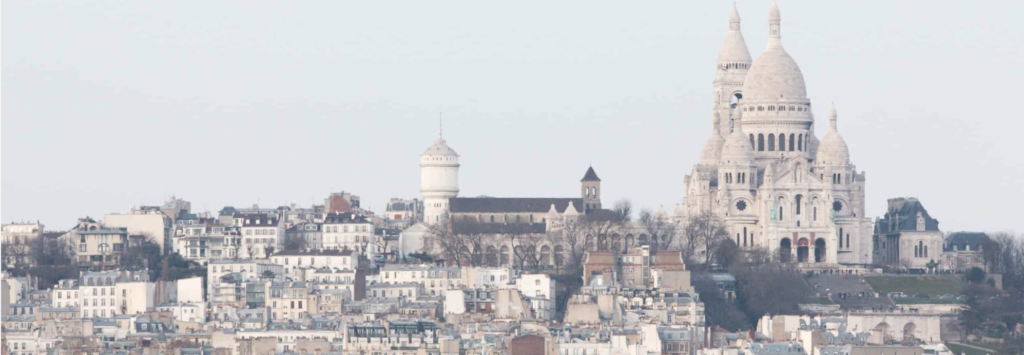
On cobblestones, croissants, and the kind of city that teaches you who you are
There are neighborhoods you visit, and there are neighborhoods that visit you back — that get inside you somehow and rearrange things. Montmartre is the second kind. It has been that for me since the first time I stood at the top of its hill and looked out over the city stretching below, grey and golden and endlessly itself, and felt something I couldn’t quite name but recognized immediately: the particular longing of someone who knows they are exactly where they are supposed to be.
I first came to Montmartre not as a tourist. In 2013, I arrived in Paris knowing absolutely no one, with a three-month Airbnb rental, a small artist’s budget, and a level of optimism that I’m not sure I could fully replicate today. I was young and a little frightened and completely certain, in the way you can only be when you’re about to do something that will either break you or make you, that I was making the right decision. The apartment I found online was tiny in the way that Parisian apartments always are — charmingly, almost defiantly tiny — but it had two balconies. One faced Sacré-Cœur Basilica. I would wake up in the morning and there it would be: white and luminous and impossibly beautiful, sitting on the hill like it had been placed there specifically for my benefit. The other balcony looked into a courtyard, the kind of interior Paris courtyard that you see in films and assume must be a set. It wasn’t.
I lived there for three months. I learned the neighborhood by getting lost in it, which is the only honest way to learn a place. I would walk out my door each morning with no particular plan and let the cobblestones lead me somewhere new. By the end of those three months, Montmartre felt less like a neighborhood and more like an extension of myself — the part of me that believed in beauty for its own sake, that thought art mattered, that wanted to live at a slight diagonal to the ordinary.
I have been back many times since. And every time, the neighborhood gives me something I didn’t know I needed.
This is my guide to Montmartre. It is also, inevitably, a love letter.
What Montmartre Actually Is: The Neighborhood Beyond the Postcard
Before we get into the specifics — where to eat, how to dress, which streets to wander — I want to say something about what Montmartre is, because I think it’s misunderstood in a way that affects how people experience it.
Montmartre has a reputation as a tourist destination, and it is one — the hill, the Basilica, the square full of portrait painters, the Moulin Rouge glowing red at the foot of the hill. All of this is real and all of it draws people, legitimately and in large numbers. But Montmartre is also a genuine neighborhood where people live, where children go to school, where the boulangerie on the corner has been there longer than anyone can remember and the woman behind the counter knows her regulars by name.
It sits in the 18th arrondissement, in the northern part of the city, elevated above the rest of Paris on a hill called the Butte. That elevation matters. It changes the quality of light, the sound of the streets, the sense of being slightly apart from the city below. When you’re up in Montmartre, Paris feels both present and distant — you can see it spread out below you, you know it’s there, but you’re not in it. You’re in this other thing, this village on a hill, this place with its own rhythm and its own personality and its own way of being Parisian.
Historically, Montmartre was where the artists came when they couldn’t afford anywhere else. Picasso had his studio here. Toulouse-Lautrec painted it. Van Gogh lived on Rue Lepic with his brother Theo. Modigliani, Utrillo, Suzanne Valadon — the art history of the early 20th century runs through these streets in a way that you can still feel if you slow down enough to feel it. The creative energy didn’t leave when the artists did. It just changed form.
Today, Montmartre is a neighborhood that has become increasingly beloved by a younger, aesthetically conscious crowd — which means that alongside the tourist infrastructure, you find genuinely beautiful independent shops, excellent coffee, natural wine bars, and the kind of slow, quality-conscious food culture that defines the best of contemporary Paris. Social media has brought more visitors here, and that brings its tensions, but it has also meant that the neighborhood’s beauty is more widely known and more carefully documented than it’s ever been.
The cobblestone streets of Montmartre are among the most-photographed in Paris. If your feed has any Paris content in it — and in 2026, whose doesn’t — you have seen them. The reality is better than the image. It always is.
Getting to Montmartre: The Journey Is Part of It
Montmartre is in the 18th arrondissement, which places it outside the central ring of Paris’s most tourist-dense areas. This is both a reason some visitors skip it (it’s not a quick detour from the Eiffel Tower or the Louvre) and, I would argue, one of its greatest assets. Getting to Montmartre requires intention. And that intention is rewarded.
The most straightforward metro route is Line 2 to Anvers or Pigalle, or Line 12 to Abbesses. All three drops you at the base of the hill or in the heart of the neighborhood. Abbesses is the most directly useful — it puts you right at Place des Abbesses, which is the natural starting point for a day in Montmartre. Worth noting: the Abbesses metro station has one of the most beautiful Art Nouveau entrances in Paris, a covered iron canopy in deep green designed by Hector Guimard, and a descent to the platform that is among the deepest in the city. The elevator queue can be long; the spiral staircase down is beautiful and occasionally alarming.
From Anvers or Pigalle, you walk up towards Rue des Abbesses — a walk of just a few minutes that takes you past bakeries and cafés and gives you your first sense of the neighborhood’s particular energy. This is also your first indication that comfortable footwear is not a suggestion but a requirement. The cobblestones are gorgeous. They are not kind to thin-soled shoes or heels you haven’t properly broken in.
For getting up the hill itself, there are two options: the stairs (197 of them, steep and rewarding) or the funicular, a small cable car that requires a separate metro ticket unless you’re carrying a Navigo pass or Paris Visite pass, which covers the funicular as well. I take the stairs whenever I can, both because the view on the way up is extraordinary and because the prospect of dessert at the top always needs a little justification. But on a hot day, or when your legs are already tired from a morning of Paris walking, the funicular is a gift.
Uber and taxis are also perfectly reasonable options if you want to arrive directly at Abbesses metro without navigating the transit system. If you’re staying somewhere central and the weather is good, the walk from parts of the 9th or 10th arrondissement is entirely doable and very beautiful — but it’s a legitimate commitment, and I’d only recommend it to confirmed Paris walkers who know what they’re signing up for.
Dressing for Montmartre: What to Wear on the Hill
I want to spend a moment on this because I get asked about it constantly and because it genuinely matters — not for aesthetic reasons only, but practical ones. What you wear to Montmartre will determine, in no small part, how much you enjoy it.
The foundation is footwear. Cobblestones, slopes, stairs — Montmartre is a neighborhood that tests your shoes. What works here: well-made sneakers (the kind that look intentional, not athletic — I’m thinking a crisp white leather low-top, or a clean retro runner in a neutral), loafers with a solid sole, ankle boots with a block heel at most. What doesn’t work: stilettos, slides with no back, anything with a thin sole that transmits every cobblestone directly to your foot. I’ve seen women in beautiful, impossible shoes make their way up the hill with the kind of determined grace that deserves its own award. I have also been that woman, and it was a mistake each time.
Beyond shoes, Montmartre rewards the kind of dressing that the French do better than anyone: effortless-looking but considered, comfortable but not sloppy. A well-cut pair of jeans, a good shirt or blouse, a jacket or coat that works in layers because the hill creates its own microclimate and can be genuinely cooler at the top than at the bottom. The clean girl aesthetic — minimal makeup, good skin, natural hair that looks like it was styled without trying — photographs beautifully against the backdrop of these streets.
For 2026, I’ve been reaching for what I think of as the “Montmartre outfit”: straight-leg dark denim, a slightly oversized linen button-down in cream or soft blue, a tote in leather or canvas with enough room for the baguette and the bottle of natural wine you will absolutely be buying, and a pair of simple loafers that I’ve worn enough times to trust completely. A silk scarf in the hair or tied at the wrist adds the kind of note that photographs well and feels right in a neighborhood this historically artistic.
For cooler months — and October through March in Montmartre can be genuinely cold, with a wind up on the hill that comes straight off the north of France — a beautiful long coat over all of the above. The camel coat is practically a Montmartre uniform. There’s a reason.
The Main Streets: How to Actually Navigate Montmartre
One of the most common mistakes visitors make in Montmartre is following only the most obvious route — up the main steps to Sacré-Cœur and back. I understand the impulse; the Basilica is extraordinary and the view from the top steps is one of the great views of Paris. But Montmartre’s real magic is in its side streets, its hidden squares, its corners that you find by turning left when you thought you’d turn right. Here are the streets worth knowing.
Rue Lepic
Start here if you’re coming from the Blanche metro stop on Line 2. Rue Lepic is a long, winding cobbled street that climbs the hill from Blanche up towards the heart of Montmartre, and it is one of the most beautiful market streets in Paris. Along its length you’ll find boulangeries, fromageries, butchers, wine shops, and small cafés that have been here for decades. In the mornings, when the market stalls are out and the street has that particular Parisian energy of purposeful domesticity, Rue Lepic is practically perfect.
Van Gogh lived at number 54 with his brother Theo in the late 1880s. The building is there, marked with a plaque that most people walk past without noticing. I like knowing it. I like the sense that these streets have been beautiful for a very long time and will continue to be.
At the top of Rue Lepic, you reach the windmills — the Moulin de la Galette and the Moulin Radet, the last surviving windmills of what was once a much larger cluster on the hill. The Moulin de la Galette is also the name of the famous painting by Renoir, a sun-drenched scene of a dance held beneath the windmill in 1876. Standing near it, you get that layered sense of time that Montmartre specializes in: the present and the past occupying the same physical space.
Rue des Abbesses
The heartbeat of the lower part of the neighborhood, Rue des Abbesses runs through the Place des Abbesses and into the main residential and commercial life of Montmartre. This is where you find the fromagerie where you buy the good cheese, the wine bar that opens at noon and is busy by half past, the small boutiques selling the kinds of things you won’t find on any chain store’s shelves.
Le Vrai Paris on Rue des Abbesses is a café worth knowing for people-watching — it has the kind of outdoor seating that lets you watch the neighborhood do its thing while you drink your coffee and do nothing in particular, which is an underrated activity. Across the street, Le Village is my personal preference for a proper glass of wine and the chèvre chaud salad that I have eaten here more times than I can count. Warm goat cheese on dressed leaves, a glass of something crisp and cold, a narrow room full of Parisians having lunch on a Tuesday — there are worse ways to spend an afternoon.
Rue des Martyrs
Technically, this street runs from the bottom of Montmartre down towards the 9th arrondissement, and the lower stretch in particular has become one of the most talked-about food streets in Paris over the past decade. It is genuinely beautiful: pâtisseries, chocolatiers, natural wine shops, small restaurants, beautiful delis, artisan shops of various kinds. It has become slightly more commercial as its reputation has grown, but the quality remains high and the atmosphere is wonderful — especially on weekend mornings when the street fills with the particular easy energy of Parisians doing their weekly shopping.
If you’re approaching Montmartre from the south and want to build in a proper food detour, walk up Rue des Martyrs and let yourself stop freely. Buy the religieuse at the pâtisserie. Try the cheese. Accept the sample of tapenade. This is a street that rewards slow, greedy attention.
A small bonus for the cultural reference-hunters among you: several scenes from the Netflix series Lupin were filmed around this area. The show is beautifully shot and uses its Paris locations with real care — walking these streets with that visual reference adds another layer to the experience.
Place du Tertre
This is the square at the heart of Montmartre, surrounded by restaurants and filled, during most of the day and all tourist season, with portrait painters and caricaturists who have worked this spot for generations. It is unabashedly touristy, and I want to say something about that: there is nothing wrong with that. The painters are real artists. The atmosphere is genuinely charming. The square has been a gathering place for artists for over a century, and while it has become something of a performance of itself, it’s a performance with genuine roots.
I’ve had my portrait done here twice, which is something I recommend unreservedly if you visit with a companion. Sit for ten or fifteen minutes, let the artist work, end up with something that is simultaneously extremely you and slightly idealized in the way that good portrait art always is. It makes for a travel memory that no photograph quite replicates.
The restaurants immediately around Place du Tertre tend toward the tourist-oriented side — not bad, but not where locals eat. For your actual meal, wander a few streets in any direction.
What to See: The Landmarks That Earn Their Reputation
Sacré-Cœur Basilica
It is impossible to talk about Montmartre without beginning here, and it is impossible to overstate how extraordinary it is in person. The Basilica of the Sacré-Cœur was built at the top of the Butte Montmartre in the late 19th and early 20th century, and its white travertine domes have become one of the most recognizable silhouettes in Paris. Unlike many of Paris’s grand monuments, Sacré-Cœur faces outward from the city rather than into it — it looks south over Paris, which means that the view from its steps is one of the most expansive you can have anywhere in the city.
I lived with a view of it from my apartment for three months and never once tired of it. In the early morning, when the light comes at a low angle from the east, it glows in a way that is genuinely almost supernatural. In the evening, lit up against a dark sky, it is one of the most beautiful things in Paris.
I have to admit, with some embarrassment, that despite living for three months approximately five minutes from its doors, I never once went inside. This is a common Montmartre resident experience, I’m told — the proximity paradox, where what is always available is always deferred. I have been told the mosaics inside are extraordinary. I intend, next visit, to actually go in. I encourage you to be more decisive than I have been.
The stairs leading up to Sacré-Cœur are one of the great communal spaces of Paris. On warm afternoons and evenings, people spread across them — students, travelers, couples, families, musicians who set up and play while the crowd on the steps provides an audience. It has an improvisational, joyful energy that feels very alive and very Paris. Bring something to drink, sit on the steps, look at the city below, and let yourself be happy for a while.
The Wall of Love — Le Mur des Je t’aime
Just off the Abbesses metro station, in the small Square Jehan Rictus, there is a wall covered in 612 ceramic tiles of deep blue lapis lazuli. On those tiles, in 311 languages plus one in Braille, are the words “I love you.” The project was created by calligrapher Fédéric Baron and artist Claire Kito, and it has been in the square since 2000. I photographed it in 2010, and the image became one of the most-resonant things I’ve made in Paris.
There is something about this wall — its scale, its simplicity, the fact that every language in the world is represented — that makes it quietly overwhelming. Look for your own language. Look for languages you recognize. Look for the ones you don’t and feel the breadth of the world that they represent. The red fragments that appear in the grouting between the tiles represent, according to the artists, the pieces of broken hearts. I find that detail very beautiful and very true.
The wall has become a major destination for social media content — it photographs beautifully, particularly in blue-toned morning light — but don’t let that put you off. Some things are popular because they deserve to be.
The Moulin Rouge
On Boulevard de Clichy, at the foot of the hill where Montmartre meets Pigalle, the Moulin Rouge does what it has done since 1889: it glows red in the night and calls you in. The famous cabaret show is a full production — elaborate costumes, can-can dancers, dinner if you book it, the whole theatrical spectacle that has made the Moulin Rouge one of the enduring entertainment institutions of Paris.
I haven’t been to the show myself — the closest I’ve come is a dinner at Crazy Horse years ago — but everyone I know who has gone reports some version of the same thing: it is more than you expect, more elaborate and more committed, and you leave feeling that you’ve seen something genuinely extraordinary rather than a tourist performance going through the motions. The building itself, even viewed from outside, has an impact. There is something about seeing it in person that makes you understand why Toulouse-Lautrec was transfixed by it.
The Dali Museum — L’Espace Dalí
Tucked on Rue Poulbot near Place du Tertre, L’Espace Dalí is a small museum dedicated to Salvador Dalí’s work in Paris — primarily sculptures and prints, with some original works and a deeply atmospheric, somewhat disorienting exhibition design that feels very true to its subject. If you have any interest in Surrealism, or even just in experiencing something genuinely strange and beautiful for an hour, this is worth your time.
The museum is compact enough that it doesn’t feel like a commitment, and the permanent collection is good enough that it doesn’t feel like a consolation prize. I always come away from it slightly altered, which is perhaps the highest praise I can offer any museum visit.
The Vineyard of Montmartre
Montmartre has a working vineyard — one of the last in Paris, tucked on the slopes of the Butte on Rue des Saules. The Clos Montmartre produces only a small quantity of wine each year, released at an annual harvest festival in October, and the wine itself is reportedly more interesting as an artifact than as a beverage. But the vineyard is beautiful, particularly in autumn when the leaves turn, and walking past it on a quiet afternoon is one of those Montmartre experiences that feels almost impossible — a vineyard, in Paris, between stone walls, on a cobblestone street. Only here.
Where to Eat and Drink: Fueling a Day on the Hill
Let me be very clear: eating in Montmartre is one of life’s genuine pleasures, but it requires some navigation. The immediate surroundings of Place du Tertre and the most tourist-trafficked paths up to Sacré-Cœur have their share of restaurants that are capitalizing on location rather than quality. A few streets in any direction from those main arteries, and the neighborhood’s real food culture opens up.
For Coffee
Coffee culture in Paris has transformed significantly over the past decade, and Montmartre has benefited from that evolution. There are now several excellent specialty coffee shops in the neighborhood that take the craft seriously — the kind of places with good single-origin beans, precise extraction, and interiors that look like they were designed by someone who has spent time in Copenhagen and Tokyo and brought the best of both back to Paris.
For mornings, I tend to start at one of the smaller café-bakeries on Rue des Abbesses or Rue Lepic — the kind of place where the coffee is good and the croissant is better and you sit in the window and watch the morning happen for as long as you want. There is no rush. This is one of the things that Montmartre teaches you: the morning is for taking your time.
For a Proper Lunch
Le Village on Rue des Abbesses remains my personal standard for a Montmartre lunch. It is small, genuinely local in feel, and the food is the kind of French bistro cooking that people spend years trying to replicate elsewhere and never quite get right: simple, careful, made with good ingredients, seasoned with confidence. The chèvre chaud salad and a glass of something white, eaten slowly at one of the small tables while the room hums quietly around you, is a completely reliable source of happiness.
For something more substantial, the side streets around Place du Tertre have several bistros that do proper French lunches — a set menu at midday that might run to three courses and is one of the best-value eating experiences in Paris. Look for a handwritten chalkboard menu outside, a room that’s at least half full of people who don’t look like tourists, and a server who seems to know everyone. Those are your signs.
For Wine and a Slow Afternoon
Montmartre’s wine bar scene has grown considerably in recent years, and there are now several bars à vins in the neighborhood that specialize in natural and biodynamic wines — the kinds of places where the person behind the bar genuinely knows what they’re talking about and is happy to guide you toward something you wouldn’t have thought to choose yourself. These places tend to open around noon, hit their stride by mid-afternoon, and become the center of a convivial, extended drinking-and-grazing session that can easily consume the better part of an afternoon.
Find a bar that has a few tables outside if the weather allows. Order something you don’t recognize. Accept the recommendation for a small plate to go with it. Stay longer than you planned. This is correct behavior.
For Pastries and Pâtisserie
The pâtisseries in Montmartre range from the very good to the genuinely exceptional. Rue des Martyrs has several of the best, with shops that do the classic French pastry canon beautifully — the mille-feuille, the tarte tatin, the Paris-Brest, the various iterations of choux and cream and perfectly caramelized pastry. There are also several newer patisseries doing more contemporary work: matcha croissants, yuzu tarts, things that bridge the French tradition and current global pastry influences in ways that are consistently interesting.
Buy more than one thing. This is not a day for restraint.
Montmartre in the Morning: Why You Should Go Early
If you can manage it — and I know that Paris on a trip involves a thousand competing pressures and that mornings are precious — try to be in Montmartre early. Before 9 AM ideally, or as close to it as you can manage.
Early morning Montmartre is a different place. The tourist crowds haven’t arrived yet. The street cleaners have been through and the cobblestones are sometimes still damp. The boulangeries are in full production mode and the smell of bread baking is omnipresent and completely overwhelming in the best way. The light at that hour, particularly in spring and autumn, is golden and low and catches the white stone of the buildings in a way that makes every corner look like a painting.
I used to walk out of my apartment at 7:30 in the morning and have the streets almost entirely to myself. It felt like the neighborhood was mine in those hours, a private Paris that operated on a different frequency from the rest of the city. I would pick up a croissant from the nearest boulangerie, walk up to the steps of Sacré-Cœur with my coffee, and sit there looking at Paris waking up below me while I ate my breakfast. Of all the things I did during those three months, that might be the one I remember most vividly.
For content creators and photographers, morning Montmartre is the moment. The light is extraordinary, the streets are empty enough to photograph cleanly, and the mood is soft and quiet in a way that blue-hour or midday shots simply can’t replicate. The cobblestone streets shoot beautifully in that early light. The Basilica, backlit by morning sun, photographs like a dream.
The Artistic Soul of Montmartre: Why This Neighborhood Still Matters Creatively
Something I want to address, because it’s something I felt very strongly during my time living here: Montmartre still has a genuine creative soul, even now, even with all the tourism and the Instagram presence and the portrait painters who cater to visitors rather than sitting in obscurity as their predecessors once did.
The history of creativity in this neighborhood is not just historical sentiment. It lives in the architecture, in the ateliers that still exist on certain quiet streets, in the presence of working artists and galleries and studios that have chosen to stay here despite rising rents and increasing visibility. The Montmartre that Picasso knew is gone, obviously — that world is over and won’t come back. But the impulse that brought artists here in the first place, the particular quality of the light and the landscape and the sense of being slightly outside the main flow of the city, that is still present. You can feel it.
I started a business during my three months in Montmartre. I don’t know how much of that was the neighborhood and how much was the stage of life I was at, but I think the two were related. There is something about living somewhere beautiful and slightly impractical, somewhere that prioritizes aesthetics and experience over efficiency, that opens up creative thinking in a way that other environments don’t. Paris in general does this, but Montmartre does it particularly.
If you’re a creative person — a writer, an artist, someone building something — I think there is genuine value in spending time here. Not just visiting, but actually sitting with it. Taking a morning to draw or write or just observe. Letting the neighborhood’s long creative history remind you that making beautiful things is a legitimate way to spend a life.
Montmartre for the Aesthetically Conscious Woman: How to Experience It on Your Own Terms
There’s a version of Montmartre that gets written about a lot — the tourist version, the checklist version, the Instagram-route version — and it’s fine, it’s genuinely enjoyable, it covers the real highlights. But I want to talk about how to experience Montmartre if you’re someone who approaches travel the way you approach getting dressed: with intention, with attention to beauty, with a preference for depth over breadth.
Go slowly. The entire neighborhood can be navigated in a few hours if you’re moving quickly. But slow down, and you find things: a perfect square that’s not on any tourist map, a small chapel with an extraordinary carved door, a courtyard glimpsed through an open gate that looks like a secret garden. Montmartre rewards slow walking the way good fashion rewards slow shopping — the best things reveal themselves to people who are paying attention.
Let yourself get lost. I know this is advice that feels theoretical until you’re actually standing at an unmarked intersection wondering which cobblestone path leads where. But a willingness to be temporarily uncertain is the entry fee for Montmartre’s best experiences. Set a general direction and allow the streets to take you somewhere you didn’t plan to go. The worst-case scenario is that you find somewhere delightful and slightly unexpected. The best-case scenario is that you find something you tell people about for years.
Pay attention to the small things. The ironwork on the balconies. The climbing roses that cover certain walls in spring. The way a particular café looks from across the street at a certain hour. The handwritten menus, the names above the shop doors, the way light falls through narrow streets at midday. Montmartre is an education in noticing, and if you’re someone who cares about aesthetics — and I’m assuming you are, since you’re reading this — you will find that this neighborhood feeds that part of you in a way that few places do.
Dress for yourself. I mentioned this in the practical section above, but I want to say it again from a different angle. There is a temptation, especially in a neighborhood this photographed and this saturated with content, to dress for the image you want to create rather than for the experience you want to have. Resist it. Dress well — you’re in Paris, on cobblestone streets, surrounded by extraordinary beauty, it would be a slight to yourself not to make an effort — but dress in a way that lets you move freely and comfortably and spend six hours on your feet without resentment. The best photos of Montmartre will be the ones where you actually look like yourself, happy and at ease, rather than curated and slightly pained.
Montmartre Through the Seasons: When to Go and What to Expect
Every season in Montmartre has something to recommend it, and I’ve experienced all of them across my various visits. Here is my honest assessment.
Spring is peak Montmartre in terms of pure beauty — the climbing roses and wisteria begin to bloom on the stone walls, the trees come into leaf and shade the cobblestone streets in dappled light, the terraces open and the neighborhood fills with a gentle outdoor energy that feels like Paris finally exhaling after winter. April and May specifically are extraordinary. The light has that particular spring quality — warm but not harsh — and the entire city is in a good mood. If you can only visit once and you have flexibility on timing, visit in May.
Summer brings the crowds — Montmartre in July and August is genuinely busy, particularly around Sacré-Cœur and Place du Tertre. The trick is the timing strategy I mentioned earlier: go early in the morning or stay late in the evening, when the day-trippers have gone and the neighborhood returns to something like itself. Summer evenings in Montmartre, sitting on the steps of the Basilica with the city spread out below in the long golden light of 9 PM, are among the most beautiful things I have done in Paris.
Autumn is my personal favorite and, I think, the season that suits Montmartre best. The light turns amber, the vineyard on the hillside changes color, the tourist numbers begin to ease after September, and the cafés feel warmer and more intimate. October in particular is extraordinary here — cool enough for a coat, warm enough to sit outside with something good to drink, the light at a low angle that makes every stone and vine and cobblestone glow.
Winter has its own austere beauty. The crowds thin considerably. The neighborhood becomes more authentically itself, occupied primarily by residents rather than visitors. The cafés are warm and full of locals, the streets are quiet and occasionally magical in a grey, cinematic way that makes you understand why so many artists chose to paint Paris in winter. If you’re visiting Paris primarily for fashion purposes — the shows, the shopping, the city’s winter style game — a morning in Montmartre is a perfect counterpoint to the intensity of the central city.
What to Buy: Shopping in Montmartre
Montmartre is not a shopping neighborhood in the sense of concentrated luxury retail — for that, you want Saint-Germain-des-Prés or the 8th arrondissement. But it has something better: genuinely independent shops, run by people who curate with care and personality rather than following a corporate brief.
The small boutiques around Rue des Abbesses and the side streets off Place du Tertre tend to specialize in the kinds of things that make excellent travel purchases: artisan jewelry, ceramics, small prints and artwork, handmade leather goods, vintage textiles, perfumes and beauty products that you won’t find in any chain. Shopping here is discovery rather than acquisition — you find things you didn’t know you were looking for.
For art specifically, the gallery presence in Montmartre is real and varied. Beyond the tourist-facing portrait painters of Place du Tertre, there are small galleries in the side streets showing contemporary work, printmaking studios that welcome visitors, and occasional open studio days that let you see working artists in their spaces. If you’re interested in art as a category beyond museum-visiting — if you want to actually acquire something, or simply see work being made — Montmartre is worth exploring at this level.
For food souvenirs — the things you carry home and regret finishing — Rue des Martyrs is your address. Good olive oils, French preserves, specialty chocolates, unusual honeys, the small-batch things that tell a story. A well-chosen bottle of wine from one of the natural wine shops here will serve you beautifully on a cold night back home when you want to remember what it felt like to sit on a cobblestone street in Paris and understand, briefly but completely, that life can be very good.
The Feeling You Take Home
I’ve been thinking, in writing this, about what it is that Montmartre actually gives you, beyond the beautiful photographs and the good meals and the specific experiences I’ve described above.
I think it gives you a particular relationship with beauty. Not the overwhelming, imperial beauty of the Louvre or the formal grandeur of the Palais Royal, but something more intimate and more personal — the beauty of a place that has survived and adapted and maintained its character over centuries, that has been home to extraordinary creativity without becoming a museum of it, that remains, despite everything, a place where people actually live and actually love and actually find the business of daily life worth doing with care.
Montmartre teaches you that beauty is not a luxury reserved for special occasions or special people. It’s embedded in the street you walk down every morning and the way the light falls on the white stone at a particular hour and the smell of bread baking and the sound of a guitar coming from an open window. It’s in the wall where someone wrote “I love you” in every language in the world because they believed the message was worth that much effort.
When I left my apartment in 2013, after three months of being slightly lost and very happy in this neighborhood, I was different in ways I couldn’t have articulated then and can only partially articulate now. More willing to trust my own eye. More committed to the idea that where you live and how you live matters, and that choosing beauty is not frivolous but essential. More convinced that getting lost sometimes is not a failure of navigation but an invitation to discover something unexpected.
I still believe all of that. Montmartre taught it to me, and I have been going back to remind myself ever since.
If you haven’t been, go. If you’ve been before, go again. If you’ve been a hundred times and think you know it, go in a different season, at a different hour, and let it show you something new.
It will. Montmartre always has something left to show you.