
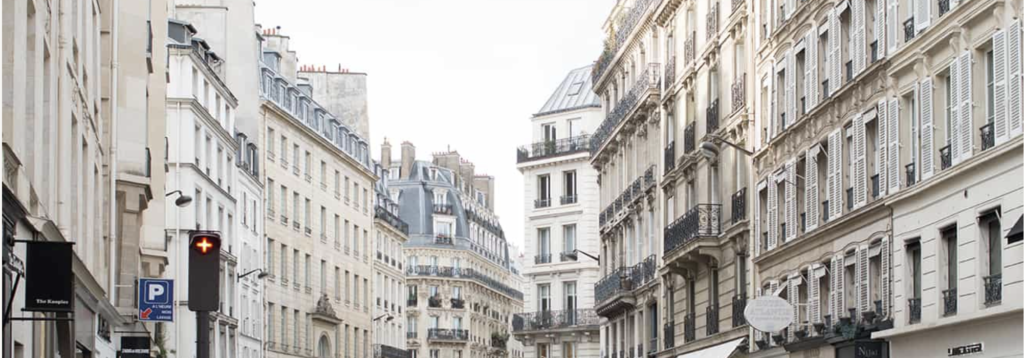
The Left Bank neighborhood that will change the way you see Paris — and yourself.
There are places in the world that don’t just impress you. They rearrange you. Saint-Germain-des-Prés is one of those places. It’s the kind of neighborhood where you step off the métro and immediately feel the shift — the air is softer somehow, the streets are narrower and more intentional, and every single corner looks like it belongs on a Pinterest board that someone has been curating for decades. Not because it’s trying to. But because it simply is.
I’ll be honest with you: I came to Saint-Germain-des-Prés a little reluctantly. I am, at heart, a Right Bank woman. I love the grandeur of the 8th, the buzz of Le Marais, the way the Right Bank has this slightly electric, fashion-forward energy that feels like the city is always running somewhere important. But my husband? He has always loved the Left Bank. Quiet streets, intellectual history, the sense that Paris here moves at a slightly different tempo — more philosophical, more considered. Over the years, and after several visits wandering these beautiful streets together, I have to admit: Saint-Germain-des-Prés has completely won me over.
This is my love letter to that neighborhood. It’s also a practical guide, because beauty and logistics are not mutually exclusive — especially when you’re traveling in heels and need to know where the best croissant is within a five-minute walk of your hotel.
The Neighborhood You Need to Know: What Makes Saint-Germain-des-Prés So Special
Saint-Germain-des-Prés sits in Paris’s 6th arrondissement, tucked into the Left Bank with a grace that never feels self-conscious. Historically, it was the intellectual heartbeat of Paris — Simone de Beauvoir and Jean-Paul Sartre used to hold court at the famous cafés here, artists and writers flooded the area after World War II, and the neighborhood became synonymous with a kind of radical, beautiful thinking. That spirit hasn’t left. It’s just dressed a little better now.
What draws me back again and again is a quality that’s very hard to name but very easy to feel: restraint. Saint-Germain-des-Prés is not loud about how beautiful it is. The luxury here is quiet. The boutiques don’t scream at you from the window. The cafés don’t hustle for your attention. The whole neighborhood has the energy of a woman who knows exactly who she is and has nothing to prove — and if you follow fashion at all, you know that that is the most magnetic quality a person (or a place) can possess.
In 2026, as quiet luxury continues to define both fashion and travel aesthetics — think Loro Piana cashmere, The Row silhouettes, neutral palettes that photograph beautifully in golden afternoon light — Saint-Germain-des-Prés has become the physical embodiment of that trend. It was there first, of course. Paris always was.
Where to Stay: Hotels That Feel Like a Life You Want to Live
Choosing where to stay in Saint-Germain-des-Prés is one of the most delicious decisions you’ll make while planning a Paris trip. The hotels here don’t feel like hotels. They feel like residences — beautifully appointed, full of personality, and deeply embedded in the neighborhood’s identity. Let me walk you through the ones I know and love.
Hôtel des Grands Voyageurs
There’s a version of traveling where you come home to your hotel room and feel genuinely happy to be there. Hôtel des Grands Voyageurs gives you that feeling. It was recently renovated, and every detail has been considered with the kind of attention that makes you trust a place instantly. The bathrooms are tiled in a way that’s somehow both classic and fresh, and they’re stocked with Diptyque products — which, if you know anything about Diptyque (the brand was actually born in Saint-Germain-des-Prés, more on that later), feels like the perfect touch.
The hotel has 138 rooms, and what I particularly love is the configuration that allows two rooms to connect through a single door — a godsend for families or for anyone traveling with a friend who values privacy. The rooftop views of Parisian rooftops are exactly as dreamy as you’re imagining. If you work remotely — and so many of us do now — the Deluxe or Junior Suite comes with a desk that actually functions as a workspace, not just a decorative ledge where you’ll pile your shopping bags.
Villa des Prés
If you want small, intimate, and purely luxurious, Villa des Prés is your answer. Just 34 rooms in the heart of the neighborhood, positioned so that everything you want — restaurants, cafés, galleries, boutiques — is essentially at your front door. Staying here feels like the travel equivalent of a clean girl aesthetic moment: nothing excess, everything intentional, all of it quietly stunning.
Relais Christine
Tucked away on Rue Christine, away from the busiest parts of the neighborhood, Relais Christine is the kind of hotel that rewards guests who appreciate subtlety. In summer, the courtyard is covered in jasmine — actual jasmine, blooming and fragrant, the way you see in French films and assume must be an exaggeration. It’s not. The lobby has a working fireplace, an honesty bar (a concept I deeply respect), and a breakfast buffet that will ruin you for all other hotel breakfasts.
Pavillon Faubourg Saint Germain
This one is genuinely special to me, and to my husband. It has become our shared Paris home — the place we return to when we want Paris to feel less like a destination and more like a life we briefly inhabit. The service here is the kind that anticipates rather than reacts, and there are very few things I value more when traveling. Their bar, James Joyce, does evening jazz and cocktails, and in winter, the fireplace in the lobby creates an atmosphere so warm and golden you’ll find yourself staying far longer than you planned. In summer, the exterior terrace becomes the most civilized place in the neighborhood. I mean that sincerely.
Le Grand Hôtel Cayré
On Boulevard Raspail, this is one of the newer additions to the Saint-Germain-des-Prés hotel scene, and it brings a fresh energy without losing the neighborhood’s inherent elegance. If you can, splurge on a room with a balcony or city view — the additional cost is genuinely worth it, and I say this as someone who usually considers hotel upgrades carefully. The sun rises over that part of the city, and if you sleep with the blackout shades pulled back, you’ll wake to one of the most beautiful gradients of light you’ve ever seen. On clear days, the suites offer views of the Eiffel Tower. I once stood on the balcony in my hotel robe with a coffee and understood, completely, why people spend their whole lives trying to get back to Paris.
Mandarin Oriental Lutetia
The only Palace Hotel on the Left Bank, and the kind of place that makes you want to dress up just to walk through the lobby. I haven’t stayed here yet — it sits high on my list — but I’ve made a point of stopping into Bar Josephine for jazz and craft cocktails, which is exactly as atmospheric as the name suggests. Located directly across from Bon Marché, it is the ideal base for anyone who intends to do serious shopping.
Hôtel Aubépine
New in late 2025, this tiny, six-room boutique on Rue de Seine feels like the fashion world’s version of a secret. Small-scale luxury, curated to within an inch of its life, on one of the most beautiful streets in the neighborhood. For those of you who’ve grown tired of massive hotel lobbies and prefer something that feels more like staying in the home of a stylish friend who has excellent taste and happens to own a Parisian pied-à-terre — this is it.
Esprit Saint Germain
A quiet side street just below Saint Sulpice, walking distance to Luxembourg Gardens, with all the hallmarks of a true luxury boutique hotel. Understated, beautiful, perfectly located. This is for the traveler who has learned that the best Paris experiences are the ones you have to work slightly harder to find.
Getting There: How to Arrive Like You Already Know the City
The métro lines 4 and 10 will take you directly to the Odéon stop or the Saint-Germain-des-Prés stop, and both are walkable to most of the neighborhood’s best spots. The bus is another option, and CityMapper remains the most reliable app for navigating Paris’s complex transit grid — download it before you land.
But here is my honest recommendation: walk. Paris rewards walkers in a way that no other city quite matches, and the walk from the Right Bank to Saint-Germain-des-Prés is one of the city’s great simple pleasures. Cross the Pont des Arts — the bridge in front of the Louvre — and you’ll find yourself on the Left Bank within minutes. The transition is almost cinematic. You feel the neighborhood change around you as you walk, and arriving on foot means you arrive with the full context of the city in your body, not just your phone.
A Day in Saint-Germain-des-Prés: The Itinerary That Actually Works
Let me walk you through how I spend a day here when I want it to feel complete rather than rushed. This is not a packed tourist schedule. This is the rhythm of a woman who has learned that the best days in Paris are built around pleasure, not logistics.
Morning begins, always, with coffee. Not from a chain. From one of the neighborhood’s classic cafés or, if you’re in the mood for something more contemporary, one of the excellent craft coffee spots that have opened in recent years. More on both shortly. Take your time with breakfast. Order a croissant. Read something, or people-watch, or just sit with the morning and let Paris be Paris around you.
Mid-morning is for wandering. The boutiques are just opening, the streets haven’t yet reached their midday energy, and the light is still doing that soft, gold-filtered thing that makes everything look like an editorial. This is the time to browse the galleries, discover the smaller side streets, and let yourself get slightly lost in the best possible way.
Afternoon is for lunch at one of the neighborhood’s classic brasseries — long, leisurely, French. Then Luxembourg Gardens, if the weather cooperates (and even if it doesn’t — there’s something about the gardens in grey light that is deeply romantic). Then more wandering: shops, markets, the occasional museum.
Evening starts with an aperitif somewhere that has outdoor seating. It ends, ideally, with dinner somewhere you’ve reserved in advance and dressed appropriately for, because Saint-Germain-des-Prés rewards the effort.
The Classic Cafés: More Than Just Coffee
The cafés of Saint-Germain-des-Prés are not just places to drink coffee. They are institutions. They are living museums. They are the reason this neighborhood exists in cultural memory the way it does, and visiting them feels less like tourism and more like participation in something that has been going on, quietly and beautifully, for a very long time.
Café de Flore on Boulevard Saint-Germain is, arguably, the most famous café in the world. It was where Sartre wrote, where Simone de Beauvoir thought, where the intellectual life of mid-century Paris happened over coffee and cigarettes and arguments that lasted until midnight. Today, it’s still beautiful — the red banquettes, the zinc bar, the mirrors, the particular quality of light that comes through the windows in the afternoon. The hot chocolate is extraordinary. Go for the experience, not just the drink.
Les Deux Magots sits just across the street, and the rivalry between the two is itself a piece of Parisian cultural history. Hemingway was a regular. So was Picasso. The terrace is one of the great places to sit in Paris on a warm afternoon, watching the neighborhood happen around you while the waiter brings your café crème with the kind of unhurried precision that the French do better than anyone.
Brasserie Lipp is, strictly speaking, a brasserie rather than a café, but it belongs in any conversation about the classic institutions of Saint-Germain-des-Prés. The Alsatian choucroute is legendary. The interior is gorgeous. The sense of being in a place where Paris has been happening for over a century is palpable in the best way.
The ritual of sitting in a Parisian café — really sitting, not just stopping for five minutes — is something that fashion and lifestyle culture has been rediscovering. There’s a whole aesthetic around it: the coffee, the small notebook, the silk scarf, the good book, the deliberate unhurriedness. Saint-Germain-des-Prés is where that aesthetic was invented, and where it still lives most authentically.
Craft Coffee in Saint-Germain-des-Prés: For the Third-Wave Convert
If classic cafés feel more atmospheric than they do delicious to you when it comes to the actual coffee — and look, I say this with love, because Parisian café coffee has historically prioritized tradition over precision — Saint-Germain-des-Prés now has excellent options for the third-wave coffee devotee.
The neighborhood has welcomed a handful of beautiful, thoughtfully designed coffee spots that take the craft seriously: single-origin beans, precise extraction, milk alternatives, the whole considered modern approach. These places attract a younger, more international crowd and tend to have the kind of interior design that’s genuinely worth photographing — all pale wood and natural light and the sort of considered minimalism that looks effortless and absolutely is not.
For the woman who starts her day with an oat flat white and a sense of intentionality, you will not struggle to find your place here.
Where to Eat: From Casual Lunches to Proper French Dinners
The food in Saint-Germain-des-Prés is the food of a neighborhood that has high standards and knows it. There are no tourist traps here in the way that plague areas near the Eiffel Tower or Montmartre. The restaurants here serve people who live and work in the neighborhood, which means they have to be good.
For casual and delicious, the side streets around Rue de Buci and Rue de Seine offer bistros and small restaurants that do the French basics beautifully — steak frites, roast chicken, terrines, good wines by the glass. These are the places where you eat at a small table near the window and feel like you’re living rather than visiting.
For something more considered, the neighborhood has a number of restaurants with serious culinary credentials, the kind that require advance reservations and reward you with food that you’ll think about weeks later. If you’re coming for a special occasion or simply want to eat at the top of what Paris offers, this neighborhood can absolutely deliver that.
The brasserie experience deserves its own mention because it’s a specifically French institution that doesn’t quite translate anywhere else. A proper brasserie is open all day, serves everything from breakfast through dinner, has a menu that covers all the French classics, and operates with a particular energy — busy but not frantic, social but not loud, efficient but never cold. Brasserie Lipp, mentioned above, is the gold standard. But there are others that carry on the tradition beautifully.
The Markets: Saint-Germain-des-Prés’s Living, Breathing Soul
If you want to understand how a Parisian neighborhood actually functions — not as a postcard, but as a place where people live — go to the market. The Marché Saint-Germain is an indoor market near Rue Lobineau that has been here in one form or another since the 18th century. It now blends fresh produce with boutique food stalls and restaurants, and the experience of wandering through it on a Saturday morning is one of my favorite things to do in this entire city.
The Rue de Buci outdoor market is another institution — a street market full of flowers, cheeses, fruits, prepared foods, and the general beautiful chaos of French market life. Go early, go slowly, buy something you’ll eat standing up on the street because you couldn’t wait. That’s correct behavior.
Markets, in the current cultural moment, have become a genuine lifestyle aesthetic — the clean girl goes to the farmers market, the quiet luxury woman buys her lavender from a market stall because it’s better and more beautiful than anything in a shop. Saint-Germain-des-Prés offers that experience in its most authentic Parisian form, and it photographs beautifully if you’re building a travel story for your audience.
Luxembourg Gardens: The Most Beautiful Garden in Paris
I will not entertain arguments on this. The Jardin du Luxembourg — Luxembourg Gardens — is the finest garden in Paris, and I say that having spent significant time in the Tuileries, the Palais Royal, the Bois de Boulogne, and all the others. There is something about Luxembourg that surpasses them all.
Perhaps it’s the scale — it’s large enough to feel like a genuine escape from the city, but not so large that it loses its intimacy. Perhaps it’s the layout, with the central Medici Fountain (one of the most romantic structures I have ever stood in front of) and the arrangement of paths and parterres that feel both formal and welcoming. Perhaps it’s the particular quality of the people who use it: students from the nearby universities, mothers with children, older Parisians playing pétanque, couples reading on the green metal chairs that you can arrange however you like.
The Medici Fountain, tucked in the quieter eastern corner of the garden, deserves its own dedicated visit. It dates from the 17th century, sits at the end of a long reflecting pool shaded by enormous plane trees, and creates an atmosphere so perfectly melancholy and beautiful that it is almost difficult to leave. In autumn, the light through those trees is extraordinary.
In spring and summer, Luxembourg Gardens is full of bloom — roses, of course, but also the famous orchards and the beds of flowers that are changed seasonally with the kind of attention to horticultural perfection that France takes as a point of national pride. If you’re putting together a travel content day, this garden will give you more beautiful images than almost anywhere else in Paris.
Shopping in Saint-Germain-des-Prés: Where Fashion Meets History
The shopping in Saint-Germain-des-Prés is, in my experience, among the best in Paris — not for sheer volume, but for quality, curation, and the sense that each boutique has been chosen for this neighborhood rather than installed there by a real estate algorithm.
The Luxury Houses
Boulevard Saint-Germain and the streets around it host outposts of the major French luxury houses — Dior, Louis Vuitton, Cartier — but also, and more interestingly, boutiques for the houses that feel particularly at home on the Left Bank. Sonia Rykiel, whose aesthetic was always deeply of this neighborhood, began here. Vanessa Bruno, who does that effortlessly chic French girl thing better than almost anyone, has a beautiful boutique here. These are the kinds of names that feel like they belong on these streets in a way that goes beyond commerce.
Isabel Marant and the French Girl Aesthetic
Isabel Marant’s flagship boutique in Saint-Germain-des-Prés is a destination in itself. Her clothes — the slightly undone blazers, the boots that look like you’ve had them forever, the blouses with just enough detail — embody the French girl aesthetic that the rest of the world has been trying to decode for decades. Shopping here doesn’t feel like shopping. It feels like an education in restraint and confidence.
Diptyque: The Most Parisian Perfume House
Diptyque was born in Saint-Germain-des-Prés, in 1961, at 34 Boulevard Saint-Germain. The original shop is still there. If you have any connection to fragrance — and I believe deeply that fragrance is one of the most underrated elements of personal style — this is a pilgrimage worth making. The candles and perfumes feel like concentrated versions of the neighborhood itself: literary, beautiful, slightly mysterious, entirely French. Their Philosykos is one of the most beautiful things ever made.
Pierre Hermé and the Art of the Macaron
The Pierre Hermé patisserie on Rue Bonaparte is, objectively, one of the most important stops in the neighborhood. Pierre Hermé’s macarons are not the sweet, slightly cloying things you might have had elsewhere. They are complex, precise, beautiful, and a legitimate argument for the macaron as a serious culinary form. The seasonal flavors are particularly extraordinary — rose and lychee, salted caramel, dark chocolate and matcha. Go early in the day for the best selection. Buy more than you think you need.
La Grande Épicerie de Paris
Technically, this is associated with Le Bon Marché in the 7th, which edges into Saint-Germain-des-Prés territory, and it is the finest food shop I have ever entered. La Grande Épicerie is where Parisian home cooks buy their extraordinary cheese, their single-estate olive oil, their seasonal vegetables, their artisan chocolates, their wine. It’s also where you buy the most beautiful food gifts to bring home — the kinds of things that can’t be found anywhere else and will make whoever receives them understand something about France that is otherwise very difficult to explain.
Bookshops and Stationery
Saint-Germain-des-Prés has always been a neighborhood of readers and writers, and the bookshops here reflect that history. There are several beautiful independent bookshops specializing in art, photography, fashion, and literature, and spending an hour browsing them is one of the most purely pleasant things you can do in this neighborhood. There are also excellent papeteries — French stationery shops — that stock the kind of notebooks and pens that make you want to write things by hand again. In a world where everything is digital, there is something deeply satisfying about buying a beautiful notebook in Paris.
The Museums: Art, Fashion, and French Cultural History
The museums of Saint-Germain-des-Prés and its immediate surroundings are among the finest in Paris, and they tend to be significantly less crowded than the Louvre or the Musée d’Orsay, which is reason enough to prioritize them.
The Musée de Cluny (officially the Musée National du Moyen Âge) is one of the great small museums in Europe — a medieval museum housed in a former abbey, displaying extraordinary tapestries, medieval decorative arts, and a collection that manages to make 600-year-old objects feel genuinely alive. The Lady and the Unicorn tapestries are considered among the masterpieces of medieval European art, and seeing them in person is one of those quiet, profound experiences that stays with you.
The Musée Delacroix is a small museum on the Place de Furstenberg — one of the most beautiful small squares in Paris — housed in the studio where Eugène Delacroix lived and worked. It’s intimate, beautifully curated, and the kind of place that makes you feel like you’ve been let in on a secret. The garden is particularly lovely.
The École des Beaux-Arts occasionally opens its exhibitions to the public, and the building itself — a historic complex of courtyards and studios just off the Seine — is worth seeing even if you don’t catch an exhibition.
For fashion lovers specifically: the Musée des Arts Décoratifs, slightly further afield but worth the journey, has one of the great fashion collections in the world and regularly hosts exhibitions on major designers and historical costume. If there’s an exhibition on while you’re visiting, go.
Beauty and Wellness: Finding Your Parisian Glow
If there’s one thing that every woman I know wants when she comes to Paris, it’s to understand what Parisian women are actually doing for their skin. The answer, in my experience, is deceptively simple: they are consistent, they are not excessive, and they are using very good products that they trust completely. They are also getting facials.
Saint-Germain-des-Prés has several excellent spa locations that specialize in facial treatments, and I think that treating yourself to a facial in Paris is one of the best investments you can make in a trip. Not for the results necessarily — though French aestheticians are genuinely skilled — but for the experience of lying in a beautiful treatment room in one of the most beautiful neighborhoods in the world, with someone taking care of your skin, and having absolutely nowhere else to be.
The French approach to skincare, which has influenced the clean beauty movement significantly, is about maintenance and respect rather than transformation and drama. A good Parisian facial is not aggressive or theatrical. It is careful, precise, and deeply soothing. You emerge looking like yourself, only better — which is, honestly, the goal of everything in Saint-Germain-des-Prés.
For product shopping: the pharmacies here are extraordinary. French pharmacy skincare — La Roche-Posay, Bioderma, Avène, Caudalie — is genuinely superior and often significantly cheaper than what you’d pay for the same products elsewhere. A pharmacy visit on Rue de Rennes or Boulevard Saint-Germain is a non-negotiable part of any beauty-conscious trip to the neighborhood.
The Aesthetic of Saint-Germain-des-Prés: What It Teaches Us About Style
I want to talk about something that might seem abstract but feels important to me whenever I’m in this neighborhood: what Saint-Germain-des-Prés teaches us about the relationship between place and personal style.
There’s a reason that the phrase “French girl style” has its own entire aesthetic universe — Pinterest boards, Instagram accounts, countless books and articles and YouTube channels dedicated to decoding it. And the thing is, when you’re actually in Saint-Germain-des-Prés, you begin to understand why. Because the women here dress in a way that reflects the neighborhood’s values: quality over quantity, confidence over trends, ease over effort.
The quiet luxury aesthetic that has dominated fashion conversation in 2025 and into 2026 — the shift away from logo-heavy, maximalist dressing toward understated quality and considered minimalism — finds its most natural habitat here. A woman in Saint-Germain-des-Prés might be wearing a perfectly cut camel coat, dark jeans, a white shirt, a silk scarf, good leather loafers. Nothing flashy. Everything right. The total is greater than the sum of its parts because every part was chosen with intention and worn with absolute conviction.
The soft glam aesthetic — luminous skin, brushed-up brows, a subtle lip — feels more at home here than anywhere else I’ve been. Not because Parisian women are trying to look beautiful, but because they’re living in a way that makes beauty feel natural rather than effortful.
What I try to bring home from every visit to Saint-Germain-des-Prés is not products or clothes (though I do bring those too). I try to bring back a little of that quality of attention. The sense that dressing yourself is worth doing carefully, that choosing where you eat and what you drink is worth thinking about, that the aesthetic of your day-to-day life matters.
A Note on Timing: When to Visit Saint-Germain-des-Prés
Every season has something to offer in this neighborhood, but I’ll give you my honest assessment.
Spring (April through June) is magnificent — Luxembourg Gardens in bloom, terraces open, golden evening light that makes everything look like an Impressionist painting. This is peak Paris for a reason.
Summer (July and August) has long days and warm nights, and the neighborhood has a slightly quieter energy as many Parisians leave the city. For those who find crowds difficult, late July and August in Paris can actually be a relief. The light in summer evenings here is extraordinary.
Autumn (September through November) is, in my personal opinion, the most beautiful time to be in Saint-Germain-des-Prés. The light turns golden and slanted, the chestnut trees in Luxembourg Gardens shift through every shade of amber, the cafés feel warmer and more intimate, and the fashion — both in the shops and on the streets — reaches its most elegant. September brings the energy of la rentrée, the French return to work and school after summer, which infuses the neighborhood with a particular purposeful vitality.
Winter (December through February) has its own magic: the fireplace hotels, the shorter days that make aperitif hour feel earned, the way the grey Paris sky makes the cream-colored Haussmann buildings look even more beautiful somehow.
What I Always Carry When I Walk These Streets
In the spirit of practical beauty advice from someone who has made this walk many times: here is what I always have with me when I spend a day in Saint-Germain-des-Prés.
A tote bag that is both beautiful and functional — the Pierre Hermé macarons and La Grande Épicerie purchases need to go somewhere, and a good tote in leather or canvas that works with whatever you’re wearing is essential. The French do the tote better than anyone.
Comfortable but elegant shoes. The streets here are cobbled in places, beautiful and difficult, and the woman who tries to navigate them in stilettos will spend more time managing her footwear than enjoying her day. Ballet flats, low loafers, well-made ankle boots — anything with a solid sole and enough structure to carry you through six hours of beautiful wandering.
A light scarf. A silk scarf in a beautiful print, or a fine cashmere square in a neutral — this is the single item that most transforms an outfit in Paris. It goes over your shoulders if the evening gets cool. It ties in your hair when you’re cycling along the Seine. It lives in your bag for every other moment. This is not a cliché recommendation. It is a genuinely functional one.
A small notebook. For the addresses of the shops you want to return to, the name of the wine you had with lunch, the title of the book in the window of the bookshop on Rue de Seine. Your phone works perfectly well for this, but there is something about a notebook in Paris that feels correct.
Final Thoughts: Why This Neighborhood Gets Under Your Skin
I have visited Saint-Germain-des-Prés many times now, and something interesting has happened: it has changed what I want from travel. Not just from Paris, but from everywhere.
Before Saint-Germain-des-Prés really got its hooks into me, I was the kind of traveler who optimized for novelty — new places, new restaurants, new experiences every time. That energy still lives in me. But this neighborhood has taught me the value of return. Of going back to the same café and sitting at the same table and ordering the same coffee and feeling, each time, that you understand something new about it. Of walking a street you’ve walked before and noticing what you missed. Of trusting that beauty doesn’t get exhausted.
The neighborhood also — and I mean this genuinely — makes me want to dress better. Not in a superficial way. In the way that being around something beautiful makes you want to show up to it with care. I find myself reaching for my best coat, my most considered outfit, the shoes I actually love rather than the ones that are just fine, because Saint-Germain-des-Prés feels like a place that deserves that.
That’s the highest compliment I know how to give a place. It makes you want to be a little more yourself, and a little more intentional about it.
When my husband asks me where I want to stay on our next Paris trip, I find that I no longer need to think about it. Left Bank. Saint-Germain-des-Prés. Hotel with a fireplace and a view of rooftops and a neighborhood that starts with the most perfect croissant I’ve ever eaten and somehow just keeps getting better from there.
I’ll see you at Café de Flore.